Daily insights for city builders, delivered every morning at 6 AM ET. I’m Brandon Donnelly — a Toronto-based real estate developer and founder of Globizen. I’ve been writing here since 2013.

Search results for: “road pricing”

  • New startup wants to solve urban congestion through data and lotteries

    image

    If you’re a regular reader of Architect This City, you’ll know that I’m a supporter of congestion and road pricing. Any valuable good or service, such as a road, that’s offered for all intents and purposes as free, will never be able to keep up with demand. You need to price it.

    However, the political risk associated with implementing something like this has made it such that few cities around the world have done it. London and Singapore are the two most common examples.

    The more populist solution is to simply build more roads and highways, even though study after study shows that this doesn’t work. If it did, we would have already solved the problem of traffic congestion. And we most certainly haven’t.

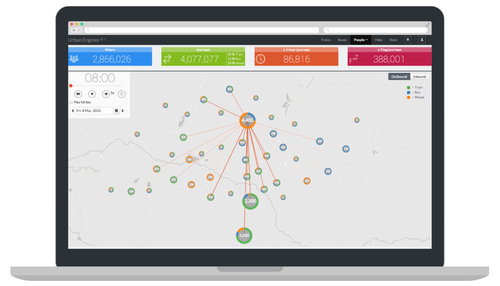
    Which is why I’m excited about a new startup that recently launched called Urban Engines. Their solution is twofold. It’s based on incentives and on treating people and cars in cities as sensors that feed back data into their network. Here’s a brief video. If you can’t see it below, click here.

    [youtube https://www.youtube.com/watch?v=oaCp5Tl-uAc]

    The data piece is almost a no-brainer (provided they can get the data). The more data we can collect about the way people and cars move in a city, the more they’ll be able to optimize and manage the flows. The possibilities are endless.

    But what I found really interesting is their incentives based approach. Typical road pricing methods are, one could argue, a punitive approach. As traffic increases so does the price of the road. (I like to look at it as efficient pricing.)

    With Urban Engines, their approach is the opposite: it’s to reward people–through money and lotteries–for driving during off peak times. It’s smart because selling a reward program to cities will be a lot easier than selling a new charge.

    Overall, this a great example of how startups are stepping up to solve some of our most important societal problems. For more information on Urban Engines, check out their website and this writeup on CityLab.

  • Transit panel responds to Metrolinx

    On September 18th, 2013, the Premier of Ontario, Kathleen Wynne, established a “transit investment strategy advisory panel.” Their mandate was to advise the Province on how to respond to the revenue tools proposed by Metrolinx (also an Ontario agency) to fund transit expansion in the region. Well that panel has just released their final report and you can read it here.

    I’d like to highlight 3 things from the report.

    1.

    The first is their assessment of how Canada’s transit policy framework stacks up against our competitors. Here’s a snippet:

    “Canada remains the only G8 country without a coordinated national framework of policies and programs for funding expansion and renewal of transit systems. As shown in the chart opposite, a review of national transit policy frameworks done by the Canadian Urban Transit Association indicates that Canada ranks at the bottom in terms of its engagement in urban public transit.”

    And here’s the chart they’re talking about. I hope it’s legible.

    2.

    The second is their conclusion on highway tolls:

    “Although highway tolls can raise a significant amount of revenue and influence travel behaviour, they are expensive, complicated, and require a lot of lead time to implement. Once transit alternatives are in place, road tolls meet our criteria and are a valid option. Following the opening of the new Highway 407 East, the Province has the option of designating the new toll revenue to the Next Wave. For now, however, the Panel has not recommended Highway Tolls as a revenue source.”

    If you’ve read any of my posts on electronic road pricing, you’ll know that I support the pricing of roads and congestion.

    3.

    The third is their list of what they call “next wave projects”, which are essentially priority projects. Here’s their list for phase one of it:

    • Relief Line
    • GO Two-Way All Day (excluding Lakeshore)
    • Hurontario LRT
    • Electrification of Union-Pearson Express
    • Yonge North Subway (partial extension, delivered after Relief Line is in service)
    • Priority portions of other rapid transit – Hamilton, Durham, Dundas, Brampton

    I’m happy to see the relief subway line on the top of that list.

    If you have any thoughts on transit planning in the Greater Toronto Area, I would love to hear from you in the comment section below.

  • What does Toronto want to be?

    So, what bold and uncomfortable 21st-century master plan should Toronto adopt? I don’t know exactly, but what I was getting at in my lead-up post is that it’s hard not to sometimes feel like Toronto is trying to run a 21st-century global city on a 19th-century Victorian street grid, surrounded by Houston.

    In the core of the city, we have narrow, generally 20-metre rights-of-way. Many of these east-west arteries are beautiful streets to walk on with fine-grained retail patterns, but the streets themselves have slow-moving streetcars in the middle two lanes and on-street parking on both sides. The result is streets that don’t move and are frustrating to navigate for all users: drivers, transit riders, and cyclists. It can take an hour to drive 10 km.

    Other major streets don’t have streetcars or much retail activity, but the land-use pattern reflects a bygone era. It doesn’t make sense to have only single-family housing on Toronto’s busiest arteries. It’s time for these streets to grow up. (To be fair, the City of Toronto is trying to achieve this with its new Major Streets policies, but the development economics do not make these changes feasible at scale.)

    As you move out of the core, Toronto’s major streets naturally widen along with the recency in which they were built. Now we have the opposite problem where we’re faced with “stroads” with little to no urbanity. Overall, it’s the result of a city that grew organically over time without the same kind of defined plan seen in cities like New York, Barcelona, and Paris (after it had already been built out).

    Here’s the thing: Toronto’s low-rise single-family era is over. Virtually the only single-family housing that gets built nowadays is when somebody demolishes an existing house and builds anew. The future is a uniformly higher-density city built on the backbone of robust transit, vehicular, and cycling networks; not a monocentric downtown that people commute to.

    So what might that mean exactly?

    To start, I believe it means getting our transit vehicles onto their own dedicated lanes, widening certain major streets (for the benefit of cars), shrinking and pedestrianizing others (for the benefit of human-scaled urbanism), carving through new major streets to fix connectivity gaps, and pricing congestion as a means of funding constant transit expansion. My fellow urbanists may not want to hear me advocate for the selective widening and creation of arterial roads, but we have to stop pretending that cars are going to disappear.

    Once the bones are in place, it’s then a matter of getting the land-use policies right and letting the private sector do what it does best — build for the future. Now, I don’t profess to know the exact combination of major street widths, one-way patterns, and whatever else should be done, but I do feel strongly that it’s time for a bold and uncomfortable 21st-century master plan for Toronto.

    What does Toronto want to be? We should host an international design competition and find out.


    Cover photo by Oles Borys

  • The $1.3 billion fund that wants unsold condominiums

    March 16, 2026 · View original


    High Art Capital recently announced the launch of a new fund called the Greater Toronto Area (GTA) Rental and Affordable Housing Initiative. It has been anchored by a $300 million mezzanine debt commitment (and a “nominal equity investment”) from the Building Ontario Fund (BOF) and is expected to be capitalized in total with a minimum of $1.3 billion.

    The objective is to acquire approximately 2,200 rental homes in blocks within newly completed, unsold condominiums across the GTA and convert them into long-term rental housing. Included within this will be approximately 550 affordable rental homes that are expected to be title-protected at rents set at the lower of 25% below local market rent or 30% of median gross household income.

    This is interesting, but it’s certainly not the first example of investors buying, or wanting to buy, excess condominium inventory. However, it may become the largest in Toronto and, as far as I know, it’s the only one to partner with the public sector (BOF is a provincial Crown agency).

    The way it is intended to work is as follows:

    Condominium developers are sitting on unsold inventory and maybe on inventory they took back after purchasers defaulted (and which may be subject to legal action). What High Art will do is say to developers, “Hey, if you give me a really awesome deal, I’ll take 50 of those condominium units off your hands.” And if the developer is desperate enough, they will say, “Sure, that sounds good. Let’s do a deal and then go for a nice closing dinner.”

    But at what price?

    As we’ve talked about many times before on the blog, developer pricing is typically based on a cost-plus model. We take our costs, add a margin, and there’s the final sticker price. The reason prices haven’t fallen as much as one might expect on unsold units is because they’re hitting the “cost floor”; developers don’t want to lose money, unless they are given no other option.

    But for this rental fund model to work at reasonable costs of debt, I suspect that, in many/most cases, deals will need to be struck below a developer’s cost basis. So, it’ll be very interesting to watch how this fund deploys capital and who the winners and losers are in this market.

    Regardless, I think it is good that we are seeing this sort of activity. The faster we deal with the pain, the faster we’ll get to the other side.


    Cover photo by Patrick Boucher on Unsplash

  • A look back at (almost) a year of New York’s congestion zone

    December 23, 2025 · View original


    It has now been almost a year since New York City implemented its congestion charge for the area of Manhattan south of 60th Street and, despite all of the critics, the results are overwhelmingly positive. Here are some of the most important data points:

    – Pollution is down by as much as 22% in the congestion zone area. – Traffic has declined by about 11% in the zone. As a reminder, traffic improved basically immediately following the $9 charge. – An average of 71,500 fewer vehicles entered the zone each day from January through to November 2025, totalling nearly 24 million fewer vehicles. – The congestion charge is forecasted to bring in $548.3 million in 2025, beating the initial goal of $500 million. (This revenue will be used by the MTA for bond issuances that will in turn fund further infrastructure improvements.) – Importantly, foot traffic in the zone is also up year-over-year compared to Manhattan as a whole (3.5% versus 1.4%, respectively). – Storefront vacancies in the zone declined more rapidly compared to Manhattan as a whole and the rest of the city. (Though the vacancy rate is still the highest in this area, presumably because of the higher rents in downtown and midtown.) – New York City’s sales tax revenue is also up 6.3% this year compared to the same period last year, outperforming all neighboring counties. This suggests that the congestion charge is not keeping shoppers away.

    So, why shouldn’t other North American cities follow New York’s lead?

    Cover photo by ian dooley on Unsplash

  • Why rent control isn’t “free”

    New research shows restrictive reforms can result in a 10% reduction in rental supply

    December 22, 2025 · View original


    One of the basic principles behind rent control policies is that you’re trying to make housing more affordable for some, while at the same time more expensive for others. Economics is the study of choice, and this is a choice, whether it gets talked about or not. Previously, we spoke about a memo from Howard Marks where he describes the impact of rent control in New York City. In economic terms, that impact looks like this:

    – Some people who couldn’t afford to live in New York City if rents were set by the free market get the opportunity to live in the city (their housing is more affordable) – Other people who would like to live in New York City and could afford higher rents can’t because there are no available apartments (rent controls reduce housing supply) – And lastly, landlords with unregulated apartments can command higher rents than would be the case if new housing supply were not being discouraged (their housing is more expensive)

    Today, let’s talk about a recent research paper (June 2025) published in the Journal of Housing Economics called, “Rent control and the supply of affordable housing.” What the authors discovered was the following:

    – Restrictive rent control reforms are associated with a 10% reduction in the total number of rental units available in a city – Restrictive rent control reforms led to an increase in the availability of units affordable to extremely low-income households – This was offset by a decline in the availability of units to other income groups, particularly those at slightly higher affordability thresholds

    Once again, we see the economic trade-offs inherent in supply-side interventions like rent control. It’s better for some and worse for others. However, governments tend to favor it because it’s “free” to them; the costs are borne by landlords and renters at higher affordability thresholds. I’ll let all of you comment on whether you think this is good or bad, but regardless, I think it’s crucial that we acknowledge the trade-offs being made.

    Cover photo by Benjamin Ashton on Unsplash

  • How online grocery shopping is strengthening retail real estate

    December 16, 2025 · View original


    There are now over 2,300 cities and towns across the US where Amazon offers free same-day grocery delivery for Prime members. This means a 2-hour delivery from an Amazon Fresh or Whole Foods Market. And apparently, 90% of what people buy this way is perishable, namely, fruit. Perishable food purchases also increased 30x this year, according to the company.

    When it comes to online grocery shopping, this falls under what is typically referred to as the “delivery” bucket. There are three main shopping categories. The delivery bucket, which is now the largest category, gets fulfilled through a local grocery store. It’s an Instacart worker or someone else collecting your food and delivering it to your home.

    The next largest bucket is pickup, or click-and-collect. This is where a consumer buys what they want online and then picks it up in person. Lastly, there’s the ship-to-home category. This is typically for non-perishable products, and the difference here is that the goods are coming from a distribution center, as opposed to a local grocery store. Think of it like a typical purchase from Amazon.

    The grocery model continues to evolve rapidly. But local stores — and the real estate that houses them — seem to be remaining central to it. In Toronto, I don’t normally shop at Whole Foods Market, but there is one very close to Parkview Mountain House that I like shopping at when I’m in Park City. And every time I go, it feels more like an Amazon store.

    There’s special pricing and deals for Prime members. The Amazon One palm scanning technology is at every register. And there’s an Amazon return facility in the store to deal with that thing you erroneously ordered from China. It’s all becoming seamlessly integrated with the broader Amazon ecosystem.

    So from a real estate standpoint, the brick-and-mortar store is not being supplanted in the way that people once speculated. The physical store is just continuing to evolve to meet a changing omnichannel landscape, acting as a grocery store, distribution center, physical customer service center, casual restaurant, and more.

    If anything, this makes the real estate more, rather than less, valuable.

    Cover photo by Karsten Winegeart on Unsplash

  • The self-driving paradox: walkable cities or super-sprawl?

    November 24, 2025 · View original


    Fred Wilson chose the perfect quote by William Gibson, here, to describe the current status of self-driving cars: “The future is already here — it’s just not very evenly distributed.” That’s how it feels right now.

    Waymo isn’t in Toronto yet, but they are expanding rapidly throughout the US and elsewhere. Last week they announced fully autonomous driving in five new cities: Miami, Dallas, Houston, San Antonio, and Orlando. Autonomy is here, as we have talked about many times. There’s no longer a question.

    But what’s interesting is that we’re at the point in the hype cycle where expectations are not as inflated as they were a number of years ago (at least that’s the way it appears to me). Years ago, everyone in real estate was talking about how it would disrupt parking requirements and reshape the landscape of our cities.

    So when does this happen?

    Fred ended his post by saying that “the downstream effects of this technology and behavior change are going to be profound.” But he doesn’t get into what these changes might be. Let’s do a reminder of that now. Some of the most commonly believed consequences are as follows:

    – Cars consume a vast amount of real estate and also spend the vast majority of their lives just sitting around idle. Switching to a “mobility-as-a-service” model will require dramatically less parking. This is going to force landlords to repurpose the parking they already have and it’s going to encourage developers to build new buildings with reduced parking, or no parking at all. That will be good for housing affordability. – However, the autonomous vehicles will need to park and corral somewhere at some point. My guess is that we will see something akin to rail yards today. This would be a good use for some of our excess parking, though this use won’t require nearly as much. I would also imagine that many of the cars will leave the most valuable and dense parts of a city during off-peak periods. – At the same time, it’s not clear what the winning business model for AVs will be. Will it be a Waymo-like model where the ride-hailing company owns and operates all of the cars? Will it be a Tesla Robotaxi model where individuals own the cars and put them out to work? In this case, maybe the Robotaxis just go back to people’s individual garages. Or will Uber remain the dominant platform? Meaning, an asset-light model that aggregates customer demand remains the highest-value component of the stack. Personally, I can’t see Tesla’s Robotaxi model being very lucrative for individual owners, so I’m inclined to look toward Waymo and Uber. – Street parking will be replaced by a proliferation of pick-up/drop-off zones. This urban design problem will need to be solved as we dramatically increase the number of people getting in and out of AVs on busy urban streets. – In the mid-1990s, Italian physicist Cesare Marchetti remarked that, all throughout history, humans have tended to cap their commute times at about 60 minutes per day. Something like a half hour each way. This became known as Marchetti’s Constant. What this has meant is that as new technologies (streetcars, cars, and so on) allowed us to move faster within that 60 minutes, humans have tended to sprawl further outward. Will AVs do the same, and could they actually break Marchetti’s Constant? – As we all know, the key difference with AVs is that we will no longer need to pay attention to our commute. We could sit in an AV and sleep, work, watch a movie, or do whatever else we’d like. One can think of it like a mobile office or mobile living room. This should, in theory, make commuting long distances a lot more enjoyable and encourage even greater “super sprawl.” – The counterforce to this phenomenon is that if more people are willing to commute long distances in an AV, we will see demand greatly outstrip supply on our roads. In other words, traffic congestion in large cities will get even worse. I think this will force more/most cities to adopt congestion pricing. Politically, it will finally become acceptable, because now we’ll be able to use “the machines” as our scapegoat. They’re overrunning our cities! Ironically, this means that we won’t adopt the thing that makes driving a lot better until we all stop driving.

    So where do these opposing forces ultimately net out? Well, my view (and bias) is that human-scaled walkable communities will always have value. We are social animals. I also think that the experience within our cities will improve dramatically. Pedestrian safety will increase (the data already supports this) and far less space will be dedicated to cars. Good.

    At the same time, I think that reducing commute friction will encourage an exurban explosion. Like the technologies that came before AVs, it’s going to empower humans to further decentralize. What this will do is exacerbate the divide between our urban cores and our suburban and exurban fringes.

    Of course, this is just me surmising. I don’t really know. But AVs are here, and I think it’s time we get back to discussing and planning for the second and third-order effects of this technology.

  • Toronto isn’t as car-oriented as you might think

    November 13, 2025 · View original


    One of the things that I’ll often hear people say about Toronto is that we’re a car-oriented city with inadequate transit, and that’s why we simply can’t implement things like congestion pricing. Usually it’s accompanied by statements like this: “Sure, I can see how it might work in London or New York, but they have proper transit systems, and we don’t.”

    But is this really fair to say?

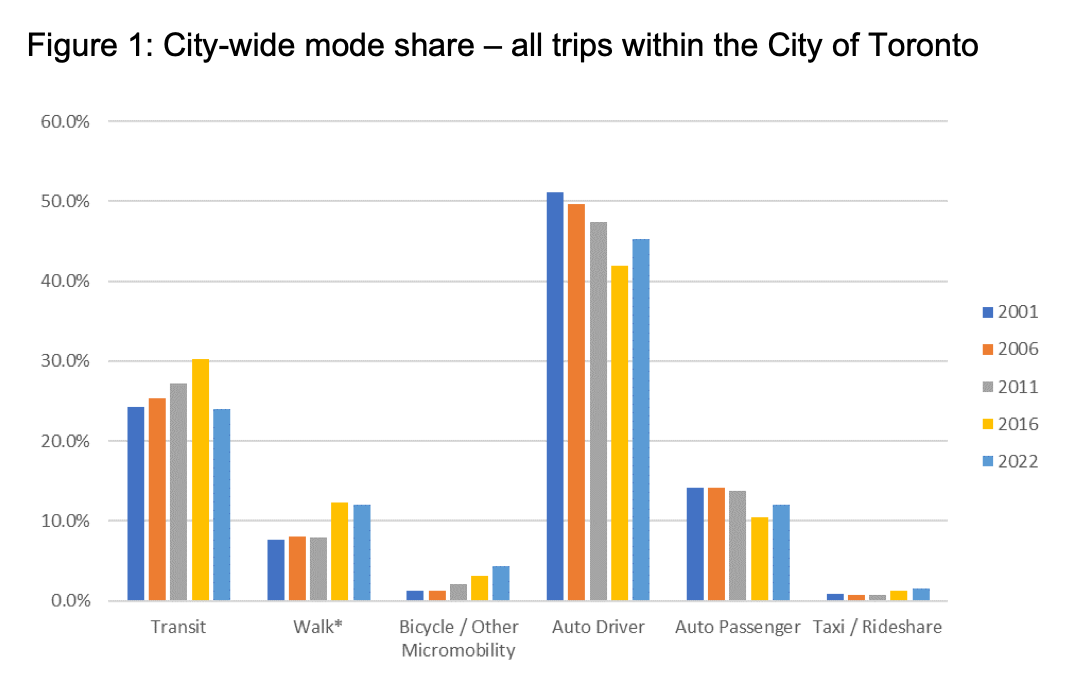
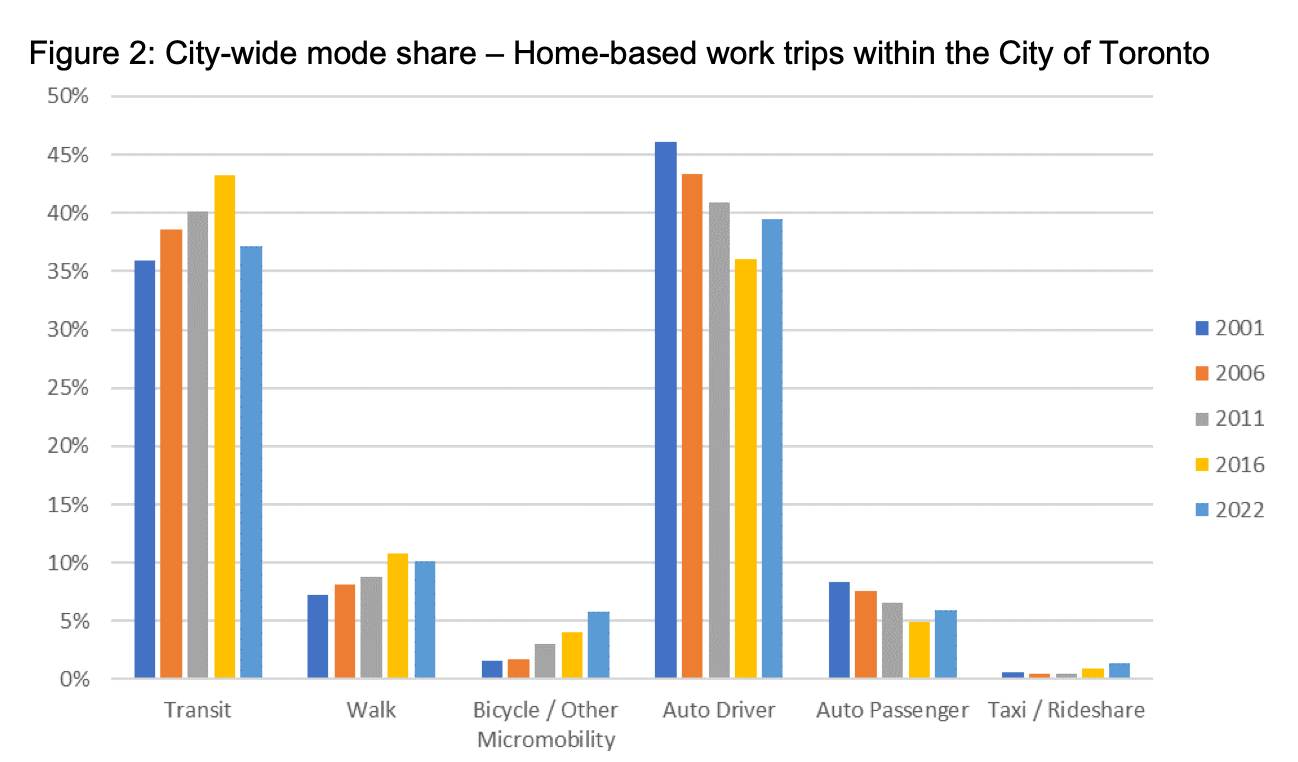
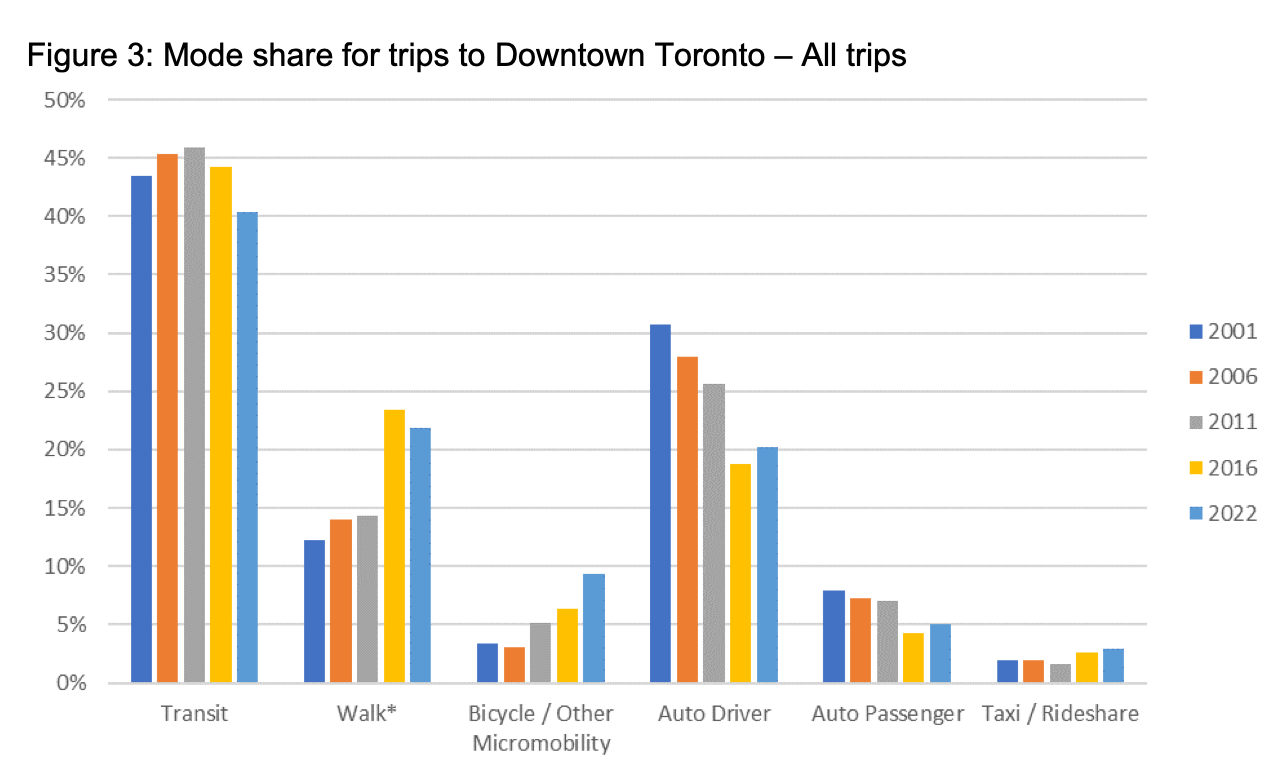
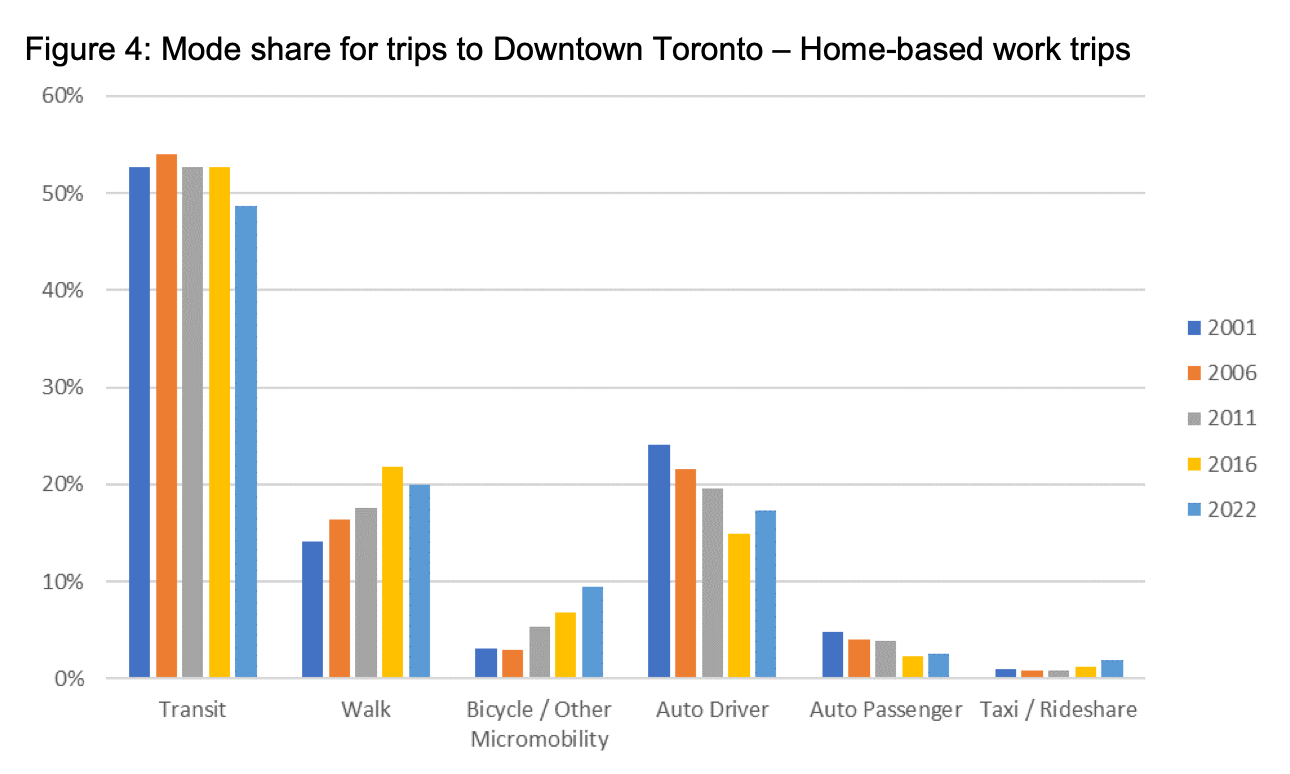
    Let’s look at some of the data from the 2022 Transportation Tomorrow Survey.

    For all trips starting and ending in the City of Toronto, people driving themselves around is the dominant mode share at 45.3%. But the transit mode share is not nothing at nearly a quarter of all trips. And if you add up taking transit, walking, cycling (and other forms of micromobility), and taxiing, you get to 42% of all trips within the city. That’s a meaningful number.

    For home-based work trips within the City of Toronto, the split between driving and taking transit becomes dangerously close. (A home-based work trip is a trip within the city that either starts or ends at home and is done for the purpose of work.) Driving sits at 39.4% and transit sits at 37.1%. Add in walking (10.2%), cycling/micromobility (5.8%), and taxiing/ridesharing (1.4%), and non-car forms of mobility dominate when it comes to getting to and from work.

    Looking at all trips to only downtown Toronto, transit once again dominates at 40.4%. Add in the other non-car forms of mobility and we’re up to nearly 75% of all trips.

    The numbers become even more pronounced if we look at only home-based work trips to downtown. In this case, transit ridership increases to 48.7%. Add in the other non-car forms of mobility and we’re now at 80%!

    These are fascinating figures because, let’s say you were considering a congestion charge for motorists driving into downtown Toronto, and that the proceeds of this charge would be used to make impactful investments in transit and other mobility infrastructure. Based on this data, you’d actually be benefiting the greatest number of Torontonians.

    These numbers also help to debunk the objection that people simply have no other option. If you’re coming into downtown Toronto, you have options. The transit exists, and the majority of Torontonians use it.

    I guess Toronto isn’t so car-oriented after all. (The rest of the region is a different story.)

    Charts via the City of Toronto (TTS 2022); cover photo by Aditya Chinchure on Unsplash

  • Do not freeze rents

    June 29, 2025 · View original


    > “Rent control is the second-best way to destroy a city, after bombing.” —Lawrence H. Summers

    Zohran Mamdani, the Democratic nominee for the mayor of New York City, clearly ran a good campaign. He used social media and short-form videos to find his audience and win with the message that the city has become unattainable to most.

    But it is also clear that the stock market really does not like his message. Shares of firms with exposure to New York City’s real estate market reacted immediately: Vornado Realty Trust, SL Green, Equity Residential, Empire State Realty Trust, LXP Industrial Trust, and others, were all down. At the same time, the wealthy vowed to leave New York for places like Florida, as they so often do these days.

    One of reasons for this negative reaction was Mamdani’s commitment to not just cap rent increases, but freeze rents in rent-stabilized units for the entire duration of his term. We’ve spoken a lot about rent control over the years (here, here, here, and other places) but, at a high level, the problem with rent controls is that they create a strong disincentive for landlords to invest and maintain their homes and for developers to build new homes. So what ultimately happens is that you get a more rapidly aging inventory of existing homes and a reduced amount of new supply.

    A full-out rent freeze takes this even further. A rent freeze does not mean that utility costs will also be frozen, that insurance and taxes will be frozen, that interest rates will be capped, and that all other landlord operating expenses will be restricted from inflating. (If this were the case, we really wouldn’t have market economy.) So what a rent freeze does is ensure that, in real dollars, a landlord is able to collect less money from tenants, while operating costs continue to increase under the line.

    The same is true in condominiums and other ownership structures. Whenever somebody talks about frozen maintenance or common element fees, I immediately remind them that this is a bad thing, not a feature. It means the condominium corporation is on an unsustainable path and will eventually run out of money. Something is being sacrificed in order to keep up with rising operating and capital expenses. At the very least, you need to keep up with inflation.

    I can appreciate that rents are too high. As a developer, I would love to be able to build to lower rents. It reduces absorption risk and it’s better for the city. But rather than just freeze rents, a more productive and sustainable approach would be to attack the underlying root causes for the problem. A rent freeze is a short-term political fix that will have second and third-order consequences. Problems for a different day and for a different mayor, perhaps. But problems nonetheless.

    Cover photo by Daryan Shamkhali on Unsplash