Daily insights for city builders, delivered every morning at 6 AM ET. I’m Brandon Donnelly — a Toronto-based real estate developer and founder of Globizen. I’ve been writing here since 2013.

Search results for: “road pricing”

  • Technology and the city

    Embedded at the bottom of this post is a great rapid-fire talk by Edward Glaeser about technology and the city. 

    Technology has always been a fundamental driver of change within our cities and I like how Glaeser starts by referring to these forces as either centripetal and centrifugal. The car was an example of the latter. It spread us out.

    At the same time, Glaeser points out that the car was really the first time that urban mobility patterns shifted from hub-and-spoke to point-to-point. Transit systems rely on hubs and some walking, which in a world of cars has led to something we call the last mile problem.

    Also worth noting is the fact that Glaeser is terrified about what autonomous vehicles will do to our cities. His point is that the fundamental law of highway traffic has shown that vehicle miles traveled increases basically 1:1 with highway miles built.

    So if all of a sudden AVs are able to decrease the cost of mobility, provide capacity benefits, and increase rider enjoyment (because you’re no longer a driver), vehicle miles traveled are going to go through the roof. This makes a strong case for some form of road pricing.

    But it also means that unlike traditional cars, which were a centrifugal force, AVs could in fact turn out to be a force that further centralizes us within dense urban centers.

    When you listen to Glaeser’s talk, you will quickly understand why so much attention (this blog included) is being paid to autonomous vehicles. They are one of – if not the – next great technology bound to reshape our cities.

    If you can’t see the video below, click here.

    [youtube https://www.youtube.com/watch?v=lbGwhWbuhfg?rel=0&w=560&h=315]
  • Free ice cream

    I was out for dinner this evening and the topic of road tolls (road pricing) came up. All of us at the table agreed that this was a missed opportunity for Toronto. Yes we proposed it, but then we got cold feet and backed away.

    Why might this be a good idea?

    City Observatory did a good job explaining this with their post about free ice cream day at Ben & Jerry’s. They argued that this sort of promotion actually provides a great crash course in transportation economics. Nobody is paying, but the lines are real long.

    Here’s an excerpt:

    Substitute “freeway” for “free cone” and you’ve got a pretty good description of how transportation economics works. When it comes to our road system, every rush hour is like free cone day at Ben and Jerry’s.  The customers (drivers) are paying zero for their use of the limited capacity of the road system, and we’re rationing this valuable product based on people’s willingness to tolerate delays (with the result that lot’s of people who don’t attach a particularly high value to their time are slowing down things for everyone).

    What we are talking about is simple, but apparently it’s not easy to execute on.

  • Is Toronto a world-class city?

    image

    Earlier this week I was on a panel discussion called Building Toronto Tomorrow. One of the questions was about whether or not Toronto is world-class city. It elicited a good discussion, so I thought I would talk about that today on the blog.

    Shamez Virani, President of CentreCourt Developments, responded by saying that he thinks Toronto is the greatest city in the world and that he wishes more people would just accept how incredible this city is. I agreed with him.

    I also responded by saying that I hate this question. I think it reeks of insecurity and I think it’s a bit of a red herring. It distracts from more direct and meaningful questions – questions such as our livability and our position as a global city.

    Because the reality is that Toronto is one of the most livable cities in the world and, in my view, we are the only true global city in Canada. We are an important node in the global economy for the flow of goods, people (we’re particularly good at this), capital, and now information. There’s a lot to be proud of.

    But that’s not to say that we’re perfect. Everyone knows we need better transit. And to name a few others (non-exhaustive list), I also think we need to:

    • Get a move on road pricing.
    • Loosen up our archaic alcohol laws and start using nightlife as a competitive advantage for attracting talent.
    • Acknowledge through our governance structures that cities are what drive today’s information economy.
    • Stop thinking about the Canadian/Toronto value proposition as being about cost savings. That is, buy this from us because our currency is weaker than yours. This is anti-innovation and there are much better ways to create sustainable value. (Innovation is still a weak spot.)
    • Focus on developing an information economy that leverages the unique talent and knowledge base of Toronto. For example, I think we’re in a great position for real estate + tech innovation.
    • Do everything we can to encourage big tech IPOs in this city. They are critical to developing the ecosystem.

    There’s a saying in Silicon Valley that you “make what you measure.” It means that whatever you decide to focus your attention on, is invariably what you end up making – regardless of whether or not you happen to be focusing on the right metric.

    In the context of Toronto, I think we’d be better served if we focused on and quantified our position in the global economy, as opposed to chasing some idea of “world-class.” The latter will grow as the former grows.

    I also think that this needs to be balanced against our livability. Sometimes there’s a tension. But there are cities – the best example is perhaps Tokyo – who have managed to pair a high quality of life with one of the strongest positions in the global economy.

    Is there anything else you think we should be doing? We can talk about it in the comments below.

    Image: Building T.O Toronto (BuzzBuzzHome Event)

  • Medellín wins 2016 Lee Kuan Yew World City Prize

    image

    Thanks to my friend Darren Davis, I just recently learned about something called The Lee Kuan Yew World City Prize.

    Named after Singapore’s first Prime Minister, the prize is a biennial award that honors cities who have made, “outstanding achievements and contributions to the creation of liveable, vibrant and sustainable urban communities around the world.” Along with the prize comes $300,000 (Singapore Dollars), which is about $287,000 Canadian as of today.

    The 2016 Prize Laureate is Medellín, Colombia.

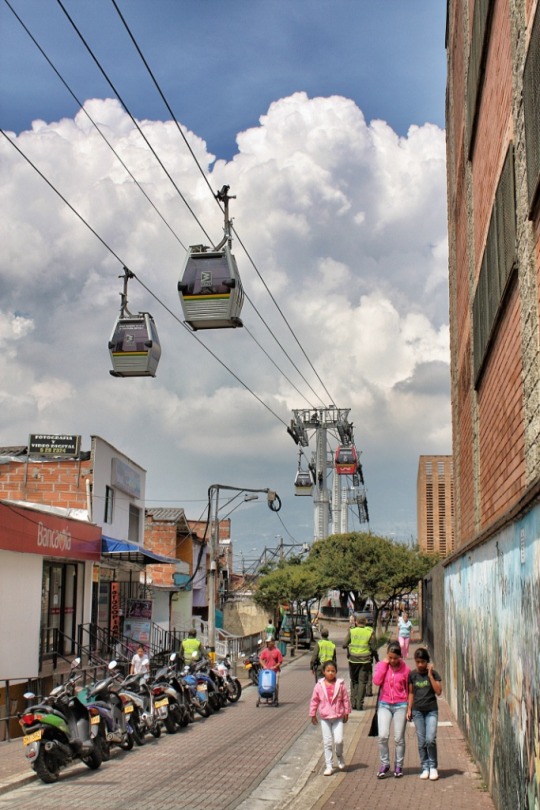
    Over the past two decades, the city has transformed itself from one of the most dangerous cities in the world to one that has become a model for social inclusion and urban innovation. Here is a video that talks about the transformation. It’s a bit cheesy, but it does provide a high-level overview of their urban initiatives. A lot of them will serve as a reminder about the importance of urban connectivity.

    If you’re a regular reader of this blog, you may also remember that my good friend Alex Feldman (VP at U3 Advisors) wrote a guest post about Medellín after he visited the city for the World Urban Forum almost two years ago. That post was called, What cities could learn from Medellín.

    It’s worth mentioning that the runners-up for this year’s World City Prize were Auckland, Sydney, Toronto, and Vienna. In the case of Toronto, our “far-from-ideal transit” was specifically called out as a negative. Thankfully we are now working on road pricing, which will provide additional funding for transit. 😉

    Image by Jorge Gobbi

  • 10 city building predictions for 2016

    Dawn by Adrian Popan on 500px.com

    https://500px.com/embed.js

    Few things are better than waking up in the mountains and seeing a notification on your phone that 9″ of fresh snow have fallen overnight, bringing the 48 hour snowfall total to 16″.

    This is what people in mountain towns live for. They ski in the morning and then head to work in the afternoon. I heard a number of people on the mountain today saying that they, “want to be in the office after lunch.” It’s a lifestyle thing.

    On that note, today I’d like to focus on 10 city building predictions for 2016. I’ve been assembling this list over the past few weeks and now that I have had my fill of Utah powder for the day, I’m dedicating the rest of the afternoon to writing.

    These are never easy to put together. But here are my thoughts:

    1. We will see increased migration to secondary cities – outside of the alpha global cities – which offer a higher quality of life, more affordable housing, and the ability to live a particular lifestyle. This includes cities like Austin (creative startup hub) and Denver (outdoor recreation).
    2. As more and more cities wake up to the importance of lifestyle in attracting top talent, I think we will see a lot of cities follow the lead of Amsterdam and create “night mayors” or some other equivalent. These cities will begin to see nightlife as a competitive urban advantage.
    3. Global cities will start experimenting with different land use and property tax reform strategies to try and deal with rising income inequality and eroding housing affordability.
    4. We will see a barbell of residential unit sizes. We’ll see more well-designed small units as a way to try and promote housing affordability and we’ll see larger urban infill units for families and baby boomers who want to live/remain in walkable urban communities.
    5. In line with above, I think we will see a further rethinking of urban spaces. Flexible spaces, unique program mixes, and a continued blurring of public/private spaces. One example of this is the trend towards small private spaces surrounded by generous public/communal spaces.
    6. The Toronto and Vancouver real estate markets will continue to chug along because of low interest rates, a weak Canadian dollar, and increased foreign investment. That said, I think we will see more restraint when it comes to over-the-top luxury product.
    7. We will finally see a disruptive technology product that starts to get people in the real estate industry thinking that change is on the way. This will not be a product that ports an offline experience online; it will a new way of thinking about the industry.
    8. This will be the year that cities stop fighting Uber (and other similar marketplaces). Cities (and lobbyists) will finally accept that this is a new reality and then work to figure out the best way to create policy around it. Edmonton, Alberta has already become the first Canadian city to regulate Uber.
    9. Road pricing will get the attention it deserves in North America. Things will start out slow, but we will finally get ourselves on a path which recognizes that we can’t build our way out of traffic congestion in most major cities.
    10. I will publish a book on becoming a real estate developer.

    Many city building trends and shifts seem to happen in a global way. But I think it’s worth noting that a lot of these predictions were likely written with my North American lens on, and in some cases my Toronto lens on.

    It’s not easy sitting down and thinking about what will happen in the future. But it’s a worthwhile exercise. It forces you to take a stance and then, when the future does come, you can see how well you did. I saw Fred Wilson do this on his blog and I thought it was a great idea.

    Now I would love to hear what you think about my predictions and what yours are for this year. Please let us know in the comment section below.

  • How to encourage traffic congestion in your city

    City
    Observatory recently republished their
    commentary
    on a report (released earlier this year) called Who Pays
    for Roads
    . I missed their original post, so this is new to me.

    The report
    and commentary are all about the mispricing of roads/driving and the fallacy
    that “user fees” (gas taxes, tolls, and so on) are enough to completely cover
    the costs associated with driving.

    I have been
    a vocal supporter of road pricing and/or congestion charges here in Toronto, and
    so I’d like to share two pieces from their commentary.

    The first
    is this paragraph, which talks about how mispricing leads to demand issues
    (i.e. traffic congestion):  

    The conventional
    wisdom of road finance is that we have a shortfall of revenue: we “need” more
    money to pay for maintenance and repair and for new construction. But the huge
    subsidy to car use has another equally important implication: because user fees
    are set too low, and because, in essence, we are paying people to drive more,
    we have excess demand for the road system. If we priced the use of our roads to
    recover even the cost of maintenance, driving would be noticeably more
    expensive, and people would have much stronger incentives to drive less, and to
    use other forms of transportation, like transit and cycling. The fact that user
    fees are too low not only means that there isn’t enough revenue, but that there
    is too much demand. One value of user fees would be that they would discourage
    excessive use of the roads, lessen wear and tear, and in many cases obviate the
    need for costly new capacity.

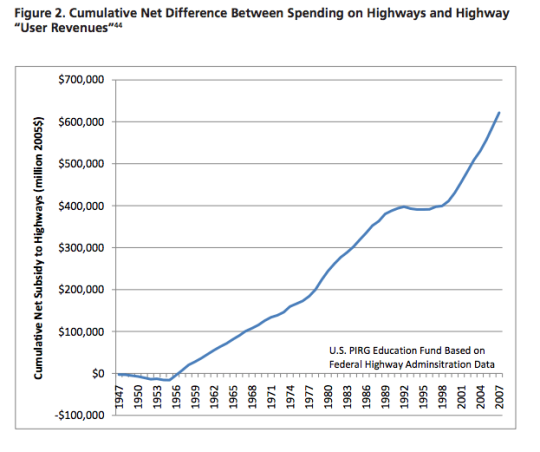
    And the second is this chart, which shows the cumulative net
    subsidy to highways in the US from the late 1940’s:

    image

    The point of all this is that when you subsidize something
    it’s because you’d like to see more, not less of it. So why then are we even surprised by the crippling traffic that plagues our
    cities? We are doing a lot to encourage exactly that.

  • How to save 8 minutes on Toronto’s highways

    City in Colour by Greg Patterson on 500px.com

    https://500px.com/embed.js

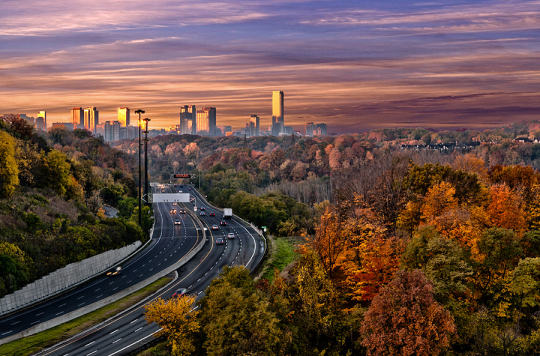
    Three months ago when Toronto City Council voted
    not to remove the Gardiner Expressway
    East (which in
    my view was a mistake
    ), it did so with a commitment to look at tolling
    options for both the Gardiner Expressway and the Don Valley Parkway (which in
    my view is a positive thing
    ).

    Last week a preliminary report was released
    discussing some of those tolling options. If reading dry city reports is your thing,
    you can do that here.

    The Coles Notes version (CliffNotes for you
    Americans) is that a $3 flat toll on both the Gardiner and the DVP – the same
    cost as riding transit in this city – would be expected to reduce vehicles on the highways by 9% and 12%, as well reduce end-to-end travel times by 3 minutes and 5
    minutes, respectively. There’s obviously a lot more in the report, but these
    figures stood out for me.

    Given how monumental the
    3 minute delay
    was in the Gardiner East debates, it will be interesting to
    see whether people treat a 3 minute time savings in a similar way. I suspect
    they won’t. The cost will be the larger issue.

    I’ve been a
    vocal supporter of tolls and road pricing on this blog
    . One of the main reasons
    for that is because I view the demand for highways as being largely inelastic
    and therefore a potentially great source of transit funding.

    The discouraging part of the above report is
    that its primary goal is to explore tolls for the purpose of “offsetting
    capital, operating, and maintenance costs.” The primary goal is not to come up
    with sustainable sources of transit funding.

    Having these costs paid for by user-fees as
    opposed to general taxes is still a good thing in my view. But an even better thing
    would be to help fund mobility solutions that we know will be far more
    effective at getting people around this region as millions more people move here
    in the coming decades.

    The other discouraging part of the report is
    that near the end it explains that while the City of Toronto Act of 2006 allows
    for toll highways, they cannot be implemented without the Province passing
    regulation.

    It’s a reminder that our governance structures do
    not reflect the current urban reality of this country.

  • Cottage weekend

    I just got home from a weekend up at a friend’s cottage. It’s an annual birthday tradition and it’s always a great time. A good cottage weekend can do wonders to reinvigorate yourself. I am ready for the week.

    But since the Pan Am Games closing ceremony fireworks are about to kick-off and I want to go watch them from my sun deck, I don’t have a lot of time to write a post. So instead, I thought I would share a few of my photos from the weekend.

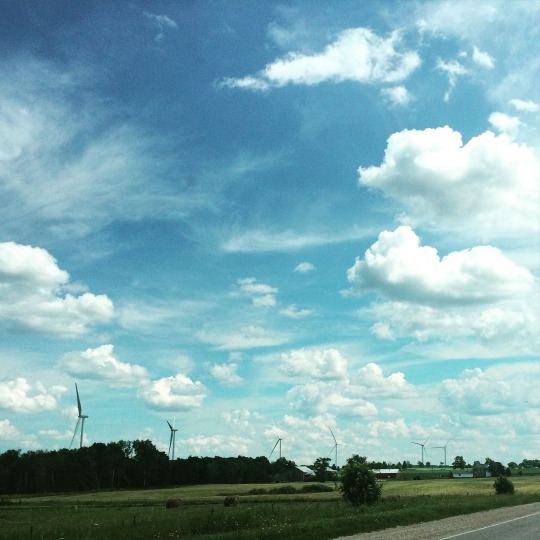
    The first photo is near Shelburne, Ontario. The wind turbines are from the Amaranth Wind Farm, which is the largest wind energy installation in Canada.

    image

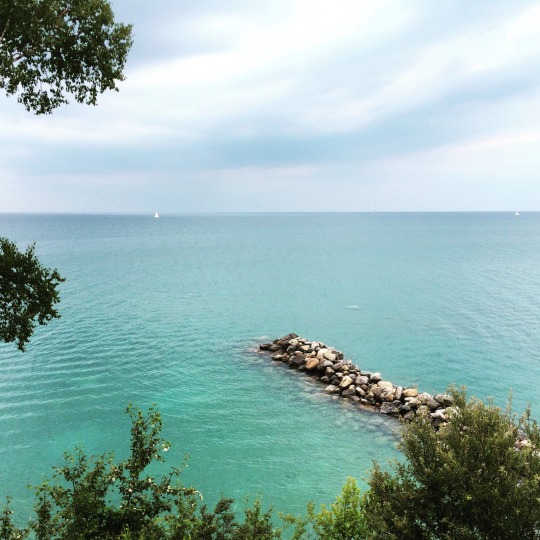
    This is the Georgian Bay. I love swimming in this water.

    image

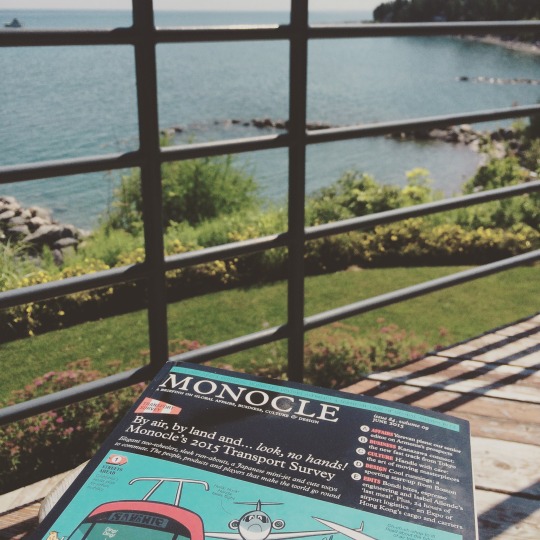
    Cottage reading: Monocle.

    image

    The wood shop. There’s a lot of creative talent at this particular cottage.

    image

    Creemore = cottage.

    image

    All of these photos were also posted to my Instagram if you’d like to follow me there. The last photo was from Snapchat (donnelly_b).

    Regular scheduled programming will resume tomorrow. I have a great guest post queued up on road pricing. I can’t wait to share it.

  • The ultimate Toronto transit map

    image

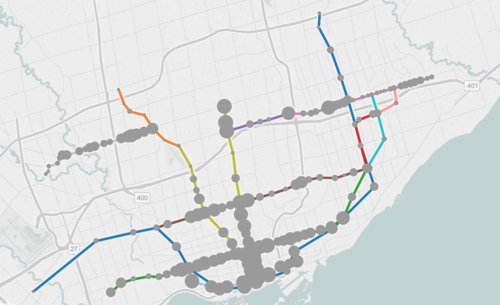
    If you live in Toronto and only give serious thought to one thing today, it should be to this interactive transit map created by Metro.

    The map shows all existing, planned, and proposed transit lines in the city, and then overlays population densities, commuting patterns, household income, and so on. It’s a super valuable map that I think reveals a lot about how we should be focusing our energies to get Toronto moving.

    So what sorts of things does it tell us? I’ll give 2 examples.

    If you look at commuting patterns across the Bloor-Danforth subway line, you’ll see that Runnymede station in the west is where people switch over from taking transit to driving. People west of that station tend to drive. Naturally, it also happens to coincide with where population densities start to fall off.

    By contrast, if you look at the east side of the city along the Danforth and beyond, the entire stretch more or less relies on transit to get around. Part of this likely has to do with income levels, but it’s also because of the availability of the Gardiner Expressway. There’s no equivalent in the east end. Dylan Reid of Spacing Magazine believes this makes a case for some sort of road pricing along the Gardiner, and I would agree.

    As a second example, look at the population densities along the proposed Downtown Relief Line, Finch LRT, and John Tory’s SmartTrack line. Outside of the core, the population densities are relatively low along the proposed SmartTrack line – which is never a good thing for rapid transit.

    There’s also no Sherbourne station on the SmartTrack line, which happens to have the highest population density across the entire Relief Line – 22,131 people per square kilometre! That’s more than any other stop along the Yonge-University subway line except for Wellesley station.

    I’ve written about this a lot before, but I think we need to do a better job of matching up transit investment with expected customer demand. Too often we let politics get in the way of rationale decision making. Maybe it’s time we did something like set minimum population densities. If you want a subway line in your area, you have to first bring the people.

    What else does this map tell you?

  • What we could do to improve traffic in Toronto

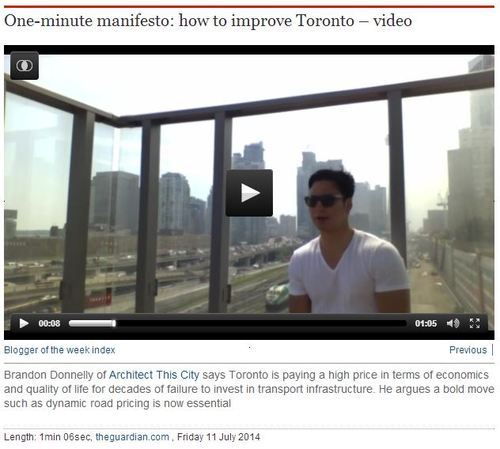
    This morning The Guardian Cities published my one-minute video talking about how much traffic sucks in Toronto and why we should be considering bold initiatives like dynamic road pricing.

    The video was shot on the sundeck of my building on a holiday Monday (meaning traffic volumes should have been less). The dirty glass makes the city look a lot smoggier than it really is, but it felt appropriate for the topic I was discussing.

    I’m sure many of you will disagree with what I’m advocting for, so let me know your thoughts in the comment section below.