Daily insights for city builders, delivered every morning at 6 AM ET. I’m Brandon Donnelly — a Toronto-based real estate developer and founder of Globizen. I’ve been writing here since 2013.

  • Are fractional vacation homes a good investment?

    August 29, 2025 · View original


    Pacaso, which is a relatively new (2020) co-ownership vacation home company, has been making the rounds online lately. That’s because the founders are accomplished, they’ve reserved their Nasdaq ticker, and they’re raising money from retail investors through their website.

    Fractional ownership is a topic we’ve discussed a number of times on the blog. And as I’ve said before, I think it’s an answer to this real estate problem: “I have a desire to own a home, or multiple homes, around the world. However, I don’t know how often I’d actually use it/them, and this desire is both expensive and a pain in the ass.”

    So it’s not surprising that the market invented timeshares, membership clubs, and fractional ownership models. Timeshares, however, have a bad rap and generally don’t involve the direct ownership of real estate. Instead, what you’re buying is the right to use a property during a certain period of time.

    Fractional ownership, on the other hand, typically does involve direct ownership of the asset. In the case of Pacaso, my understanding is that each property is acquired through a single-purpose entity (usually a US LLC). Buyers then acquire a membership interest in that SPE.

    This is obviously better. It’s how most real estate projects are structured legally. But there remain a number of important questions about this model: Are fractional shares in a vacation home liquid? How big is the market? And should owners expect appreciation over time?

    I haven’t seen great data on this ownership model. There are lots of fractional opportunities and, in theory, a 100% sale of the home could always be offered — which should appreciate like any other property in the market. But selling fractional shares is always going to be less liquid and more challenging.

    Maybe that’s okay. Maybe it’s best to think of it more like a consumer good than a real estate investment. But then, why not just spend your money on hotels when you vacation?

    This could be my developer GP bias at work — where I’d rather not own an asset with a bunch of strangers and have no control — but I have a hard time getting my head around the fractional ownership model. I think it serves a very clear desire in the market. But is it a good business, and is it the optimal way to buy a vacation home?

    Note: None of this is financial advice.

  • The Delmore in Surfside receives foundation permit

    August 28, 2025 · View original


    It has been over four years since the Surfside tragedy in South Florida and the partial collapse of the 12-storey Champlain Towers South building. In response to this, the state of Florida enacted stricter condominium regulations. Buildings over 30 years old (or over 25 years if located within three miles of a coast) must now undergo mandatory structural inspections. Condominium reserve funds are also required to be fully funded, and owners can no longer waive or reduce the contributions. Surprisingly, this was not the case before.

    The site itself has also moved forward. In May 2022, Dubai-based DAMAC International acquired the 1.8-acre parcel for $120 million. They hired Zaha Hadid Architects (ZHA) and, in 2023, submitted designs to the Town of Surfside. Earlier this year, pre-construction condominium sales launched for The Delmore — with a starting price of $15 million and an average price of $40 million. And this month, the developer announced that they have secured a foundation permit.

    With only 37 condominiums in the project, the land cost alone works out to over $3.2 million per suite.

    Rendering via DAMAC

  • Waymo is now testing in New York City

    August 27, 2025 · View original


    Waymo has just been granted approval to test its autonomous vehicles in New York City. The permit allows up to eight of the company’s Jaguar SUVs to circulate in Manhattan and downtown Brooklyn. And according to the company, the plan is to start “immediately.” This first approval only runs until the end of September, after which it will need to be extended — but I’m guessing that shouldn’t be too difficult to obtain.

    What’s noteworthy about this announcement is that (1) New York City is a big and complex place and (2) it’s the first city for Waymo that receives snow. The company currently operates in San Francisco, Austin, Phoenix, and Los Angeles.

    That said, the company has been doing cold weather testing since, I think, 2012. And in 2016, they opened a 53,000-square-foot self-driving center in Michigan for this purpose. They’ve also run tests in Truckee, California, Upstate New York, and the Detroit area. So presumably its sensors are ready to melt snow and ice. But it’s looking like the true test will be on the streets of New York.

    Next should be Toronto.

  • US datacenter construction is about to overtake offices and warehouses

    August 26, 2025 · View original


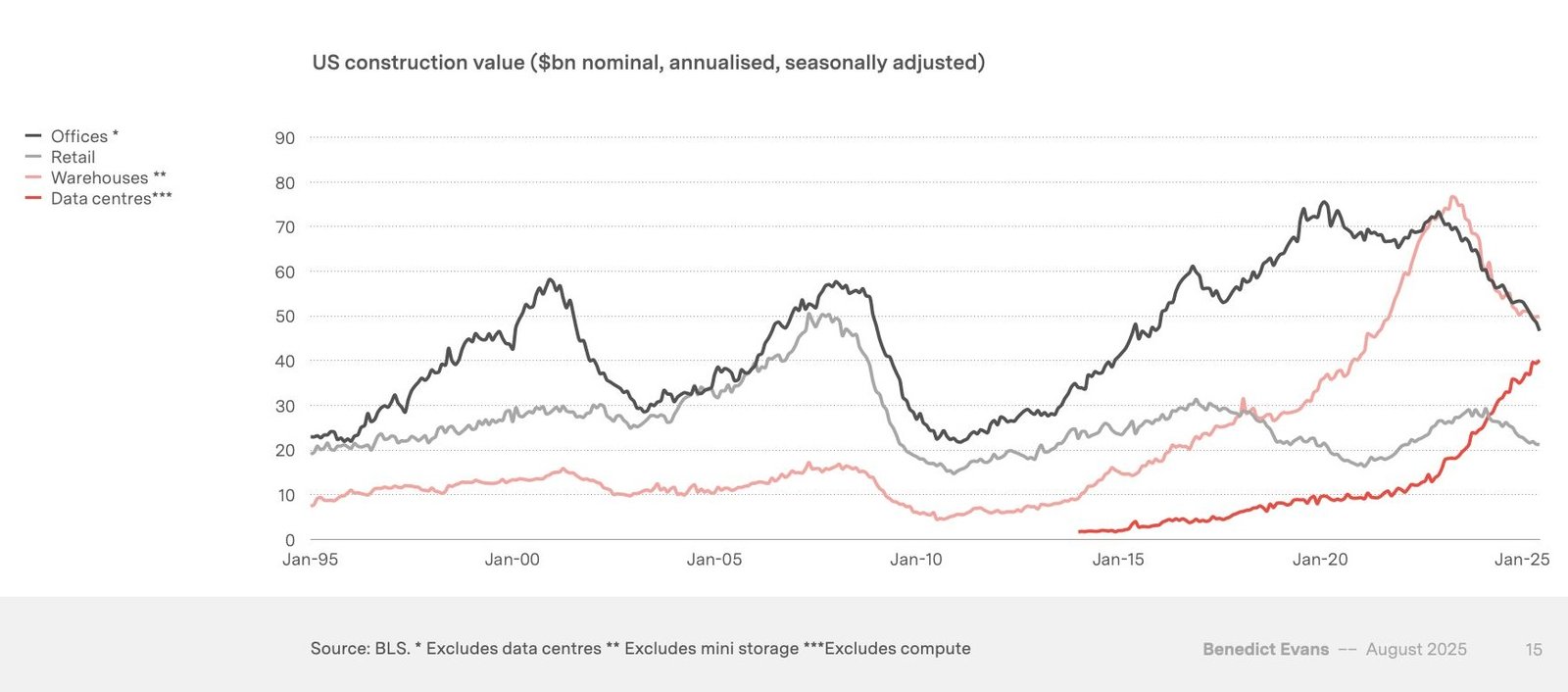
    I came across this chart from Benedict Evans on LinkedIn. (I must have been doing my quarterly check-in to see what the AI models are saying.) It shows US construction value broken down by offices, retail, warehouses (industrial), and data centers.

    The office cyclicality is interesting to see. But of course, the point of this chart is the dramatic rise in data center construction. As of August 2025, it’s about 2x retail construction and it’s on track to overtake both offices and warehouses.

    Will this happen and is this pace of construction sustainable? I frankly don’t know. But AI and the need for more compute are obviously here to stay.

    I’m reminded of something that venture capitalist Fred Wilson once wrote on his blog. His argument was that when it comes to speculative frenzies, or just new stuff in general, it’s common to be directionally correct, but be off in terms of the order of magnitude.

    I wouldn’t be surprised if this proves to be true for AI-driven investments.

  • Time to remove the stigma around shopping carts

    August 25, 2025 · View original


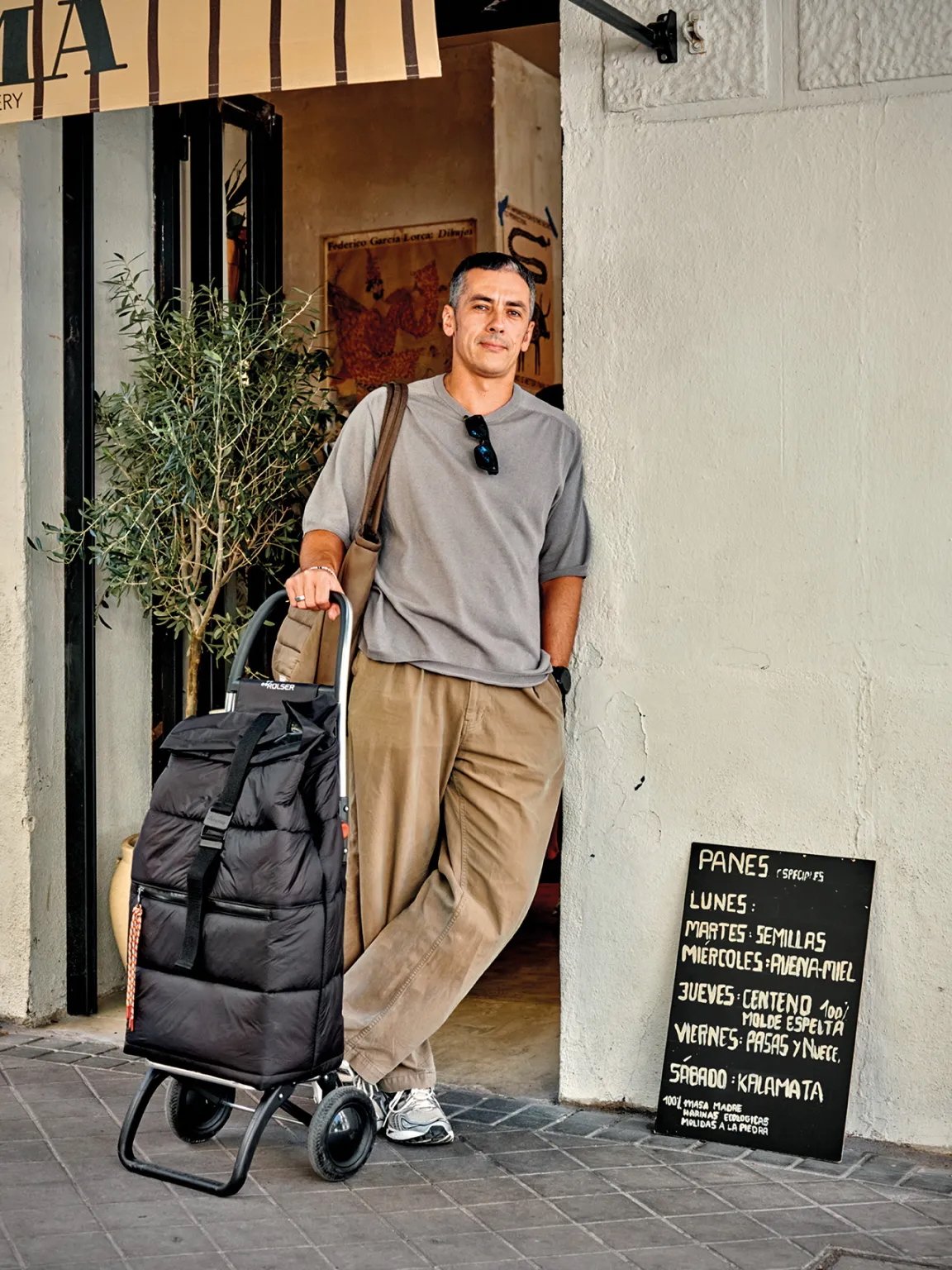
    I’m not actually sure what the official name is for this kind of bag. Is it a shopping cart, shopping trolley or something else? The answer likely depends on where you are. Whatever it is, the September issue of Monocle has a feature on Spanish shopping trolley maker Rolser.

    And for it, they photographed a bunch of cool urbanites with their trolleys, and then asked them: What’s in your Rolser? See above photo. Supposedly, or at least according to the company, about 63% of Spanish households have a Rolser in their house.

    This is interesting. Because in my part of the world, the percentage would be low. In fact, there are stigmas around them. Many people associate grocery carts with elderly people and sometimes with people who can’t afford a car. But that’s the wrong way to think about this bag.

    It’s actually a built environment association. The correct framing is: Are you urban enough to be able to use one? Because they’re very common throughout Europe. Here, for example, is Paris, where they’re called a chariot de courses or a sac à roulettes.

    All of this has me thinking two things. One, our household is overdue for one. And two, this is an opportunity. These are utilitarian and often stigmatized objects that could very easily be reframed into a lifestyle design object for urban cities around the world. (Though, to be fair, the Rolser pictured above looks pretty good.)

    The only prerequisite is a walkable urban environment. Maybe it’s time that Globizen gets into the city roller business. Or maybe one of you can just run with this idea and then I can buy one.

    Photo: Monocle

  • The urban swimming renaissance

    August 24, 2025 · View original


    Cities like Copenhagen, Zurich and many others have, of course, long been pioneers when it comes getting people into natural waterways. But this summer we notably saw the fruits of Paris’ €1.6 billion investment to clean up the Seine ahead of the Olympic Games. And so very quickly, it is becoming clear that this is becoming one of the hallmarks of the world’s most livable cities. How clean is your water and do you enable your citizens to easily swim in it?

    It’s for this reason that earlier in the summer I wrote a post titled “Toronto needs a summer bathing culture.” It was not to suggest that nobody swims in our bodies of water — lots of people do — it was to argue that there’s more we could be doing. Sunnyside Bathing Pavilion, to give just one example, feels like a century-old abandoned relic sitting on prime beachfront.

    Some of you seemed to take offence to this post, suggesting that I should maybe get out and swim in some of our outdoor pools, like the one at Sunnyside. And I can assure you that I have. I’m a regular swimmer in the public pools of Toronto. But that is not what this urban swimming renaissance is about: “Contrary to popular belief, or simply a fair assumption, a lido does not a swimmable city make.”

    What this is about is free, easy access to natural bodies of water. And what makes this livability feature so meaningful is that it’s both an urban amenity and clear evidence that a city has their shit together (pun intended). It means the city has high standards for water quality and that it manages its sewage in a way that doesn’t pollute its waterways.

    Summer isn’t over yet, so if you live in a place where this is possible, go for a swim. And if you’d like to become more involved in this movement, check out The Swimmable Cities alliance. Launched on the eve of the Paris Olympics, it is now a global community dedicated to transforming our urban waterways. There is also the option for organizations to become signatories. Globizen has just applied to be one, and maybe you’d like to do the same.

    Photo: Helsinki by Kuvio

  • Dictators in a box on the world’s ledger

    August 23, 2025 · View original


    I spent the past week listening to this Bankless podcast with Vitalik Buterin (the Canadian programmer and co-founder of Ethereum). It took me a week because I was listening to it off and on while I was in the car, headed to and from One Delisle and other meetings. But it’s a fascinating episode. I think Vitalik is easily one of the most important minds of our generation.

    But let me be honest and say that I wasn’t able to follow everything in the podcast. I clearly still have a lot to learn when it comes to cryptography. For this reason, I’m not going to recommend that you all watch/listen to the episode — not unless you’re prepared to go in deep. This is also supposed to be a blog for city builders (at least most of the time).

    But I did want to share one takeaway that I found interesting.

    In the episode, Vitalik describes Ethereum as the world’s ledger. This maybe won’t mean very much if you’re not familiar with crypto, but the goal is a universal, permissionless, and censorship-resistant place for recording and securing basically everything: property title records, financial assets, AI-generated cat videos, and so on. Put another way, Ethereum wants to become a foundational layer of trust for the world.

    Then, later in the episode, they somehow get onto the topic of dictators. There was a general acknowledgment that dictatorships do have their benefits, but that they also have obvious downfalls. Ideally, we would have a best-of-both-worlds scenario. We want the efficiencies of dictatorships, with all of the benefits of capitalist democracies.

    Vitalik refers to this scenario as “dictators in a box,” and he argues that we already have them: they’re called entrepreneurs. When you start a company, you get to run within your box, and that is the power of entrepreneurship. But importantly, these boxes exist within a broader framework that includes the rule of law, property rights, freedom of speech, and all the other benefits of capitalist democracies.

    This is how Ethereum sees itself — as a foundation on top of which “dictators in a box” can build new ideas, businesses, and opportunities. And because of this layering, it will be Ethereum that provides the backstop against people doing bad things, like stealing someone’s crypto or falsely claiming that they hold title to a property when they don’t.

    I found this analogy fascinating, and I think it offers a glimpse of what’s at stake if/when Ethereum becomes what it’s aiming to become — the world’s ledger.

  • Unpacking multiplexes

    August 22, 2025 · View original


    > Tweet: Amazing panel https://t.co/XYvfayrQvI

    Yesterday evening I sat on a panel at The Canadian Real Estate Investor’s 2nd annual Unpacking Multiplexes event. I’m not sure that I would construe myself as an expert on multiplexes, but I was asked to talk from more of a macro perspective and also talk about our productized rental housing strategy. And so that’s what I did. A big thanks to Daniel Foch and Nick Hill for inviting me.

    Two things stood out to me from the sold-out event (~250 people).

    First, there’s a massive amount of interest in building multiplexes in Toronto. In attendance were people ranging from experienced builders to people who are just starting out and looking for their first multiplex site. This breadth of interest seems to be one of the features of this housing typology.

    It’s small enough that it’s accessible to small developers or even individual homeowners who maybe want to live in one of the homes and rent out the rest. At the same time, there are developers who used to be at big shops, are now on their own, and want to build a big business with this scale of housing. Both are good outcomes.

    Second, this entire push for more housing feels very much like an iterative process. The City of Toronto is monitoring these new policies, watching how the market responds, and then making adjustments as needed. This is the way to do it, and it should make us all feel optimistic about the future of our city.

    We’re on our way to creating more missing middle housing — in every sense of the word middle.

  • Housing starts in Ontario are now lagging the rest of Canada

    August 21, 2025 · View original


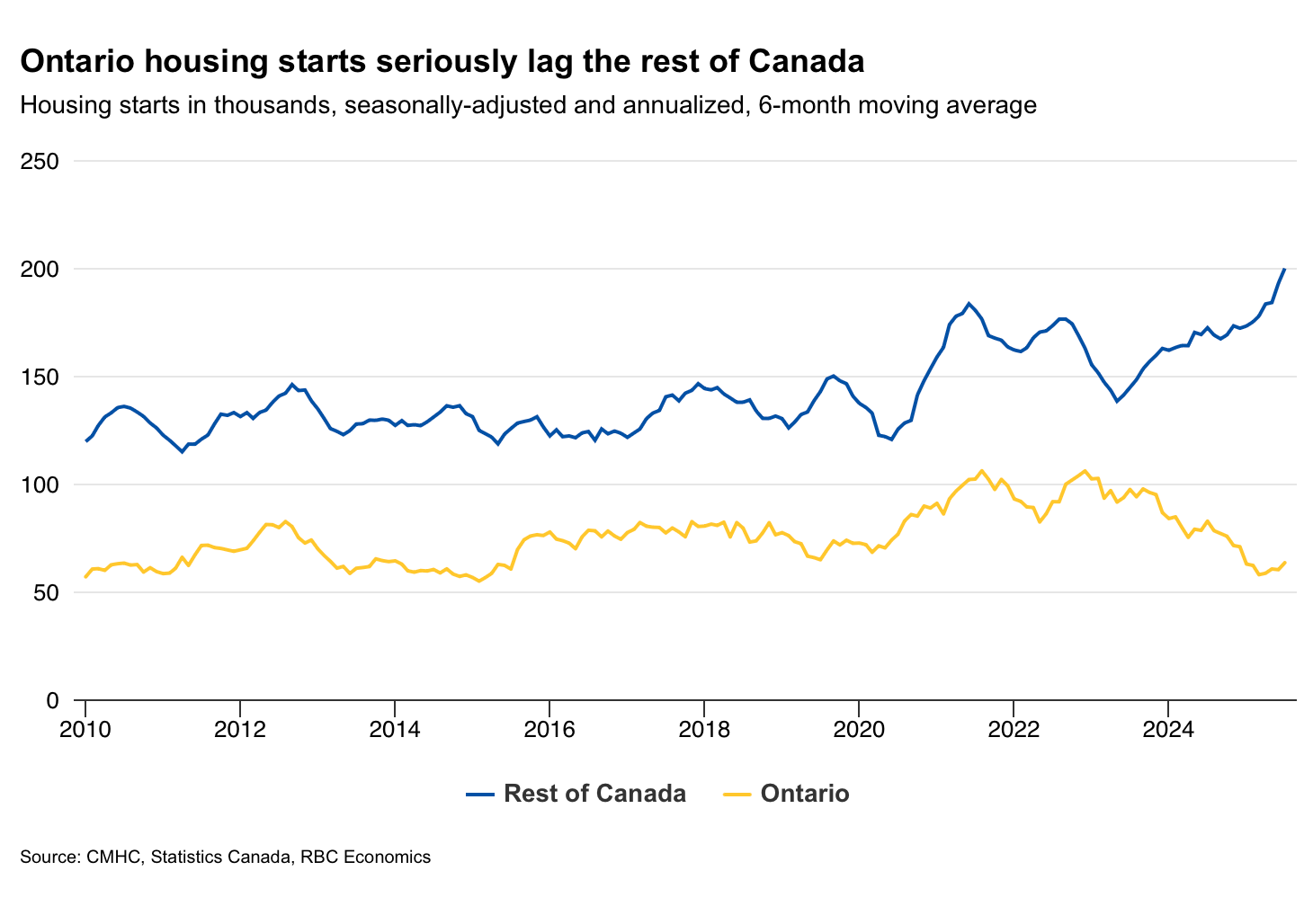
    RBC published a special housing report this week where they argued that, “Canada isn’t in a housing starts slump — Ontario is.” The report is based on new figures from the Canada Mortgage and Housing Corporation that show Ontario lagging behind the rest of the country when it comes to new homes.

    The reason for this is the paralysis of the pre-construction condo market in the Greater Toronto Area, which, up until recently, has been the biggest contributor to new supply — both when it comes to for-sale homes and for-rent homes. (This July rental housing report by BILD estimates that about 39% of all condominiums in the GTA were rented out as of 2022.)

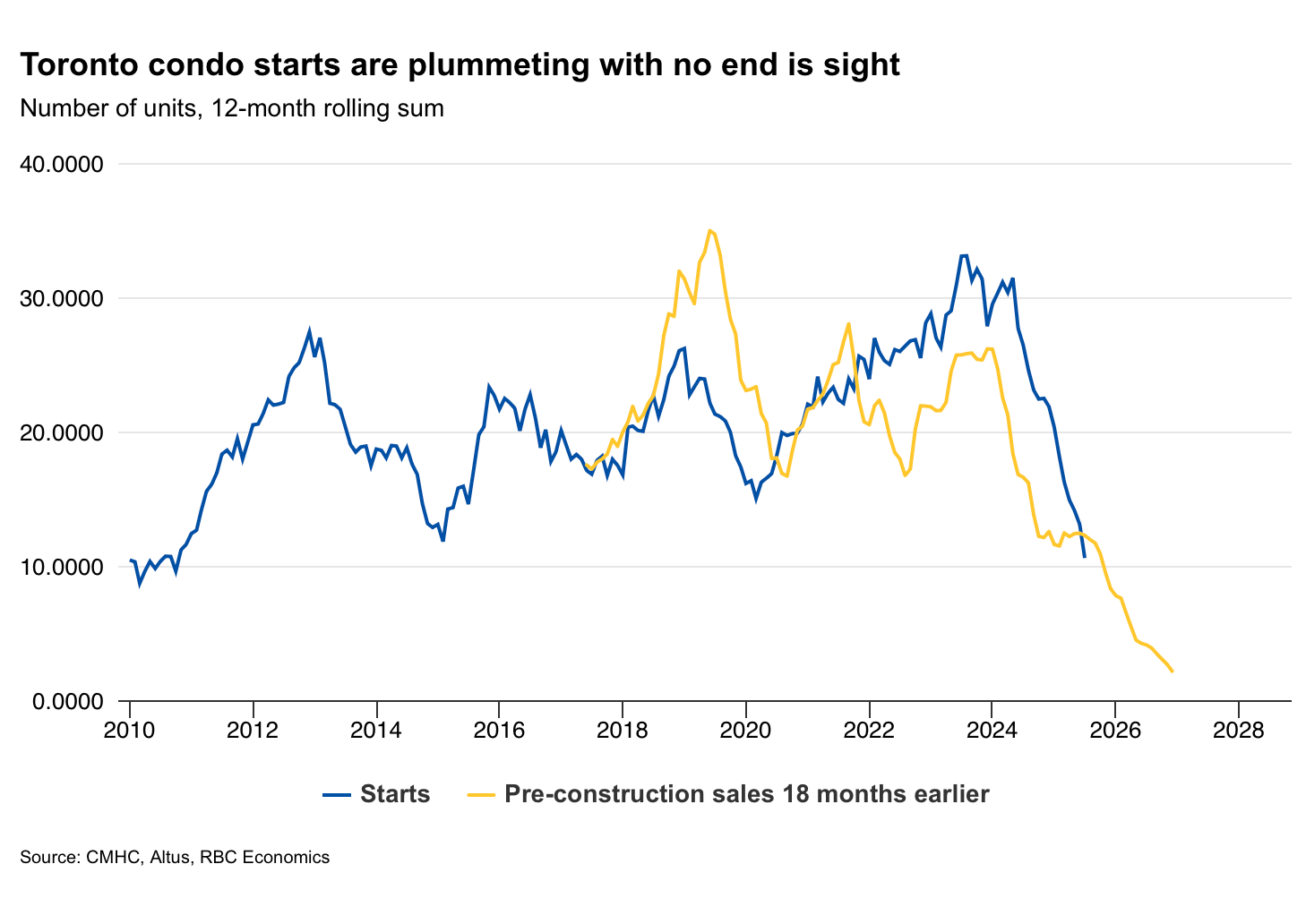
    My favorite chart from RBC is the one below, which overlays Toronto condominium starts with pre-construction sales from 18 months earlier. Naturally, the two are pretty closely correlated. Sales beget starts. What this tells us is that, at this point, condo starts are going to remain depressed until at least 2027.

    But in reality, starts are likely to remain depressed for even longer. The market still needs to absorb the current pipeline of projects under construction. I have said before that this could take another two years. And if that’s right, we could be into 2029-2030 before condo starts turn around, given the lag between sales and starts.

    Some of this supply will, of course, convert to purpose-built rental. But I suspect the conversion rate will end up much lower than most people are currently hoping. Only a minority of projects underwritten as condominiums will be able to make the switch. By default, this means we will eventually enter a period of severe undersupply.

    But as Robert Hogue says in his RBC report, “the full impact of the current slowdown in housing starts won’t be felt for years in Ontario.” And this is absolutely true. It’s an insidious problem right now. We currently have more supply delivering than we have buyers and renters. But just wait. It’s coming.

  • Low-amenity, well-designed, mid-market homes are what’s missing

    August 20, 2025 · View original


    The term “missing middle” is typically used to refer to a missing scale in our built environment. It is that middle scale of housing between low-rise and high-rise. But there’s another way to think about it and that is in terms of the market that the housing is serving.

    Over the last cycle, cities like Toronto saw a kind of “barbell” dynamic. Meaning, new supply tended to target the poles. It was delivering for young professionals and young couples on one end and for downsizers and wealthy retirees on the other. But what has been missing is new supply that targets the belly of the market. And by this I mean something like low-amenity, well-designed, mid-market homes.

    Of course, there are good reasons for why this is the case. The cost structure of new developments makes it so that the only feasible way to underwrite new projects is to maximize rents through smaller suite sizes and copious amounts of amenities. It is not that developers don’t want to do it any other way, it’s that they generally can’t.

    This is the paradox underpinning Canada’s housing crisis. Yes rents are softening and vacancies are rising right now, but it would still be right to say that we are in a crisis. And that’s because it largely exists in a different segment of the market — the biggest one.

    In my view, this is our great challenge and opportunity as we move through this downturn. And I would bet that once we unlock the right model(s), we will see just how pent-up the demand for housing is in cities like Toronto and Vancouver.