Daily insights for city builders, delivered every morning at 6 AM ET. I’m Brandon Donnelly — a Toronto-based real estate developer and founder of Globizen. I’ve been writing here since 2013.

Category: Uncategorized

  • The geographic inversion of New York’s subway ridership recovery

    May 27, 2026 · View original


    New York City is the most urban city in America, with the largest subway network by far, and yet, even here, ridership levels have yet to recover to their pre-pandemic levels. Recent data shows subway ridership hovering between 70% and 80% of 2019 levels, and the MTA anticipates that it will remain “at about that level through 2029.”

    The obvious explanation is that office workers continue to work from home on occasion, and that’s certainly a significant part of the story here. But it doesn’t appear to be the entire story.

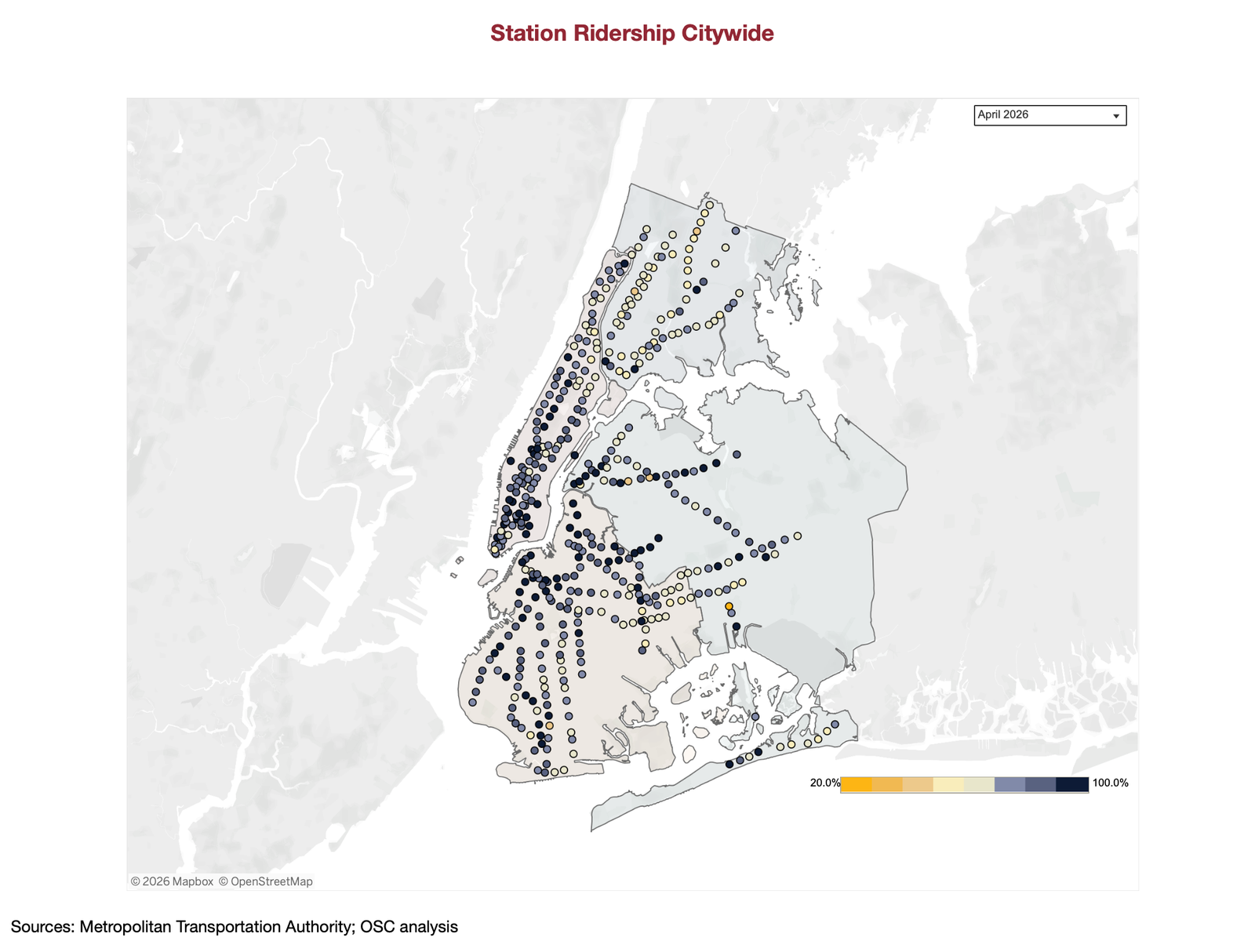
    For example, looking at station ridership recovery across the city, there visually appears to be a geographic correlation with areas in Upper Manhattan, the Bronx, and the outer boroughs in general not recovering to the same extent as Manhattan.

    In the early days of the pandemic, ridership levels were mostly correlated with median household incomes. Ridership remained higher in the outer boroughs, while residents in wealthier neighbourhoods simply worked from home. Since then, that correlation has weakened and the geography has inverted.

    This suggests to me that in addition to WFH, there has also been a structural mobility shift for many households. We know that car registrations in NYC spiked during the pandemic, and presumably that means some new mobility habits were formed.


    Cover photo by Igor Wang on Unsplash

    Chart from Subway Recovery Tracker

  • Toronto Tech Week

    May 26, 2026 · View original


    This week, May 25 to 29, is Toronto Tech Week. If you’d like to check out the event calendar, click here.

    What’s interesting about how the week is structured is that it’s not a traditional conference. It’s more of a decentralized, open platform where anyone can join or host an in-person event, as long as it serves the shared goal of showcasing Toronto as a city of builders. It feels very tech-appropriate, and it means you can tailor the week to your interests.

    I’m laser-focused on my own building right now (otherwise I’d be all over the it), but I am enjoying following it online and seeing the energy that it brings to our city. Toronto is one of the greatest cities in the world, and there’s no shortage of talented entrepreneurs working to build the future right here.

    What we do need to be better at, though, is celebrating the people taking risks and providing them with the capital and resources to make wild and crazy bets. But I’m sure that’s all happening right now at Tech Week. Go Toronto!

  • Customers, costs, and typologies in the next housing cycle

    May 25, 2026 · View original


    Because of how long it takes to build a building, real estate markets almost always overbuild at the top, and underbuild at the bottom (see yesterday’s post about the pig in the python). In a theoretically perfect economic model, supply would adapt instantly to changes in demand. But in the real world of development, this adaptation can take 5 to 10 years.

    At the same time, it’s not just about the quantity of real estate being delivered at any given time; it’s also a question of what kind of real estate. We talk a lot around here about this moment in time being a healthy reset for Toronto’s housing market (and other markets). But what exactly are we resetting? I find it helpful to think of it in terms of three prongs.

    First, there’s customer type. Who will be the buyers and tenants during the next cycle and what will they be looking for? For instance, when it comes to pre-construction condominiums, to what extent will individual investors factor in like they did during the last cycle? Many think they will play a much smaller role.

    Second, there’s the cost structure. The cost of building is changing, and hopefully we will see continued efforts to make housing more cost-effective to deliver. And third, there’s a question of building typology. As the demand profile changes and as costs evolve, it is naturally going to have an impact on the kind of buildings that get built.

    My gut is that we will see more housing geared toward end-users in medium-density builds, but only time will tell.


    Cover photo by Lennon Kong on Unsplash

  • Pig in the python

    May 24, 2026 · View original


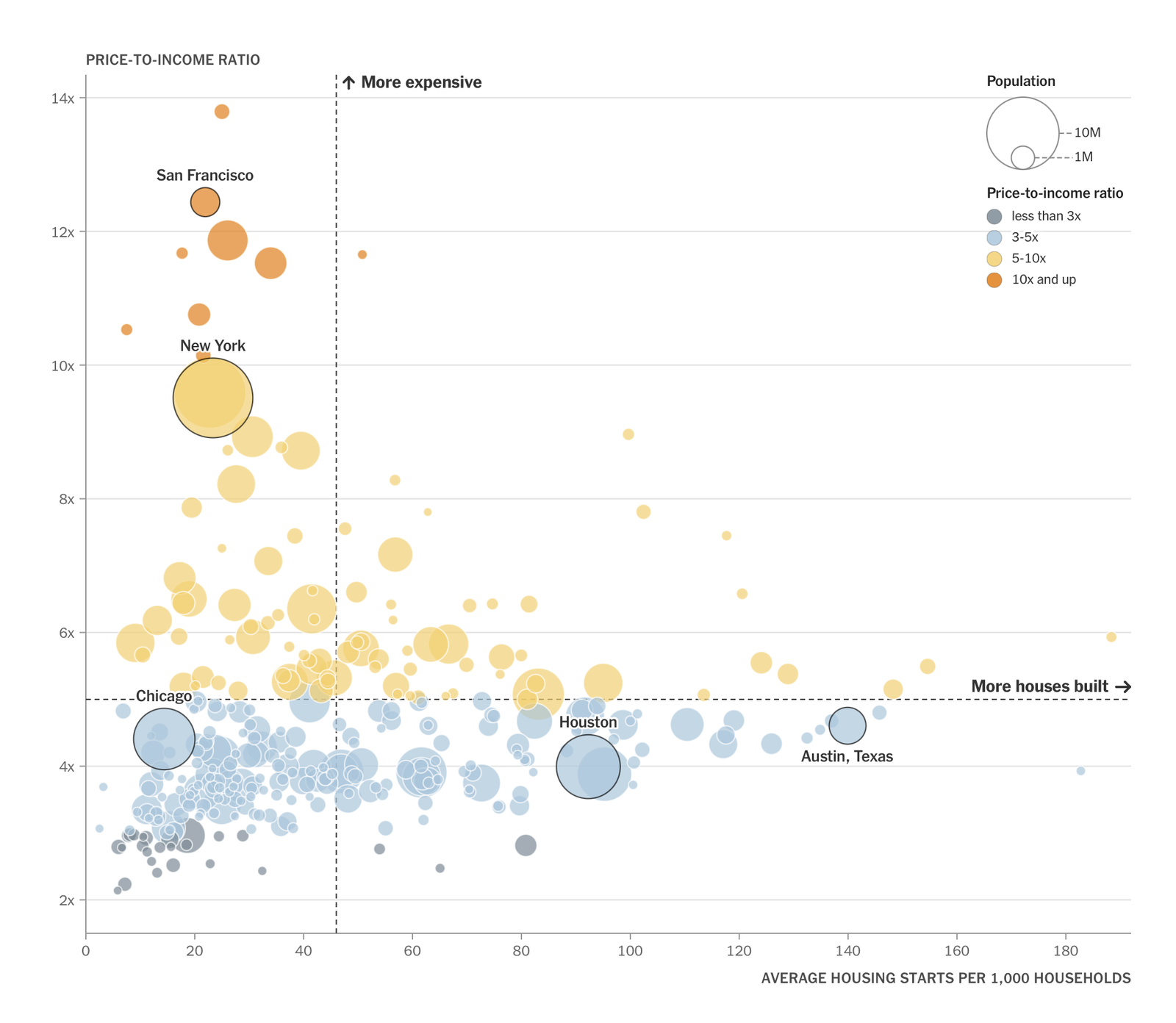
    Here is a chart that we have all seen many times before. This one is from a recent New York Times opinion piece called, “America Needs to Build More Housing” and it shows the relationship between home prices (the price-to-income ratio) and houses built (average housing starts per 1,000 households). In this scatter chart, the four quadrants are as follows:

    – Cities that don’t build a lot of housing and are expensive (San Francisco) – Cities that don’t build a lot of housing but are still relatively affordable (Chicago) – Cities that build a lot of housing and are affordable (Austin) – Cities that build a lot of housing but are still relatively expensive (Hilton Head Island)

    This last quadrant has the fewest number of data points and a number of the locations are resort or second-home destinations, which have their own unique market dynamics. Similarly, the lower-supply cities, like Chicago and Detroit, have managed to maintain some degree of affordability by virtue of the fact that their population and economic demand haven’t grown as quickly as in other cities.

    But generally speaking, the correlation is as one would expect: more homes equals lower prices. It is, however, worth pointing out that not all homes are created equal. The cost and time required to build a low-rise, wood-framed house in the suburbs is not the same as building a high-density, reinforced-concrete tower in the city.

    Still, we know that all forms of supply ultimately improve affordability in a market. With this in mind, how might one describe Toronto today? We’ve been told we’re in the midst of a housing crisis, and yet there are lots of available homes on the market, both to buy and rent. Indeed, it’s a buyer’s and tenant’s market. So what’s going on?

    Well, it’s important to keep in mind that a chart like this represents a long-term historical average and that building new housing generally takes a long time (too long, I might add). Right now, we could describe the Toronto housing market like the proverbial “pig in a python.”

    The market is in the midst of absorbing a huge influx of completed supply and, as our chart suggests, this is having a deflationary effect on home prices in the short term. However, once this pig gets digested, there’s absolutely nothing next in the pipeline to digest, and according to basic economics, we know exactly what that will mean for the market.


    Cover photo by Artem Labunsky on Unsplash

    Chart via the New York Times

  • Evaluating rent controls in a fully built out city

    May 23, 2026 · View original


    Paris has residential rent controls. They were put in place on a test basis starting on July 1, 2019 and, broadly speaking, they limit what rents can be charged on a per-square-metre basis according to the neighbourhood, rental type (unfurnished or furnished), number of bedrooms, and the period of construction.

    Since then, there have been various studies examining their effects. Here’s a recent one by Apur. In this report, the authors conclude that over the six-year period, the controls moderated rents by -5% compared to where they would have been had they been unfettered. Importantly, they also conclude that the rent control policies have had no meaningful impact on the city’s rental supply.

    However, it’s important to point out that “rental supply” means the supply of rental homes in buildings already built. The report does not talk about new construction. And as I understand it, the rent controls are more flexible for new construction. There’s also a complément de loyer (rent supplement) that developers and landlords can charge for new builds that are energy efficient and offer exceptional comfort or amenities.

    Regardless of the specifics, it’s interesting to think about rent controls in a city like Paris. The central part of the region, Paris proper, is already built out and constructs very little new housing each year. By some estimates, the net amount (factoring in existing units being demolished) is only something like 1,500 to 2,000 units annually. And if you consider new market-rate units, it’s an even smaller number.

    From a policy standpoint, this presumably means you’re a lot less concerned about new housing supply — at least in the central neighbourhoods — and more concerned about the overall affordability of the existing supply.


    Cover photo by Salomé Watel on Unsplash

  • Introducing Propeur

    May 22, 2026 · View original


    I sat next to a software developer at my friend’s wedding a few weeks ago, and I figured I would ask him the obvious question: “What percentage of the code that you write today is now being done through AI?” At first he was reticent to answer, but eventually he told me that it’s, like, the majority. That sounded right.

    I then decided to pull out my phone and force upon him something that I’ve been vibe coding. I’m sure he found this boring, but his response was interesting nonetheless. He said, “This is the future of software. It is going to be both highly personalized and built by actual users. And because of this, it’s going to be better software.” In other words, accountants will build what they need, photographers will build what they need, and real estate developers will build what they need.

    What I showed him was Propeur.com, a residential property management platform tailored toward small Ontario landlords that I have been building for my own purposes and as a tool that Globizen can use for its infill rental projects. It’s still early days and there are bugs to work out, but here’s what you can do so far:

    – Add your rental properties and receive a Monday morning email with a summary of what happened over the last week and what’s on the horizon. – Manage tenants and rental units, including move-in and move-out dates, and all of the critical dates surrounding rental increases. – Automatically track current debt balances and maturity dates. – Store all relevant property documents, and have them automatically labeled and categorized in the appropriate folders. – Create a public property profile for both on-market and off-market units (here’s an example). – Sync bank accounts and categorize expenses by property and unit. – Export transactions to a CSV, filtered by property, date, and revenue/expense category. – Log maintenance requests and automatically email them out to a contractor or maintenance person (the next step will likely be some kind of tenant portal). – Export tax reports at the end of the year.

    Again, it’s still very much a preliminary beta release and there are certainly bugs. But already, I find myself using it almost daily. If you’re a small landlord in Ontario and would like to give it a spin, you can sign up here. I’d love to get your feedback on the platform. And if it’s something you find useful, please feel free to drop me a line and I’ll buy you a coffee.


    Cover photo by Alexander Andrews on Unsplash

  • The end of zero marginal cost

    May 21, 2026 · View original


    The conventional beauty of the internet and software was that it had effectively zero marginal cost. That is to say, it might cost you a lot of money to create something initially, but once created, you could scale it very quickly, more or less for free. This has been a great way to make money, and it’s the opposite of something like real estate development where everything takes forever and costs too much money.

    But the landscape has shifted rapidly. Dror Poleg wrote this week that intelligence, rather than software, is now eating the world. The fundamental difference is that while software had zero marginal cost, AI does not. When we ask AI something, it has to reason it out in real time, and in order to do that, it needs to consume lots of energy and compute.

    That changes things:

    > As a result of the above, we are seeing something we’ve never seen before: Software demand is beginning to bump into physical constraints. The world is struggling to allocate sufficient land to build data centers and to produce and redirect the energy required to meet AI demand. Tech giants like Google, Amazon, Meta, and Microsoft are spending an unprecedented amount of money to build these new data centers, but they are approaching their financial limits. Google has recently partnered with Blackstone, one of the world’s largest landlords, to expand and expedite the construction of new data centers.

    > All this sounds like great news for real estate developers. Finally, order has been restored in the universe: If you want to grow your business, you need to pay more rent; the natural scarcity of land is asserting itself. Instead of software eating the world, it is now the world that is eating the free cash flow generated by software companies.

    However, these specific dynamics may only remain true in the short to medium term. As dystopian as it may seem, there is indeed an organized and real effort to bring data centres into space. Some of the advantages of this include abundant, continuous energy and zero land-use constraints to fetter growth. Now, I don’t know enough to comment on the feasibility or timing, but it certainly sounds like great fodder for a Black Mirror episode.


    Cover photo by SpaceX on Unsplash

  • An original piece of the Eiffel Tower from 1889 is up for sale

    May 20, 2026 · View original


    In 1983, the Eiffel Tower underwent a significant structural renovation that included the removal of an original helical staircase used to bring visitors up the tower. New elevators were installed in its place, and the specific section connecting the second and third floors was dismantled and cut into 24 sections.

    Four of these sections were saved for French public heritage, and the remaining 20 sections were auctioned off to the public. Since then, these stair sections have traded for staggering numbers, with the record being Section No. 13 selling for €523,800 in 2016.

    But now, for the first time since the original 1983 auction, Stair Section No. 1 is about to hit the market through Artcurial. The pre-sale estimate is €120,000-€150,000, but as is customary with auction houses (and auction dynamics in general), I’m sure this is a deliberately low number.

    If any of you are in the market for an original Eiffel Tower staircase from 1889, you can register for the auction here, which is scheduled to take place on May 21 at 2pm Paris time. I’ll be checking in from afar with curiosity. Because somebody is really going to want this.


    Photos from Artcurial

  • Are short-haul flights on the way out?

    May 19, 2026 · View original


    Jet fuel costs have nearly doubled since the US and Israel attacked Iran in February. This is obviously straining the overall economics of air travel, but the most impacted segment is the one that has always been tenuous: short-haul flights.

    As I understand it, airlines generally prefer flights that are at least 2 hours long. Takeoff and landing consume the most fuel, and add a lot of wear and tear on a plane’s equipment, so you want a long enough flight to amortize these costs. This is why for the 10 years spanning 2016 to 2026, US flights spanning less than 250 miles declined by 11% — the largest drop of any route length.

    Now, in some cases, these short-haul flights are simply necessary loss leaders. For example, the flight from Milwaukee to Chicago is comically short. It’s only about 70 miles, translating into an actual cruising time of around 20 minutes. But it’s an important route for connecting passengers and the overall hub-and-spoke airline model.

    This also makes it slightly harder for rail to effectively compete, because you need to solve for two clear passenger demands (again, assuming they’re connecting): (1) people leaving Milwaukee will want to check their bags at the point of departure and (2) they don’t want to arrive downtown, they want to arrive at the airport for their connecting flight.

    That said, both of these wants are solvable. Hong Kong, for instance, allows in-town check-in where passengers drop their bags downtown before boarding the airport train. This is particularly convenient if you have to check out of your hotel and need to rid yourself of your luggage until you arrive at your final destination.

    Very cool, so what’s my point?

    I mention all this because if short-haul flights are the flight segment that airlines don’t love to operate, then it only strengthens the opportunity for high-speed rail to fill this gap in the market and become a seamless component of overall global mobility.

    Here in Canada, the obvious opportunity is the Toronto-Montreal corridor. This is arguably the single best opportunity in North America when you consider its geography, construction viability (lots of undeveloped land to lay new track), and ability to replace short-haul flights. The broader Windsor-Quebec City corridor is also, as we know, the densest part of Canada with roughly 50% of our entire population.

    But the overall opportunity is twofold: it will service origin-destination travel and it will connect Toronto and Montreal as global airport hubs. In fact, this is one of the stated reasons for why Air Canada joined the high-speed Alto project as a core consortium partner:

    > Connections with other modes of transport, such as rail or bus, are part of the solutions the company is already developing to offer the most relevant mobility option, responding in a sustainable way to the specific needs of each of its customers. In the longer term, the contribution of its expertise to the Cadence team will enable the airline to contribute to the harmonious integration of a future intercity rail network with existing airport hubs in the Quebec-Windsor corridor, for the benefit of all travellers.

    Here’s a specific example. Montreal largely serves as Canada’s direct gateway to France’s secondary cities, Francophone Africa, and the Mediterranean. So if you live in Toronto and want to fly to Marseille or Algiers or Mallorca, you are going to connect in Montreal (or connect across the Atlantic somewhere in Europe).

    The multi-modal train option would include an in-town baggage check at Union Station in Toronto, a 3-hour train ride to Montreal, a seamless rail connection from Gare Centrale to YUL (with the REM airport train set to open in 2027), and then your flight to Europe or Africa.

    The overall travel time should be comparable, except in the high-speed rail option you’d have more uninterrupted time to work, watch a movie, or sleep. And now that Air Canada gets to rid itself of its less profitable (or unprofitable?) short-haul flights, it should have the margin to aggressively market these tickets.

    If this customer experience is designed properly — with one booking, competitive fares, clean transfers, and convenient baggage handling — it will quickly dominate the market. We know this because it’s already working in Europe.


    Cover photo by 7 on Unsplash

  • Are home prices and social media the reasons we’re having even fewer babies?

    May 18, 2026 · View original


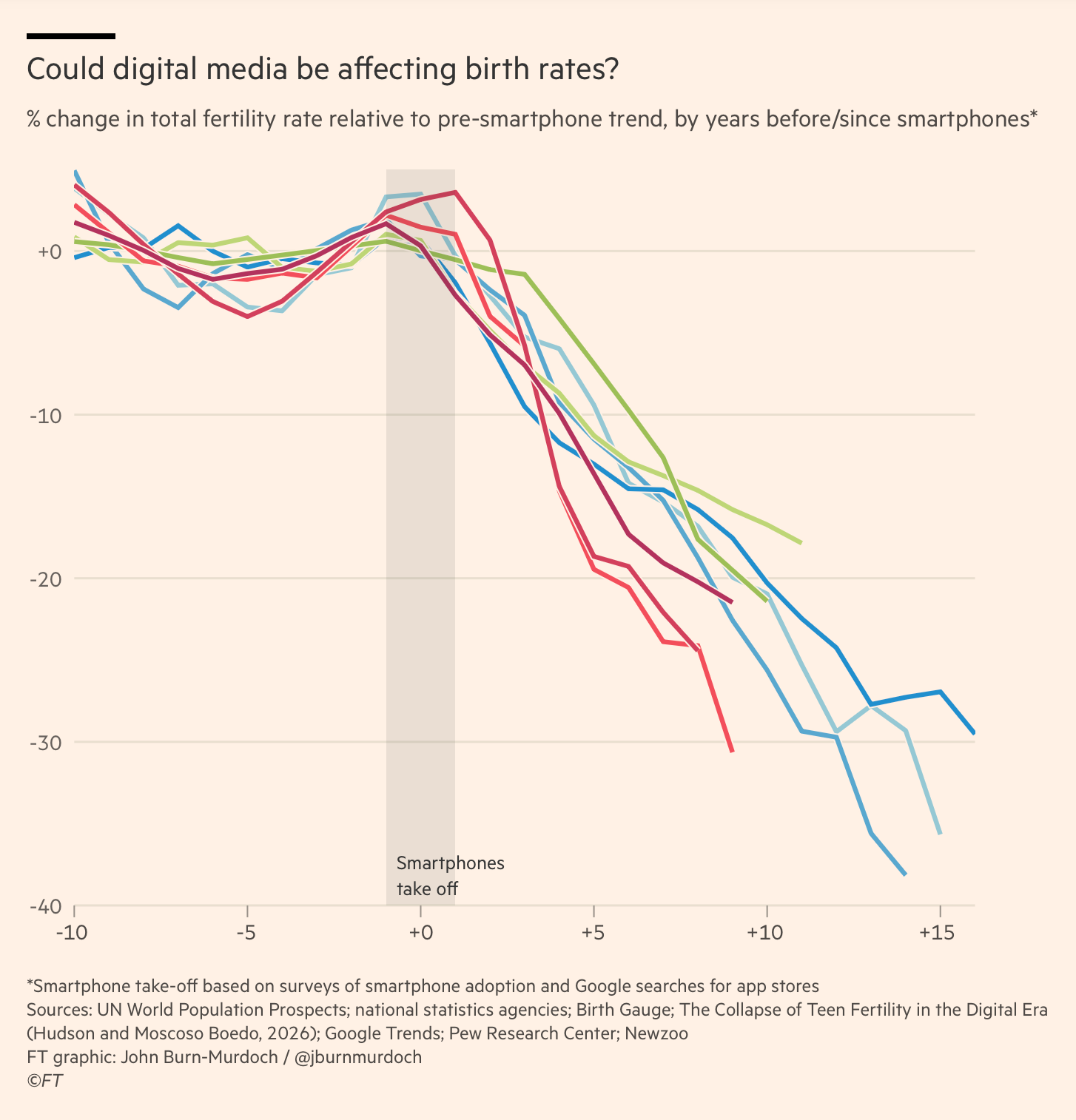
    Now that we are expecting our first child, it appears to me like everyone around us is also having babies. This is almost certainly some kind of frequency bias at work, because I know that the fertility rate in Canada is officially ultra-low (the technical term) and falling globally. According to a recent Financial Times article by John Burn-Murdoch, two-thirds of the world’s countries are now averaging a fertility rate below the replacement rate of 2.1. And in 66 countries, including Canada, the number is now closer to one than to two.

    The obvious explanation for these falling rates is economic. Children are expensive and require a lot of work, which can make things difficult if you don’t have a sufficient amount of money and/or time. This is why there’s a strong inverse correlation between birth rates in the developed world and the developing world. Generally speaking, as a country develops, its birth rate drops.

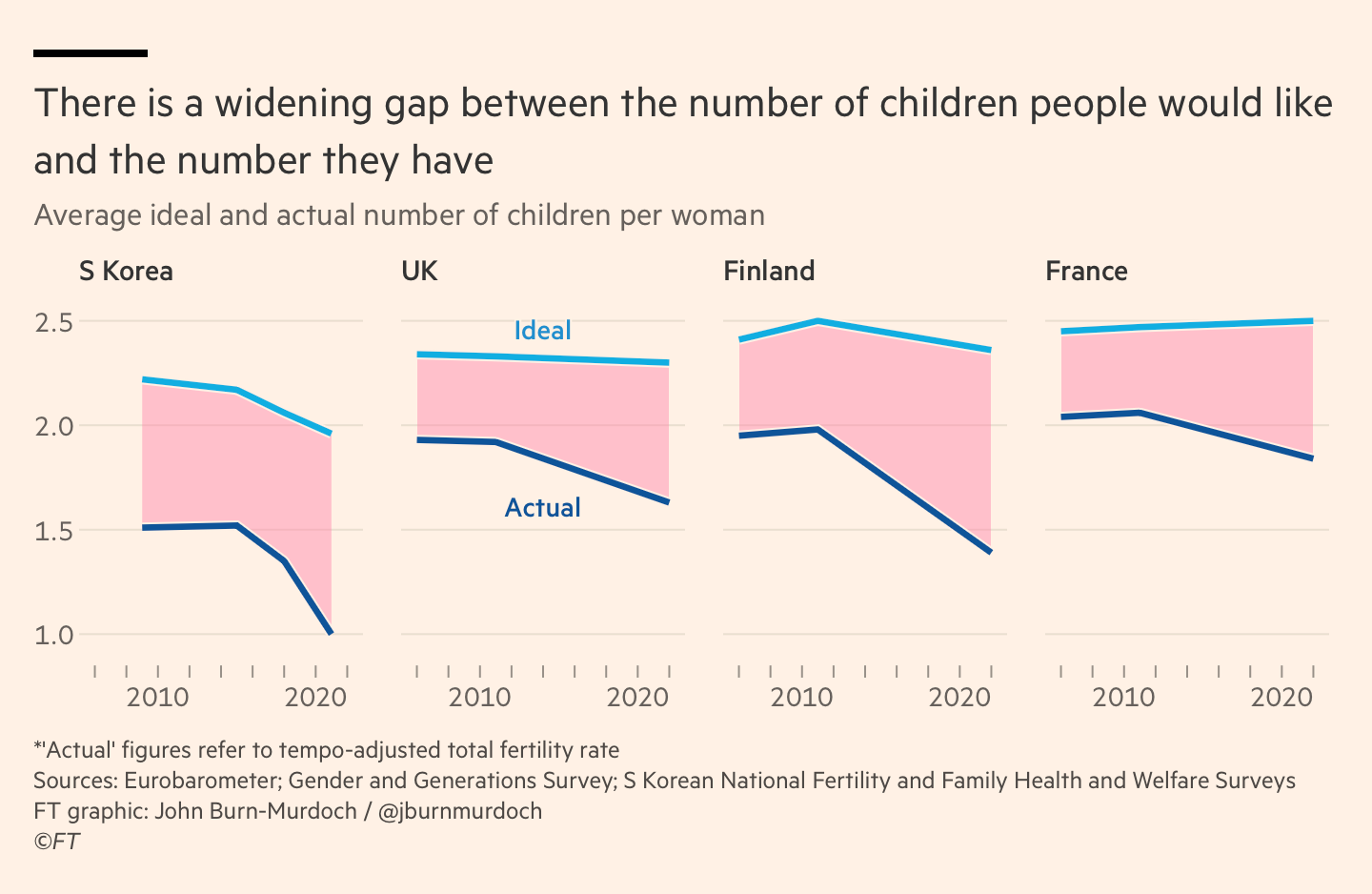
    One very specific reason for this appears to be the cost of housing. Indeed, studies have found causal links between rising housing costs and declining fertility rates. And this could be one of the reasons why there’s often a spread between what women report as being their ideal number of children and the actual number they have. Perhaps they wanted more, but they didn’t have that extra bedroom in the home.

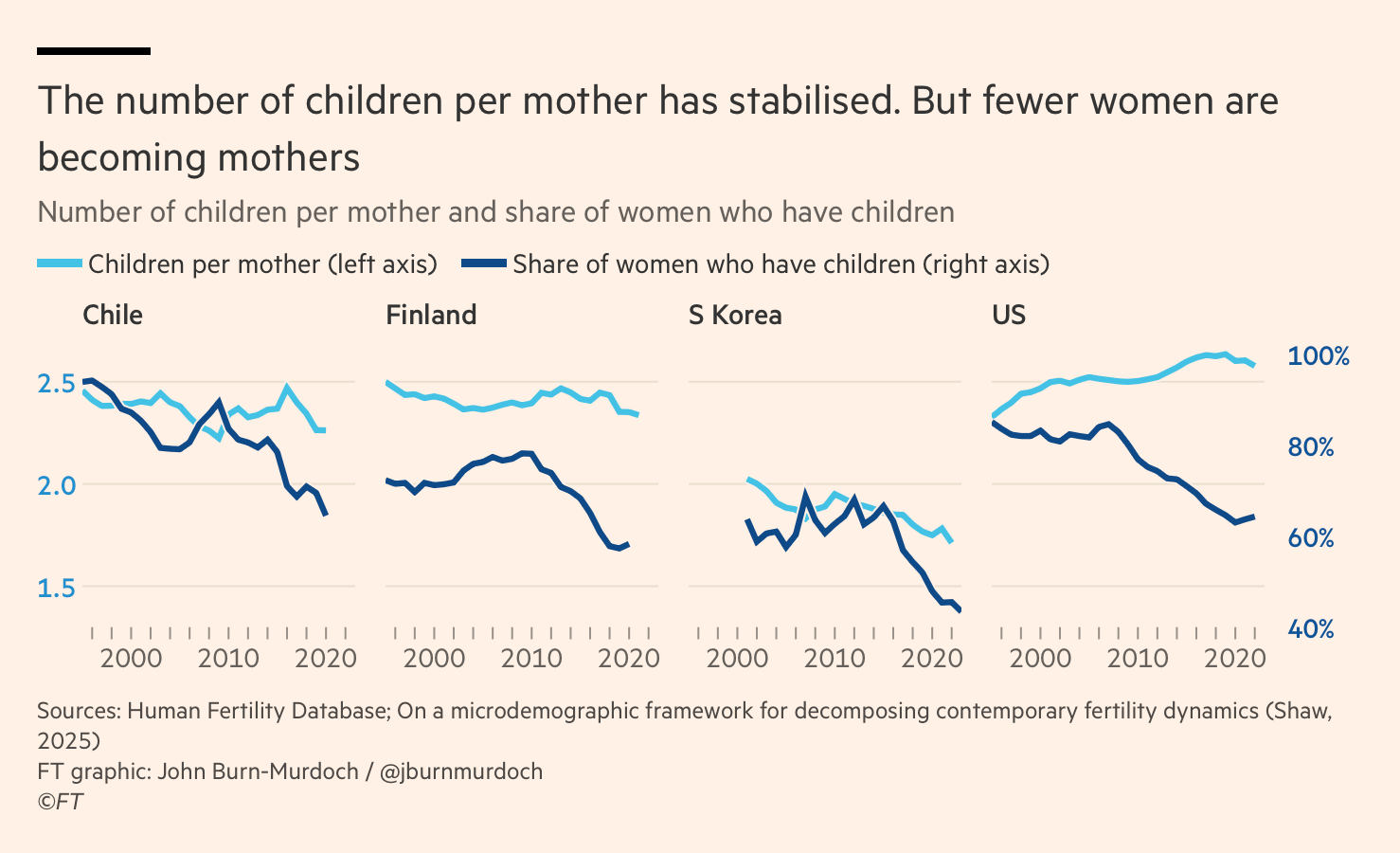
    On top of all this, there’s a growing realization that there’s another powerful force at work here: social media. Young people are increasingly spending their free time on their phones, forgoing in-person social gatherings and therefore missing out on opportunities to find people who would like to have sex with them. A compelling dataset for this hypothesis is the fact that while the number of children per mother seems to have stabilized in many countries, the overarching problem is that fewer women are becoming mothers in the first place.

    Another dimension to social media is that it distorts our perception of the world. In the same FT article, demographer Lyman Stone is quoted as saying: “If you spend lots of time socialising with your peers in the real world, your standards [for a potential partner] are anchored in the real world. If you spend your time on Instagram, your standards are anchored to an artificial sense of what is normal.”

    The world is increasingly viewing social media as this generation’s smoking. However, it’s unreasonable to think that smartphones and social media will ever go away. If you’re trying to market anything today, that’s where the eyeballs are. But I do think all of this only strengthens the case for us to build more walkable, urban, and inclusive neighbourhoods; cities where it’s possible to walk to a corner store and bump into a neighbour along the way. Not only is human interaction nice, but it has been shown to increase social trust within communities.

    In my view, car-oriented communities and self-driving cars that people will sit in for hours only exacerbate the problems of loneliness and social isolation. Cities are ultimately markets. They are labour markets and, yes, they are dating markets. The best cities reduce the friction around people doing business, trading goods and services, having fun, and meeting people. And it sounds like we could use more of that, not less, right now.


    Cover photo by camilo jimenez on Unsplash

    Charts by John Burn-Murdoch via the Financial Times