Daily insights for city builders, delivered every morning at 6 AM ET. I’m Brandon Donnelly — a Toronto-based real estate developer and founder of Globizen. I’ve been writing here since 2013.

Category: Places

  • Why 2029 will be the bottom for Toronto housing supply

    November 23, 2025 · View original


    > Tweet: Contrary to some reports, we’re not actually building much rental housing in Toronto these days. https://t.co/t20UiwpQzV

    Rental apartment completions in the Greater Toronto & Hamilton Area (GTHA) are expected to exceed condo completions for the first time in a very long time starting in 2028. But what does this mean for the overall market, and is it actually going to be enough new housing? Let’s look at some of the numbers.

    Last year, the GTHA recorded 29,671 new condo completions. This was some sort of a record. This year, condo completions are projected to total around 31,396 homes. Even higher. But then completions start to fall off, with 17,487 homes scheduled for completion in 2026. By 2029, this number is expected to be close to 1,000. So let’s call it zero for argument’s sake.

    If we are to crudely assume that 50% of these new condominiums ultimately make it to the secondary condo rental market, then we are expecting nearly 16,000 condo rentals this year, just under 9,000 condo rentals in 2026, and ultimately no new condo rentals by around 2029 (or some number close to it).

    Now let’s consider the purpose-built rental side of the equation.

    The 10-year average for purpose-built rental apartment starts in the GTHA is only 2,819 homes. This is a far cry from the volume of rental housing that we delivered in the 60s and 70s. Of course, with the new condominium market largely shut off, there’s renewed interest in building purpose-built rentals.

    In 2024, purpose-built rental apartment completions totalled 5,537 homes. And in the first half of this year, 3,156 homes reached the occupancy stage. Extrapolating out, I’m guessing that puts us somewhere around 6,000 new purpose-built rental apartment homes by the end of 2025.

    If we pause and think about only 2025, we’re on track to deliver roughly 37,000 new condo/rental apartments and ~22,000 new rental homes (again assuming 50% of the new condominiums become secondary rentals). I view this as our peak supply year for this cycle.

    There’s a lot of talk about a “record” number of purpose-built rental apartments now under construction, and while it is true that the numbers are elevated compared to the latest 10-year average, it is not a long-term record compared to the 60s and 70s and, more importantly, it is not enough to offset our dwindling new condominium supply.

    Even if purpose-built rental completions spiked to 8,000 or even 10,000 new homes next year, we are still going to see a drop in new rentals and new housing overall in the GTHA. 2026 is the turning point year where new supply turns south. And it’s going to keep going south until probably 2029, which is when I believe we will see supply bottom out.

    Nothing in this post should be construed as investment or development advice, but here’s the way I’m thinking about it:

    – 2025: ~37,000 new condominium/apartment homes (peak supply year resulting from the pandemic boom) – 2026: ~25,000 new homes (supply begins its decline) – 2027: ~18,000 new homes – 2028: ~10,000 to 13,000 new homes – 2029: ~8,000 to 10,000 new homes (supply bottom)

    I have no idea what will happen with interest rates, immigration, investor sentiment, and the countless other factors that impact a housing market, but even if things started to turn around next year, it would be mostly impossible to avoid the housing supply bottom that I believe we have coming in 2029. Buildings take a long time to build.

    Conclusion: I think that 2026 will prove to be an excellent year to buy assets (land, unsold inventory, IPP, and so on), and that 2028 onward will be an excellent time to be delivering new homes. By then, we should be dramatically undersupplying the market. It doesn’t feel that way today, but eventually the bill from our frozen development market will come due.

    Cover photo by Adam Vradenburg on Unsplash
  • We need pipelines to build a post-oil Canada

    November 18, 2025 · View original


    I’m not sure that oil is Canada’s only economic hard power, but it has to be our largest:

    > “To effectively use oil, Canada’s only economic hard power, Carney needs to get not just one, but two pipelines built,” said Adam Waterous, chief executive of Calgary’s Waterous Energy Fund, a major oil sands investor.

    It’s hard to imagine a more strategically important investment for Canada. Right now, virtually all of Canada’s oil exports go to the US. That gives us zero leverage. We are price takers! To correct this, we need to diversify our customer base. And the only way we do that is by building pipelines to our coastlines and then selling to the rest of the world.

    But beyond shoring up our economy, I’d argue that this is also the way we accelerate decarbonization. Here’s the plan: We get rich, and then reinvest the profits into renewable energy, the world’s largest sovereign wealth fund, and critical nation-building infrastructure like housing, transport, and education.

    Oil and gas profits won’t last forever. This is about building for that future.

    Cover photo by Chris Liverani on Unsplash

  • Salt Lake is at that point in the development cycle

    November 17, 2025 · View original


    Real estate may be local, but a lot of markets appear to be correlated. I felt that way this past summer when I was meeting with developers in Paris and I continue to feel this way when I read articles about other markets. Here’s a recent one from Building Salt Lake talking about the state of Utah’s multi-family market.

    Based on the article, cap rates appear to be in the mid-4s for newish product, which is too low right now:

    > Investors aren’t jumping at the 4.6 cap deals they can typically find in Utah today, she added, when they could get over 5.5 in other major markets. > > “Salt Lake, a 4.6 cap, I personally think it’s a little mispriced relative to where else we can put our money,” Schultz said.

    This means that there aren’t the asset trades to support new development. To justify ground-up development, developers need to see a positive spread between their development yield and the exit cap — one that compensates them for the additional risk of construction. If that spread isn’t there, or if it’s unclear what it might actually be, development shuts off.

    Rents and values coming down also doesn’t help:

    > Back in 2022, which was the peak of the market, you could underwrite double-digit rent growth on a typical 250-apartment deal Downtown. Now, he said, “we’re seeing that effective rents down about 8.25%.”

    > Overall multifamily values are down 26%, King said, though he added that’s not indicative of every single project or every deal. He also said that decline came after four years of record supply and double-digit rent growth.

    What should be clear from these excerpts is that Salt Lake City is not at the point in the cycle where developers are jumping to deliver new ground-up multi-family product. They’re at the point in the cycle where firms are looking and hoping to buy distressed assets below replacement cost.

    Cover photo by Saul Flores on Unsplash

  • Toronto re-embraces small-scale retail

    November 15, 2025 · View original


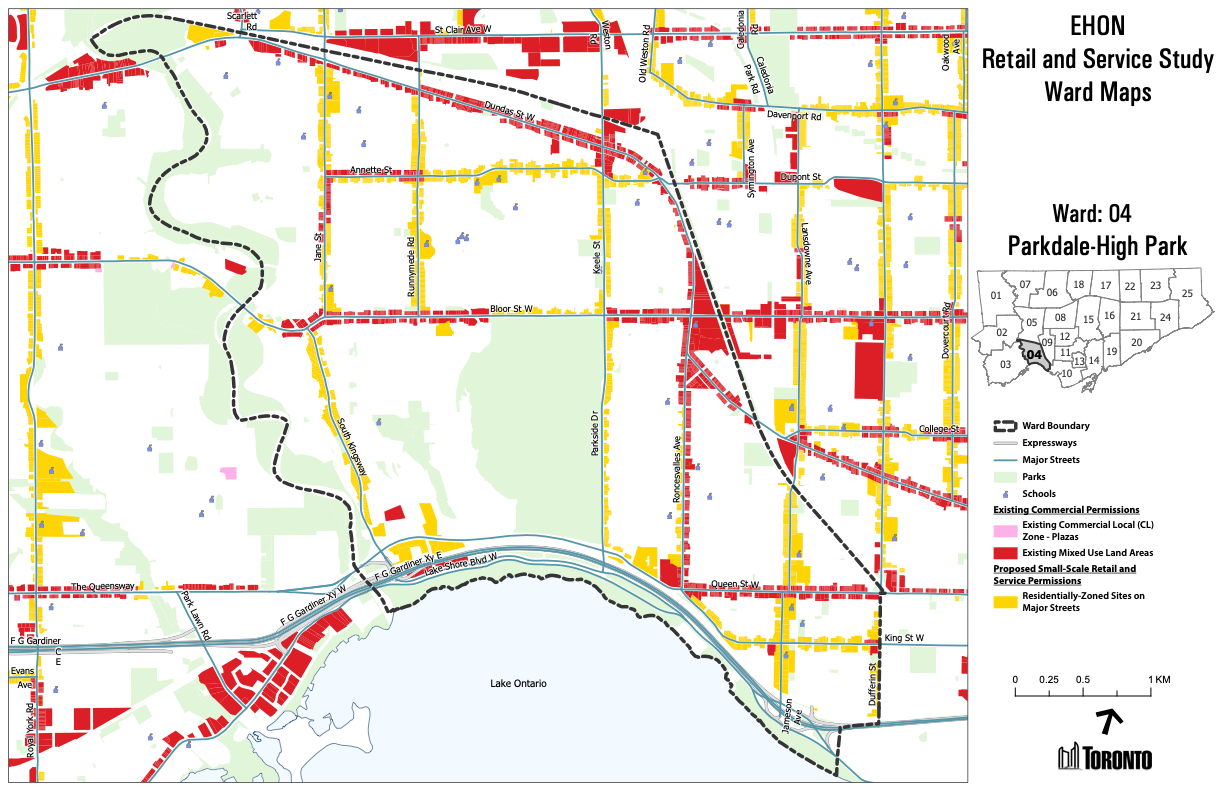
    Good news: If you would like to open a small-scale retail business in Toronto — and you have a property that is residentially zoned on a major street (in one of the approved areas), or you have a corner property on a designated “community street,” or you have a property that abuts a non-residential use such as a park or public school — you may now be allowed to do it, with some restrictions. (Consult your local planner for exact details.)

    This, as we talked about recently, is meaningful progress for Toronto. But as is always the case, it was not easy. Toward the end, local community groups even started using AI slop in an attempt to terrify the public into thinking that this would be a harbinger of littering hoodlums loitering in all of our neighborhoods.

    Thankfully, this city has people like Dan Seljak, Blair Scorgie, and many others — including, of course, the EHON team at the City — who have been instrumental in getting something passed, even if it had to change a little along the way. City building ain’t easy. They should all be proud of what they’ve accomplished. I look forward to seeing what kind of local entrepreneurship this unlocks. Go Toronto.

    Cover photo by Joe Yu on Unsplash

  • Toronto isn’t as car-oriented as you might think

    November 13, 2025 · View original


    One of the things that I’ll often hear people say about Toronto is that we’re a car-oriented city with inadequate transit, and that’s why we simply can’t implement things like congestion pricing. Usually it’s accompanied by statements like this: “Sure, I can see how it might work in London or New York, but they have proper transit systems, and we don’t.”

    But is this really fair to say?

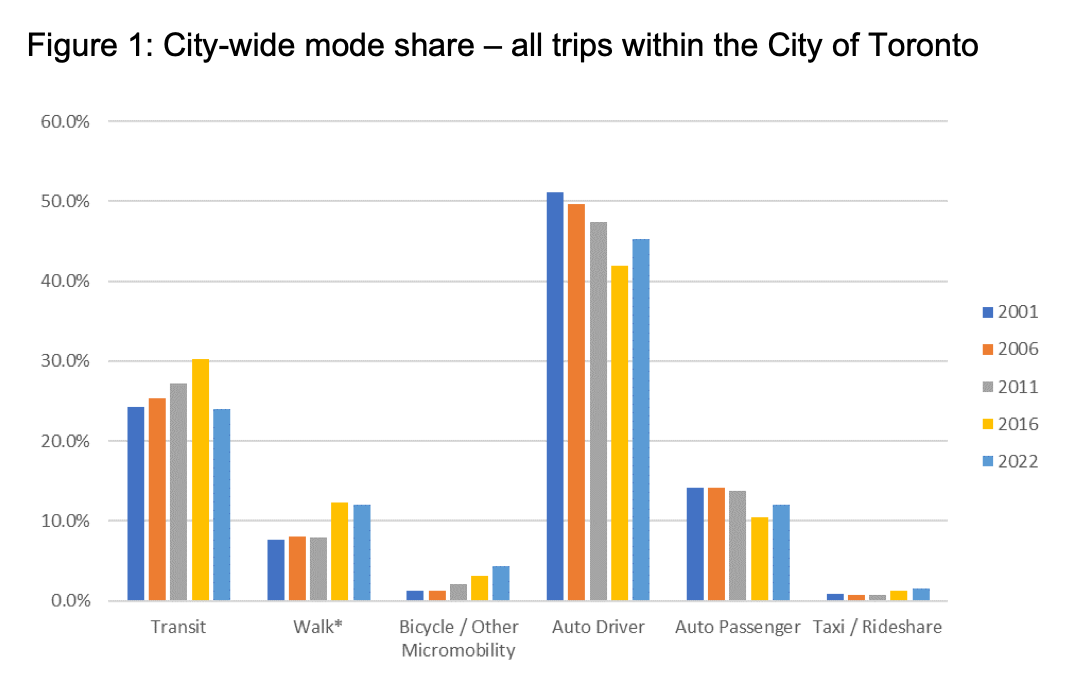
    Let’s look at some of the data from the 2022 Transportation Tomorrow Survey.

    For all trips starting and ending in the City of Toronto, people driving themselves around is the dominant mode share at 45.3%. But the transit mode share is not nothing at nearly a quarter of all trips. And if you add up taking transit, walking, cycling (and other forms of micromobility), and taxiing, you get to 42% of all trips within the city. That’s a meaningful number.

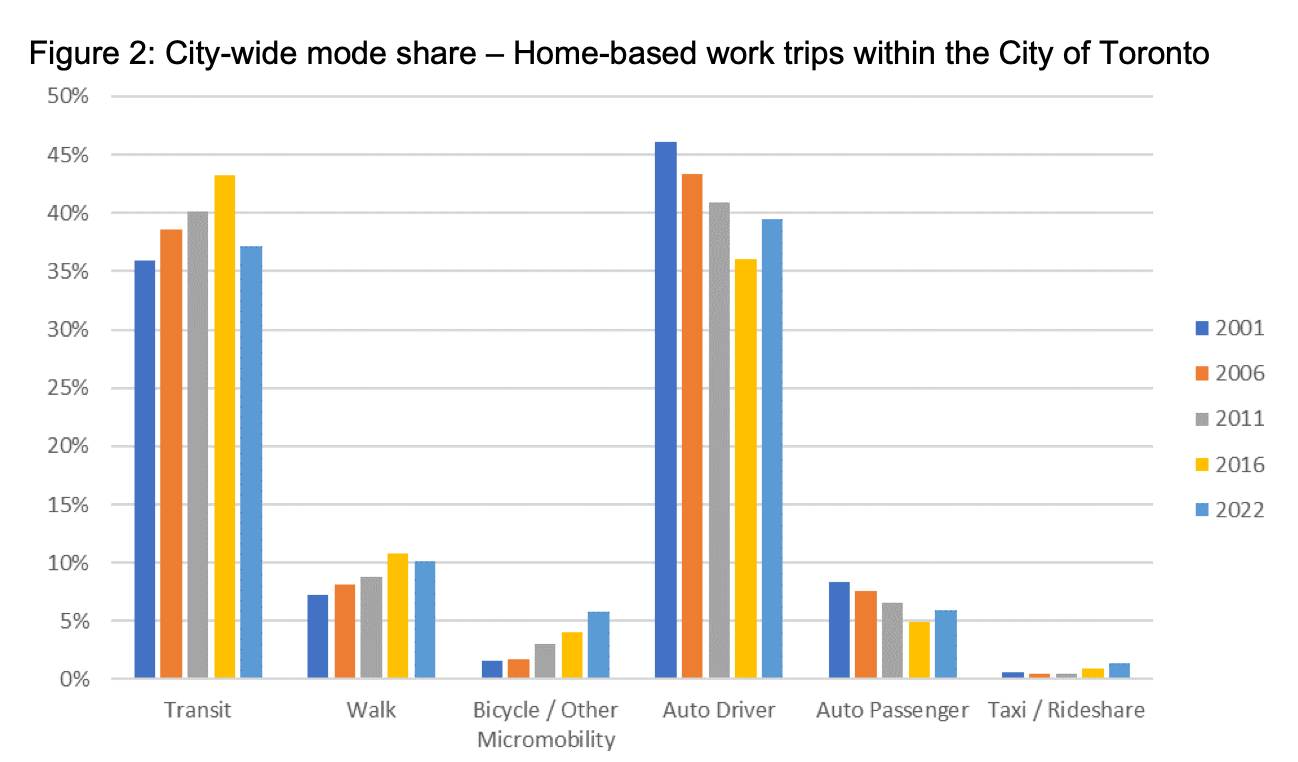
    For home-based work trips within the City of Toronto, the split between driving and taking transit becomes dangerously close. (A home-based work trip is a trip within the city that either starts or ends at home and is done for the purpose of work.) Driving sits at 39.4% and transit sits at 37.1%. Add in walking (10.2%), cycling/micromobility (5.8%), and taxiing/ridesharing (1.4%), and non-car forms of mobility dominate when it comes to getting to and from work.

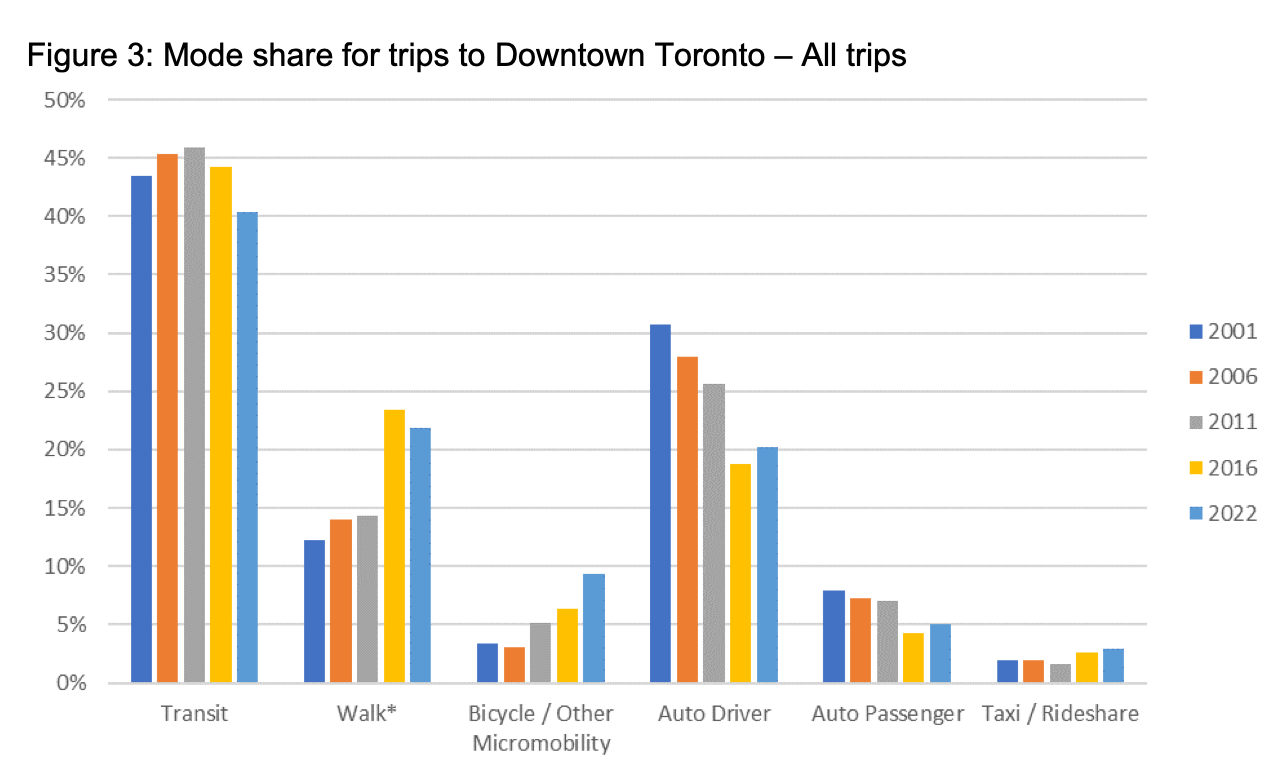
    Looking at all trips to only downtown Toronto, transit once again dominates at 40.4%. Add in the other non-car forms of mobility and we’re up to nearly 75% of all trips.

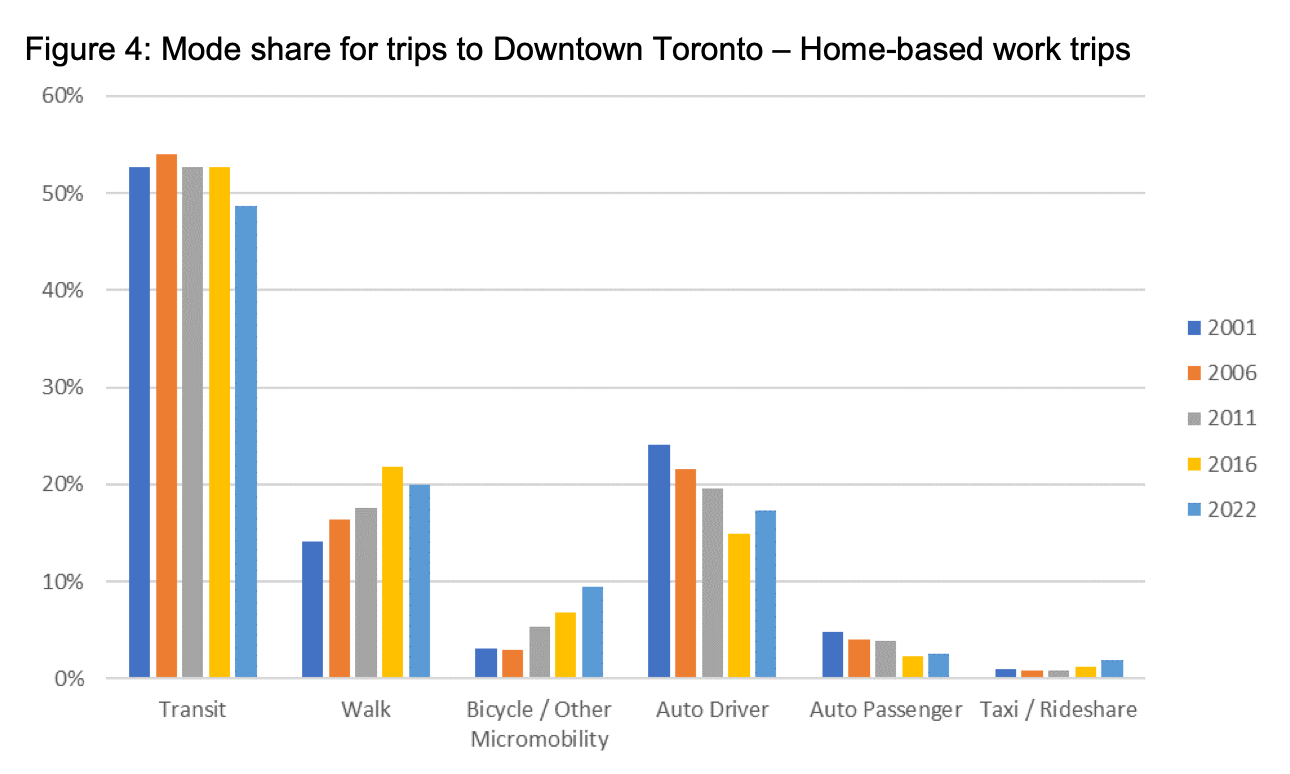
    The numbers become even more pronounced if we look at only home-based work trips to downtown. In this case, transit ridership increases to 48.7%. Add in the other non-car forms of mobility and we’re now at 80%!

    These are fascinating figures because, let’s say you were considering a congestion charge for motorists driving into downtown Toronto, and that the proceeds of this charge would be used to make impactful investments in transit and other mobility infrastructure. Based on this data, you’d actually be benefiting the greatest number of Torontonians.

    These numbers also help to debunk the objection that people simply have no other option. If you’re coming into downtown Toronto, you have options. The transit exists, and the majority of Torontonians use it.

    I guess Toronto isn’t so car-oriented after all. (The rest of the region is a different story.)

    Charts via the City of Toronto (TTS 2022); cover photo by Aditya Chinchure on Unsplash

  • The architectural icons born from Toronto’s last real estate cycle

    November 9, 2025 · View original


    CoStar recently published an article titled “Architectural stars appear on the skyline of Canada’s largest city — Toronto reaches a new level of global reach and ambition.”

    What the article is talking about is a slew of iconic, under-construction projects designed by some of the world’s most celebrated living architects. Namely, Forma by Frank Gehry (Los Angeles), One Delisle by Jeanne Gang (Chicago), KING Toronto by Bjarke Ingels (Copenhagen), as well as a handful of other noteworthy projects by some of the best local firms in Toronto.

    It is no doubt an exciting moment. These are projects that, I think, the world will come to associate with our great city. They will strengthen the global brand of Toronto.

    But let me also state the obvious: These projects are the result of a particular moment in time and a particular point in the last real estate cycle. They wouldn’t exist today, irrespective of our level of ambition.

    This is not to say that this calibre of project won’t exist again in the future — it will. But for right now, these are special and differentiated architectural treasures that truly stand alone, showing us what is possible when we bet on the unknowable future.

  • The market for three-bedroom apartments isn’t what you think

    November 2, 2025 · View original


    Erica Alini of The Globe and Mail just published this article called, “The era of the shoebox condo is over.” You should read it, and not just because I’m quoted in it. One thing that I appreciate about the article is that it gets into some of the development economics underlying new projects.

    The high-level math provided by Bryn Davidson of Lanefab (Vancouver) once again shows that land is the residual claimant in a pro forma and that the price developers can feasibly pay needs to be greater than the status-quo value. It’s exactly what I was getting at in this recent post about the Impossible Toronto publication.

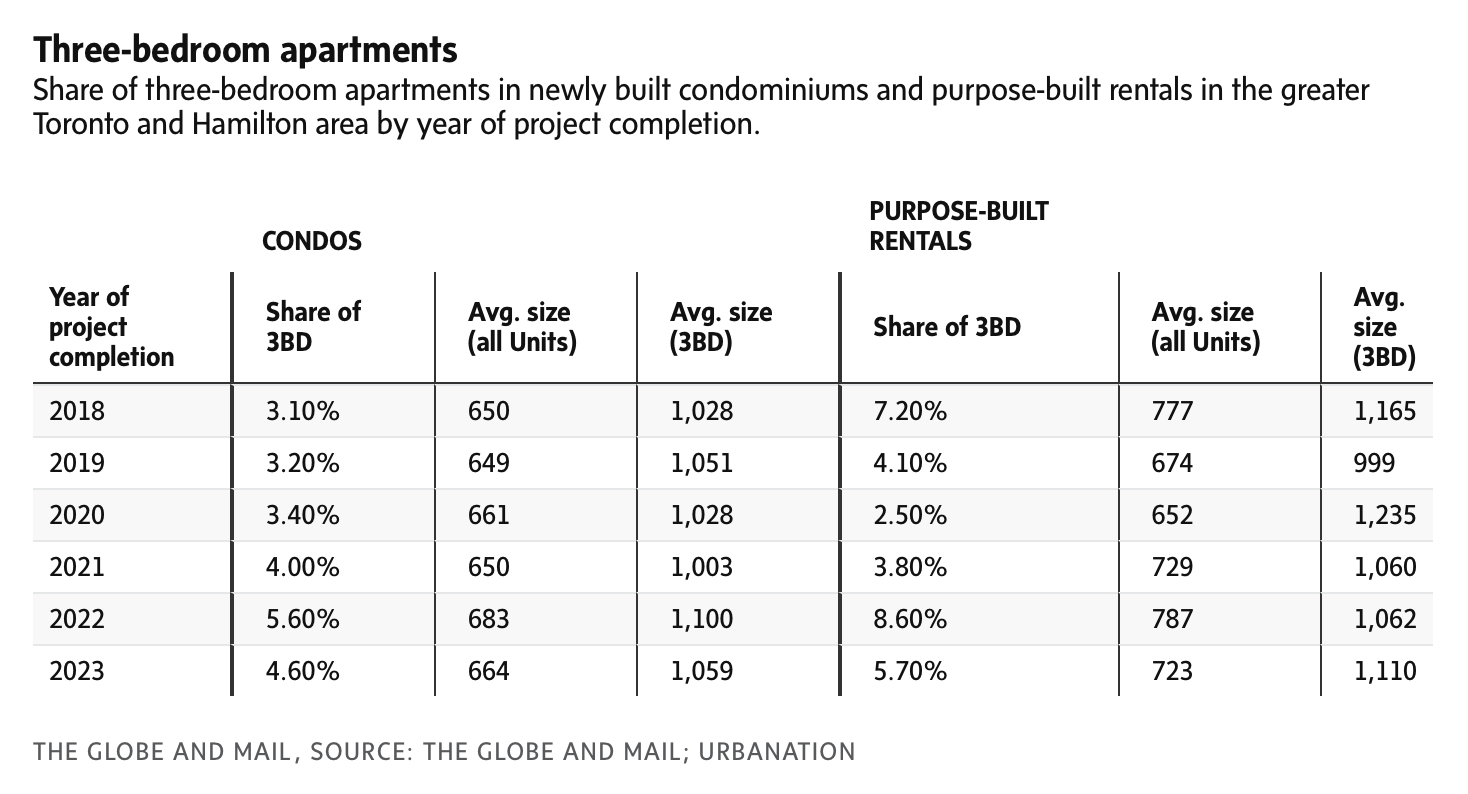
    The other thing I’d like to highlight is the following chart showing the share of three-bedroom apartments in newly built condominiums and purpose-built rentals in the city:

    What’s interesting about this six-year period of completions is that there isn’t a meaningful difference between condominiums and rentals. Average unit sizes as a whole tend to be slightly larger in rental projects, but in terms of the share of three-bedroom suites and the average size of those three-bedrooms, the differences aren’t meaningful.

    This suggests that it’s less about investors “distorting” the market (see pundits talking about the condo market), and more about the fact that the demand isn’t there. And the reason the demand isn’t there is because these types of homes are expensive. If you can afford $5,000 per month in rent, you generally have some options.

    Table from the Globe and Mail; cover photo by Lotus Design N Print on Unsplash

  • A three-meter-wide home in Tokyo

    November 1, 2025 · View original


    > Tweet: Zero-setback house in Tokyo, designed by Haryu Wood Studio & Selma Masic. Three levels, family of four, and just 63 square meters in total area. https://t.co/8mNdI7PrUm

    I am endlessly fascinated by some of the small homes that get built in Tokyo. This one, also pictured above, is called the Borderless House.

    Designed by Selma Masic — in collaboration with Sei Haganuma (Haryu Wood Studio) — the house sits on a 3-meter-wide lot, has a total area of 63 square meters across three floors (~678 square feet), and allegedly houses a family of four. Bridgestone also appears to be its immediate neighbor.

    To put these dimensions into perspective, 3 meters is roughly the width of a “typical” new apartment living room here in Toronto. Usually, if you have a floor plate that can accommodate an outboard bedroom up at the glass, you design for a structural grid somewhere between 6–6.5 meters.

    This gives you around 10 feet for the living room and around 10 feet for the bedroom. (As a a Canadian, it’s important to always bounce back and forth between metric and imperial.) In this case, the entire lot is only 3 meters wide, though a corner lot always enhances a floor plan.

    All of this is fascinating because, compared to North America, it represents a completely different way of conceptualizing space. Of course, the point of posts like this one is not to suggest that this is what all homes should be like. The point is that there are benefits to allowing those who would like such a home to be able to build it.

    Cover photo by Selma Masic

  • Does quality of life have to decline as a city grows?

    October 29, 2025 · View original


    When it comes to cities, quality of life is a subjective measure. Some people may prefer a small city where homes are more affordable and commute times are negligible, while others may find the unique amenities of a big city more appealing — enough to outweigh the negatives.

    Whatever the exact case, there are some obvious negatives that come with urban scale. The usual suspects are high housing costs, traffic congestion, noise and pollution, crime and safety concerns, and the list goes on. But is it universally true that quality of life has to decline as a city grows?

    I don’t think so at all. I wasn’t able to find a good primary source on this topic, but the obvious example and outlier that comes to mind is Tokyo. It is both the largest metropolitan area in the world and a city that consistently ranks near the top of most quality of life indices.

    So how do they do it?

    There are lots of ingredients that go into a city like Tokyo, but I would argue that one of if not its most important, is its transit network. Tokyo has one of the highest rail modal splits and one of the lowest driving rates in the world. And it’s the only way a city of this scale could actually function as efficiently as it does.

    This is not me being an ideologue (which I am sometimes called); it is me being a pragmatist. Show me a big global city with more than 10 million people that is oriented around the car and does not have a traffic congestion problem, and I’ll happily change my mind.

    Cover photo by Leongsan on Unsplash

  • Exactly how impossible is a dense, urban Toronto?

    October 27, 2025 · View original


    Back in the summer, I wrote about the publication Impossible Toronto that my friends Gabriel Fain, Francesco Valente-Gorjup, and Aleris Rodgers authored for the Neptis Foundation. (If you’d like to purchase a copy of the book, you can now do that online here.) And this past weekend, Alex Bozikovic of The Globe and Mail wrote about it in an article called, “A dense, urban Canada? It’s possible.“

    Here’s an excerpt:

    > The formula is simple: Replace century-old houses in the middle of the city with courtyard blocks – apartment buildings of four to six storeys, lined up side by side along the street and leaving a doughnut-hole of green. Their apartments have windows facing both the street and a green space at the centre of the block. Such buildings make up the fabric of many Western European cities.

    > Yet they are impossible to build in Canada for a variety of regulatory reasons. Most important: Our building codes require every apartment to have two separate exit stairs. If you eliminate that rule and follow the lead of Switzerland and Germany (two officious, safety-conscious states), everything changes. Buildings become much less bulky. Apartments gain light and fresh air in every room. Homes become more square, with better layouts and better rooms. This means a dramatic improvement in residents’ quality of life.

    Alex is exactly right that required exiting is a major hindrance to the housing type proposed in Impossible Toronto. We talk a lot about this on the blog, and as an industry. But big picture, it is only one item in a long list of things that will need to change if we actually want to emulate the housing types that are typical of most Western European cities.

    My contribution to Impossible Toronto was a handful of high-level development pro formas (pages 94-95). I was asked to model what is permissible today under the new “Expanding Housing Options in Neighbourhoods” (EHON) policies, and then model the Impossible Toronto typology. Finally, we decided to toggle this second pro forma to show what it would take to make it financially feasible, including removing things like development charges and site plan control.

    It’s important to point out that our current EHON permissions — which support as-of-right 6 storey apartments on all major streets — are already challenging to underwrite and have not yet been proven to work at scale. The starting problem is that developers need to be able to arrive at a residual land value that is greater than the as-is value of what’s there today — usually that’s a single-family home in the case of the EHON policies.

    This can happen in two ways. Developers need to be able to get enough density to justify a higher land value and/or the development cost structure needs to be low enough that enough value can be attributed to the land. This is where things like single-stair buildings come into play. They allow for more efficient designs, which help with project viability on a few different dimensions.

    Without a viable acquisition, housing projects do not start. So in my view, we need to attack this impossible problem from two sides. First, as-of-right densities need to translate into land values that are greater than the status quo. This is what will motivate landowners to sell. Second, the end result needs to be high-quality livable housing that as many people as possible can afford.

    If we can achieve these two outcomes, then we have a chance to not only make the impossible, possible, but we have a chance to scale it across Toronto and Canada.

    Cover photo by Aditya Chinchure on Unsplash