Daily insights for city builders, delivered every morning at 6 AM ET. I’m Brandon Donnelly — a Toronto-based real estate developer and founder of Globizen. I’ve been writing here since 2013.

Category: Places

  • The economics behind Toronto’s condominium freeze

    October 23, 2025 · View original


    > [Tweet: Home prices in Toronto are not higher than Winnipeg because of development fees.

    Development fees have ZERO impact on what a typical buyer is willing to spend on a home.

    They only impact the price a builder needs to sell at to make a profit.](https://x.com/JohnPasalis/status/1981021084792053986)

    Urbanation just released its Q3-2025 condominium market survey results for the Greater Toronto and Hamilton Area. Last quarter, a total of 319 new condominium apartments were sold across the entire region. This is the lowest quarterly total since Q3-1990 and is 92% below the latest 10-year average for Q3 periods. It also places us on track for the worst sales year in about three and a half decades. But this isn’t news to anyone in the industry. And I’ll remind you all that, in my view, now is the time for contrarianism, not conformity.

    Here’s something I found interesting in the data, though, and it ties into the above quote tweet. The average prices for unsold condominiums in Q3 were as follows:

    – $1,315 psf for unsold pre-construction suites (i.e. projects in the pre-sale period) – $1,199 psf for unsold developer-owned suites (i.e. remaining inventory in built projects) – $867 psf for resales in recently completed buildings

    Why do you think there’s this gradient? The answer is that these are condominiums of different vintages and, therefore, of different cost structures. Developers generally price projects on a cost-plus basis — meaning if development charges go up (see above tweet), then developers have no choice but to raise home prices to cover their costs. And if the market isn’t there at these new higher prices, well then too bad for developers. We don’t get to build. The floor is the floor.

    In economic terms, what is happening right now is that the marginal cost of producing new condominium homes exceeds the marginal benefit to home buyers (i.e. costs are greater than what the market is willing to pay for new condominium homes). And for this to change, one or both of the following adjustments will need to occur. The cost of building will need to come down and/or the price buyers are willing to pay for new homes will need to go up. Until then, Urbanation will continue to publish gnarly market updates.
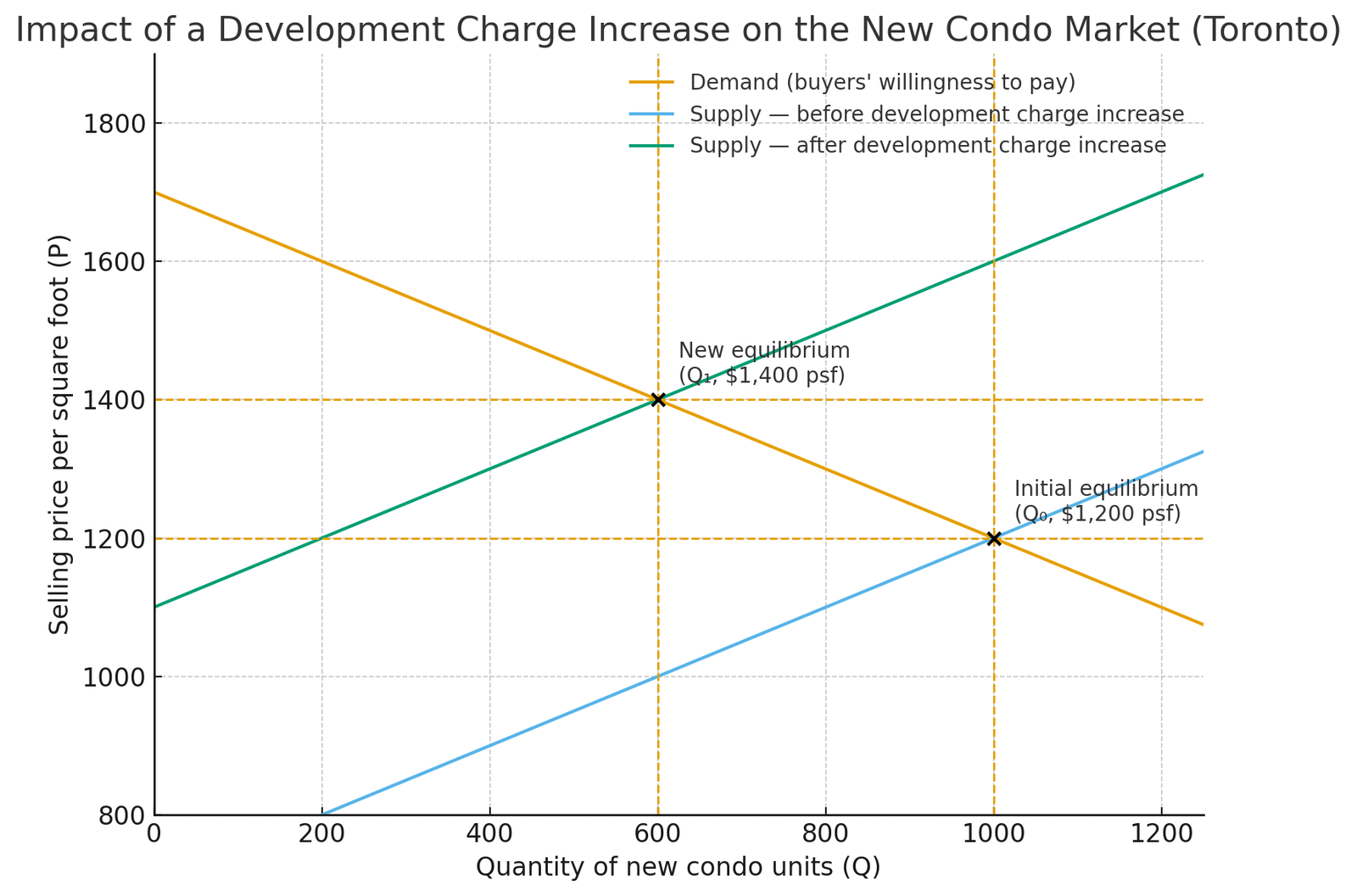
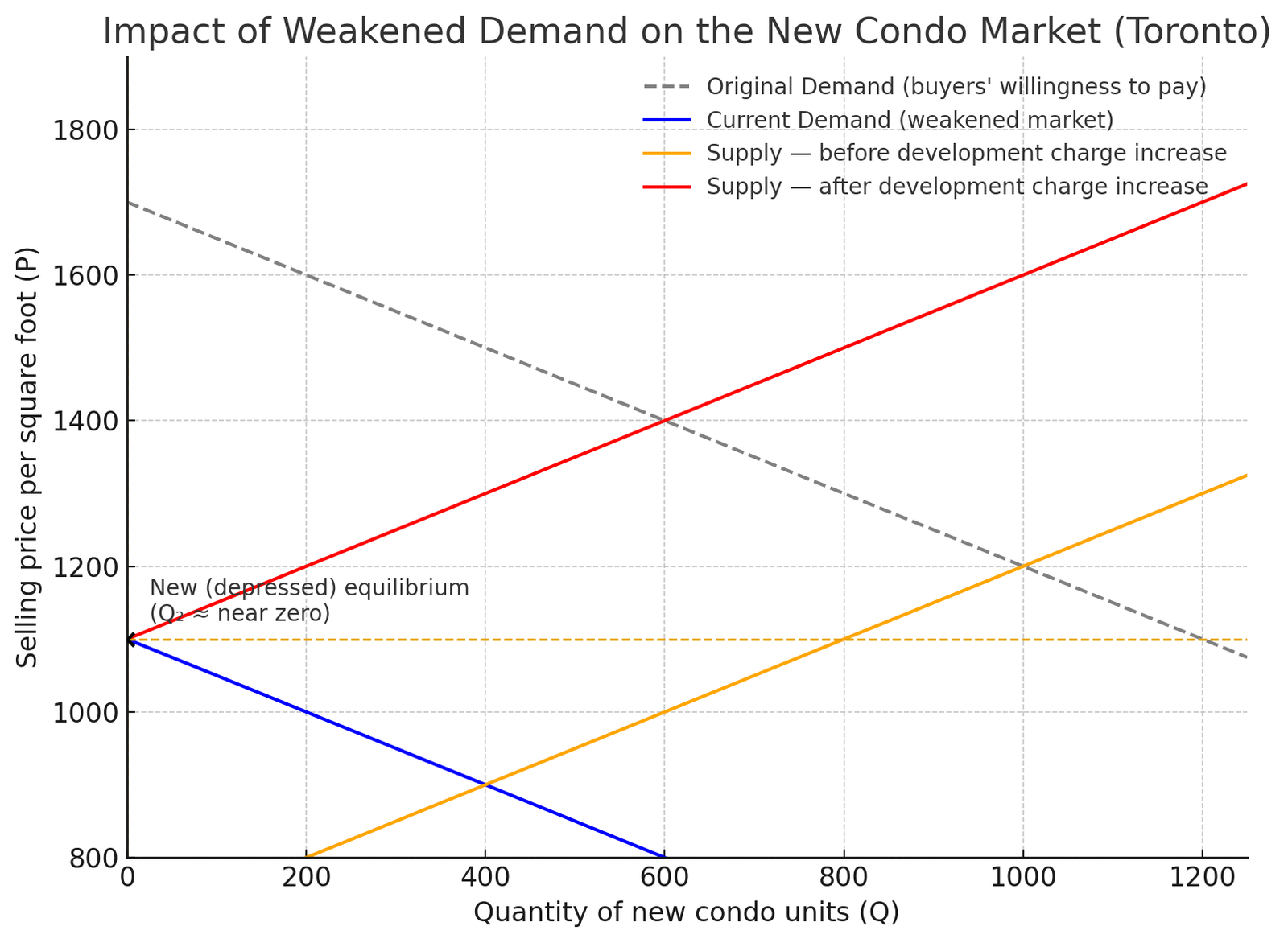
    But while the market works to find a new equilibrium, I do think it’s disingenuous to try and detach the cost of building new homes from end-user prices (which is what the above quote tweet seems to do). Increasing the marginal cost of a good forces prices to rise. In turn, the quantity demanded falls because fewer people can afford it. And if the demand curve also shifts to the left, which is what happened starting in 2022, then the quantity demanded can even approach zero (see second chart).

    Pretending we can heavily tax housing and not pay the price doesn’t help anyone looking for more affordable options.
  • Current status of single-stair buildings in Toronto

    October 19, 2025 · View original


    As many of you know, the Ontario Building Code requires multi-residential buildings over two storeys in height above grade to have more than one means of exiting the building. This typically means two exit stairs.

    If you’d like to build something more ambitious than this, you generally have two options. One, you could design your second-floor homes to be multi-storey. I’m not a building code expert, but I’ve seen architects like Craig Race (and others) do this without triggering the requirement for a second exit.

    Your second option is to apply for what’s called an “alternative solution.” This is basically a way of saying to the building department, “Hey, my design deviates from the standard prescriptive method, but it still achieves an equal or greater level of safety, performance, and functionality, so you should approve it anyway.”

    Last year, the City of Toronto sent a message that it was going to be more open to single-egress alternative solutions. It commissioned a report that looked at the feasibility of relaxing egress requirements for buildings up to four storeys and published a guide to help builders prepare these proposals. The goal was and is to encourage more missing middle housing.

    So has it worked?

    This past week, Pamela Blais shared her experiences on Twitter. She is trying to build a three-storey sixplex (Part 9 of the Ontario Building Code) with a single stair, so she submitted an ASP. It included:

    – Fully sprinklered building – Widened exit stair (1200mm vs. 900mm) – Expanded landings (1650mm) – Stairwell skylight for smoke exhaust – Improved fire ratings (structure, suite separation, exits, and balconies) – Balcony in every home for refuge or direct exit

    And the city’s response was: “Nope. This does not meet the required performance levels.”

    I can also share that we have had meetings with code consultants regarding the feasibility of doing a single stair in a six-storey building and the guidance we received was that there’s no way an ASP would be approved. We would be wasting our time and money. All of this should make it clear that we’re not there yet.

    Thank you, Pamela, for sharing your experience. As one commenter on Twitter said: “A noble quest you are on.”

  • Stubborn on vision, flexible on the details

    October 18, 2025 · View original


    So what did we uncover during yesterday’s great urban design debate?

    If I can extract one overarching takeaway, it’s maybe this one: We need to be big and bold (have a compelling vision!), while at the same time getting out of the way of small-scale urban innovation. Joe Berridge, for example, felt strongly that Toronto is not taking full advantage of its waterfront. We’ve been too focused on bike lanes and parks, rather than on creating noteworthy global draws and aggressively marketing ourselves externally. Toronto needs its Sydney moment — something like a globally significant Opera House that attracts people from all around the world. I don’t disagree. Cities need to do things that are remarkable.

    At the same time, we spent a lot of time talking about the micro scale. Some of the most loved urban environments from around the world have the simplest built form: fine-grained and humble buildings fronting onto human-scaled streets — streets like Ossington in Toronto and seemingly every street in Paris. But that was then. This kind of built environment is mostly incongruent with how we plan and develop new communities today. We develop big, we impose top-down planning, and we no longer have the same inherent flexibility that our older building stock had.

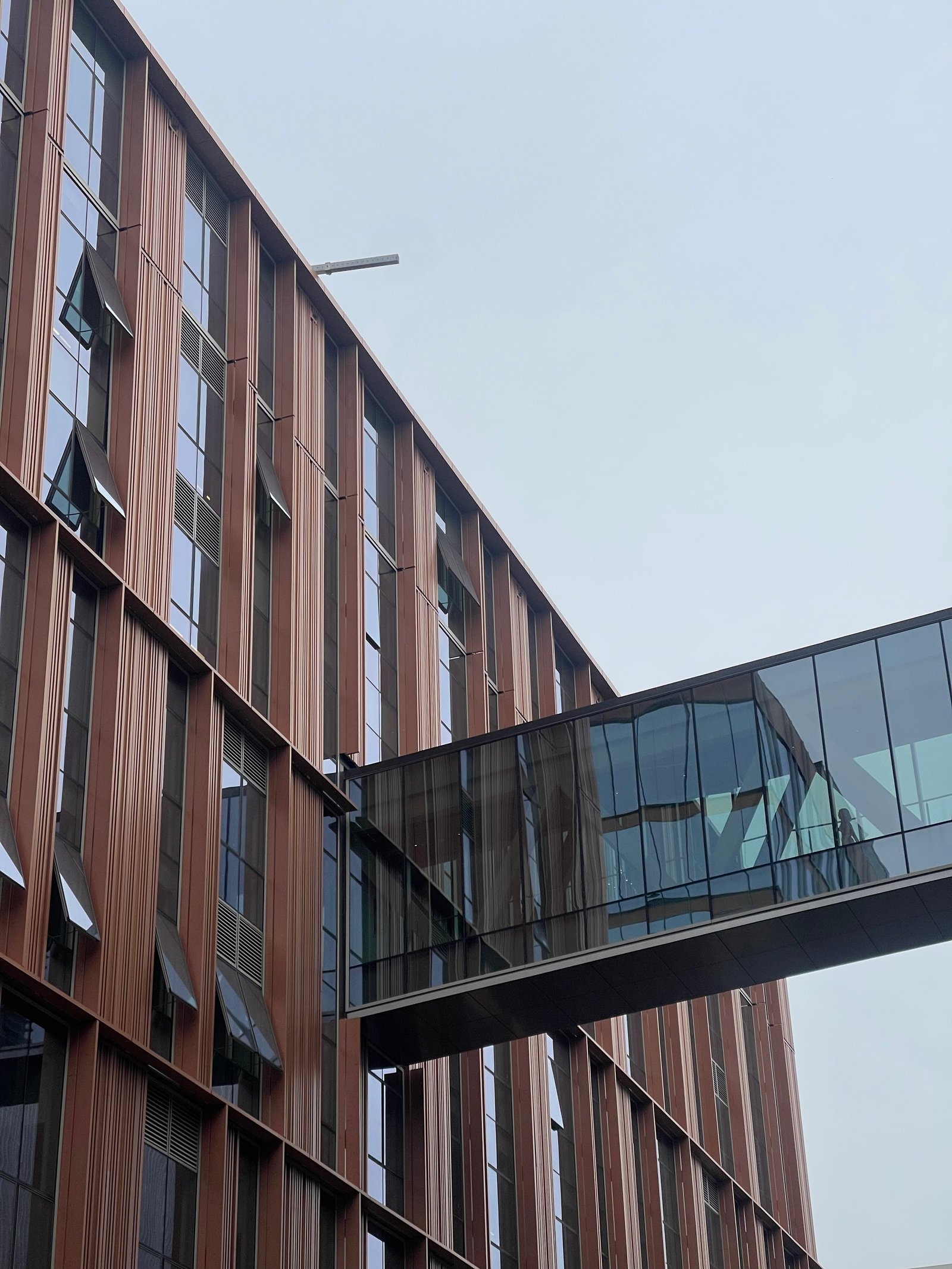
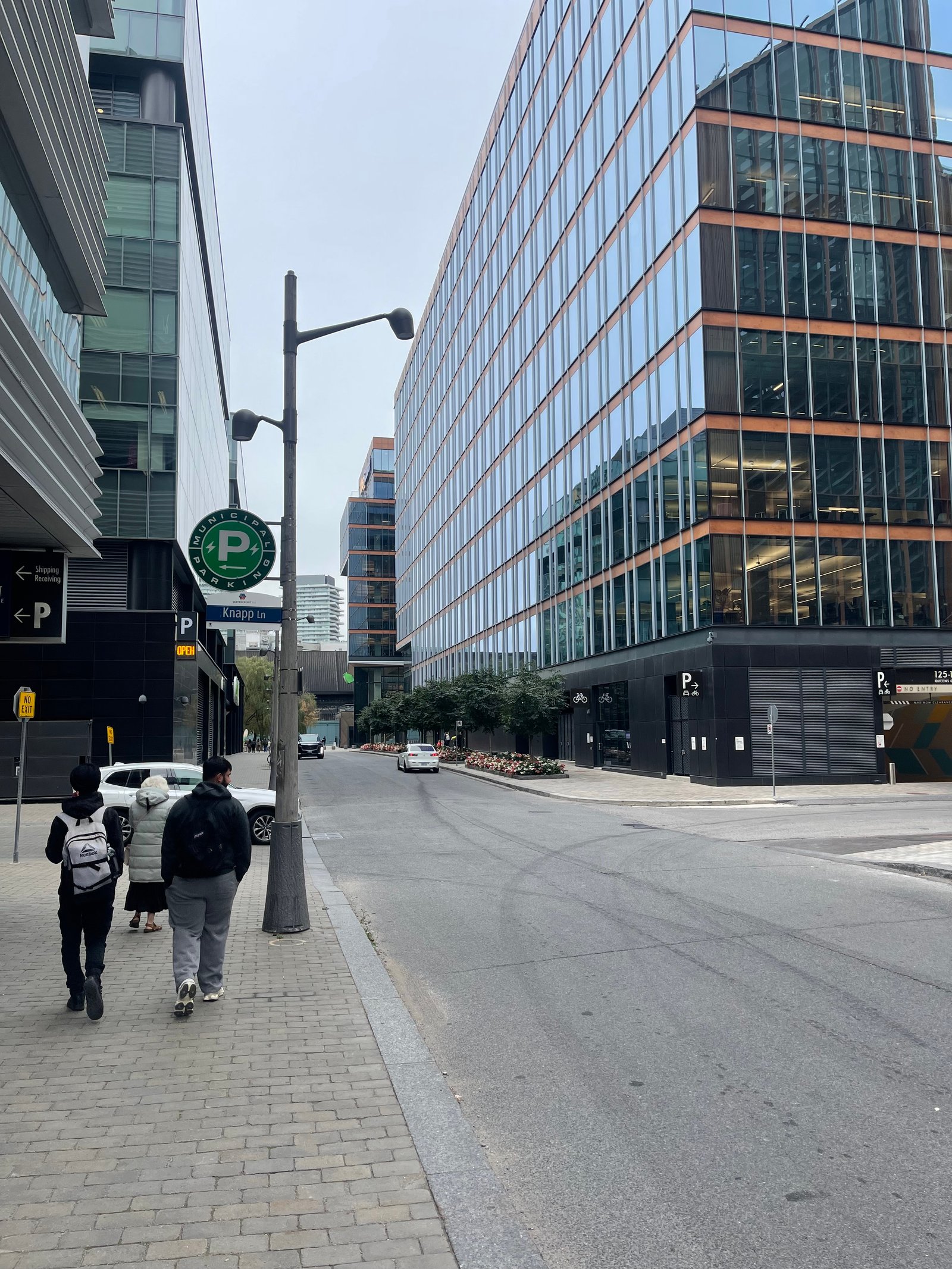
    Take, for instance, Toronto’s East Bayfront, which is where this conference is taking place. It’s a recently developed community with many or most of the hallmarks that constitute good urban design today: handsome architecture (including mass-timber buildings), pedestrian-friendly streets, well-designed public realms, and more. And yet, the area is largely void of any urban vibrancy. Other than the boardwalk along the water and a handful of restaurant patios, there’s very little public life. Many of the buildings are also connected by bridges, which is not in and of itself a problem, but it further removes life from the street.

    Here are a few photos of the area that I took while leaving the panel:

    Compare this to a random street in Tokyo:

    The buildings are ugly, or at least nondescript. None of the tenants are following a consistent signage standard. There are no sidewalks. And there’s an overhead rail line bisecting the street. And yet, it’s vibrant. It’s a successful urban street. Most older cities have areas akin to this, but it’s a real challenge to create it from scratch in new developments (see above). I’m very interested in this challenge and, as we have talked about many times before on the blog, I think part of the answer lies in allowing flexibility and ground-up change. It’s impossible to predict what an area could become and, for that reason, top-down planning will never get it exactly right.

    Thinking about it this way, urban design isn’t dead; it just maybe needs a refocusing. And what I propose is approaching it along the lines of Jeff Bezos’ old management adage: You want to be stubborn on vision, but flexible on the details.

  • Winning and losing at the same time

    October 16, 2025 · View original


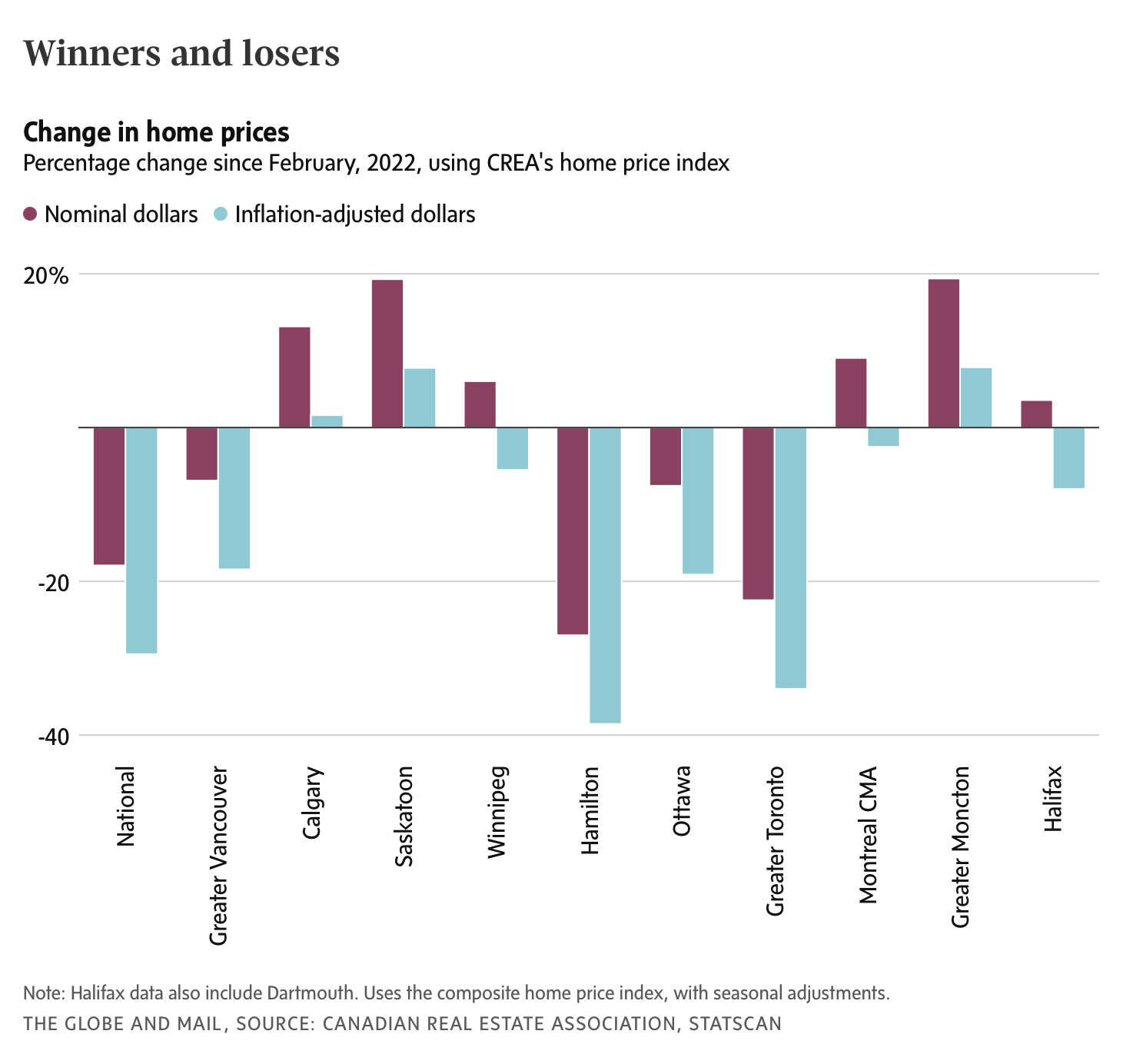
    The Globe and Mail just published this article about Canada’s real estate markets. It’s behind a paywall, but if you’re able to access it, you’ll find 10 housing charts. The first is called “Winners and losers,” and what it shows is the percentage change in CREA’s home price index since February 2022 — which, in hindsight, was the top of the market. (I don’t know what the end date is for this data, though.)

    The first thing you’ll see is that, very broadly, there’s Southern Ontario and Greater Vancouver, and then the rest of Canada. Prices have fallen materially in Canada’s most expensive markets, whereas in cities like Calgary, Saskatoon, and Moncton, nominal home prices are up by double-digit percentages. There isn’t just one Canadian market.

    The other thing I found interesting is the title “Winners and losers,” because it reminded me of the great paradox of modern housing policy. And by this I mean: which cities are winning and which are losing? If you already own a home, then winning is positive price appreciation. But if you don’t already own a home and you’d like to in the future, well then, falling home prices is winning — they’ve just become more affordable.

    Not surprisingly, it’s hard solving for two opposing kinds of winning.

  • Paris is not a medium-density city

    October 9, 2025 · View original


    Earlier in the week, I came across this tweet about Paris: “Haussmann cracked the code on what makes a beautiful medium-density city. Why is it then that we can’t replicate this all around the world? Genuine question.” This is a topic that is near and dear to this blog, so I thought we should discuss it.

    But before we can answer this question, I think it’s important to ask whether it’s even fair to call Paris a medium-density city. Paris is generally considered to be the densest city in Europe. Most sources peg Paris proper (inside the Boulevard Périphérique) at around 21,000 people per km². However, there are areas that reach over 50,000 people per km², which is dense enough to rival any big megalopolis. So, from my perspective, I would not classify Paris as medium density.

    It’s a high-density city.

    The primary reason why this feature is so often overlooked is likely because the buildings aren’t very tall. People see mid-rise buildings of 6–8 storeys and automatically assume that these must translate into some form of a medium-density city. But this is the height–density fallacy. The two do not necessarily correlate. Paris is an example of a high-density city with mid-rise buildings. But I also can think of many low-density cities with high-rise buildings.

    Another reason I suspect Paris’s high urban density is often missed is that it’s also a highly livable and loved city. It doesn’t feel that dense (even if living spaces are compact and expensive). The term density can also carry negative connotations for some. Paris, high density? It can’t be. But that just helps to prove the point that density is good. You can’t have urban vibrancy without it.

    All of this gets at one part of the answer to our original question. Paris is not more widely replicated because building height is only one aspect of the Parisian model. Paris is not mid-rise buildings transitioning down to single-family houses. Paris is not mid-rise buildings in only designated areas. Paris is mid-rise buildings everywhere — and at very high densities.

    Not every city is prepared to do that. But if you truly want to emulate Paris, then that’s what it will take.

  • Utah creates new Condominium Construction Loan Program

    October 4, 2025 · View original


    The state of Utah is trying to build 35,000 starter homes over the next five years. Last year, $300 million was allocated to something known as the Utah Homes Investment Program (UHIP). The initial idea was that these funds would be provided as low-cost deposits to financial institutions so that they could, in turn, offer low-interest loans to homebuilders who committed to building single-family starter homes.

    But this didn’t go as planned. Apparently, the low-cost deposits weren’t low enough to compensate for the perceived lending risk. So Governor Cox asked if the funds could instead be directed to the Utah Housing Corporation. Enter the Condominium Construction Loan Program. The way this newly created program works is that UHC can now provide low-cost loans — up to 100% LTC — directly to developers.

    However, there are some stipulations:

    – Warrantable projects: The projects must be warrantable to the Federal Home Loan Mortgage Corporation, meaning the property and the individual condominium units need to be eligible for conventional mortgage financing. – Owner-occupancy requirement: The individual condominium units must be sold to an owner-occupant, with a recorded deed restriction in place for a period of not less than five years. This is obviously to stop investors from buying and reselling. – Equity sharing: The equity appreciation on the condominium unit is shared between UHC and the first owner-occupant. The homeowner earns 75% of the equity appreciation (15% per full year of occupancy, through five years), with the balance going to UHC upon sale of the unit.

    So it’s a trade-off: buyers get access to new homes at below-market pricing (because the developer’s cost structure is reduced), and in exchange, they give up some of the potential upside. Will it work and help Utah achieve its starter home goal by 2030? I don’t know. But it’s clear recognition that if you want to deliver below-market housing, you need to provide subsidies.

  • Riz Dhanji on Toronto’s housing market

    October 2, 2025 · View original


    Riz Dhanji, who is the founder and president of RAD Marketing, is a long-time partner of ours. We are working together on One Delisle and on our waterfront project in the Niagara Benchlands. Riz has worked on some of Canada’s most high-profile development projects, has been through past cycles, and has even sold real estate to Elton John. That’s something.

    So today, I’m happy to share this recent Livabl podcast that he appeared on with host Matthew Slutsky.

    One theme that you’ll notice in the episode is the focus on end-user buyers. Talk to anyone in the condominium business and they’ll tell you that these are the few active buyers today. Investors are largely sitting on the sidelines. On the surface, this should be a healthy reset for the market — a refocusing on the actual customer. It’s also, in my opinion, a generational opportunity for buyers.

    But what I continue to find ironic is the number of end-users who also remain sidelined. For years, pundits loved to criticize Toronto’s new home market for being too geared toward investors. The argument was that it was a market based on speculation and that investors were crowding out real people from fulfilling their basic shelter needs. Developers were creating financial assets, not homes.

    Now the pundits have gotten exactly what they wanted: less speculation, less competition, and lower prices. So where, then, are all the end-users? Why are they not banging down the doors of sales galleries and saying, “Thank goodness — we’re no longer being crowded out?”

    Instead, what has happened is that the market has stalled out and new housing supply has largely shut off (the effects of which won’t be felt for a few more years).

    The question now is what will it look like once it returns. Who will be the buyers? Like every market, most people prefer to buy when everyone else is buying the same thing. So I suspect many end-users are waiting until there’s more activity (i.e. competition). But when that time comes, they won’t be the only buyers in the market.

  • Build Toronto advocates for congestion pricing

    September 26, 2025 · View original


    Back in the spring, I wrote about a platform called Build Canada. More recently, this same group launched their first “city project” called Build Toronto (which is not to be confused with the city corporation that ultimately became CreateTO). Similar to Build Canada, they publish regular memos and advocate for policies and projects that will help build Canada’s largest city.

    Their most recent memo is by the CEO of A2X, Jamie McDonald, and it covers a topic that we discuss a lot on this blog: congestion pricing. Jamie talks about the drag that congestion has on the region’s economy (upwards of $45 billion every year?), the numerous successes we can point to from around the world, and then lays out the following proposal:

    – Create a downtown congestion pricing zone – Introduce dynamic highway pricing across the GTA – Guarantee fairness and predictable exemptions – Invest in alternatives before launch

    This is the way. And it remains deeply disappointing that we don’t have the political leadership to move this forward. Instead, we sit in traffic. But after a decade of writing about it, I think I’ve said about all I can say about the virtues of congestion pricing. We absolutely know it works. Now we just need to spread the word and continue to apply pressure. I’m glad that groups like Build Toronto are helping to do exactly that.

  • Toronto is finally intensifying its neighborhoods

    September 22, 2025 · View original


    > Tweet: It’s happening. Toronto is intensifying its neighborhoods with fourplexes, fiveplexes, sixplexes, and laneway homes. https://t.co/ARCHTjWI65

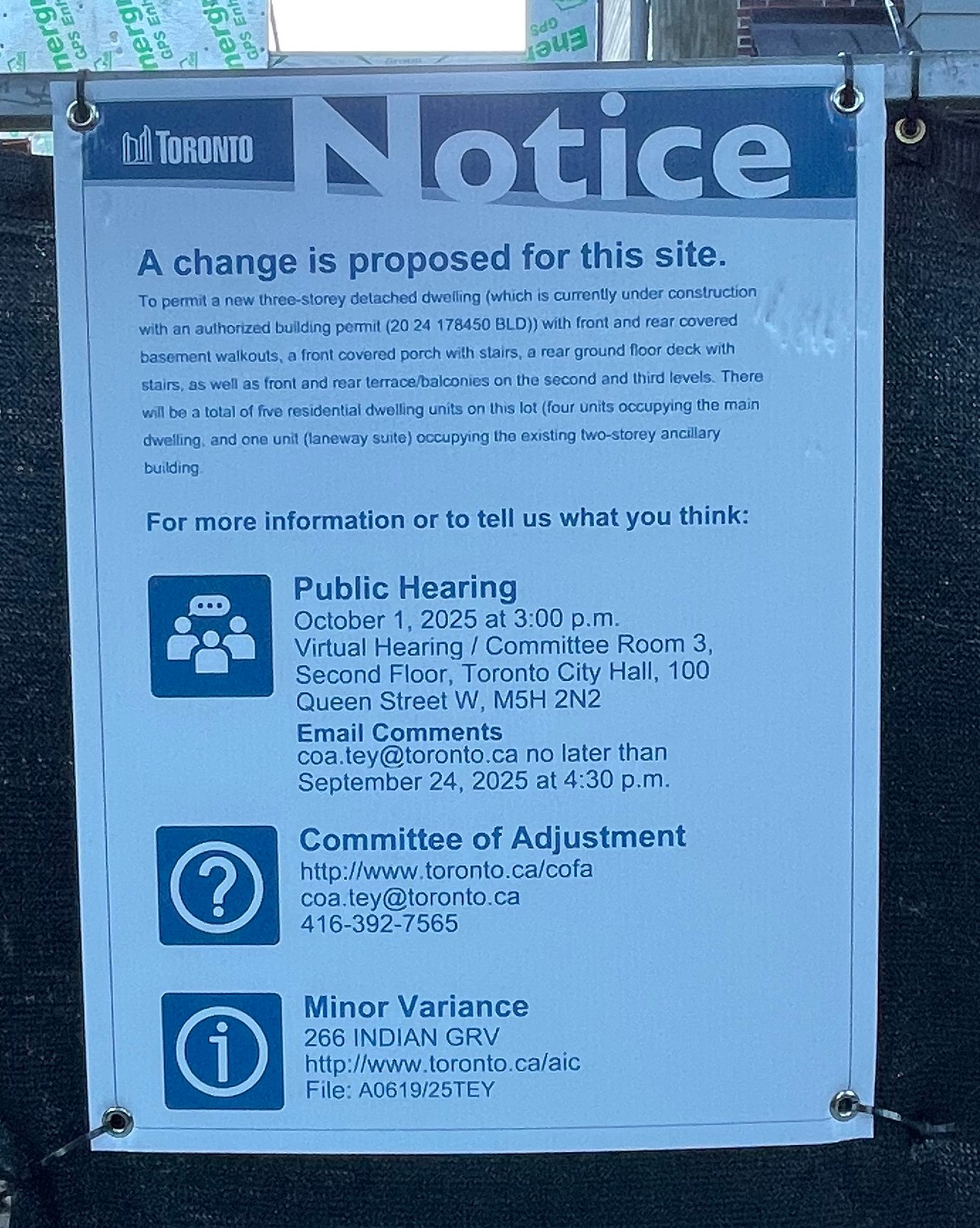
    Bianca and I went for a walk around the Junction over the weekend, as we like to do, and I was pleasantly surprised to find a number of “multiplexes” under construction. That is, small infill rental projects with four or five homes, sometimes including a laneway house at the back. (Sorry, no sixplexes were spotted just yet.) It immediately made me think, “Wow, it’s happening! Toronto is intensifying its neighborhoods.”

    For those of you who haven’t been following closely, many of Toronto’s neighborhoods have been bleeding population over the past few decades. It’s only where we’ve allowed larger-scale new developments that we’ve really seen populations increase. That’s what has precipitated our current push to expand housing options in our low-rise neighborhoods. And already, you can find evidence that it’s starting to work.

    That said, it’s worth mentioning a few things. Some of the planning notice signs that I stumbled upon dated back to 2022, and some were current. This raises at least two lines of questions. One, why is a small project that went to the Committee of Adjustment in 2022 still under construction? Was it because of planning delays, or something else? And two, why are today’s projects still having to go to the CofA? Are we still not there yet in terms of the planning policies?

    I don’t know the precise answers to these questions, but I do know that planning staff actively monitor which variances are requested and ultimately approved. If the same variance continues to show up, then it’s a clear indication that it should just become policy, and not be something that needs to be sought. This should give some comfort that we should only get better at facilitating this scale of housing.

  • Running through New York City

    September 19, 2025 · View original


    YouTube video

    I’m not a runner. I’ve just never gotten into it. But I can appreciate why people love it, and I imagine that some of the things I love about cycling also happen with running. One of those things is the ability to experience a place while working out.

    Here’s an example.

    I think this recent video by Satisfy does a great job of capturing what it must feel like to effortlessly glide through a city like New York. They also picked the perfect song, so turn your sound on. If you enjoy running and/or NYC, you’ll enjoy the video.