


It's happening. Toronto is intensifying its neighborhoods with fourplexes, fiveplexes, sixplexes, and laneway homes.
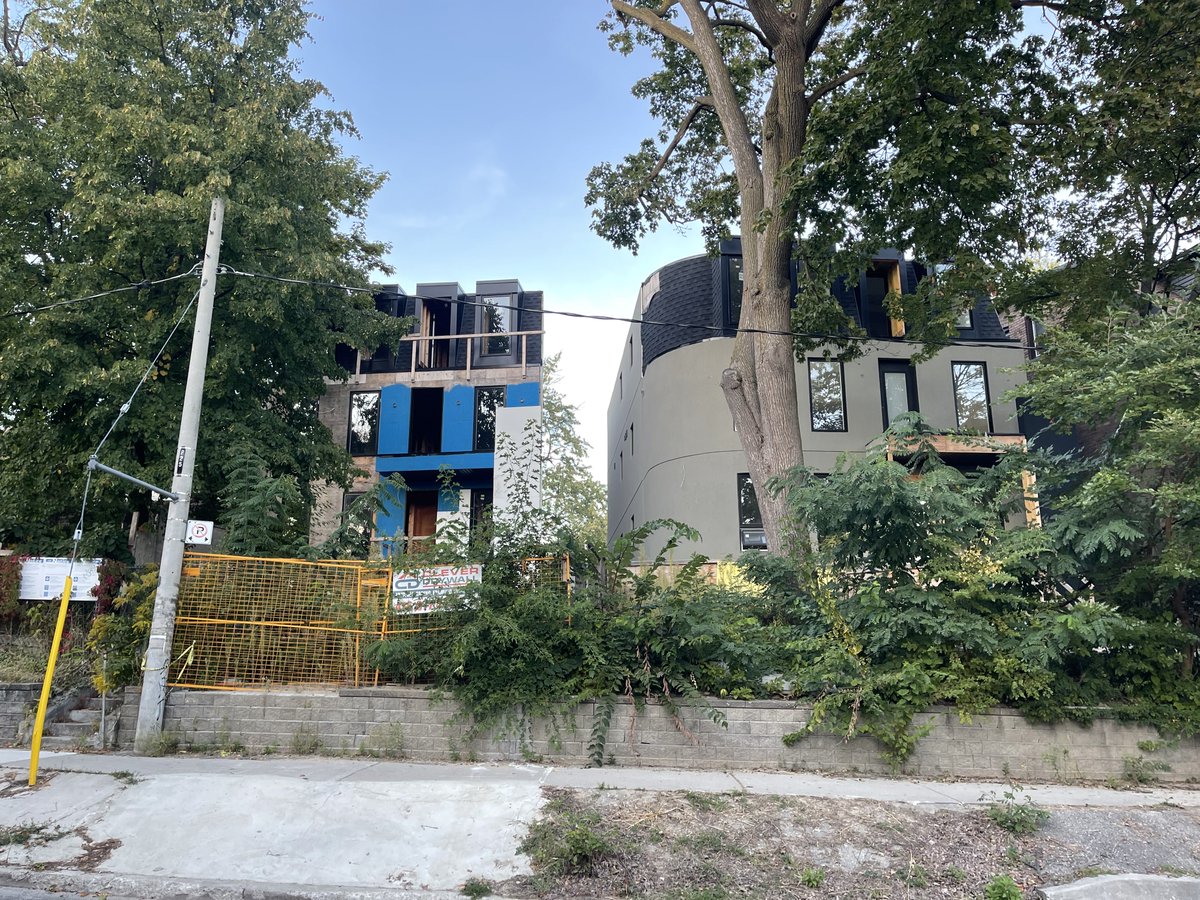
Bianca and I went for a walk around the Junction over the weekend, as we like to do, and I was pleasantly surprised to find a number of "multiplexes" under construction. That is, small infill rental projects with four or five homes, sometimes including a laneway house at the back. (Sorry, no sixplexes were spotted just yet.) It immediately made me think, "Wow, it's happening! Toronto is intensifying its neighborhoods."
For those of you who haven't been following closely, many of Toronto's neighborhoods have been bleeding population over the past few decades. It's only where we've allowed larger-scale new developments that we've really seen populations increase. That's what has precipitated our current push to expand housing options in our low-rise neighborhoods. And already, you can find evidence that it's starting to work.
That said, it's worth mentioning a few things. Some of the planning notice signs that I stumbled upon dated back to 2022, and some were current. This raises at least two lines of questions. One, why is a small project that went to the Committee of Adjustment in 2022 still under construction? Was it because of planning delays, or something else? And two, why are today's projects still having to go to the CofA? Are we still not there yet in terms of the planning policies?

I don't know the precise answers to these questions, but I do know that planning staff actively monitor which variances are requested and ultimately approved. If the same variance continues to show up, then it's a clear indication that it should just become policy, and not be something that needs to be sought. This should give some comfort that we should only get better at facilitating this scale of housing.
The term "missing middle" is typically used to refer to a missing scale in our built environment. It is that middle scale of housing between low-rise and high-rise. But there's another way to think about it and that is in terms of the market that the housing is serving.
Over the last cycle, cities like Toronto saw a kind of "barbell" dynamic. Meaning, new supply tended to target the poles. It was delivering for young professionals and young couples on one end and for downsizers and wealthy retirees on the other. But what has been missing is new supply that targets the belly of the market. And by this I mean something like low-amenity, well-designed, mid-market homes.
Of course, there are good reasons for why this is the case. The cost structure of new developments makes it so that the only feasible way to underwrite new projects is to maximize rents through smaller suite sizes and copious amounts of amenities. It is not that developers don't want to do it any other way, it's that they generally can't.
This is the paradox underpinning Canada's housing crisis. Yes rents are softening and vacancies are rising right now, but it would still be right to say that we are in a crisis. And that's because it largely exists in a different segment of the market — the biggest one.
In my view, this is our great challenge and opportunity as we move through this downturn. And I would bet that once we unlock the right model(s), we will see just how pent-up the demand for housing is in cities like Toronto and Vancouver.

Yesterday afternoon, our team had a productive in-person meeting with senior planning staff at the City of Toronto. The purpose of the meeting was to talk about the challenges associated with delivering infill missing middle housing and to brainstorm the possible solutions.
Some of the key topics that we discussed: Type-G loading / garbage requirements, amenity space requirements, right-sizing the Site Plan Control process, single-stair exiting, the cost of connecting to Toronto Hydro, the challenges with assembling small lots, specifics of the Major Street Study, and a bunch of other things. So many of the things that we regularly talk about on this blog.
We also walked everyone through the site we had under contract but eventually dropped because the margins were just too thin. This included opening up our pro forma, projecting it onto the screen, and going through it line-by-line. We are happy to do this because we think this transparency helps everyone truly understand the obstacles.
What's clear is that we all want to see more family-friendly housing lining our avenues and major streets. And so there's a real feeling of collaboration during meetings like the one we had yesterday. We're all at the stage of "what is it going to take? Let's figure it out!" This can-do attitude makes me feel optimistic that we are going to get there. And once we do, Toronto will be that much better for it.
It was also nice having an in-person meeting back at City Hall. To be honest, I can't remember the last time I did that. But it used to be standard operating procedure. We'd all arrive early, huddle in the cafe at the bottom of the building for a pre-meeting, and then look around to see what other teams/projects were also on deck with the city. It made me feel nostalgic — and older.
Enjoy the weekend, everyone.
Bianca and I went for a walk around the Junction over the weekend, as we like to do, and I was pleasantly surprised to find a number of "multiplexes" under construction. That is, small infill rental projects with four or five homes, sometimes including a laneway house at the back. (Sorry, no sixplexes were spotted just yet.) It immediately made me think, "Wow, it's happening! Toronto is intensifying its neighborhoods."
For those of you who haven't been following closely, many of Toronto's neighborhoods have been bleeding population over the past few decades. It's only where we've allowed larger-scale new developments that we've really seen populations increase. That's what has precipitated our current push to expand housing options in our low-rise neighborhoods. And already, you can find evidence that it's starting to work.
That said, it's worth mentioning a few things. Some of the planning notice signs that I stumbled upon dated back to 2022, and some were current. This raises at least two lines of questions. One, why is a small project that went to the Committee of Adjustment in 2022 still under construction? Was it because of planning delays, or something else? And two, why are today's projects still having to go to the CofA? Are we still not there yet in terms of the planning policies?
I don't know the precise answers to these questions, but I do know that planning staff actively monitor which variances are requested and ultimately approved. If the same variance continues to show up, then it's a clear indication that it should just become policy, and not be something that needs to be sought. This should give some comfort that we should only get better at facilitating this scale of housing.
The term "missing middle" is typically used to refer to a missing scale in our built environment. It is that middle scale of housing between low-rise and high-rise. But there's another way to think about it and that is in terms of the market that the housing is serving.
Over the last cycle, cities like Toronto saw a kind of "barbell" dynamic. Meaning, new supply tended to target the poles. It was delivering for young professionals and young couples on one end and for downsizers and wealthy retirees on the other. But what has been missing is new supply that targets the belly of the market. And by this I mean something like low-amenity, well-designed, mid-market homes.
Of course, there are good reasons for why this is the case. The cost structure of new developments makes it so that the only feasible way to underwrite new projects is to maximize rents through smaller suite sizes and copious amounts of amenities. It is not that developers don't want to do it any other way, it's that they generally can't.
This is the paradox underpinning Canada's housing crisis. Yes rents are softening and vacancies are rising right now, but it would still be right to say that we are in a crisis. And that's because it largely exists in a different segment of the market — the biggest one.
In my view, this is our great challenge and opportunity as we move through this downturn. And I would bet that once we unlock the right model(s), we will see just how pent-up the demand for housing is in cities like Toronto and Vancouver.
Yesterday afternoon, our team had a productive in-person meeting with senior planning staff at the City of Toronto. The purpose of the meeting was to talk about the challenges associated with delivering infill missing middle housing and to brainstorm the possible solutions.
Some of the key topics that we discussed: Type-G loading / garbage requirements, amenity space requirements, right-sizing the Site Plan Control process, single-stair exiting, the cost of connecting to Toronto Hydro, the challenges with assembling small lots, specifics of the Major Street Study, and a bunch of other things. So many of the things that we regularly talk about on this blog.
We also walked everyone through the site we had under contract but eventually dropped because the margins were just too thin. This included opening up our pro forma, projecting it onto the screen, and going through it line-by-line. We are happy to do this because we think this transparency helps everyone truly understand the obstacles.
What's clear is that we all want to see more family-friendly housing lining our avenues and major streets. And so there's a real feeling of collaboration during meetings like the one we had yesterday. We're all at the stage of "what is it going to take? Let's figure it out!" This can-do attitude makes me feel optimistic that we are going to get there. And once we do, Toronto will be that much better for it.
It was also nice having an in-person meeting back at City Hall. To be honest, I can't remember the last time I did that. But it used to be standard operating procedure. We'd all arrive early, huddle in the cafe at the bottom of the building for a pre-meeting, and then look around to see what other teams/projects were also on deck with the city. It made me feel nostalgic — and older.
Enjoy the weekend, everyone.
Share Dialog
Share Dialog
Share Dialog
Share Dialog
Share Dialog
Share Dialog