Daily insights for city builders, delivered every morning at 6 AM ET. I’m Brandon Donnelly — a Toronto-based real estate developer and founder of Globizen. I’ve been writing here since 2013.

Category: Art

  • Nobody wants to collect NFTs anymore

    Back when everyone wanted to buy and trade crypto, my friend Evgeny started a marketplace for NFT photography called Sloika. This, to me, felt like an obviously good idea, both in general and for him specifically. Evgeny had previously cofounded the photo company 500px, and so Sloika was initially conceived of as 500px, but for web3. This is a good story.

    I have collected a number of photos via Sloika and, in general, I continue to regularly collect NFTs. Of course today, relatively few people want to trade and collect NFTs. The market is largely dead. What is obvious is that there was a giant NFT bubble and it popped in 2022, along with some other asset bubbles.

    But does this necessarily mean that NFTs and NFT art are bad ideas?

    When I think of bubbles I often think of something that Fred Wilson wrote on his blog. His argument was that bubbles tend to be directionally right; it’s the magnitude that we get wrong. A good example of this is the dot com bubble. Yes, it was a massive bubble. But it was directionally right. The internet was going to matter — a lot it turns out.

    Even if we go back to “tulip mania” during the Dutch Golden Age — which is often brought up as the pinnacle of dumb bubbles — one could argue that it was still directionally right. Today, tulips remain the most sold flower in the US. So we still love them; we just got a little too excited back in the 17the century.

    When it comes to NFT art, I like to think in terms of these questions:

    • Will humans continue to appreciate art? (Seems obvious.)
    • Will humans continue to want to collect things? (This is arguably a fundamental human instinct.)
    • Will provenance and authenticity continue to matter in art? (Blockchain technologies are really good at this.)

    Perhaps the only question that remains is whether people will want to collect digital art. But even this feels fairly obvious to me. The challenge, I think, is that the display side of the market needs to be more built out. Because alongside the instinct to collect things is the instinct to display them. That’s why NFTs initially took off as profile pics on social media.

    So as a start, I think more, better, and cheaper displays would be a big help. There’s something very different about projecting an NFT in your living room versus having it live in a crypto wallet on your phone or computer. You need to really experience it, just as you would a conventional piece of art. And like all art, context matters.

    I haven’t yet invested in a dedicated NFT display, but I plan to do that in the near future. And I’m looking forward to displaying my collection of NFTs, including the one at the top of this post. It’s a drone shot of the west side of Toronto in the middle of winter, and it was gifted to me by Evgeny. Thank you for that. It’s an honor to have it as part of my art collection.

    Photo: Six Bling (via SuperRare)

  • Junction House by Air Norm

    If you work in the development industry in Toronto, then you know, or know of, Norm Li. He runs one of the top visual content studios in the city and the country. But he (and the company) also do a bunch of other things like DJ at industry events and fly around in a helicopter taking incredible photos of the city from above. He invited me to join him in 2018 and I captured photos like these.

    This past week he sent me a text with the below photos of Junction House and a message saying, “new lock screen.” I, of course, immediately blasted them around to the team and then asked if I could post them online. I love how these turned out. And every time I see our placemaking sign, I am happy that we fought for what we all believed would end up looking pretty cool.

    Thanks for the photos, Norm.

  • Fashion and design capital of the world!

    The first and only other time that I have visited Milan was over 20 years ago. I was 19 or so, and a close friend and I decided to take the train into Centrale without a place to stay and without a plan, other than to get into some trouble.

    We ultimately succeeded at this ambitious plan. But I clearly didn’t see enough of the city, and I left thinking that it was a bit of a grimy and sleepy place. I was disappointed. I thought it would be fashion everywhere, and it wasn’t for me. And this impression has lingered with me ever since.

    Boy have I been missing out.

    I have fallen in love with Milan on this very short trip. It really is a capital of fashion and design. This is not a city of meandering tourists looking for the Pantheon (okay, there’s still some of that); it is a big city of business and culture. And if I had to compare and contrast it to other cities, I would say this.

    Its built form is not nearly as manicured and as fussy as Paris’. In fact, in some ways, it’s a bit like Toronto. Its overall urbanism is messier, and you have to scratch beneath the surface and sneak into some courtyards before you really uncover its true beauty. But once you do, it’s magical.

    At the same time, its street fashion strikes me as being slightly fussier. There is an effortlessness in Paris that doesn’t seem as pronounced in Milan (though it is still there). Here, there’s a little more flash and a little more, “I’m sexy and stylish, and I would like you to be aware of that.”

    But this is not to say that you won’t see men and women in suits and stilettos riding a bicycle. It still feels effortless. It still feels natural. And when you’re here, you can’t help but feel like you’re probably not stylish enough for this capital of fashion and design.

  • A few observations about Venice

    We are on the train headed to Milan this morning, so as is customary on this blog, here are a few observations from the last few days in Venice:

    • Venice was a dominant republic for some 1,000 years. It was the fulcrum point of trade in Europe and, at one point, its wealthiest city. But that started to change in the 15th century, which is an important reminder that nothing is guaranteed. The world changes. Markets change. And maybe you won’t be as relevant tomorrow, unless you can find another economic reason for being.
    • If you’re an old city with lots of history, perhaps the easiest fallback plan is tourism. And it goes without saying that Venice gets a lot of tourists. I was, of course, one of them. After Italian, the most commonly overheard language on the streets seemed to be French. Maybe it was the time of year?
    • Besides my debilitating spring allergies, May feels like a reasonably optimal time to visit the city. I don’t think you want to visit Venice in peak summer. Too many meandering tourists taking photos (myself included). And too hot and humid. A high probability of “walking rage.”
    • Hotels in Venice are not cheap. But the city itself didn’t seem overly expensive, at least compared to many other top tourist destinations. Think €2.50 jugs of wine, €20-30 for very nice local leather goods, and €110 for a 7-course Michelin-starred meal.
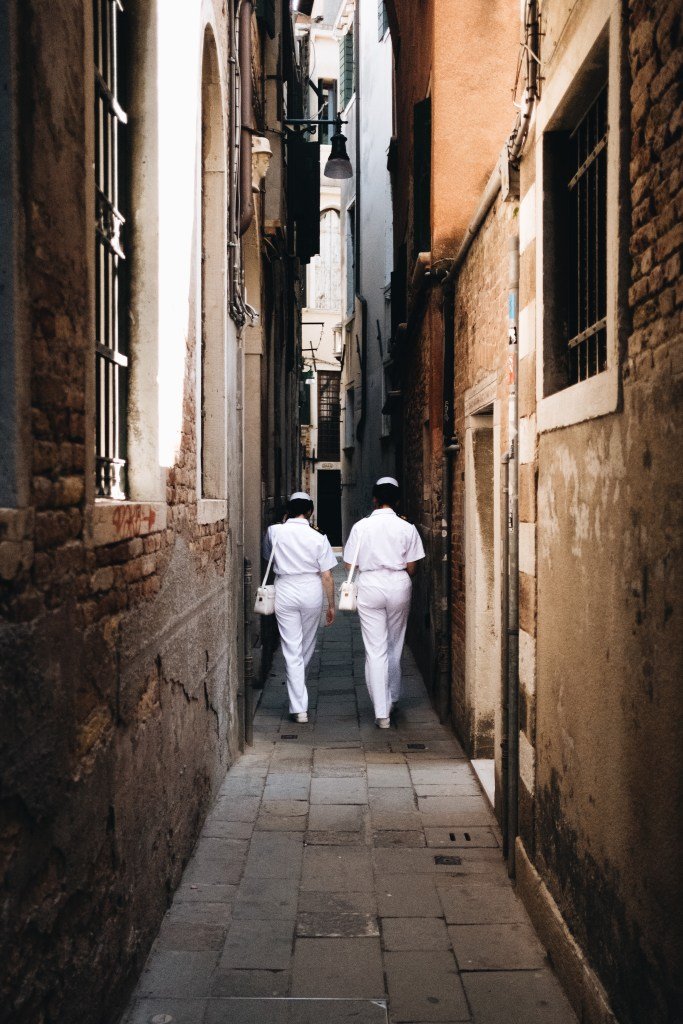
    • Venice has some of the most compact streets I have ever walked in. I didn’t have my laser distance measurer on me, but in many cases, you can barely fit two people side-by-side. I certainly couldn’t extend my arms fully outward. (See above photo.)
    • Wonderful doorbells. Virtually every apartment in Venice, has an array of doorbells at its front door. They are beautiful, typically in metal, and almost always round. But in addition to looking nice, there is also something very personal and about seeing people’s names right on the street. This probably tells you something about how differently privacy and security are viewed in the city.
    • That said, Venice isn’t a place where I would want a pied-à-terre. (I like to think about this sort of thing when I travel because it speaks to impressions of a place.) I mean, I love it, but: Too many tourists and the whole “we are sinking and have regular floods” thing seems like a bit of a problem. For me, it’s a city that I’d like to regularly visit. We spent much of our 2 days at the Venice Biennale, and there’s obviously a lot more to see.
    • Finally, and this also goes without saying, but Venice is a city that is necessarily preoccupied with controlling water. Our hotel room had big rain boots in it, just in case. The base of every building is generally solid up to knee height. Interiors have tall tile baseboards. Front doors have removable flood dams. And there are markings across the city indicating some of its historic flood levels. As I understand it, this was always a problem for Venice; however, it is getting worse. I think it tells you just how economically valuable it was for Venice to be located where it is, in a shallow lagoon at the top of the Adriatic Sea.
  • Harnessing air conditioning condensate

    We spent yesterday and today at the Venice Biennale (both the Giardini and the Arsenale). I really enjoyed it and I’m glad that I was finally able to attend. One of my favorite exhibits was Bahrain’s. It is called “Sweating Assets”, and it’s a demonstration of how air conditioning condensate might be harnessed from the country’s significant cooling infrastructure.

    Here’s a video of it in action:

    In the middle of the exhibit is a big glass box. This is meant to represent a ubiquitous conditioned space. And as the humid Venice air hits this glass box, condensation is created. This water is then channeled to various soil deposits, where greenery is already starting to grow. And presumably it will continue to grow over the life of the exhibit.

    They were careful not to come across as encouraging excessive air conditioning. This was not the point. Instead, the message was: Air conditioning is already an omnipresent necessity in the country, and here is how something that is mostly ignored today — AC condensate — could be turned into a meaningful asset.

    I thought it was clever. And they also gave out a nice book for free.

  • Toronto’s next best photo-op is in the Junction

    Today is a travel day, so I don’t have a whole lot to say. But BlogTO did just publish a story about our Junction placemaking sign: “This intersection is set to become Toronto’s next best photo-op.” I am also happy to report that the sign’s timer has now been installed, which means that, starting today, it will get illuminated each night from sunset to 11PM. (We’re required to shut it off at this time because, you know.)

    So far the response has been overwhelmingly positive. And I truly hope that this installation will become a symbol for the Junction neighborhood. This was our sole purpose for pursuing it. It would also be ironic if something that was so difficult to get approval for ends up being loved by city. Perhaps it’s a lesson that stubbornness can be a good thing when you believe in something.

  • Not for sale!

    One of the things that I have wanted to do since I was in architecture school was visit the Venice Biennale. Partially because I would hear people say, ” so and so exhibited at the Biennale this year”, and that made it sound cool. But mostly because it’s the oldest cultural exhibition of its kind in the world — it was inaugurated in 1895 — and because there’s an entire section of it dedicated to architecture. So I’m excited to say that it looks like this month is going to be the month.

    The way I am told the Venice Biennale of Architecture works is that there are two main components. There are the national pavilions in the Biennale Gardens, and there is the Arsenale, which is where lots of different nations exhibit under one roof. Canada is one of the 29 countries that has its own pavilion and, if you aren’t familiar with its history, it’s worth watching this short video:

    At the time of writing this post, it only had 277 views, so I’m guessing that most of you have not seen it. I felt patriotic when I watched it, because the purpose of these pavilions is that they host each country’s official representation during the Biennale. It’s Canada to the world and that makes me proud. This year, Canada is being represented by Architects Against Housing Alienation (AAHA) with an exhibit called “Not for Sale!

    Here’s an excerpt from the project description:

    Real estate speculation is a form of extortion. It converts homes into spatio-financial assets, changing the form, function, and aesthetics of housing to better serve the logics of wealth storage and speculation. The process is violent, resulting in an urban environment that is racist, sexist, and classist at a systemic level. This global phenomenon is nowhere more visible than in Canada, a country whose economy is now dominated by real estate.

    In other words, it looks like the pavilion is going to be turned into a scathing criticism of what I do for a living: real estate development. How neat! The other neat thing about the Venice Biennale is that One Delisle is going to be featured in an exhibition called, “Reconceptualizing Urban Housing.” Our team has been working on this project with Studio Gang since 2016, and so it’s a great honor to have it recognized on such a global stage.

    It also means that the Venice Biennale is going to simultaneously tell me that my work is doing some amount of good for Toronto, and that I’m also contributing to racism, sexism, and classism at a systemic level. I can’t wait.

  • All lit up in the Junction!

    Friday was a busy day at Junction House.

    In the morning, we gave a hard hat tour to Toronto’s City Planning Division. They are currently revisiting the Mid-Rise Building Performance Standards, and so this was an opportunity to see what these standards translate to when you’re on site trying to actually build a mid-rise building.

    It was great to see the group so highly engaged and looking for ways to improve the delivery of this housing typology. Thanks for taking the time to visit Junction House.

    Then we had the “official lighting ceremony” for the placemaking art. And by official lighting ceremony, I mean that there were a handful of us playing around with a drone and trying to get cool pictures on our phones. However, did we have one actual videographer, so stay tuned for some proper video footage of the installation.

    Finally, in the evening after sunset, we got to see it illuminated for the very first time. And it was everything we had hoped for! An idea turned into reality, many years later. Shout out to the Urban Toronto community for spotting one of our earlier prototypes online and then encouraging us to make some design changes. We are happy we listened.

    But what do you all think? I’d love to hear your thoughts in the comment section below.

  • Junction House just got its placemaking art

    Today was a fantastic day for the development manic meter. This was finally installed at Junction House:

    If you happen to find yourself in the area, check it out at 2720 Dundas Street West. And if you’d like to know a little bit about how this placemaking art came to be, click here.

  • What would you do if you were Mayor?

    Let’s assume that you’re Mayor of your city and that, for whatever reason, you have no need to pander to voters. You’re a benevolent dictator. You can do whatever you think is best overall for the city and it will just happen. What would you do? This is more or less the question I asked on Twitter this morning, and I think it’s only fair that I answer my own question. So here is a non-exhaustive list of items that came to mind while thinking of Toronto:

    • Substantially increase the pay of public sector workers throughout the city and bonus them based on measurable outcomes. Forget things like time limits on development applications; instead align incentives. For example, if we’re trying to get more shovels in the ground on affordable housing, incentivize people based on building permits issued. I’ll never forget what Roger Martin told me while I was at Rotman. When he became Dean of the school, Rotman was a whatever business school that wasn’t faring all that competitively in the rankings. One of the problems he discovered was that the school’s professors were getting paid far less than those at Wharton, Harvard, Stanford, and so on. So if you were a star, why would you ever want to teach at Rotman? He immediately matched the salaries of those top-tier schools and then, not surprisingly, the top-tier talent arrived. You get what you pay for.
    • Immediately price roads and congestion, and direct, to the fullest extent possible, the funds toward transit and cycling infrastructure. At the same time, the planning and building of transit would be depoliticized. There would be a reccurring funding stream and a plan that we’re continually building out. Minimize protracted debates. Never stop building. There’s a lot of talk this mayor election about solving traffic congestion. I have yet to see a plan that will actually work. Accurately pricing congestion likely won’t be popular, but I can guarantee you that it will be highly effective.
    • Ensure that property taxes are sustainably covering the costs of operating the city and then, at a minimum, peg all future increases to CPI.
    • Make any new housing development less than 12 storeys as-of-right. That would mean, no rezoning process and no site plan approval; just straight to building permit.
    • Empower the private sector to build affordable housing through incentives and subsidies. Affordable housing isn’t feasible to build on its own, which is why nobody is doing it. Inclusionary zoning also won’t get us there. Make developers want to build it and they’ll do it.
    • Liberalize licensing and cut red tape to empower small entrepreneurs across the city in various industries. A perfect example in my mind is street food. Toronto is the most diverse city in the world with some of the best restaurants, and yet the only thing you can buy on the street is a stupid hot dog. If we empowered small entrepreneurs to setup shop on our streets, we would easily have the best street food scene in the world. And I am positive that there are countless other latent opportunities in this city that are being held back by dumb and archaic rules.
    • Make dramatic improvements to our public realm with an eye toward becoming the most beautiful and livable city in the world. Finally pedestrianize Kensington Market, remove the elevated Gardiner Expressway, make it so that we can swim in the Lake, build beautiful public washrooms all across the city that are actually open and aren’t gross, and the list goes on. And yes, “beauty” should be requirement so that we don’t end up with shit like this.
    • Focus on art, design, culture, and innovation as central pillars of Toronto’s brand. Miami is a good example of what this approach — along with favourable taxes and nice weather — can do for a city. I’ve said this before, but here’s just one example: Toronto is in many ways the birthplace of the cryptocurrency Ethereum. Why is nobody talking about this? Why are we not celebrating and leveraging this? It’s a missed opportunity. Broadly speaking though, I think just having and doing three things can be effective in promoting new ideas for these pillars: have reasonably affordable housing, be a city that young people want to live in, and remain open and tolerant to immigrants.
    • Stop thinking of the night-time economy as a nuisance and instead think of it as a powerful economic development tool. I recently responded to this “night economy survey” that the City of Toronto released and the obvious bias is that nighttime things are seen as a terrible nuisance. In other words, “tell us how do we make all of this less annoying for grouchy voters.” My response was to extend last call to 4am and to start thinking of it as an opportunity to draw in young people, tourists, and whoever else. This complements my previous point.

    This is, again, a completely non-exhaustive list. But if I had to summarize the overall ambition, it would be to make Toronto a truly exceptional and remarkable city. We should never be happy with mediocrity.

    What else would you do? Leave a comment below.

    Photo by Aditya Chinchure on Unsplash