Daily insights for city builders, delivered every morning at 6 AM ET. I’m Brandon Donnelly — a Toronto-based real estate developer and founder of Globizen. I’ve been writing here since 2013.

Month: February 2026

  • The myth of the full city

    February 18, 2026 · View original


    Whether it’s said out loud or not, invariably something like this comes up when talking about new housing development:

    > “There’s another solution,” says Lucas, mulling over the housing shortage. “I’m not saying I know what it is. Maybe the city’s full. What’s wrong with Windsor instead? Or Cornwall? A hundred years ago, manufacturing and employment were spread out way better than they are now. Everybody needing to be in Toronto and Vancouver is killing us.”

    So, is Toronto full? Do we need to return our urban economies to what they were a century ago? To use rough whole numbers, let’s consider that Toronto’s average population density (in the city proper) is upwards of 5,000 per km2. It’s much higher in the downtown core, but our low-density inner suburbs bring down the average.

    Now, let’s consider Paris, as we often do on this blog. Paris proper has roughly 1/6th the footprint of Toronto (again, the city proper boundary) and roughly 4x the population density (upward of 20,000 people per km2). So, if Toronto is full, what the hell is going on with Paris?

    Even Paris is nowhere near full. The opportunities for intensification in central neighborhoods may not be as obvious as they are in Toronto, but urban Paris continues to grow through small-scale projects, office conversions, and, most notably, through ambitious transit projects and mixed-use developments designed to stitch together the greater urban region.

    Cities do, of course, face constraints, but they’re never technically “full.” “Full” is generally shorthand for, “I already live here and I like the way things are, and so I would prefer no one else come and disrupt what I’ve presently got going on.”

    Because if this weren’t the case, then I suppose you might hear more people say, “I really wanted to move to Toronto, but it was quite literally full. Like, absolutely no physical room for me. I couldn’t do it. I would have had to sleep on the streets.” Nope. We’ve got a space allocation for you. In fact, if you’re in the market for a new home, give me a call.

    Importantly, this is different from a city being, maybe, too expensive. That is not the same as not having any more room. But the two are interconnected: saying a city is full and then blocking housing because of said fullness creates a self-fulfilling prophecy of artificial scarcity. This drives up prices and can then create a false sense of being full.

    Of course, in this scenario, you aren’t out of land; you’re out of permission to use the land differently. “Full” is a funny thing.


    Cover photo by Julian Gentile on Unsplash
  • The housing bias still holding back the Toronto of tomorrow

    February 17, 2026 · View original


    Last week, we spoke about one of Toronto’s failures when it comes to new “missing middle” housing, namely our inability to look forward to the Toronto of tomorrow, as opposed to only thinking about the Toronto of today. But let’s not forget that there are greater biases at play here influencing these outcomes.

    Beneath our concerns about not enough parking (how dare you wage a war on the car?) and congruency with neighbourhood character is a deeply rooted aversion toward higher-density apartment living; one that is arguably most prevalent in the English-speaking world.

    Consider Toronto’s response to the handsome Spadina Gardens apartment building at the start of the 20th century. We were certain that only people of questionable moral fibre would ever want to live in a four-storey apartment block!

    Since then, we’ve become far more open-minded, but survey people in the Anglosphere about whether they’d like to live in an elegant Parisian block, and you’ll often discover a stark preference for detached housing. In contrast, survey people on the European continent, or in Asia, and you’ll often see different preferences.

    Combine these preferences with the common law system prevalent throughout English-speaking countries — where individuals can more easily object to and block projects if, you know, the “vibe” is off — and the broad result is very different housing outcomes. There’s data to suggest that civil law countries tend to build more housing.


    Cover photo by Clarisse Croset on Unsplash

  • Housing starts in London were 94% below target last year

    How regulation and the loss of investor capital created a perfect storm for housing supply

    February 16, 2026 · View original


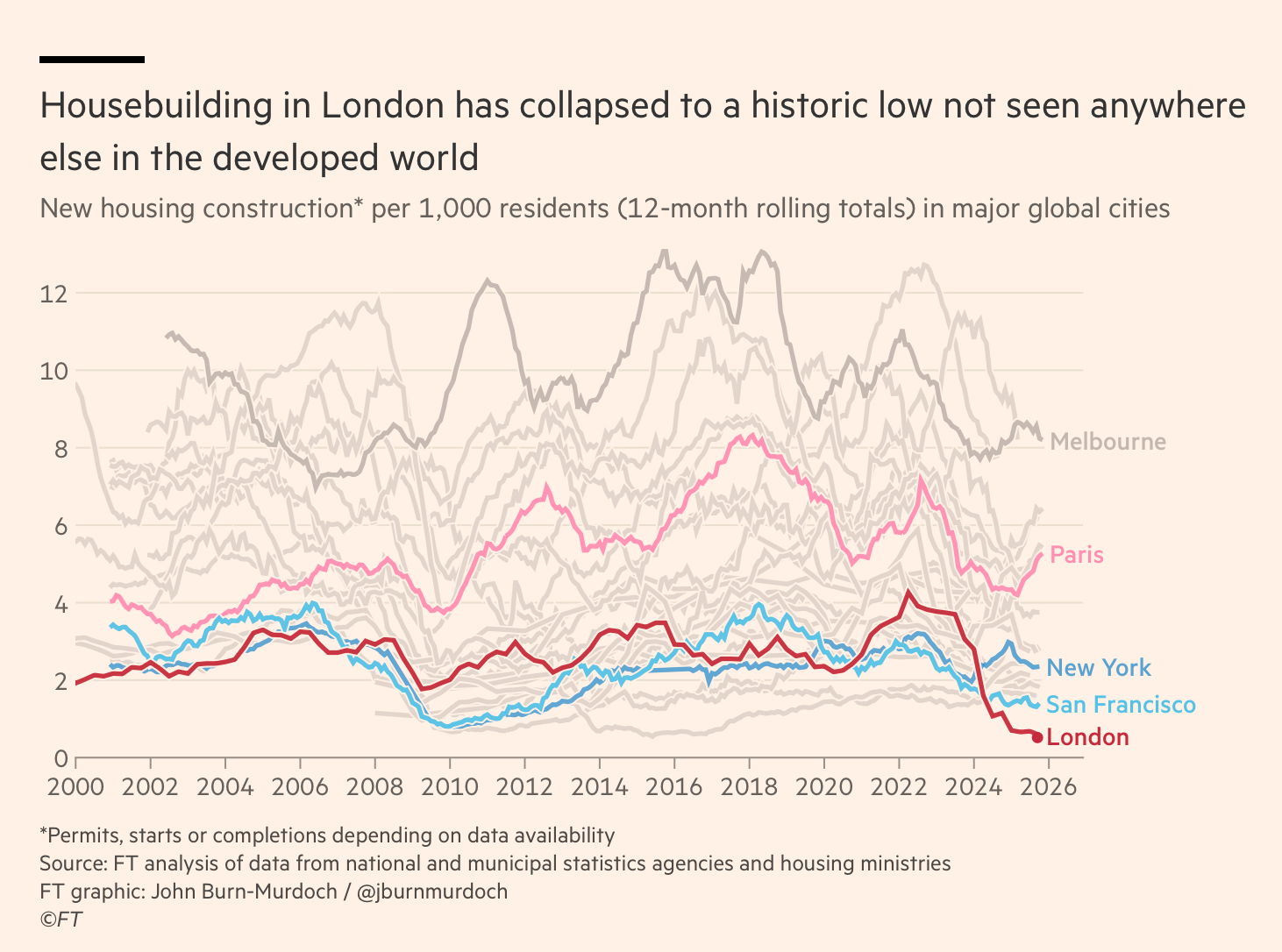
    London has an ambitious housing target of 88,000 new homes per year — yes, per year — over the next decade. This is part of a broader national goal to create upwards of 1.5 million homes in the UK. It’s an admirable goal, but the city appears destined to fail. According to a recent FT article by John Burn-Murdoch (their chief data reporter), London saw just 5,891 housing starts last year, which is 94% below its annual target and which represents a 75% year-over-year decline. When compared to many other global cities, London now ranks at or near the bottom when it comes to new homes per 1,000 residents:

    Burn-Murdoch cites a multitude of factors responsible for this suboptimal performance: onerous new safety standards following the horrific 2017 Grenfell Tower fire, more stringent environmental regulations (compared to other European countries), the disappearance of international buyers in the residential buy-to-let market, and increased demand for non-residential uses. What is obvious is that building safety is paramount and nothing like what happened with the Grenfell Tower should ever happen again. But with ~281,000 new homes approved but financially unviable, there does appear to be a desire to balance safety with supply).

    His third point is an interesting one in that parallels have played out in Toronto’s new condominium market. The pejorative narrative of “foreigners taking homes away from locals” is commonplace in cities all around the world, which is why Canada ultimately moved to temporarily ban foreign buyers. But what we start to see here is the impact on overall housing supply. Indeed, a 2017 study from LSE (cited in the above FT article) found that international capital and residential pre-sales are essential ingredients in de-risking high-density projects and promoting greater housing supply.

    Tying this all together, what has happened is the creation of an interdependency: we have made new housing developments so complicated and onerous to construct that the only financially feasible way to build them is to amortize all of the required time and money across bigger projects. Then, given the scale and cost of these projects, they have become dependent on investors and international capital to provide financing. Raise interest rates, remove the capital source, and then all of a sudden you have far less housing than 88,000 new homes per year.

    It is for reasons like these that I get frustrated when critics simply blame developers or investors for shortcomings in a housing market. Finding villains is a lot easier than doing the difficult work of unpacking what’s really going on and coming up with solutions.


    Cover photo by Gonzalo Sanchez on Unsplash

    Chart from the Financial Times

  • Stablecoins have created borderless value transfer

    February 15, 2026 · View original


    Stablecoins, as we have talked about, seem to be the first cryptocurrency use case that has achieved product-market fit. According to this recent piece by Chris Dixon in the Financial Times (which was later republished here), stablecoins moved over $12 trillion in value last year, even after filtering out stuff like bot activity. This is closing in on the $17 trillion in transactions that Visa processed last year; but crucially, stablecoin transactions are made at a fraction of the cost.

    It also doesn’t matter if people recognize that they’re using crypto or not. The backend is continuing to be abstracted:

    > People all over the world will barely recognise when they’re using stablecoins when making transactions supported by them. Most people will assume they’re just using dollars. And they will be, because the differences between a stablecoin and a dollar are becoming an abstraction for the end user.

    And the great promise is the following:

    > This isn’t just about payments. It’s a realignment of global finance. The internet gave us borderless communication. Stablecoins give us borderless value transfer. With clear rules and market structure in place, they can become both the pipes and the pillars of a new financial system.

    What’s also interesting, though, is that this shift seems to be strengthening US dollar dominance, as opposed to undermining it:

    > Stablecoin adoption also has an underappreciated second-order effect: The tokens reinforce dollar dominance in a multipolar world, creating a strong new source of demand for US debt. Leading stablecoin issuers like Circle and Tether already have nearly $140bn in direct holdings of short-term government debt, making them a top 20 holder of US debt today.

    If you’re looking to invest alongside this shift — and, oh boy, this is definitely not investment advice! — well, then, buying some Ether (ETH) may not be the worst idea. The majority of stablecoin transactions settle on Ethereum or on an Ethereum Layer 2, meaning that every time a transaction is completed, some amount of ETH is burned or destroyed. (Here’s a Coinbase referral link that will give you C$30 in Bitcoin (BTC) when you sign up and trade.)

    The bull case for ETH is that it will simultaneously become (1) the mandatory collateral and fuel for a new financial system, and (2) a deflationary asset, where more ETH is generally getting burned than is being created to reward network validators. Whether this will happen and boost the price of ETH, of course, remains to be seen. But in my view, the writing is very obviously all over the wall. Stablecoins have become part of the mainstream. The question is: where will all the value accrue in this new world?


    Cover photo by Kanchanara on Unsplash

  • The great density dilution

    Development density used to be hugely valuable in Toronto; now, it’s not.

    February 14, 2026 · View original


    Development density used to have significant value here in Toronto. Every square meter mattered. In fact, as many of you know, entire development businesses were centered around assembling sites, rezoning for the maximum amount of area, and then selling to another developer who would then build out the final project. The process of rezoning a site often takes years, and sometimes much longer, so there’s a logic to splitting up these efforts.

    But then demand waned and, all of a sudden, development density had much less value, if it was even liquid at all. This business model no longer works. On top of this, the City of Toronto is now in the process of updating its zoning by-laws to allow greater heights and densities across 120 major transit station areas and protected major transit station areas across the city. These updates are expected to be brought to City Council in the spring of this year.

    The result is that these areas will have minimum heights and densities that may take a site’s zoning from 4 storeys to 30 storeys. And the great irony will be that sites that spent years, and sometimes decades, battling for taller buildings, may soon receive as-of-right permissions that exceed their hard-fought zoning approvals. This is how much the planning and development landscape has changed in Toronto over the years.

    And it further reinforces the point I made back in 2024 when I wrote that development value has shifted from land to the build. Density is now widely available. Execution is what matters most today.


    Cover photo by Patrick Tomasso on Unsplash

  • Why Toronto is still failing when it comes to missing middle housing

    February 13, 2026 · View original


    In yesterday’s post, we spoke about the strengthening of Toronto’s urban grid and how the city has evolved and is evolving beyond a monocentric, downtown-oriented city. But in arguing this, I was careful to say that the policies and our efforts remain a work in progress. And that’s because, when the rubber hits the road, it’s not easy transforming car-oriented suburbs into something that resembles urbanity.

    Here, for example, is a six-storey infill apartment project proposed for Pharmacy Avenue, south of St. Clair Avenue East, in Scarborough. Pharmacy is a designated “major street,” so in theory, a project of this scale could advance straight to a building permit. But for whatever reason, the developer needed some planning variances and went to the Committee of Adjustment to ask for permission.

    The Committee recently said no:

    > “I understand it’s an arterial [and] I understand we want intensification along arterials,” one of the members said at the hearing, “but honestly, to shoehorn an apartment building into a lot like this doesn’t make any sense to me.” Tristone has appealed.

    Which is frustrating:

    > Blair Scorgie, Mr. Malhotra’s planning consultant, points to apparent contradictions in the city’s land use and zoning policies. While council voted in favour of such intensification on its major streets, including those in the suburbs, proposals that optimize what’s allowed run up against other provisions in the official plan that aim to regulate “neighbourhood character” as well as a host of highly site-specific zoning rules that predate the city’s 1998 amalgamation. > > “The fact that it appeared like `mini-mid-rise’ surrounded by bungalows has absolutely nothing to do with the policy and the regulatory framework,” he says. “That has everything to do with neighbourhood character and the prioritization of the existing context over the planned future context that’s envisioned by the city.”

    Blair hits the nail on the head with these comments. Six storeys shouldn’t matter. A lack of parking also shouldn’t matter. The reason the proposal was refused is because the lens of review was that of yesterday’s Toronto, rather than that of the Toronto of tomorrow. If the goal is more housing, and a medium-density grid that can support a comprehensive transit network, then these are exactly the kind of projects we should be building all across the city.

    And they should not necessitate any planning variances.


    Cover photo by Joaquin Alcaraz on Unsplash

    Project rendering from Noam Hazan Design Studio

  • The new Eglinton line and Toronto’s strengthening urban grid

    February 12, 2026 · View original


    Toronto’s Eglinton Line 5 opened last weekend — finally. I have yet to ride it, but I’m really looking forward to doing so the next time my day brings me north of St. Clair or I find the time for a joyride. Notwithstanding the fact that it took a really long time, it’s a crucial piece of transit infrastructure for the city.

    It’s a need that we arguably recognized in the 80s with a proposed busway, and then started and stopped construction on in the 90s with the Eglinton West line. Some four decades later, we now have a 25-station, 19-kilometre rapid transit line that runs across the middle of the city.

    Transit consultant Jarrett Walker is calling it the first major transit investment that shows Toronto is moving away from its downtown-oriented network. Historically, Toronto’s transit network has emphasized bringing commuters from the suburbs and other lower-density parts of the city to downtown for work. Then, at the end of the day, these people would return home. Simple.

    But this kind of network no longer reflects the reality of today’s city, which has become and is continuing to become far more polycentric.

    Walker’s argument is that Toronto needs a transit network to match its grid geography, so that “people can go from anywhere to anywhere in a simple L-shaped trip, usually with a single transfer.” Line 5 is an example of this approach and, of course, we need much more of it.

    But the other thing that is needed alongside a “grid transit network” is the right land-use approach. One of the fundamental principles that we espouse on this blog is that land-use and transportation planning are interdependent.

    In this regard, Toronto is undertaking some important planning work. It has been proposing new Avenues (a defined term that you can read about here) and encouraging more housing along all of its Major Streets (also a defined term).

    These efforts remain a work in progress, but at their core, they serve to broadly increase the average density across the city (which is a prerequisite for transit ridership) and to, what I’m going to call, “strengthen the urban grid.” It helps move Toronto further away from being a monocentric, downtown-oriented city toward something more akin to a Paris.

    What we have is a really interesting moment in time where transportation efforts and land-use policies are starting to coalesce around a new kind of Toronto. One that is decidedly more urban and less car-oriented. This is good. Now, let’s do it faster.


    Transit map via the TTC

  • How the Gordie Howe bridge broke a billion dollar monopoly

    February 11, 2026 · View original


    How the Gordie Howe International Bridge came to be is a city and nation-building story worth telling. The Windsor-Detroit crossing is the busiest commercial border crossing in North America. It handles about one-third of the trade.) between Canada and the US, or about $1 billion per day, much of which passes over the Ambassador Bridge.

    This is problematic for a few reasons.

    One, there are concerns about capacity. Two, the bridge is, unfortunately, in the wrong place and doesn’t offer direct highway-to-highway access. A truck coming off the Ambassador Bridge in Windsor has to pass through something like 17 traffic lights before reaching Highway 401. And third, and most importantly, the bridge is privately owned.

    So, at some point, various people in government got together and said, “Hey, this bridge is pretty critical to our respective economies, it might be in our national interests to have a publicly owned bridge.”

    The federal government of Canada reportedly tried to buy the bridge in 2009, but the late Manuel Moroun wanted too much for it, and a deal was not struck. So then, in 2012, the Canadian and US governments approved the construction of a new bridge, now nearing completion and called the Gordie Howe International Bridge.

    However, a second river crossing meant that Moroun would no longer have a monopoly, and so, an aggressive lobbying campaign was mounted. It was so effective that the bridge almost got canceled and funding for it became a “third rail” in Michigan politics. To save the project, the following deal was struck:

    – Canada pays 100% of the ~C$6.4 billion cost to build the bridge. – From the outset, the bridge is a joint binational asset owned equally by the Government of Canada and the State of Michigan, even though Canada is financing the entire project. – Construction jobs and materials are sourced from both sides of the border. – Oversight of the bridge is handled by the International Authority, a board with equal representation (3 members from Canada, 3 from Michigan). – Canada receives 100% of the toll revenue until it recoups its costs; after that, toll revenue will be shared with Michigan.

    In other words, the only way this deal got done was (1) for Michigan not to spend any money on it and (2) for Canada to finance Michigan. This was the solution to dysfunctional politics, where individual interests trump the greater good. I have not looked into and modeled the exact terms under which Canada is financing Michigan, but let’s hope that taxpayers are being fairly compensated for bringing this solution.

    Regardless, there’s no doubt that this is a crucial nation-building project for both Canada and the US. It will be an exciting moment for our countries when it opens and people and goods begin to flow. Based on the current status of construction, my understanding is that this will happen early this year. It’s basically ready.


    Cover photo from Gordie Howe International Bridge

  • The unbundling of the home

    Why self-storage continues to be a growing real estate asset class

    February 10, 2026 · View original


    I have never rented a self-storage unit. I have stored things at my parents’ places during certain periods of my life, such as when I moved to the US for grad school, but as a general rule, I never seem to conclude that I have too much stuff and that I should maybe rent some storage. However, I do on occasion fantasize about having a garage or large “man cave” where I could store an assortment of exotic snowboards, bicycles, and other life essentials. I mean, who doesn’t, right?

    In any event, I seem to be in the minority, because self-storage is a growing real estate asset class:

    > Investors have dramatically increased their allocation to self-storage over the last several years in the US]. A rush into the asset class occurred from 2020 to 2022, when transaction volume hit $50 billion, far exceeding the $35 billion spent during the entire seven‑year period from 2013 to 2020, according to [Cushman & Wakefield. Transaction volumes are now normalized but remain well above their pre‑pandemic baseline.

    Moreover:

    > It proved to be the best-performing sector in the NCREIF Property Index from 2005 to 2022, with returns since 2010 nearly double that of the overall index.

    So what’s driving this? Some of the explanations include a frozen housing market, millennials who haven’t yet bought a garage and are starved for room, and small-scale entrepreneurs who use it as cheap warehouse space. According to some reports, this latter use case accounts for nearly a third of total demand. And this makes sense to me. But generally, I have tended to apply an egocentric bias to this asset class. My mind discounts it because I don’t personally use it.

    One way to look at self-storage is that it represents the “unbundling of residential real estate.” Housing has gotten so expensive that we continue to search for ways to make it smaller and more efficient. One second-order consequence of this is that storage now needs to be disaggregated and moved to an off-site location where land is cheaper and the build costs are lower. From this perspective, there are strong structural reasons for the sector’s growth.

    There are also noteworthy differences between Canada and the US. Americans use self-storage at roughly 2 to 3x the rate of Canadians when measured by square footage per capita. Is this because Americans are bigger consumers and have more stuff? Or is it because the industry is more mature and built out at this point? It’s likely both of these factors.

    According to Avison Young, the supply of new self-storage in Canada is projected to nearly double year-over-year from under 1 million square feet in 2025 to over 1.8 million square feet in 2026. Another specific demographic factor contributing to this growth is Canada’s aging population. People are downsizing and then needing to put their stuff somewhere. How long this stuff stays in storage, I don’t know, but it’s there.

    I think the personal tension I have with self-storage is that there’s a big part of me that aspires to have less stuff. When I travel, I take great pride in often packing only a carry-on. There’s something liberating about having everything I need in one roller. Less is more. But then again, I could really use a new commuter bicycle and I have been meaning to get into splitboarding. How much do those storage units cost again?


    Cover photo by Aga Adamek on Unsplash

  • Patience is a virtue

    February 9, 2026 · View original


    A closed-end real estate fund is an investment vehicle with a finite life (call it anywhere from 5 to 12 years, plus extension options). These types of funds have a specific timeframe for raising capital, investing, harvesting the investments they have made, and then distributing proceeds to investors. This is in contrast to an open-ended fund, also known as an “evergreen” fund, which has an infinite life and can accept investments throughout its lifespan.

    As a result of these differences, closed-end funds are often used for opportunistic or value-add opportunities where the defined strategy is to buy, fix/develop, and then sell, whereas open-ended funds are often used for core opportunities, where the assets are intended to be held indefinitely for income. Neither fund structure is inherently good or bad; each has its benefits and drawbacks.

    However, the perceived weighting of these benefits and drawbacks shifts during market cycles. Since global real estate markets started to turn downward in 2022, the ability to be patient and think long-term has become a key ingredient for survival. You may have done everything you said you would do perfectly, but the market may not be there to grant you the liquidity you had originally planned for.

    Now the question becomes: How patient can and should we be?

    In my opinion, the greatest opportunities exist for (1) the larger firms that have a strong balance sheet and defensible income-producing properties and (2) the smaller, nimble firms that can capitalize on the dislocation in the market (and aren’t overly burdened with legacy assets that are sucking up resources and capacity).

    This perspective is true of other sectors as well. This weekend, venture capitalist Chris Dixon of a16z wrote a post titled, “The long game for crypto.” In it, he alludes to the current market downturn (ETH is down nearly 60% from its all-time high) and says that “we play the long game at a16z and a16z crypto: Our funds are structured with 10+ year horizons because building new industries takes time.”

    The fact that he wrote this post says a lot, I think, about the psyche of investors today. The perceived weighting has changed, and people are now investing and building more for the future. As the late Charlie Munger once said, “The big money is not in the buying and the selling, but in the waiting.”


    Cover photo by KAi’S PHOTOGRAPHY on Unsplash