
Canada must become a global superpower
The silver lining to the US starting a trade war with Canada and regularly threatening annexation is that it has forced this country out of complacency. Indeed, I'm hard pressed to remember a time, at least in my lifetime, when patriotism and nationalism has united so much of Canada. According to a recent survey by Angus Reid, the percentage of Canadians expressing a "deep emotional attachment" to the country jumped from 49% in December 2024 to 59% in February 2025. And as further evidence of...

The bank robbery capital of the world
Between 1985 and 1995, Los Angeles' retail bank branches were robbed some 17,106 times. In 1992, which was the the city's worst year for robberies, the number was 2,641. This roughly translated into about one bank robbery every 45 minutes of each banking day. All of this, according to this CrimeReads piece by Peter Houlahan, gave Los Angeles the dubious title of "The Bank Robbery Capital of the World" during this time period. So what caused this? Well according to Peter it was facil...
The story behind those pixelated video game mosaics in Paris
If you've ever been to Paris, you've probably noticed the small pixelated art pieces that are scattered all around the city on buildings and various other hard surfaces. Or maybe you haven't seen or noticed them in Paris, but you've seen similarly pixelated mosaics in one of the other 79 cities around the world where they can be found. Or maybe you have no idea what I'm talking about right now. Huh? Here's an example from Bolivia (click here if you can't see...

Canada must become a global superpower
The silver lining to the US starting a trade war with Canada and regularly threatening annexation is that it has forced this country out of complacency. Indeed, I'm hard pressed to remember a time, at least in my lifetime, when patriotism and nationalism has united so much of Canada. According to a recent survey by Angus Reid, the percentage of Canadians expressing a "deep emotional attachment" to the country jumped from 49% in December 2024 to 59% in February 2025. And as further evidence of...

The bank robbery capital of the world
Between 1985 and 1995, Los Angeles' retail bank branches were robbed some 17,106 times. In 1992, which was the the city's worst year for robberies, the number was 2,641. This roughly translated into about one bank robbery every 45 minutes of each banking day. All of this, according to this CrimeReads piece by Peter Houlahan, gave Los Angeles the dubious title of "The Bank Robbery Capital of the World" during this time period. So what caused this? Well according to Peter it was facil...
The story behind those pixelated video game mosaics in Paris
If you've ever been to Paris, you've probably noticed the small pixelated art pieces that are scattered all around the city on buildings and various other hard surfaces. Or maybe you haven't seen or noticed them in Paris, but you've seen similarly pixelated mosaics in one of the other 79 cities around the world where they can be found. Or maybe you have no idea what I'm talking about right now. Huh? Here's an example from Bolivia (click here if you can't see...
Share Dialog
Share Dialog


One of the themes we cover on this blog is the importance of place in a world where people are becoming increasingly untethered. While I'm a firm believer that great local places have enduring value, this does not mean that technology isn't driving greater fluidity in the way people live, work, play, and optimize their taxes.
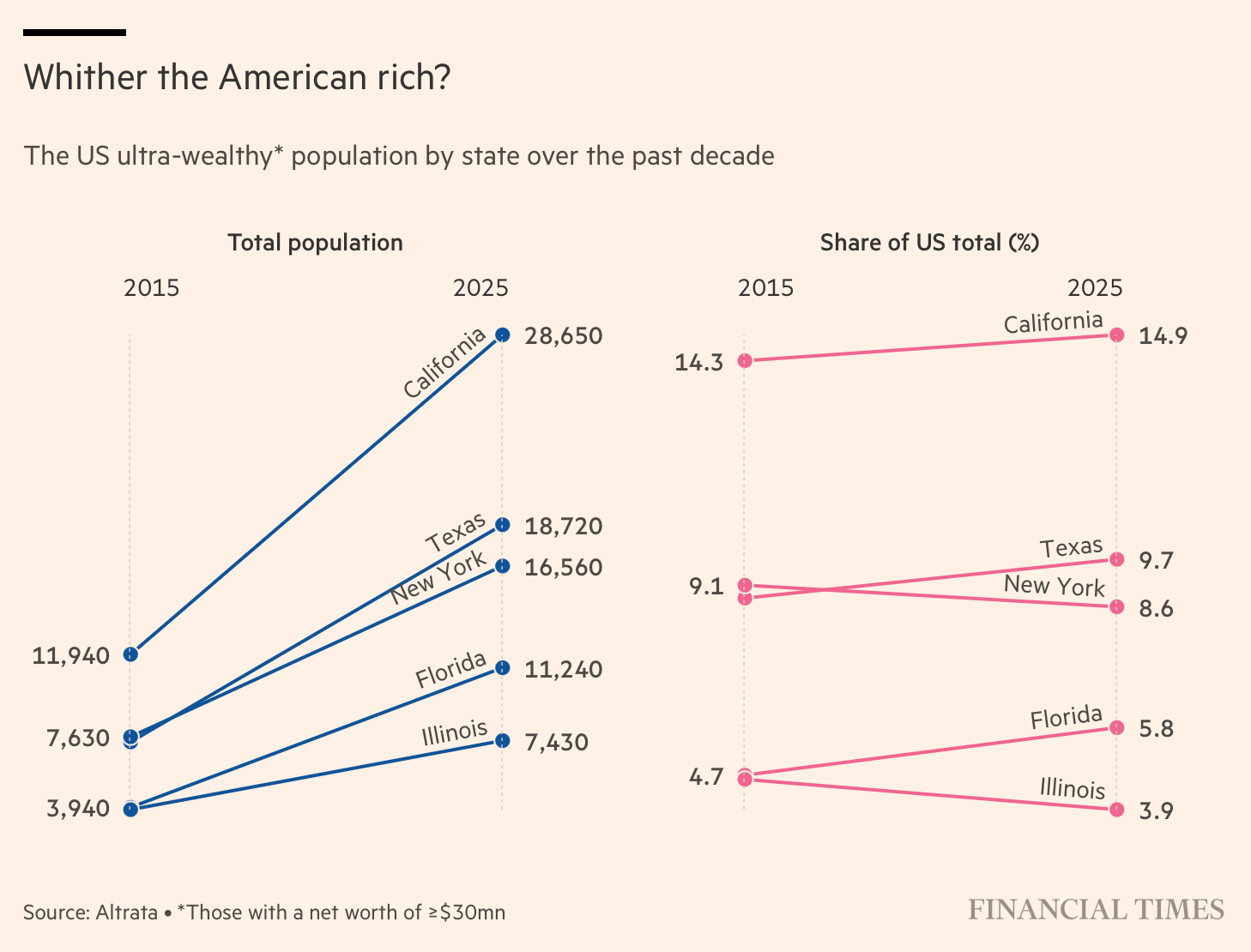
Over the last decade, the population of ultra-wealthy Americans (those with a net worth greater than or equal to $30 million) has risen noticeably in two states: Texas and Florida. California, a high-tax state, still dominates; however, Texas has overtaken New York, and Florida has overtaken Illinois. Notably, both Texas and Florida have no state income tax — they also have warmer weather than New York and Illinois.
As we have talked about before, there's a longstanding migration trend in the US toward sun, urban sprawl, and lower taxes. But it's not always as clear-cut as a rich person fully relocating to a lower-tax jurisdiction and completely severing ties. The enduring value of place means that many people still travel back and forth to meet whatever personal or professional obligations they might have.
And today, there are apps, such as TaxBird, that will meticulously track the number of days you spend (or your phone spends) in each jurisdiction to ensure you don't cross any important residency thresholds.
The global standard is the 183-day rule (or roughly half a year). In many or most cases, if you are physically present in a place for more than 50% of the year, you are automatically considered a resident for tax purposes. But it's not always this simple, so check with your tax advisor. Regardless, the untethering of life and work is surely allowing more people to tax-optimize in this way.
None of this is surprising.
As Charlie Munger used to say, "Show me the incentive, and I'll show you the outcome." But now we need to think about the longer-term ramifications for colder, higher-tax jurisdictions as capital and tax revenue continue to be siphoned off, not only to Texas and Florida, but to Dubai, Singapore, Hong Kong, Switzerland, Monaco and other places.
Cover photo by Colin Lloyd on Unsplash
One of the themes we cover on this blog is the importance of place in a world where people are becoming increasingly untethered. While I'm a firm believer that great local places have enduring value, this does not mean that technology isn't driving greater fluidity in the way people live, work, play, and optimize their taxes.
Over the last decade, the population of ultra-wealthy Americans (those with a net worth greater than or equal to $30 million) has risen noticeably in two states: Texas and Florida. California, a high-tax state, still dominates; however, Texas has overtaken New York, and Florida has overtaken Illinois. Notably, both Texas and Florida have no state income tax — they also have warmer weather than New York and Illinois.

As we have talked about before, there's a longstanding migration trend in the US toward sun, urban sprawl, and lower taxes. But it's not always as clear-cut as a rich person fully relocating to a lower-tax jurisdiction and completely severing ties. The enduring value of place means that many people still travel back and forth to meet whatever personal or professional obligations they might have.
And today, there are apps, such as TaxBird, that will meticulously track the number of days you spend (or your phone spends) in each jurisdiction to ensure you don't cross any important residency thresholds.
The global standard is the 183-day rule (or roughly half a year). In many or most cases, if you are physically present in a place for more than 50% of the year, you are automatically considered a resident for tax purposes. But it's not always this simple, so check with your tax advisor. Regardless, the untethering of life and work is surely allowing more people to tax-optimize in this way.
None of this is surprising.
As Charlie Munger used to say, "Show me the incentive, and I'll show you the outcome." But now we need to think about the longer-term ramifications for colder, higher-tax jurisdictions as capital and tax revenue continue to be siphoned off, not only to Texas and Florida, but to Dubai, Singapore, Hong Kong, Switzerland, Monaco and other places.
Cover photo by Colin Lloyd on Unsplash
No comments yet