Daily insights for city builders, delivered every morning at 6 AM ET. I’m Brandon Donnelly — a Toronto-based real estate developer and founder of Globizen. I’ve been writing here since 2013.

Tag: venice

  • Venice to Venice

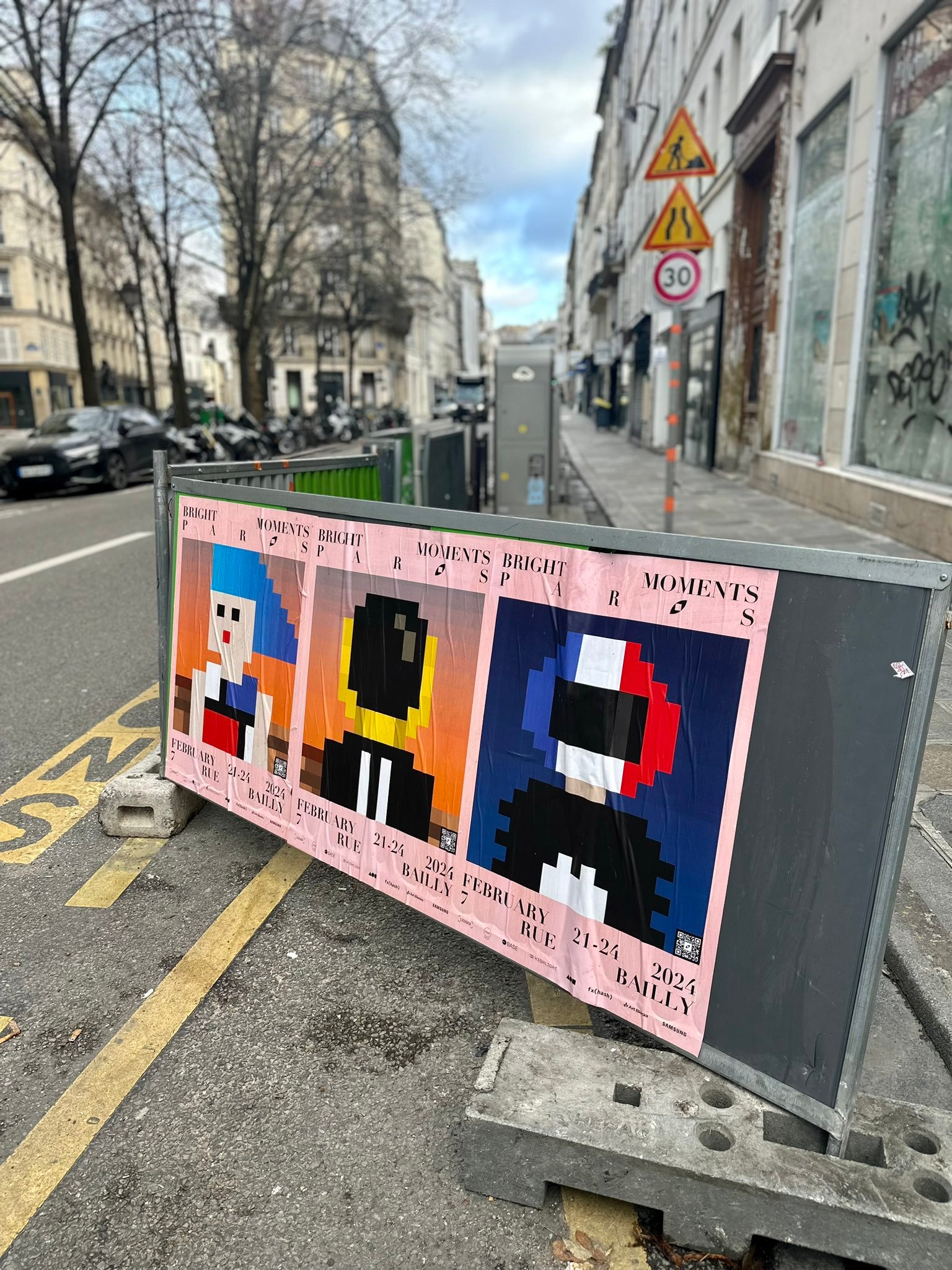
    Crypto Citizens are a collection of 10,000 NFTs that were minted between 2021 and 2024, starting first in Venice, California and ending in Venice, Italy. Each of their 10 locations has a sub-collection of 1,000 pieces and I am the owner of CryptoParisian #112, because, well, Paris was the next best city for me after they egregiously skipped over Toronto.

    This is one of the most ambitious projects in the NFT art community and, now that they’ve completed their world tour, they’ve just released a documentary called Venice to Venice. It is currently being screened in private venues around the world, but eventually there will be a world premiere at a film festival. This is when I presume they will land in Toronto!

    If you’d like to watch the trailer and/or mint it, click here.

    Photo: Seth Goldstein

  • CryptoParisian #112

    I have written about Bright Moments before. They are a digital art company exploring the intersection of NFTs and real-world experiences. It started as a popup gallery in Venice Beach California, where artists could show new work and where collectors could buy IRL. They then created their own pixel art collection called CryptoVenetians. It included 1,000 different people-centered NFTs by artist QianQian. Since then, they have gone on to host events and create new CryptoCitizen collections in New York, Berlin, London, Mexico City, Tokyo, and Buenos Aires. And this week they were in Paris.

    (I don’t know why they skipped over Toronto!)

    Their end goal is to create a complete collection of 10,000 NFTs, most of which are tied to a specific city. (The only one that isn’t is their CryptoGalacticans collection.) What’s obviously great about this approach is that it’s a way to promote digital art and onboard new users into the crypto space. They are literally going around the world, throwing parties, and saying “look how cool and fun this whole crypto thing is.” At the same time, it also links the digital and the physical, which I believe is fundamental. We’re social beings and web3 will never change that.

    The other interesting thing about Bright Moments is that they are structured as a decentralized autonomous organization (or DOA). That’s like a company, except that governance is distributed to its tokenholders and it’s all managed on a blockchain. But it still operates as a company and it can raise money like one too. In 2021, Union Square Ventures invested 500 ETH into the DOA through a blockchain transaction that would naturally be public if you cared to look it up. Based on today’s spot price of about CA$4k per ETH, that was a CA$2 million investment.

    In the case of Bright Moments, its tokenholders are the people who own a CryptoCitizen. These are the people who get to vote on how the organization is run. They can also earn money if they do things like host a community dinner or organize a local meetup, with the idea being that, as an organization, you want to encourage this sort of bottom-up participation and innovation. I find it fascinating to watch this new governance and entity structure emerge, and it will only continue to evolve.

    I’ve been following Bright Moments more or less since they dropped the CryptoVenetians. I thought about jumping in then, but I figured I would wait to see if there would be a CryptoTorontonian. That would obviously be my number one choice. But once they announced their final list of cities, and Toronto wasn’t on it, I grumpily decided I would instead wait for a CryptoParisian. And since this week was Paris, it was time.

    I now hold CryptoParisian #112:

    I like that it has the Pont Neuf and that the human is wearing sunglasses.

    This means that I now have a small ownership stake in the Bright Moments DOA. So presumably I’ll soon have a say in important and serious matters! It also means that when they launch their final CryptoCitizen collection in Venice, Italy this spring (nice work going full circle here), there is a chance I might get airdropped a CryptoVenetian. It’s a random process, so whatever. I also know that it’s easy to look at this pixelated Parisian and think, “WTF, Brandon.” But something new is building here. And I’m sure that all of the folks who were in Paris this week can testify to that.

  • Venice announces new “entrance fee”

    Over the weekend, we spoke about using road pricing as a way to correct supply and demand imbalances on city roads and highways. Because it turns out that when roads, or anything else for that matter, are free, people tend to use them a lot more. It’s why when you suddenly submeter utilities in an apartment building, consumption tends to drop off significantly. Now it’s no longer “free”.

    It’s for this exact reason that Venice — a city that has been complaining about too many tourists for many years — has decided to implement a new entrance fee. Starting spring 2024, day trippers will have to pay €5 to enter the “old city” of Venice.

    If you own a home there, you’re exempt because presumably you’re already paying property taxes. And if you’re staying overnight, you’re also exempt, because presumably you’re going to be paying whatever hotel taxes the city levies. But if you’re just coming in for the day, you’re going to need to pay.

    Now, I don’t know if €5, structured in this way, is going to fully address the city’s overtourism concerns. Maybe it needs to be a lot more. But it is a step in the right direction. If you have too much demand for a certain amount of supply, you can generally lower demand by increasing the price. Perhaps the only exception is a Birkin bag. Apparently you can charge any price for these.

    Photo by Martin Katler on Unsplash

  • From unfashionable, dirty, and full of prostitutes, to too many tourists

    Cities are complicated. And we have spoken before about how it can sometimes feel like they never really reach homeostasis. In extreme cases, it might seem like they’re either decaying and losing people, or they’re too successful.

    I was reminded of this again this morning while reading an article about how Rome’s historic city center is being overrun with Airbnbs and tourists, and how it is pushing out the locals. It has, arguably, become too successful as a tourist destination.

    Of course, this problem isn’t unique to Rome. Venice has the same thing going on, though probably to a greater extent. And Amsterdam is currently working to attract more highbrow tourists and to move their red light district out of the city center.

    But the question I have is: What’s the right amount of tourism? If 25,000 listings is too many for Rome, what’s the right number? And do cities ever really achieve homeostasis, where, you know, things feel just right? Here’s an excerpt from the above article that describes what parts of Rome were like before the tourism boom:

    Ms. Rapaccini remembers when Monti was a quiet, authentic haven for arty types and locals. She and her late partner, the film director Mario Monicelli, who received six Oscar nominations, moved to Monti in 1988. The area was unfashionable, dirty and full of prostitutes, but beautiful in its gritty way, “like a little village” even though it was in the heart of a big, bustling city, she recalls. The apartments were cheap and the area began to attract film types, journalists and artisans – none of them rich – who mixed easily with local workers and shop owners.

    It’s a romantic description of what sounds like a pretty gritty area. Unfashionable, dirty, and full of prostitutes is apparently better than full of annoying American tourists. And perhaps it is. But then what was the area like before it was unfashionable, dirty, and full of prostitutes? Was that also better?

    I have no idea. But cities are constantly changing and evolving, and they were doing it long before any of us arrived, especially in the case of an ancient city like Rome. Maybe that’s what makes it so difficult to hang onto that exact moment in time when everything was just right.

    Chart: Globe and Mail

  • A few observations about Venice

    We are on the train headed to Milan this morning, so as is customary on this blog, here are a few observations from the last few days in Venice:

    • Venice was a dominant republic for some 1,000 years. It was the fulcrum point of trade in Europe and, at one point, its wealthiest city. But that started to change in the 15th century, which is an important reminder that nothing is guaranteed. The world changes. Markets change. And maybe you won’t be as relevant tomorrow, unless you can find another economic reason for being.
    • If you’re an old city with lots of history, perhaps the easiest fallback plan is tourism. And it goes without saying that Venice gets a lot of tourists. I was, of course, one of them. After Italian, the most commonly overheard language on the streets seemed to be French. Maybe it was the time of year?
    • Besides my debilitating spring allergies, May feels like a reasonably optimal time to visit the city. I don’t think you want to visit Venice in peak summer. Too many meandering tourists taking photos (myself included). And too hot and humid. A high probability of “walking rage.”
    • Hotels in Venice are not cheap. But the city itself didn’t seem overly expensive, at least compared to many other top tourist destinations. Think €2.50 jugs of wine, €20-30 for very nice local leather goods, and €110 for a 7-course Michelin-starred meal.
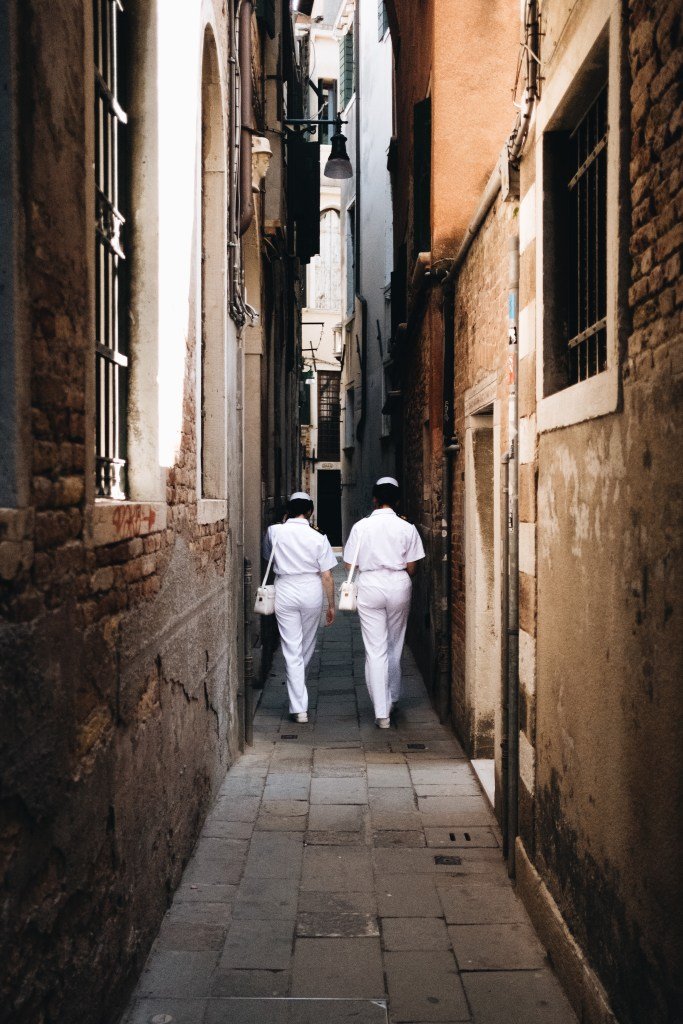
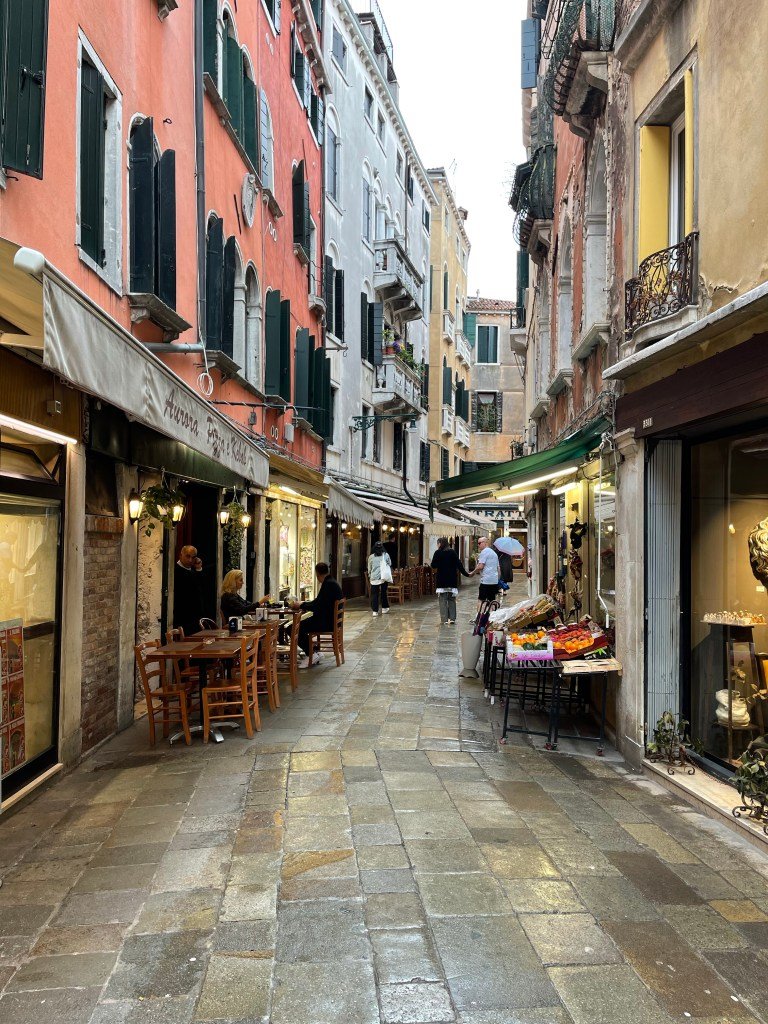
    • Venice has some of the most compact streets I have ever walked in. I didn’t have my laser distance measurer on me, but in many cases, you can barely fit two people side-by-side. I certainly couldn’t extend my arms fully outward. (See above photo.)
    • Wonderful doorbells. Virtually every apartment in Venice, has an array of doorbells at its front door. They are beautiful, typically in metal, and almost always round. But in addition to looking nice, there is also something very personal and about seeing people’s names right on the street. This probably tells you something about how differently privacy and security are viewed in the city.
    • That said, Venice isn’t a place where I would want a pied-à-terre. (I like to think about this sort of thing when I travel because it speaks to impressions of a place.) I mean, I love it, but: Too many tourists and the whole “we are sinking and have regular floods” thing seems like a bit of a problem. For me, it’s a city that I’d like to regularly visit. We spent much of our 2 days at the Venice Biennale, and there’s obviously a lot more to see.
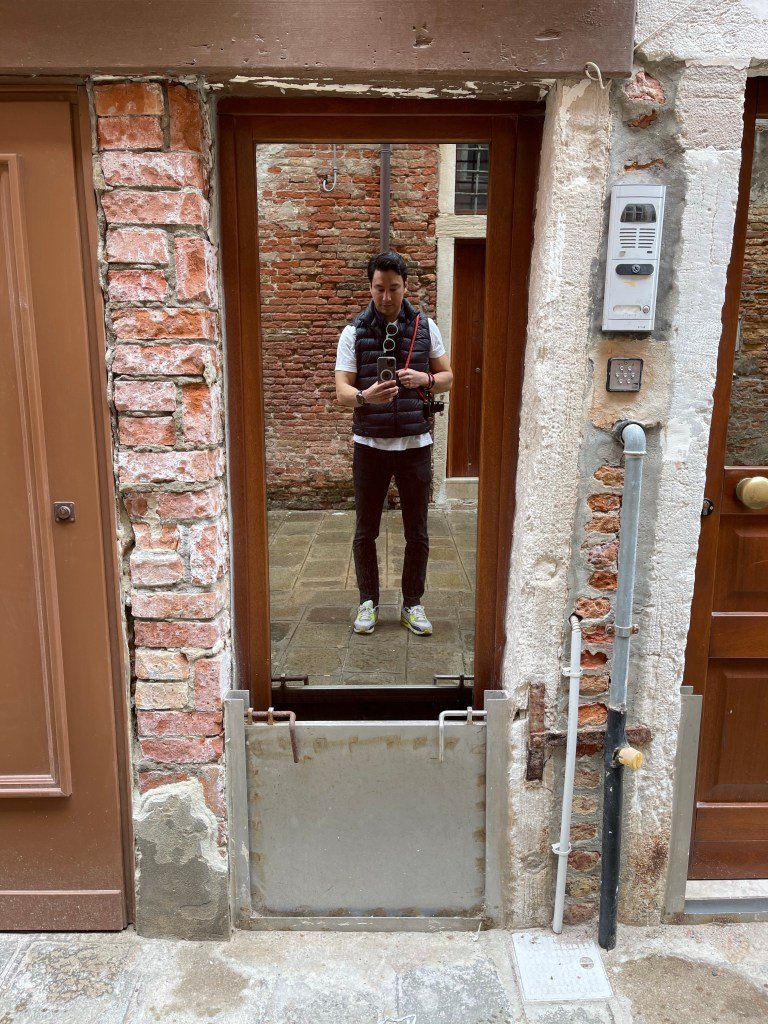
    • Finally, and this also goes without saying, but Venice is a city that is necessarily preoccupied with controlling water. Our hotel room had big rain boots in it, just in case. The base of every building is generally solid up to knee height. Interiors have tall tile baseboards. Front doors have removable flood dams. And there are markings across the city indicating some of its historic flood levels. As I understand it, this was always a problem for Venice; however, it is getting worse. I think it tells you just how economically valuable it was for Venice to be located where it is, in a shallow lagoon at the top of the Adriatic Sea.
  • Streets of Venice

    This entire city is centered around controlling water. Omnipresent front-door flood dam:

    Venice has great doorbell game. If it hasn’t already been done, I think someone should make a coffee table book of these:

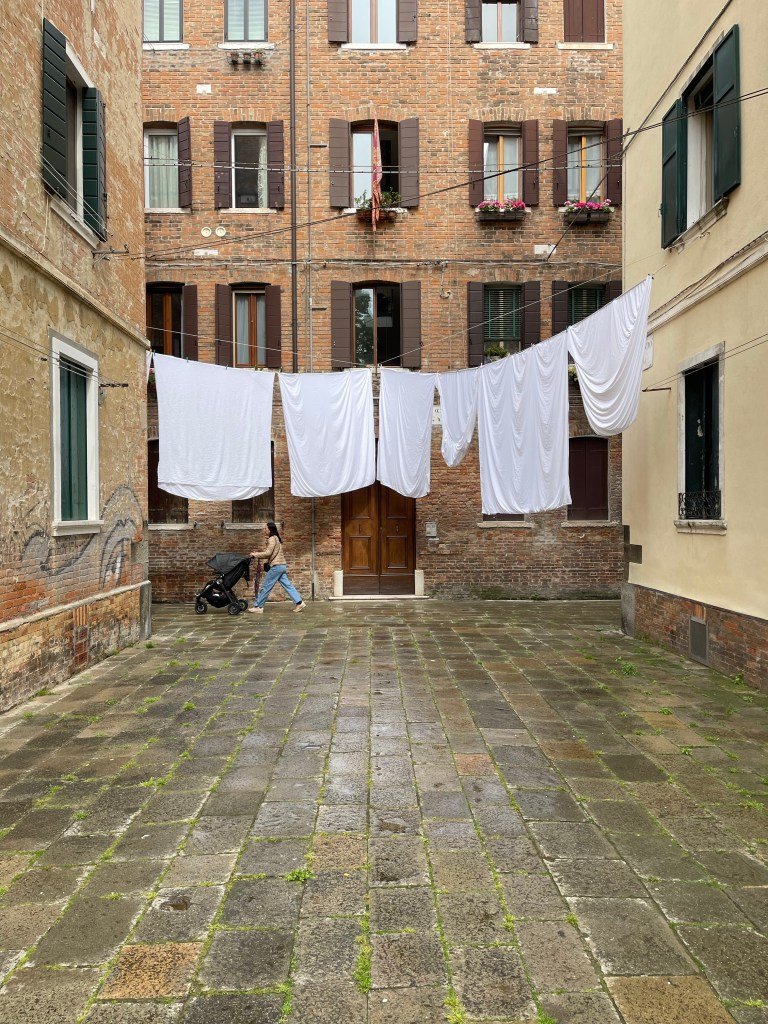
    This city is also quite prolific when it comes to urban laundry:

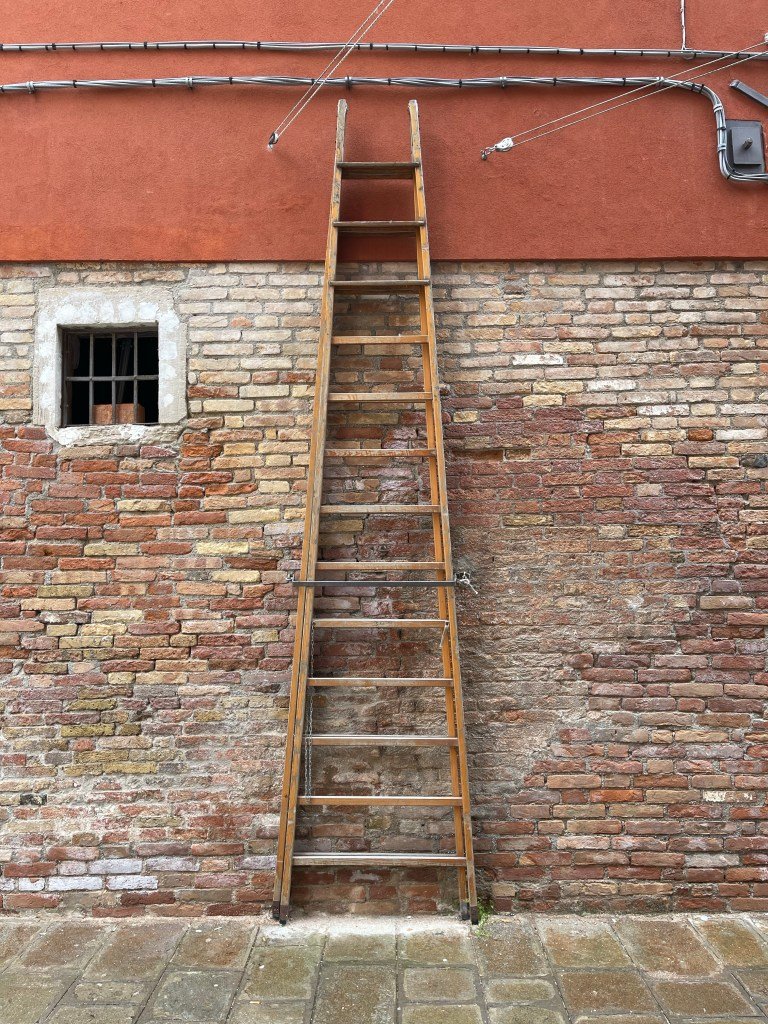
    We found a number of these street ladders. Presumably laundry related:

    Religion in the streets:

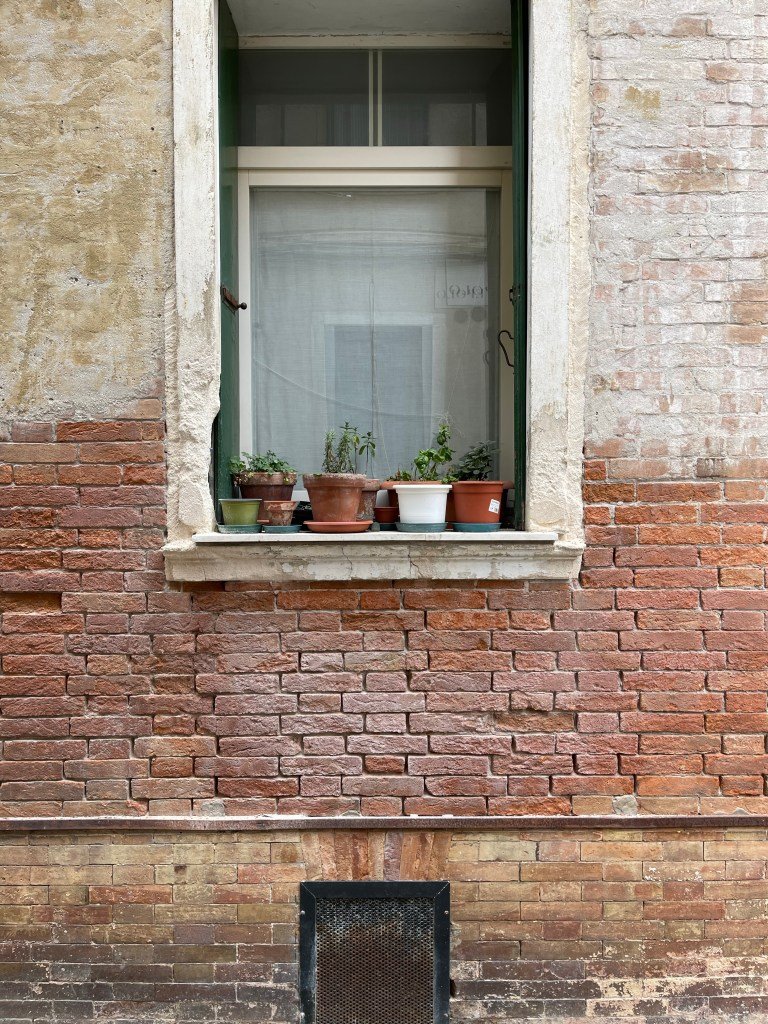
    Window garden:

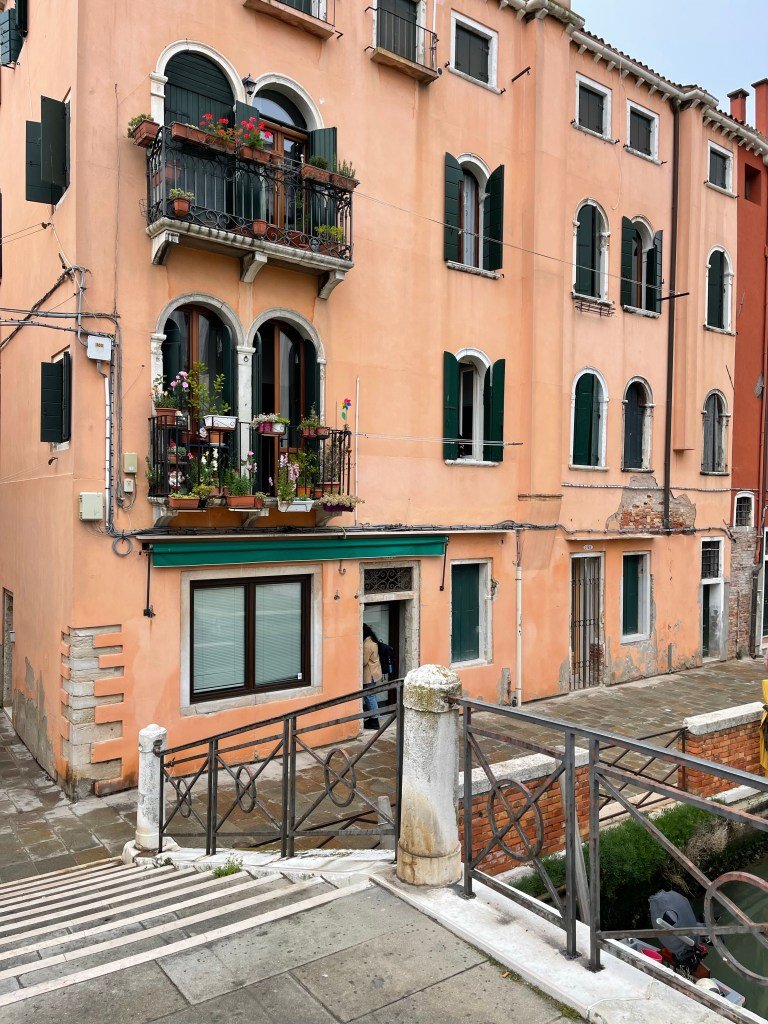
    Balcony gardens. Your reminder that (1) small balconies can still be impactful and that (2) balconies with a relationship to the street are used differently:

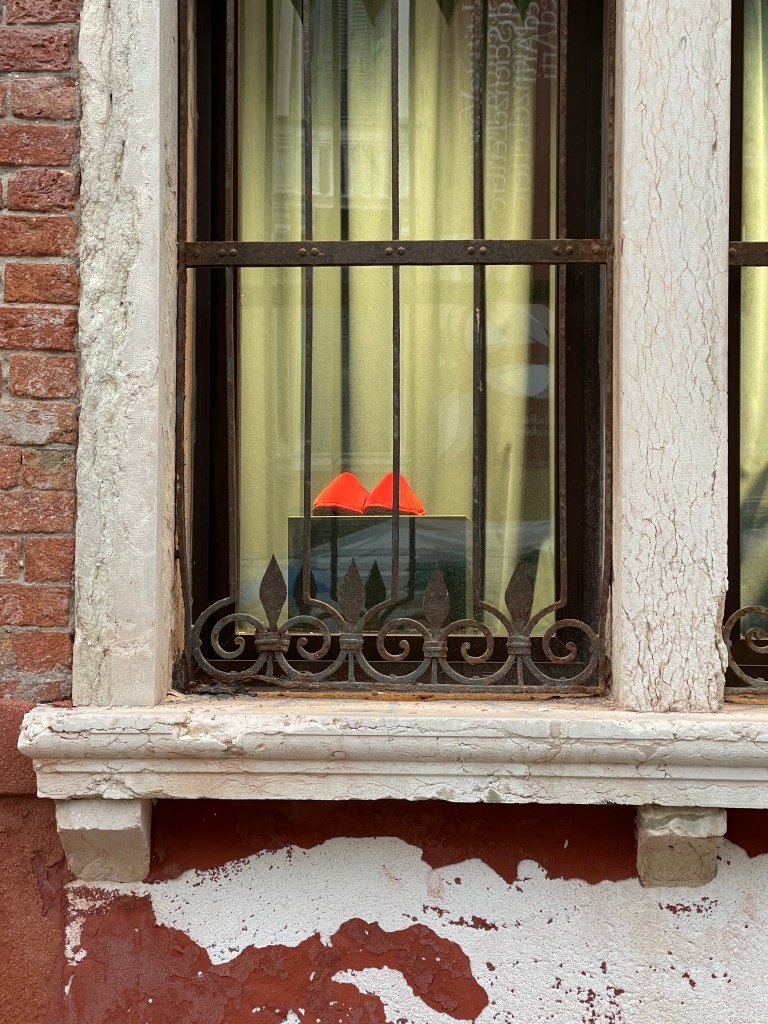
    Colorful shoes and green curtains:

    Grand Canal:

    The kind of street we should allow in North American cities:

  • The greatest photo of Venice I have ever seen

    This afternoon we went to the Mucem (Museum of Civilizations of Europe and the Mediterranean) here in Marseille. By far, my favorite exhibition was one that dealt with the urbanization of five cities surrounding the Mediterranean — namely Marseille, Venice, Istanbul, Cairo, and Alger. At one point, this was the center of the commercial world. Great empires were forged and great fortunes were made here. But things have changed a little since then. And in some cases, what we are now left with are scenes like the one you see above (photograph by Martin Parr). This is easily the greatest photo of Venice I have ever seen. Venice is a tiny city, but it receives tens of millions of tourists each year. This photo does an extraordinary job of capturing what that might feel like.

  • Interview with the mayor of Amsterdam, Femke Halsema

    Back in 2014, Amsterdam became the first city to have what is called a “night mayor.” The role of a night mayor is what the name suggests. They are intended to be the chief executive officer of a city’s nighttime economy. And so it was and it continues to be recognition that the night can be an important economic development tool.

    This seemed to work out well for Amsterdam, which is why many other cities quickly followed suit with their own night mayor elections. During this time, a number of us here in Toronto also started advocating for our own nighttime CEO. (FYI, here is a link to the current night mayor of Amsterdam.)

    But fast forward to today and the tone seems to have changed in Amsterdam. The city’s daytime mayor, Femke Halsema, is now actively concerned about over-tourism and, in particular, the way that some tourists behave when they check-in to Amsterdam.

    Here’s an excerpt from a recent interview that she did with Bloomberg:

    We have to tackle two problems. The first problem is what I’d call the London problem: Our city is becoming too expensive. That is also part of being an international city and having many expats living here. But it has consequences for the middle classes. It’s very difficult to find a house in Amsterdam except for the highest incomes, so our middle class — teachers, police officers, people working in health care — are leaving the city. We’re very alert about it. For a city to survive in the long run you need social stability and people from middle or lower classes to also feel at home.

    Our second problem is the Venice problem: The people who live here become estranged especially in the city center, because it’s no longer part of their city. We have to find a new balance, in being a home for people from Amsterdam and at the same time welcoming international visitors and tourists.

    More specifically, the Venice problem seems to be a problem of behavior:

    It’s not a form of tourism we welcome or don’t welcome — it’s a form of behavior. What we do not welcome is people who come here on a vacation from morals. They express a form of behavior they would not express at home. People coming here to lose their morals is a problem for us.

    It is for this reason that the city is hoping to relocate its red light district to outside of the city center. The intention is not to get rid of it, or for the city to turn its back on its long history of tolerance, but it does want to move it somewhere else in the hopes that Amsterdam will become more associated with culture than hedonism.

    But does moving it actually change any behaviors? If one were to develop a purpose-built “erotic center” from the ground up, is it even possible to make it more integrated with the broader city (minimize the Venice problem) and, to use the mayor’s words, make it more chic than what currently exists?

    These are all exceedingly tough city building questions that can’t really be untangled from questions of morality.

    For the full Bloomberg interview with mayor Halsema, click here.

    Photo by Azhar J on Unsplash

  • In real life in New York City

    This past weekend Bright Moments opened up their NFT art gallery in New York’s Soho. This is the company’s second gallery. The first was in Venice, California. And there are plans for eight more cities, with Berlin being the next one. (When is Toronto?!)

    Bright Moments is a decentralized autonomous organization (DAO), which is interesting in its own right but is a topic for another post. You can read a bit more about Bright Moments and DAOs, here and here.

    What I would instead like to talk about today is how Bright Moments is operating at the intersection of NFT art and real-world spaces. They are in effect a community. It’s a place for artists to release/showcase their work and a place for people to connect.

    One of the things that the company is doing with each gallery launch is minting an NFT collection that is tied to the city and that uses the local demonym. When they opened their popup in Venice, they launched the CryptoVenetians. And last weekend in New York they launched the CryptoNewYorkers.

    In each case, 1,000 NFTs were minted and the idea is that once they have expanded to their 10 cities, there will be a collection of 10,000 NFTs.

    I have said it before, but this is an exciting time in the world. Maybe this current NFT craze ends up being a massive bubble, or maybe it doesn’t. Either way, things are exciting.

    But here’s the thing.

    Organizations like Bright Moments show you just how important physical spaces, live communities, and cities continue to be. It doesn’t matter that this is digital art being displayed on a screen and that one could be viewing it from anywhere. People want to hang out in the same room and experience these sorts of new things together.

    I can’t see that ever going away.

  • Map art using Google Earth satellite images

    I just discovered the work of artist and photographer Federico Winer. More specifically, I just discovered his ongoing art project called ULTRADISTANCIA, which uses Google Earth satellite imagery as a starting point for beautiful map art.

    Above is a piece from his “Mines” collection. What you are seeing is the Ekati Diamond Mine in Canada’s Northwest Territories. It is located about 310 km northeast of Yellowknife, 200 km south of the Article Circle, and apparently it’s Canada’s first surface and underground diamond mine.

    In addition to using images of mines, Federico has transformed airports, ports, and other urban landscapes. Here is a link to his “Selected” gallery, which includes places ranging from Venice to Minas Gerais, Brazil. I think his work is amazing.

    If you’re interested in learning more about his workflow, you can also check out this short video.

    Image: ULTRADISTANCIA