Daily insights for city builders, delivered every morning at 6 AM ET. I’m Brandon Donnelly — a Toronto-based real estate developer and founder of Globizen. I’ve been writing here since 2013.

Tag: venice

  • Venice in numbers

    Here are some interesting figures about Venice take from this recent FT article by Chris Allnutt:

    • Tourist visits to Venice last year were estimated to be about 1/5 of what they usually are
    • Short-term rental bookings as of December 2020 were down about 74% year-over-year
    • It is estimated that short-term rentals normally represent about 12% of homes in Venice (this is significantly higher than the “typical city” which is estimated to be about 1-2%)
    • Even before the pandemic, average property prices had declined from about €4,500 per square meter in 2018 to €4,341 in 2019 (2020 data is still coming)
    • Pre-pandemic, the population of the city was about 50,000, which is less than a third of what it was back in the 1950s
    • A 2018 study by Airbnb reported that for every local Venetian the city had 74 tourists on average (wow)
    • Being a dominant port city, the city has generally been disproportionately impacted by plagues and other health crises throughout its history
    • The Lazzaretto Vecchio, which still stands today, is a small island in the Venetian Lagoon that was founded in the 15th century as a hospital to care for plague victims; apparently it was the first of its kind in the world
    • During the 15th century, Venice saw its population drop by about two-thirds as a result of an epidemic
    • At the height of the Republic of Venice in the 1790s, the city had a population of about 170,000; after falling to Napoleon it halved to about 96,000
    • It’s worth pointing out that the “height of the republic” occurred after many great epidemics; the subsequent population decline was seemingly the result of a conquest and not pestilence

    Photo by @canmandawe on Unsplash

  • How Europe is reopening

    Just over a month ago, as North America was beginning its lockdown, the Europeans were the ones showing us how to stay sane in quarantine through balcony orchestras and viral internet videos. Now we’re looking to them for how best to reopen the economy and minimize the number of fits and starts.

    • This morning Spain recorded its lowest daily death rate from the coronavirus. It is beginning to prepare for a phased relaxation of its lockdown rules. Things will not return to normal overnight. [Financial Times]
    • Spain allowed construction activity and manufacturing to resume this past week. As a reminder, Spain’s strict lockdown started on March 14. [New York Times]
    • Bookstores are open in Venice, but that’s about it. Customers have to enter one at a time, or schedule an appointment. Hotels, restaurants, and cafes remain shuttered. It is believed that at least 1/6th of all Italian restaurants and bars will not survive. Reopening is not happening uniformly across Italy’s 20 regions. [Wall Street Journal]
    • Last week, Denmark became the first country in the Western world to reopen elementary schools. The desks are far apart and teaching outside is being maximized, but some/many are concerned that this is too soon. Are we prioritizing the economy (i.e. free up the parents) over the health of our children? [New York Times]
    • The Czech Republic currently has one of the lowest number of cases on the continent. But hardware stores and bike shops are some of the only nonessential businesses that are allowed to be open. The Easter weekend saw an over 60% increase in year-over-year sales. Biking is something to do right now. [Wall Street Journal]
    • On Monday, the lockdown will be further relaxed by the Czech government. Weddings of up to 10 people will start to be allowed. Gyms are expected to open on May 11, but their change rooms will remain closed. (I’m surprised by this one.) Malls, hotels, and indoor restaurants aren’t expected to reopen until June 8 at the earliest. Should the number of new daily cases exceed 400 going forward, the government has said it will reimpose a lockdown. [Wall Street Journal]
    • The UK is not yet considering a relaxation of its lockdown. As of Sunday, the situation remains “deeply worrying.” The UK currently has the 5th highest national death toll. [Globe and Mail]
    • On April 13, Emmanuel Macron announced that France would begin a phased reopening of its economy — schools and some businesses — starting on May 11. This is a unique approach. He gave a firm date, well into the future. What if this doesn’t make sense when the time comes? Clearly the government felt that the psychological benefits of a firm date outweighed the potential risks. Minimize uncertainty during an uncertain time. [Le Monde]
    • Lots of discussion around the porosity of borders. Logically, there’s a view that unless there’s a common strategy, it’s better to keep borders closed. But what are the economic implications of doing that? [New York Times]

    Photo by Grant Lemons on Unsplash

  • Nurx announces home testing kit

    I have been debating whether I should continue writing about what is already on all of our minds, or if I should focus my attention on positivity and humor. The latter is hugely important at a time like this, which is why I have been trying to intersperse my thoughts, both here and on Twitter, with things like funny videos, dance music, and architecture.

    But the reality is that none of us know how this is all going to play out. As I mentioned yesterday, very few of us have a mental model for this kind of macro event. So it’s important for all of us to continue learning. Is our country taking the right approach? Are we doing enough? How long are we going to have to live like this and what does that mean for the global economy?

    The Financial Times published an invaluable story earlier this week about a small town outside of Venice called, Vò. With only 3,300 people, the town was supposedly able to test and retest all of its residents while the rest of northern Italy was growing as an epicenter for the Wuhan virus.

    In late February, they completed their first round of testing and found that about 3% of the town had been infected. But it’s important to note that about 50% of those that were infected were completely asymptomatic! However, because everyone was tested, the asymptomatic people got immediately quarantined.

    The town did a second round of testing about 10 days later and that point the infection rate had dropped to about 0.3%. Of course, if all those asymptomatic people had been out and about in the town of Vò, this would not have been the case. There now appears to be no new cases in Vò.

    It is for this reason that the WHO is urging diligent and repeated testing. But that obviously needs to be done in a sensible way. Having people line up — together — for hours upon hours is an obvious problem. Most people are not getting tested.

    Earlier this morning, San Francisco-based Nurx announced a home testing kit for the Wuhan virus. Supposedly it is the first of its kind in the US. (It’s not yet available in Canada — I asked). I don’t know how available it is to Americans or how accurate it is, yet, but I do know that something like this needs to become widespread.

  • New York City is testing new “flex gates”

    I spent a good chunk of this morning talking and thinking about underground building details that most people (unless you’re in the industry) would never think to consider. This is not a criticism on most people. I mean, I don’t know how iPhones are made. I just use and enjoy them. But when it comes to buildings, I’m paid to ask questions and understand how things work.

    There’s a lot of risk in the ground.

    You have to think about things like bearing capacity, environmental contamination (usually), hydrostatic pressure and, generally, how you’re going to manage water, particularly if you have a high groundwater table. Usually this last one is about making sure you’re keeping the water out. A pretty important detail both below and above grade.

    So when I came home tonight and saw the below tweet, I felt obligated to write about it.

    If you read the reply from NYC’s Metropolitan Transportation Authority, you’ll see that this is them testing something they call a “flex gate.” It is a flood barrier that allows them to seal off subway entrances in the case of a storm surge and they run these tests (shown above) for 4 hours at a time to make sure they’re installed property. This one was.

    Managing water is a big part of city building. New York City, Miami, Venice, and countless others know this all too well right now.

  • Holding back the sea, in Venice, maybe

    Venice has been keeping flood records for 150 years, though it is generally understood that the city has been regularly flooding since the very beginning. It usually happens between the fall and the spring and the earliest record is believed to be from the 6th century.

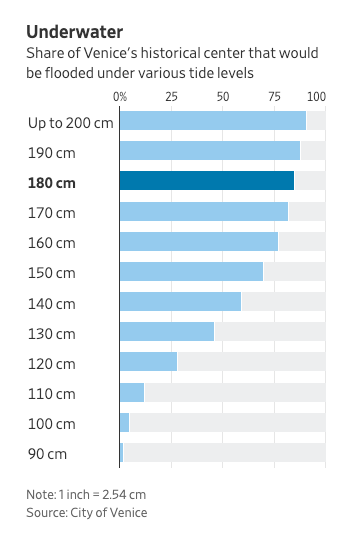
    This past week, Venice saw its acqua alta (or high water) peak at 187cm (6’2″) above its normal level. This is the second highest number on record and is just below its 1966 peak. At these numbers, about 80% of the historic center is underwater. Here is a chart from the WSJ explaining that:

    Venice has been working on a flood management project called MOSE since the 1980s. The name is an acronym, but there’s a deliberate biblical reference here. Remember when Moses parted the red sea?

    The project has been mired in engineering delays and corruption scandals, and so it’s not yet operational. If it were, it would have, in theory, protected the city this past week. 2022 is the anticipated completion date, but I don’t know if that’s realistic or not.

    The system consists of 78 mobile gates that fill with water and sit flat on the seabed when the tide is low. When a high tide is predicted, the gates are then to be pumped with air so that they rise (hinged on one side) and close off the three inlets that connect the Venetian Lagoon to the Adriatic Sea.

    As I was reading about this project and everything else that has been going on in Venice this past week, I became curious about how exactly the Dutch have been managing to hold back the sea. I mean, a big chunk of the Netherlands sits below sea level.

    If you’re also curious, here’s a video that explains how they do it.

  • Look what fits in a parking lot

    Brent Toderian likes to start Twitter hashtags that revolve around city building. One of his most recent is #LookWhatFitsInAParkingLot. For this one, he asked the Twittersphere to consider the things we love in cities that might fit inside a parking lot.

    Here is one of the best responses — Dodger Stadium edition:

    https://twitter.com/pw3n/status/1176349879154556931?s=20

    Venice, Amsterdam, and Shibuya (Tokyo) were all overlaid — at the same scale — on the surface parking surrounding Dodger Stadium. There are about 16,000 parking spaces, which actually take up more land than the stadium itself.

    To be fair, I bet if you overlaid parts of Los Angeles on this same parking, it would look similarly astounding. But that shouldn’t change what you take away from this post: parking is very land consumptive.

  • Last-mile electric scooters — will they work?

    I’ve been hearing a lot about Bird recently. Perhaps it has something to do with the $15 million Series A round they raised last month (February 2018) and the $100 million Series B round they announced earlier today.

    A “Bird” is small electric scooters that look like this and can be rented from your phone for short haul trips. They are currently available in Santa Monica, Venice, UCLA, Westwood, and San Diego, and they are intended to be ridden in existing bike lanes.

    What may be particularly interesting to this blog audience is the fact that Bird is calling itself a “last-mile electric vehicle sharing company.” The pitch: 40% of car trips (in the US?) are less than 2 miles long. Let’s replace those using electric scooters.

    One of the first things that came to my mind is that this feels more accessible than cycling. Cycling to work can be a commitment. You have to think about your attire and the sweat factor, among other things.

    Would you agree?

  • One of the most expensive neighborhoods in LA

    image

    Oftentimes when I visit a city I like to ask myself: Which neighborhood would I want to live in if I were to move here?

    Today I spent much of the afternoon hanging around Venice. After we got there, I told my friend that if I moved to LA, I would probably want to live there. I told him that, relative to the rest of the city, I liked the compressed scale of the neighborhood. There are many pedestrian-only lanes and streets beyond the boardwalk. And I told him that I thought it was interesting how the neighborhood seems to combine both bohemians and yuppies (though many people seem to hate the yuppy part).

    But I’m obviously not alone in my thinking. My friend quickly informed me that Venice is one of the most expensive neighborhoods in LA and that it’s been adding essentially no new housing supply. Here’s an excerpt from an LA Weekly article published at the beginning of this year:

    Anti-development activists like to argue that development fuels gentrification, that the construction of new, high-end apartment buildings makes the whole neighborhood more expensive.

    But the case of Venice is a counterpoint. For the last 50 years, Venice has successfully fought developers to a stalemate. The housing supply stayed constant, while demand grew. As a result, the value of property in Venice has soared.

    In 1996, according to data provided by Zillow, the average home value in Venice was $251,000 — more expensive than Silver Lake and Encino but cheaper than Westwood, Studio City, Mid-Wilshire and Los Feliz. Today, Venice’s average home value is nearly $1.6 million, more expensive than all of those neighborhoods — more expensive, in fact, than its historically tony neighbor to the north, the city of Santa Monica, which, according to Alvarez’s research, added more than 10,000 dwelling units between 1960 and 2010.

    Perhaps I should give this some more thought.

  • The Toronto font

    Susan Kare was the screen graphics and font designer for the original Apple Macintosh computer in the 1980s. Being from Philadelphia’s affluent Main Line, she initially proposed that the various fonts be named after the railroad stops along it.

    However, when Steve Jobs asked where the names had came from, he contested that, if the fonts were to be named after cities, they should be named after “world-class cities”, rather than small ones that nobody had ever heard of.

    image

    And since that’s what Jobs wanted, that’s what Jobs got. The fonts were renamed: Venice, London, Athens, Toronto, Chicago, New York and Geneva. Some of these font names you’ll probably still recognize but some, including Toronto, were eventually abandoned. 

    The Toronto font was removed from System 6 onwards. So from 1988 onwards.