Daily insights for city builders, delivered every morning at 6 AM ET. I’m Brandon Donnelly — a Toronto-based real estate developer and founder of Globizen. I’ve been writing here since 2013.

Tag: transit

  • Lessons in transit success

    image

    Dylan Reid of Spacing was recently at the International Transport Forum in Leipzig, Germany and has been publishing some interesting posts related to transit. Here is one about what makes transit systems succeed and fail.

    I really like the point that we too often think about transit projects as culminating with a big opening, while overlooking the importance of operations. It’s a bit like focusing on the wedding ceremony and forgetting that the ceremony is only really there to (hopefully) mark the beginning of a lifelong union.

    One of the reasons why this is important is because, as Reid points out, “fares need to provide a strong and consistent proportion of the agency’s funding.” So you need bums in seats, which means you need to build the right transit in the right locations. In other words, a new subway line through a low density suburb will probably result in an abysmal farebox recovery ratio.

    At the same time:

    “…fares will rarely cover all of an agency’s costs. Hong Kong’s Kam noted that, to be truly autonomous, an operator needs an additional dedicated, independent source of revenue. This cannot be based on additional transit-related non-fare revenue (e.g. advertising) – such revenue is helpful but never significant. It needs to be an external source. In Hong Kong, it is based on the agency’s extensive property ownership, but in other cities it could be a congestion charge, a dedicated sales or income tax, or other mechanism. Only with such a source can the agency have the independence to make its own choices for reinvestment and improvements.”

    This is one of the reasons why I am such a strong supporter of road pricing.

    Another point that Reid makes is that transit agencies should always have a consistent pipeline of new projects, rather than erratic periods of expansion. This makes a lot of sense given what it takes to ramp up for a large infrastructure project. But it’s obviously contingent on having sustainable funding sources.

    Click here if you’d like to read the rest of Dylan Reid’s post.
  • Thickets of haphazardly planned condo towers

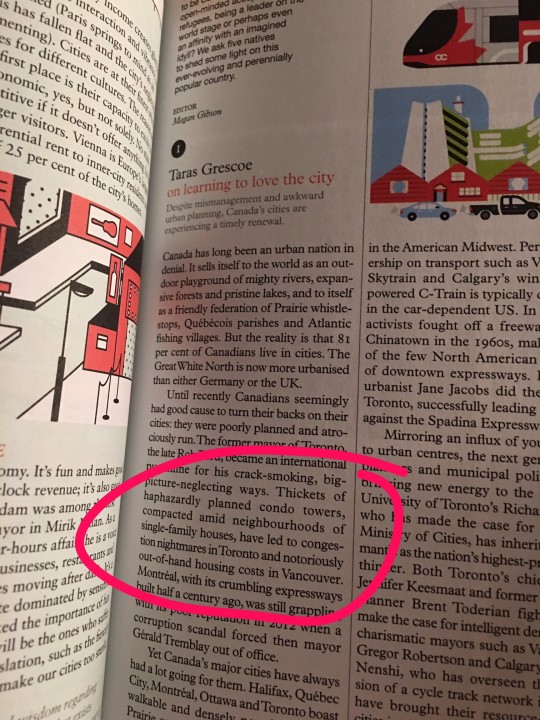
    I couldn’t sleep last night, so I got up and pulled out an old issue of Monocle magazine from my nightstand. I then stumbled upon the following article by Taras Grescoe.

    What really stood out for me was this line:

    “Thickets of haphazardly planned condo towers, compacted amid neighbourhoods of single-family houses, have led to congestion nightmares in Toronto and notoriously out-of-hand housing costs in Vancouver.”

    It bothered me for a few reasons:

    – The frame of reference is the single-family house. It perpetuates the cultural bias that what matters most in cities, like Toronto and Vancouver, is low-rise housing.

    – I don’t get the “haphazardly planned” comment. New tower development has been heavily concentrated in the downtown core, growth centers, along the Yonge subway corridor, and so on. Their built form is also significantly influenced by their relationship to these low-rise “Neighbourhoods.”

    – I believe that building up, as opposed to out, is the way to address congestion nightmares. Though I will concede that our ability to plan and execute on transit in this city is positively deplorable. 

    – How did thickets of condos create an affordability problem in Vancouver? Many factors at play in this city, including a powerful geographic supply constraint.

    Those are just a few of my thoughts from early this morning. What are yours?

  • Shareable cities

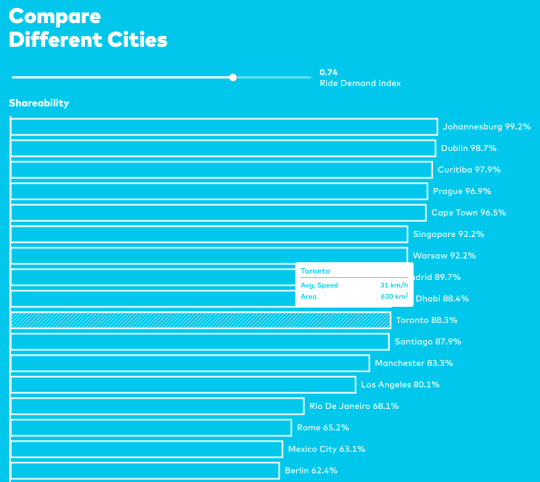
    The MIT Senseable City Lab recently looked at which cities are the most “shareable” when it comes to ride sharing services such as UberPOOL. Their goal was determine what fraction of individual trips (inefficient) could be shared or pooled (more efficient). To do this, they developed a single “shareability curve.” Full research paper, here.

    Not surprisingly, New York City does very well in this analysis. Its shareability is well above 95% for a delta of 5 minutes. That’s because the city has a large population, a small geographic area, enormous density, and lots of taxi traffic. (They used taxi data in their research.)

    But New York City also does very well when it comes to transit ridership. Highest in North America. So it strikes me that the characteristics that make a city “shareable” also apply to transit – which is effectively another form of ride sharing. Might we see the distinction between these 2 forms of mobility blur in the future? I think so.

  • Transit Flow

    This is a map of the Bay Area Rapid Transit network:

    And this is an elegant visualization by Ray Luong of ridership levels over the course of one day: February 4, 2016. If you can’t see the embedded video below, click here.

    [youtube https://www.youtube.com/watch?v=owGgbAS7Wq8?rel=0&w=560&h=315]

    Note how the lines speed up as they go through the Transbay Tube connecting San Francisco and Oakland. That’s actually what happens. Within the 10 km-long tube, the trains reach ~130 km/h, which is more than twice as fast as the average speed throughout the rest of the network.

  • 3 pilot options for Toronto’s King Street corridor

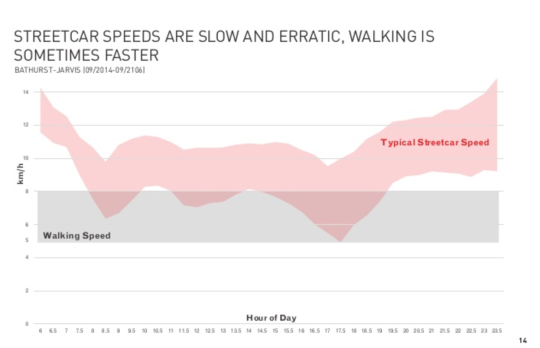
    Anyone who has ridden Toronto’s King streetcar during rush hour can tell you that the service is broken. It’s unreliable. It’s overcrowded. And during peak times it can be faster to walk. Chart below.

    Part of the problem is a misallocation of resources. Only 16% of the people who use the corridor are in cars. And yet 64% of the physical space is allocated to drivers.

    Not surprisingly, this creates a bottleneck for the ~65,000 transit riders who use the service daily. (Busiest surface route in the region.) We are not optimizing for the right variable.

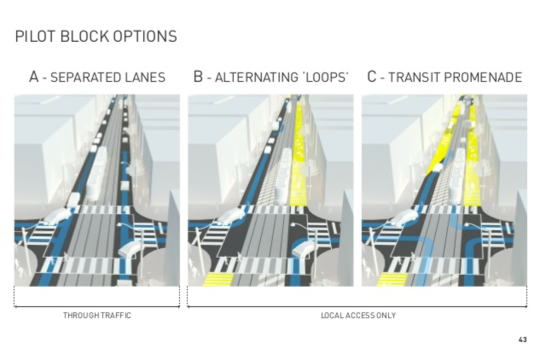
    It’s for this reason that the city is working on a rethink of the corridor. I wrote about this initiative last year, but earlier this week it got a bit more real with the release of the following 3 pilot block options.

    The plan is to launch a pilot sometime this fall (2017). This is good news. 

    If you’d like to go through the full King Street Pilot Study Public Meeting presentation, you can do that by clicking here. The above images were taken from that presentation.

  • The third Los Angeles

    I just stumbled upon an interview with Christopher Hawthorne (architecture critic for the Los Angeles Times) talking about a “third Los Angeles.” 

    His argument is that the first Los Angeles ran from about 1880 to World War II, and was characterized by a form of urbanism that most of, today, do not associate with LA. It was a city of streetcars, innovative multi-family housing, and local landscapes.

    The second Los Angeles was the second half of the 20th century. And it is the LA that probably comes to mind for most people when they think of LA. It is the city of freeways, single-family homes, and sprawl.

    The third Los Angeles is the city’s most recent iteration and started sometime around 2000. Like many things in life, it is in some ways a return to the past: namely the first LA. It is about urban intensification, transit, and more drought resistant landscapes. It is a city that senses its geographic limits.

    I like how he talks about some of the challenges associated with intensification and this third LA:

    “People in very good conscience who live in Santa Monica or San Francisco think of a moratorium on development as a progressive thing to support rather than reactionary or conservative or just in their own political self-interest. I don’t have a problem with somebody who bought a house at a certain point saying, “I bought into a certain place, you know, I want it to stay this way, and I’m going to use whatever resources I can to keep it that way.” They have every right to say that, even if I disagree. I have a problem with people saying that’s consistent with a progressive agenda about cities or a forward-looking attitude about the environment or about resources. It’s not.”

  • Detroit tests new QLINE streetcar

    Detroit has started testing its new streetcars on Woodward Avenue. Quicken Loans bought the naming rights to the line, so it’s now officially called the QLINE. If you’re British, this name probably won’t instil feelings of rapidity.

    Here’s a recent tweet from M1-Rail (click here if it doesn’t show up below):

    //platform.twitter.com/widgets.js

    Note how the train is running curbside.

    There’s lots of debate about the economic benefits of streetcar/LRT over other transit solutions such as BRT. But if you’re a regular reader of this blog, you’ll probably know that I am a supporter of light rail.

    In the case of Detroit, I also think there’s symbolic importance to bringing back light rail to the core of the city. The last Detroit streetcar was shut down in 1956.

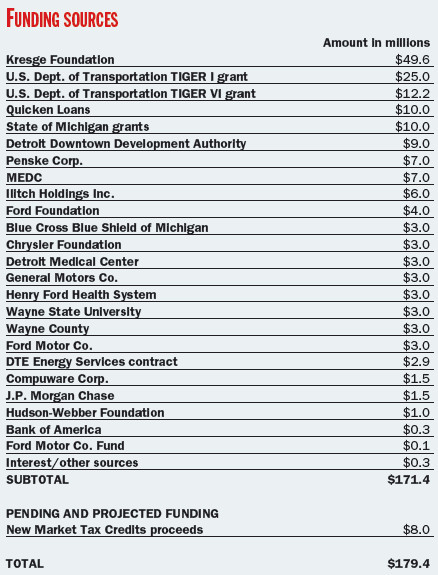
    It’s also worth mentioning how the streetcar line was funded. Below is a breakdown of funding sources dated 2014.

    image

    There may have been some changes since then, but it’s positive to see the public and private sectors come together, alongside a large infusion of philanthropic money (The Kresge Foundation).

    Many of the companies on the above list sponsored individual stations. The cost to do so was $3 million, which is why you see that number show up a few times. Compuware and JP Morgan Chase shared a station at $1.5 million each.

    Is this a transit funding model worth replicating?

  • So how’s Uber doing?

    A travel expense management company called Certify recently analyzed over 10 million ground transportation receipts across North America for the 3-month period ending last September (2016). 

    And what they found was that, for the first time ever, Uber and Lyft exceeded traditional taxis and rental cars when it came to business expenses. Uber was at 48% and Lyft was at 4%. So together, these two platforms have more than half of this particular market.

    If you compare this to Certify’s data from the same quarter last year, “ride-hailing services” previously accounted for 34% of receipts, whereas taxis and rental cars were at 22% and 44%, respectively. So Uber is up in a big way.

    This may not be surprising for a lot of you, but I thought it would be valuable to check-in on what the numbers say. 

    I’m hit with two thoughts. Firstly, it’s not a question of mobile apps superseding traditional taxis; it’s a question of one company taking over. And secondly, people seem to be favoring Uber over driving themselves around. I know I’ve been heading in that direction.

    Those are two powerful trends.

  • Local rail-driven agglomeration economies

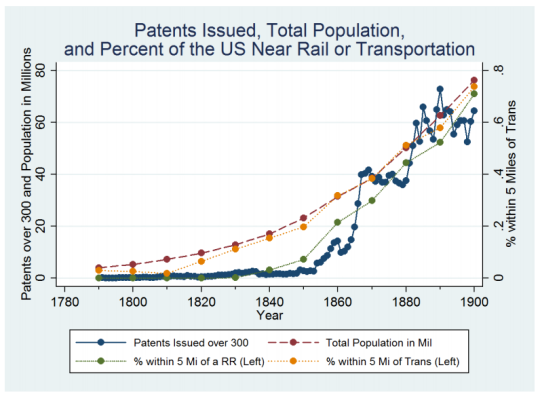
    This morning I came across the below graph in a Medium article by Eric Jaffe of Sidewalk Labs. It is taken from a research paper by Elisabeth Ruth Perlman called, Dense Enough To Be Brilliant: Patents, Urbanization, and Transportation in Nineteenth Century America.

    What this chart shows is patents issued – a proxy for innovation – in all U.S. counties between 1790 and 1900. This data is then compared against access to transport, such as rail. The discovery is a statistically significant relationship between innovation (patents issued) and rail (transport) access.

    The spike in the 1850s (shown above) is as a result of increased rail access.

    But Perlman takes it a step further and asks: what is causing this spike in innovation? Is it because inventors and creators started responding to the larger market now accessible to them because of rail connectivity? Or did transportation somehow improve productivity and the flow of information?

    To answer this question, she dug into the patents themselves (over 700,000 of them) to try and identify how ideas and key words were spreading. What she found is that rail access alone doesn’t encourage innovation. References to new technologies did not increase.

    What mattered was what happened locally. Transportation improvements promoted urbanization and density during her study period, and that’s what drove innovation. Connectivity created agglomeration economies at the local level.

    Obviously a lot has changed since the 19th century. But whether it’s rail connectivity or internet connectivity, have the rules really changed? Place still matters. What happens locally still matters. Perhaps even more. 

    This is an important lesson to consider as we build our cities and invest in transportation. Rail alone isn’t enough. What matters more is what we build around it. Are we dense enough to be brilliant?

  • Toronto mayor proposes road tolls, finally

    When I wrote yesterday’s post about road tolls, it hadn’t been announced that Toronto Mayor John Tory was going to call for road tolls on both of the highways coming into downtown. That didn’t leak until late in the evening. So I was just writing another post on a topic that I care about.

    Today, however, that announcement was made and the proposal is a flat $2 toll on both the Gardiner Expressway and the Don Valley Parkway. It is expected that this could bring in close to $200 million a year in new revenue for the city – all of which would be dedicated towards transit and roads. Good.

    First, I want to applaud the mayor for coming out in support of road pricing. I didn’t agree with him on the Gardiner East, but I agree with him on this – mostly. It is a bold move.

    The reason I say mostly is because I hope that we don’t simply default to a fixed and blunt road toll. There are more sophisticated options out there, such as variable pricing models that change based on demand/congestion levels.

    Here’s a post that explains how that works and why I think it’s a good model.

    With this approach, it becomes more of a congestion charge rather than a toll. It also gives commuters the option of driving during off-peak times to save money. And if we implemented something like this, I am sure that we would see employers and office hours adapt. More on this in the above post.

    Still, I absolutely believe that it’s a step in the right direction for this great city. So thank you Mayor Tory.