Daily insights for city builders, delivered every morning at 6 AM ET. I’m Brandon Donnelly — a Toronto-based real estate developer and founder of Globizen. I’ve been writing here since 2013.

Tag: tech

  • Tech Time: The ŌURA Ring

    Because my blog emails go out at 6AM every morning, many people think that I am up at 4AM every day typing away at my computer and drinking coffee. I do not get up this early. In fact, I’m naturally more of a night person. But since our world is heavily biased against night people, I do what I can to conform.

    Perhaps because of this, I am very interested in sleep optimization. I have a Fitbit that I occasionally use, but I seem to go through phases with it. I think part of the problem is that the data I get from it doesn’t feel like enough.

    This week I was intrigued to learn about something called the ŌURA ring. Yes, it’s another sleep and activity tracker. But it does some unique things. And because it’s a ring, it’s in constant contact with your finger’s arteries. So presumably the data is better.

    The ring’s output appears to be centered around something called “readiness”, which the company refers to as “an optimal physical and mental state that can be achieved by acquiring the ultimate balance between sleep and activity.” 

    To give a more concrete example, the ring tracks something known as heart rate variability (HRV). Fitbit and Apple devices don’t do this, but supposedly it’s quite a telling datapoint. Professional sports teams are starting to track this so they know how “ready” the players are.

    I’m not yet sure I’m ready to invest in the ring (they start at USD$299), but I am definitely intrigued. 

    If you’d like to read more about “the science” behind it, you can do that here. If you’d like to watch a mini-review, click here. And if you’re ready to pull the trigger, you can use the coupon code “kevinrose” to get 25% off. I discovered the ring via his newsletter.

    Image: OURA
  • Opendoor is now selling ~300 homes per month

    Farhad Manjoo of the New York Times published an article this morning about Opendoor – a startup that I have written about multiple times on this blog – called, The Rise of the Fat Start-Up. (His definition of “fat” is that the startup owns lots of hard assets, which considered atypical in tech.)

    Below are a couple of interesting tidbits from the article:

    • Opendoor has raised over $300 million in equity and over $500 million in debt since inception.
    • Opendoor plans to be in 10 cities by the end of this year.
    • Average commission charged on Opendoor is 7.5%, which is higher than a traditional real estate agent and higher than what was quoted before in the press. The higher % is because of certainty and convenience.
    • Opendoor offers a leaseback option if you’d like to stay in your house for a period of time after you’ve sold it.
    • Their conversion rate (offers made to closings) is about 30%.
    • Other startups are now in the market with similar models, including Offerpad and Knock. Zillow is working with Offerpad on a pilot. Someone is starting to feel threatened.

    The article also quotes a blogger and real estate analyst named Mike Delprete. Heads-up: His blog is called “Adventures in Real Estate Tech.” I’m sure this will appeal to many of you. I obviously just subscribed.

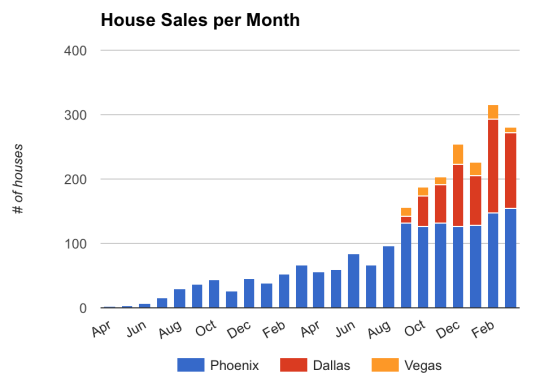
    Mike dug into MLS records in order to figure out Opendoor’s transaction volumes, since the company is not releasing this information. Here’s what he found (the chart is up to March 2017):

    The trend line is certainly moving in the right direction. But Mike also believes that Opendoor is only netting around $8,320 in profit per home and that much of it is driven by appreciation. There’s also substantial risk in owning so many homes – each one is usually held for a few months.

    But you can be sure they’re thinking well beyond where they are at today. Expect many more updates on this blog.

  • The value of relative pricing comparisons

    I find the topic of pricing incredibly interesting. How much is someone willing to pay for item X? I’ve said this before, but pricing was one of my favorite classes in business school.

    Here is a line that I really liked from a recent blog post by Tomasz Tunguz’s on price anchoring:

    “Relative pricing comparisons are among the most common method of price rationalization.”

    The topic of his post may not be all that interesting to this audience – it’s about software as service platforms – but the principles should be. 

    In Tomasz’s post he talks about how companies building SaaS products aimed at salespeople will often have their pricing compared to that of Salesforce. In other words, people might say to themselves: Salesforce costs $X per seat. Is this other product worth half of $X? Salesforce is the anchor.

    I can tell you that I do this all the time. (Do you?) I’ll say to myself, condos of this build quality are selling for $Y in this neighborhood. Is this other neighborhood better or worse? If better, how much of a premium might someone apply to it?

    So if you’re in the business of pricing products, you may want to give some thought to how your customers might be anchored when assessing your offering. Relative pricing comparisons allow us to rationalize dollars in our mind.

  • Building a city from the internet up

    There has been a lot of exciting tech + urbanism news this week in Toronto. Uber announced that it’s building a new artificial intelligence team in the city and it came out that Sidewalk Labs (Alphabet company) had responded to an RFP put out by Waterfront Toronto. 

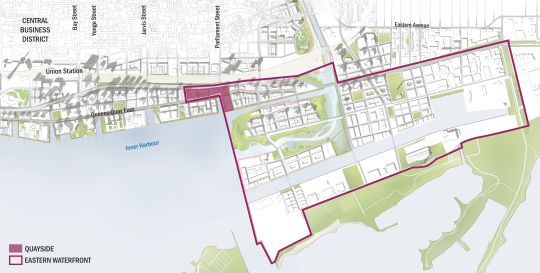
    The RFP, which closed at the end of last month, was to find an “innovation and funding partner” for the 12-acre Quayside precinct shown above in purple. It’s the first parcel of the “eastern waterfront.” (Click here if you’d like to download a copy of the actual Request for Proposal.)

    These days, it’s easy to be cynical about these sorts of announcements. Every day you hear about some new innovation center or tech hub. But what’s perhaps unique about this one is that Sidewalk Labs is thinking crazier than most and they have the financial backing that crazy sometimes needs.

    If you’re not at all familiar with Sidewalk Labs, I suggest you read this post about how the company wants to build cities “from the internet up.” It’s by their CEO, Daniel L. Doctoroff. 

    Not surprisingly, they are thinking about everything from automated trash systems and autonomous vehicles (including their impact on built form, cost of living, productivity, etc.) to exchange-based thermal grids and more cost effective construction methods. And it’s not just about the technology. It’s about marrying tech + urbanism.

    Also interesting is their model of setting up a “hyper-focused labs”, which are each run by entrepreneurs-in-residence. These internal labs are focused on things like housing affordability, the health challenges faced by low-income city residents, and so on. 

    It’s all very exciting. So let’s ensure this moves forward and let’s hope Sidewalk Labs keeps thinking crazy. Toronto is ready to lead and show the world how a city built from the internet up should perform.

  • Data is the new oil

    “A NEW commodity spawns a lucrative, fast-growing industry, prompting antitrust regulators to step in to restrain those who control its flow. A century ago, the resource in question was oil. Now similar concerns are being raised by the giants that deal in data, the oil of the digital era.“

    The Economist just penned an interesting piece arguing that the world’s most valuable resource is no longer oil, but data. That’s why the five most valuable publicly traded companies in the world are all tech/data companies.

    But the point they are really making is that current antitrust remedies are poorly suited to this new precious commodity. For example, in today’s world authorities need to be thinking not just about firm size, but about the extent of their data collection.

    There’s a reason firms with no (meaningful) revenue get acquired for huge numbers. Yes, sometimes it’s just for the talent. But it’s also because of the data they control and the potential threat they pose.

    So much of what we do today leaves a digital trace. And those traces are hugely valuable. I suspect we will be hearing more about this as the data economy continues to spawn tech giants.

  • Retail tipping point

    Venture capitalist Benedict Evans recently published a post on his blog called, Ten Year Futures. If you haven’t already noticed, I really enjoy this sort of curiosity and line of thinking. Here is an excerpt where he talks about retail being at a tipping point:

    “First, ecommerce, having grown more or less in a straight line for the past twenty years, is starting to reach the point that broad classes of retailer have real trouble. It’s useful to compare physical retail with newspapers, which face many of the same problems: a fixed cost base with falling revenues, the near-disappearance of a physical distribution advantage, and above all, unbundling and disaggregation. Everything bad that the internet did to media is probably going to happen to retailers. The tipping point might now be approaching, particularly in the US, where the situation is worsened by the fact that there is far more retail square footage per capita than in any other developed market. And when the store closes and you turn to shopping online (or are simply forced to, if enough physical retail goes away), you don’t buy all the same things, any more than you read all the same things when you took your media consumption online. When we went from a corner store to a department store, and then from a department store to big box retail, we didn’t all buy exactly the same things but in different places – we bought different things. If you go from buying soap powder in Wal-Mart based on brand and eye-level placement to telling Alexa ‘I need more soap’, some of your buying will look different.”

    I’ve said this many times before, but the way the above excerpt ends is yet another remind that one has to look deeper beyond the obvious change(s). Yes, ecommerce is growing and impacting physical retail. But what other changes might ensue because of this shift?

  • Technology and the city

    Embedded at the bottom of this post is a great rapid-fire talk by Edward Glaeser about technology and the city. 

    Technology has always been a fundamental driver of change within our cities and I like how Glaeser starts by referring to these forces as either centripetal and centrifugal. The car was an example of the latter. It spread us out.

    At the same time, Glaeser points out that the car was really the first time that urban mobility patterns shifted from hub-and-spoke to point-to-point. Transit systems rely on hubs and some walking, which in a world of cars has led to something we call the last mile problem.

    Also worth noting is the fact that Glaeser is terrified about what autonomous vehicles will do to our cities. His point is that the fundamental law of highway traffic has shown that vehicle miles traveled increases basically 1:1 with highway miles built.

    So if all of a sudden AVs are able to decrease the cost of mobility, provide capacity benefits, and increase rider enjoyment (because you’re no longer a driver), vehicle miles traveled are going to go through the roof. This makes a strong case for some form of road pricing.

    But it also means that unlike traditional cars, which were a centrifugal force, AVs could in fact turn out to be a force that further centralizes us within dense urban centers.

    When you listen to Glaeser’s talk, you will quickly understand why so much attention (this blog included) is being paid to autonomous vehicles. They are one of – if not the – next great technology bound to reshape our cities.

    If you can’t see the video below, click here.

    [youtube https://www.youtube.com/watch?v=lbGwhWbuhfg?rel=0&w=560&h=315]

  • Instagram Stories has more active users than all of Snapchat

    Instagram has a company chart that shows: Days to Reach the Next 100 Million Users. It is only the chart where they want to see it decline. The first 100 million users took 28 months. And the last took only 4 months. Instagram now has 700 million active users.

    Instagram is also saying that they have 200 million people using their Stories feature – you know, the feature they blatantly stole from Snapchat. This would mean that more people are using Instagram Stories than Snapchat has daily users (~158 million).

    Anecdotally, I can tell you that I’ve almost completely stopped using Snapchat. (Snapchat battery usage over the last 7 days = <1%.) I still prefer Snapchat’s direct messaging functionality, but not enough to continue using the platform. Instagram now provides basically the same functionality – plus my photos – in a single app. 

    But more importantly, Instagram’s network and my network are bigger there. And network effects are clearly the most important thing. In fact, by directly copying Snapchat, Instagram (Facebook) made sure that this competition was only about network size and not about features. Monopoly power.

    In real estate, if you own a property in a great location, your position is pretty defensible. (Though you may not be completely immune.) But in tech, that is clearly not the case. Someone might copy everything you’ve done and beat you at your own game.

    As someone who used to be very bullish on Snapchat, I am now wondering if I need to remove my Snapchat handle from the header of my blog emails. I mean, I’m not there very often anymore. But maybe, just maybe, Snapchat will find a way to compete outside of network effects at a game that Instagram/Facebook can’t play.

    How would you or are you placing your bets?

  • Envelope Beta

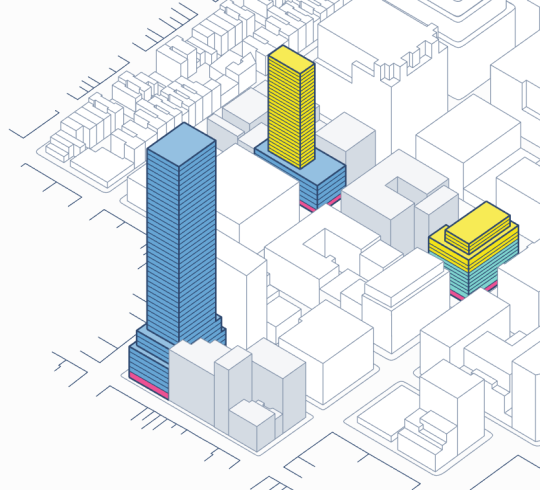
    My friend Bruce of getrefm.com (real estate financial modeling) just introduced me to a new real estate startup called Envelope. Basically it’s 3D mapping software that allows you to quickly visualize the zoning envelope for a particular site. It’s similar to what Flux.io was initially trying to do.

    Now, I think this is very cool, but my first reaction was: What if the zoning is out of date? What if approvals/entitlements are done a site-specific basis? This isn’t the case in every city, but I’ve heard some people in Toronto argue that this city basically has no zoning code. (We can debate that one in the comments, I’m sure.)

    That being said, there are still many design guidelines in this city that shape built form and I could see a tool like this being incredibly useful. They’re still in private beta but I would like to try it out. Hopefully they’ll see this blog post and let me have an early peek.

    Image: envelope.city

  • DroneBase — real estate aerials

    image

    Real estate companies often have a need for aerial photography. Perhaps you want to showcase an existing building. Perhaps you want to capture the views from a future/proposed building. Or perhaps you’d like to document a building under construction.

    Usually in the latter case, you have to find a neighboring building and negotiate some sort of agreement so that you can place a camera on it and document your construction site. This is probably still the solution if you want a clean time lapse video.

    But drones have opened up a new world of possibility and today I thought I would share with you a company called DroneBase. They’ll probably hate that I’m making this reference, but one way to describe them is Uber for drones. They connect a “large network of drone pilots” to customers needing drone footage for commercial or creative purposes.

    If you take a look at their website, you’ll see that they cater a lot to the real estate and construction industries. I’m not sure how active they are in Toronto and Canada right now, but if they aren’t that active I’m sure it’s only a matter of time before they are. 

    And over time, I am sure that a network like this will only mean faster, better, and more affordable aerial footage.