Daily insights for city builders, delivered every morning at 6 AM ET. I’m Brandon Donnelly — a Toronto-based real estate developer and founder of Globizen. I’ve been writing here since 2013.

Tag: tech

  • Motivation and coordination

    Albert Wenger of Union Square Ventures recently gave a talk at the 2017 Blockstack Summit about “Decentralization and the Knowledge Age.”

    He starts by talking about motivation and coordination.

    The state, he argues, is good at coordination, but not so good at motivation. The market, on the other hand, is good at motivation, but not so good at coordination. Money and self-interest are powerful incentives.

    He then talks about how networks have improved the market, the firm, and the state. When the cost of sharing information drops, everything gets better.

    But there are downsides to networks. For one, they form monopolies. Consider Facebook in social. Google in search. Amazon in ecommerce.

    They also create environments ripe for censorship and “algorithmic abuse.” Everything you see in your feeds is optimized to make you respond and/or feel a certain way. The line between delivering you relevant content and deliberate manipulation is perhaps a fine one.

    So what’s the solution? Decentralized blockchain networks are one exciting possibility. But they also have their own limits and drawbacks. Albert touches on those in his talk.

    The video is about 24 minutes. If you can’t see it below, click here.

    [youtube https://www.youtube.com/watch?v=LgQT874KHuw?rel=0&w=560&h=315]

  • Power to the people

    Bloomberg columnist Barry Ritholtz recently interviewed Richard Barton about his startup companies. Barton founded Expedia while he was an executive at Microsoft (Gates and Ballmer era) and then went on to cofound Zillow (real estate site) and Glassdoor (jobs site). 

    I’ve been following the work of Barton for many years now because I admire the common thread among his startups: They’re about bringing transparency to industries where transparency is lacking. I used to try and dissect his thinking when I was working on my own real estate/tech startup.

    I believe there’s still a lot of room for transparency in the real estate space, but that doesn’t negate the work that Barton has done. He’s all about using technology to bring “power to the people.” That’s a good thing.

    Click here to listen to the podcast.

  • From self-storage to urban logistics

    image

    I have long told myself that if I ever needed to rent self-storage space, it would mean that I own too much stuff and that I need to get rid of some of my shit. But I recognize that there are many reasons why someone might need extra storage and I recognize that the storage market in the United States alone is something to the tune of $30 billion a year.

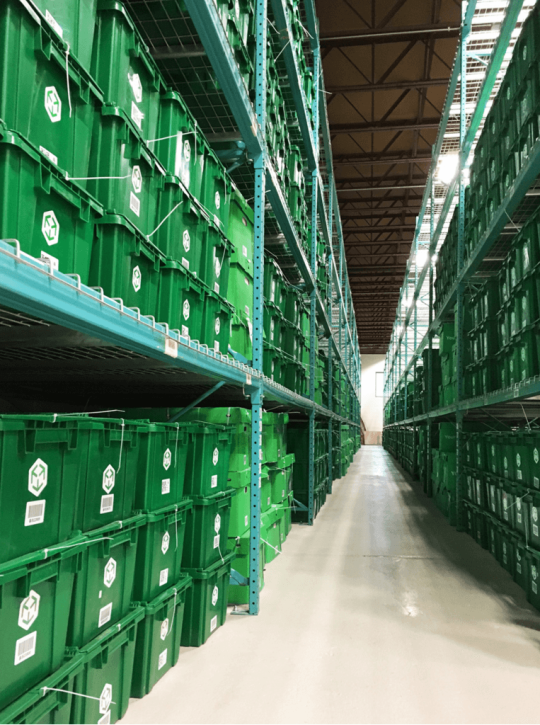
    Here is an interesting case study about the storage company MakeSpace, which to-date has raised almost $60 million in equity funding. Their model is likely one that you’ve heard of or used before. Instead of you yourself going to the “self-storage” facility, they do the pickup and delivery. So they call themselves a logistics business, like Amazon, except that it works in reverse. Instead of you receiving deliveries, they take your stuff from your home back out to their warehouses.

    Because of the route management software that they’ve been building over the last 4.5 years and because there’s enough density in the areas that they service, their pick-up and drop-off routes are apparently profitable. You no doubt need a certain amount of scale for that to happen, but they seem to have it. By the end of this year, they expect their reoccurring revenues to be in the $10′s of millions. That’s coming from the volumes of green boxes you see at the top of this post.

    What’s particularly relevant for this audience are the built form and real estate implications. Because their customers aren’t physically visiting their facilities, they’ve been able to locate all of their distribution centers on the outskirts of the cities in which they operate. And because of this, their physical real estate costs are said to be less than 50% of traditional self-storage firms and they believe this number will trend to around 20% as volumes continue to grow.

    All of this has me thinking about some of the other implications of the on-demand economy on cities and on real estate.

    Image via Both Sides of the Table

  • Lease vs. Life

    image

    When I was in graduate school in the U.S., I remember it being a pain having to always sign a 1 year lease. I only wanted 8 months so that I could take off during the summers. Too bad Flip wasn’t around back then.

    Flip is a startup that I just discovered, which is positioning itself as the “easiest way to sublet or get out of your lease.” It’s all about reconciling the conflict between lease and life, which don’t always match up.

    The platform is free to listers. So you don’t get charged to post a lease or to flip a lease. Renters get charged a service fee equal to 5% of one month’s rent.

    It’s interesting to think about the surge in short-term rentals and platforms such as Flip that are effectively helping to reduce lease terms by way of streamlining the “flipping” process. 

    Are millennials ushering in a new era of mobility and transience?

    One feature that I think is neat and that I would like to point out is “Bounties.” The platform allows listers to attach a bounty ($) to any listing. Users are then able to grab a unique URL that can be shared around online. If someone takes over a lease via one of your links, you get paid the bounty. Smart.

    In case you’re curious – I certainly was – here’s a ranking of all 50 U.S. states according to how friendly they are to subletters. It also summarizes how to legally sublet. On the friendly side is New York and on the less friendly side is Wyoming.

    Photo by Dan Gold on Unsplash

  • The “R” word

    Albert Wenger recently penned an interesting post about the “R” word.

    It’s about health insurance and why redistribution is a toxic word in U.S. politics, but also why much of what we do as a society – from public roads to insurance – is actually about redistribution. What I like about the post is that he cuts through a lot of the noise and gets right at the crux of things.

    Here’s part of his conclusion:

    So what should you take away from this? There always is some element of redistribution to insurance – at a minimum ex post and generally also ex ante. The “why should I (usually some healthy person) pay for x (usually some payment for someone from a different demographic)” objection to health insurance is about redistribution. We should acknowledge this openly and not pretend that it is otherwise, because then we can move forward and say “you should, because that is your contribution to how our society works.”

    The point of his post, which he reiterates in the comment section, is that “insurance is a commons more than it is a market.” Too much individual choice – for instance, rich people opting out because they don’t need it – actually weakens the system.

    But you should really read his entire post. It’s good.

    Photo by Jamie Street on Unsplash

  • Should Uber be shut down?

    image

    Last week Travis Kalanick – the cofounder who built Uber into the most highly valued privately held startup in the world – stepped down as chief executive at the request of his investors. This was the culmination of months of controversy related to the company’s toxic corporate culture.

    So what’s next? 

    Benjamin Edelman, associate professor at Harvard Business School, recently argued that this is it for the company: Uber Can’t be Fixed – It’s Time for Regulators to Shut It Down. I discovered the article through a good friend of mine who has felt similarly since the beginning. Uber’s business model is predicated on illegality and that should not be misconstrued as “innovation”.

    I have a few thoughts on this.

    But let me start by saying that this post is not a comment on the company’s corporate culture or its internal practices related to lobbying governments. I have not really been following what’s going on internally and I’ll leave other, more informed, people to comment on those matters.

    With that said, here are 3 thoughts.

    One, shutting down the company feels like an extreme case of throwing out the baby with the bathwater. Lots of companies go through restructuring, assuming that’s needed, without completely capitulating.

    Two, before Uber came along it was still challenging to pay for a taxi in Toronto with a credit card. More often than not the driver would tell you that the machine was broken or ask that you instead pay with cash. At that point, I would have accepted a clunky payment machine mounted to the rear of the front seats as an innovation.

    To say that Uber’s technological innovations were all banal things that its competitors were already about to introduce is downplaying so much of what the company has done outside of its beneficial cost structure. 

    We got perfect information: Where is my car right now? We got full pricing transparency before even accepting a ride: Should I take an Uber or transit or should I drive? We got the ability to get in and out of a taxi without pulling out our wallets: I’ll quickly jump out at this red light. We got dynamic ride pooling and cost sharing: Let’s split this ride 3 ways to bring the fare down. And we got clean cars that didn’t smell.

    Why weren’t any of the incumbent taxi companies do this?

    Three, I fully agree that Uber (unfairly?) benefited from a meaningful cost advantage by operating in the unregulated side of the market. This was a huge boon for the company because, as the data suggests, the demand for taxis is highly elastic.

    But I also believe that the incumbent taxi companies were perpetuating a marketplace that was anything but free enterprise. It ensured that the status quo was maintained and that those who historically benefited from the system continued to benefit from the system.

    Because of this, I’m not sure that we would have seen the innovation that we saw without a company like Uber deciding to operate within a gray area and not ask for permission. Protectionism may have stomped it out. This may be why Hailo – which operated in the regulated side of the taxi marketplace here in Toronto – ultimately wasn’t able to survive.

    Though I suppose you could argue that Hailo’s failure (at least here in Toronto) strengthens the argument that Uber was only able to thrive because of its illegal cost structure. 

    However, it’s important to remember that Uber got its start by actually charging more than traditional taxis. At the outset it didn’t have enough liquidity in its marketplace to compete based on speed and/or price, and so it decided to offer a premium experience. 

    UberX didn’t introduce steep discounts until later on and even today many people will gladly accept surge pricing at multiples of a regular taxi fare. Clearly customers are deriving some other benefits from the app.

    Edelman ends his piece by referencing Napster as an example of another startup that defied legality and was ultimately forced to shut down. Again, shutting Uber down seems extreme to me, but I do agree with his conclusion. Regardless of what happens, the lawful innovations that Uber introduced are here to stay.

    Photo by Carl Joseph on Unsplash

  • The grocery wars: Why Amazon bought Whole Foods

    The big news on Friday was that Amazon has agreed to buy grocery chain Whole Foods for $13.4 billion.

    Some people – such as Bruce Berkowitz, who manages the $2.3 billion Fairholme Fund and who is the second largest shareholder of Sears Holdings Corp. – believe that this says to the market that “there is a need for physical space in retailing.” Everything can’t be online.

    I obviously agree that there’s value in real estate / physical locations, but I don’t see this as Amazon capitulating in any way. This is not Amazon saying to itself: “Well, AmazonFresh hasn’t grown as quickly as we’d like, so let’s forget this ecommerce thing.” No, Amazon is determined to win.

    Indeed, the fact that shares of supermarket operators tumbled across the U.S., Canada, and Europe, probably signals that the market is expecting something other than the status quo following this acquisition. 

    All of this is a big deal because grocery is a big deal

    There’s a reason Wal-Mart ramped up grocery (and now derives over half of its revenue from it). There’s a reason why drug stores are proliferating across our cities (and expanding their grocery offerings). In Toronto it’s Shoppers Drug Mart and Rexall. In New York it’s Duane Reade.

    We buy groceries frequently and we overwhelmingly still buy them in person. So online grocery is the holy grail of ecommerce of right now. Everyone wants to nail it first.

    How does this acquisition help Amazon do that? Here are two thoughts.

    1) The real estate still matters. 

    Even in a world where most groceries are purchased online, you need still need physical distribution centers in close proximity to lots of customers.

    Whole Foods has more than 460 stores across the U.S., Canada, and Britain. Their formatting would obviously evolve, but the bones are there for Amazon to leverage.

    Startups such as Instacart have tried to circumvent this requirement by fulfilling only the delivery portion. And arguably their pitch to other grocers may now be stronger: “You need to offer this to compete with Amazon/Whole Foods.” (Instacart currently provides this service Whole Foods.) But you can bet Amazon will want to squeeze/control this part of the supply chain.

    2) The data.

    Many analysts are already assuming that Amazon will work to automate away cashiers, similar to what it’s trying to do with its Amazon Go concept store. If you combine this with other offerings such as 15 minute pickup (Amazon Fresh PIckup), you can easily imagine a world where us customers get weaned off of in-person shopping.

    For example, if my regular grocery store made better use of its data, it would probably come to the conclusion that I generally buy things like orange juice, milk, and avocados (I’m a Millennial) every X days. I’m sure if you look at my shopping habits, I’m pretty predictable. Whenever I go to a new store it always takes me 100% longer to shop because I don’t generally wander. I target my stuff.

    Now if I could get somehow prompted to re-order my regular items every X – 1 days, chances are I would gladly tap order. And now I’m shopping for groceries online. Get ready for the grocery wars.

  • The geography of superstars

    We often talk about superstar cities such as New York, London and, in the case of tech, San Francisco. But what about the superstar people that drive these economies?

    Aaron Renn recently wrote a post called “The Superstar Gap”, where he argues that the interior of the U.S. is suffering from a big handicap because of its lack of superstars. Chicago is one example he gives. Very good, but not the best.

    He also cites a 2010 analysis by Carl Wohlt that shows the “100 Most Creative People in Business” predominately living in the West and Northeast, compared to the Midwest and South.

    This is interesting because – if we assume this gap to be true – it gets me thinking about a number of important questions:

    • Is it that the interior isn’t effectively fostering superstar talent?
    • How much superstar talent is actually latent and untapped?
    • Is it that superstar talent is getting sucked into a select few superstar cities, away from other places? Definitely happening.
    • How many superstar cities (filled with superstar people) can sustainably exist in today’s world?

    Now by definition, superstar talent is going to be a smaller segment of the population – it’s one tail of the bell curve. 

    But I do think we should be careful not to assume that the raw talent doesn’t exist in certain cities. People and place are linked, and superstar cities are arguably just empowering new forms of individual superstardom.

    If we are to use successful startups as one measure of superstardom, it’s important to keep in mind that they are incredibly fragile in their nascent stages. The right people need to come together. The right funding has to fall into place. And the list goes on. 

    Below is an excerpt from a 2006 essay by Paul Graham (Y Combinator) called, Want to start a startup?

    Successful startups are almost never started by one person. Usually they begin with a conversation in which someone mentions that something would be a good idea for a company, and his friend says, “Yeah, that is a good idea, let’s try it.” If you’re missing that second person who says “let’s try it,” the startup never happens.

    That someone might have been a superstar.

  • Internet Trends 2017

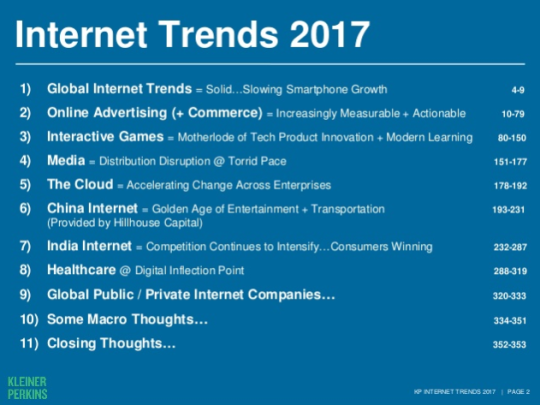
    Mary Meeker – who is a partner in the VC firm Kleiner Perkins – just recently released her annual Internet Trends report. 

    I’ve pasted the table of contents above so you can quickly decide if you’d like to spend your time going through it. The entire report is over 350 slides.

    If you can’t see the embedded slideshow below or if you’d like to access the reports from previous years, click here.

    [slideshare id=KGiWuuYFlhbQBC&w=595&h=485&fb=0&mw=0&mh=0&style=border:1px solid #CCC; border-width:1px; margin-bottom:5px; max-width: 100%;&sc=no]

  • Will Zillow’s new “Instant Offers” disrupt real estate agents?

    Last month Zillow.com launched a new feature called “Instant Offers.” Press real estate can be found here.

    It is:

    “…a way for homeowners to sell their homes quickly by providing them with offers from investors and a comparative market analysis (CMA) from a local real estate agent, as an estimate for what the home might fetch on the open market.

    Here is a bit more about how it works:

    “To participate in Zillow Instant Offers, verified homeowners interested in receiving investor offers confirm information about the home (number of bedrooms, square footage, etc.), highlight any updates and provide several photos of the home. From there, select investors who buy homes in the area can present their offers alongside the CMA from a local real estate agent. Any investor offers and the CMA will include an overview of fees associated with each option, to enable sellers to make an informed apples-to-apples comparison.”

    When I first saw the headline, I thought they were copying Opendoor. But it’s not the same model. They aren’t buying the homes, like Opendoor, they are simply working to coordinate an “instant” transaction. Still, I’m sure that Opendoor provided at least some of the impetus for this feature.

    Of course, the most interesting question with these online real estate platforms is: Will they disrupt real estate agents? Mike Delprete wrote a great post about this in the wake of Zillow’s announcement.

    But ultimately he concludes something that I have felt strongly for years:

    “So, while real estate sites are best positioned to disrupt the real estate industry by displacing agents, they’re also the least likely to do so, because agents are their biggest customers and source of revenue.”

    The irony.

    About 70% of Zillow’s revenue comes from real estate agents. So it seems unlikely that they – at least currently – will be the ones that turn the tables on agents. 

    Some real estate platforms have started diversifying their revenue streams for probably this exact reason. But who knows, it may be a new entrant, rather than an incumbent, who pulls this off.