Daily insights for city builders, delivered every morning at 6 AM ET. I’m Brandon Donnelly — a Toronto-based real estate developer and founder of Globizen. I’ve been writing here since 2013.

Tag: tech

  • 10x the scale

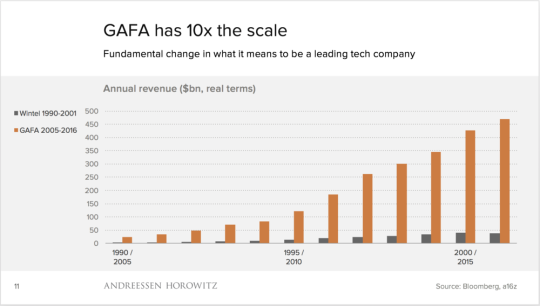
    Below is a chart from Benedict Evans comparing annual revenue from the Wintel era (Microsoft + Intel) to the current GAFA era (Google, Apple, Facebook, and Amazon). 

    His argument is that, today, “the scale of tech winners” is about 10x what it was during the previous cycle.

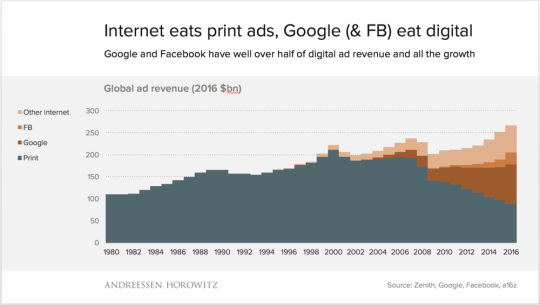
    And here is a chart, from that same post, showing how the internet ate print ads when it comes to global revenue:

    A lot of this has to do with the unprecedented growth of smartphones and the sheer number of people who came and are coming online. Mobile is 10x the PC market.

    But the other interesting narrative from the post is the argument that these companies (GAFA) have learned from previous generations just how aggressive you need to be to survive.

    The shift to mobile posed a structural threat to Facebook. At the time of its IPO, there were serious doubts as to whether the company would be able to pull off this transition.

    Which is why the founder went out and spent 10% of the company to acquire companies that would help with this transition and ensure its survival. That seems to have worked.

    In the words of Andrew Grove: “Only the paranoid survive.“ And in today’s tech world, the rewards for surviving are that much bigger.

  • Attention = money; why the attention economy is broken

    “…the path to profit is to manufacture attention more cheaply than what you get paid for it.” Ev Williams

    A big part of our economy is centered around attention. Some would argue we are living in a de facto attention economy. That is now our scarce resource. There are only so many waking hours in a day and every company and social media platform is fighting for their sliver of your attention.

    However, the irony of the attention economy is that, while it has gotten easier to make and share “content” with the world, the quality of that content matters less than the attention it garners. Because that’s what the system rewards. Whatever you may think about Trump, he has mastered the art of attracting attention.

    Ev Williams – co-founder of Twitter and CEO of Medium – recently wrote a piece on this topic called: Words still matter. It is very much about the mission driving his publishing platform, Medium. Here is an excerpt:

    It’s not that there aren’t journalists, publishers, and thinkers doing great work and putting it out there. But the realities of the attention economy are very tough for those who create things designed for anything but the widest possible (i.e., lowest-common-denominator) audience. For ad-driven sites, the revenue per reader has been dropping for years (while the experience worsens and privacy disintegrates), leaving little room for research, fact checking, or polish… let alone nuance or complexity. The system demands quantity. It demands speed. And it demands little else — except our clicks.

    Their solution is the Medium Partner Program. It is an “open paywall” that allows publishers of great content to lock some of their best content behind a paywall. Their view is that to fix the attention economy, we need to move beyond ad-supported lowest-common-denominator content. 

    This not entirely novel, but they are calling themselves the first “open paywall” platform. I would be curious to hear your thoughts about this in the comment section below. I’ve had a few people suggest to me that I employ a similar approach for this blog. I’m not convinced.

  • Sidewalk Labs, Amazon HQ2, and the Milanese Leonardo

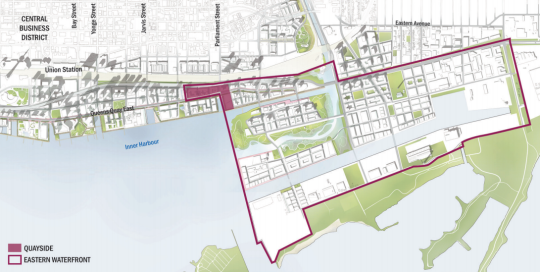
    Earlier this week the WSJ announced that Sidewalk Labs (Alphabet Inc.’s urban innovation organization) is close to a deal with Waterfront Toronto to develop a new 12-acre section of the eastern waterfront. Sidewalk Labs would be their innovation and funding partner. It’s not final yet and it’s still subject to board approval, but the sentiment is that it should go.

    There aren’t a lot of details about the project – other than the fact that it will be fairly big, up to 3 million square feet – but the overall intent is digital city building. It’s about imagining what a city could be if you built it today “from the internet up.” More info about Sidewalk Labs, here.

    I thought of this project as I read Seth Godin’s daily blog post this morning in bed. Here are two snippets from that post:

    When a new technology arrives, it’s often the nerds and the neophiliacs who embrace it. People who see themselves as busy and important often dismiss the new medium or tool as a bit of a gimmick and then “go back to work.”

    There’s never a guarantee that the next technology is going to be the one that moves to the center of the conversation. But it’s certain that a new technology will. It always has.

    Openness matters.

    I’m anxious to learn more details about the project, but this is obviously very exciting. It also creates momentum and strengthens the case for Amazon HQ2 in Toronto. The above 12-acre Quayside area is only the tip of the iceberg. There’s the rest of the eastern waterfront and also East Harbour.

    image

    Some people have been critical of this city’s push for Amazon HQ2. Anthony Lacavera, chairman of Globalive Capital, called this “the biggest Trojan Horse of all time.” His view is that Amazon would simply use HQ2 Toronto as a mechanism for cheaper labor (USD > CAD) and to siphon the best and brightest down to the US.

    Now, I agree that it would be more impactful to create the next Amazon then to simply lure in its second headquarters. Big entrepreneurial successes are what fuel the darwinian evolution of startup hubs. The founders, early employees and investors make boatloads of money and then they start reinvesting that back into the ecosystem by, among other things, backing the next generation of entrepreneurs.

    But does this necessarily mean that an Amazon HQ2 would be detrimental to Toronto by acting as a conduit to the US? Will it discourage entrepreneurship? Should we eschew all US firms out of fear that this may in fact happen? I don’t think so.

    There’s tremendous value in concentrating smart people in one place – ideas build on ideas. And I don’t think technology has been able to disrupt that, at least not yet. One example of this is a theory that Paul Graham calls the Milanese Leonardo:

    You can see how powerful cities are from something I wrote about earlier: the case of the Milanese Leonardo. Practically every fifteenth century Italian painter you’ve heard of was from Florence, even though Milan was just as big. People in Florence weren’t genetically different, so you have to assume there was someone born in Milan with as much natural ability as Leonardo. What happened to him?

    And his reasoning is as follows:

    Nothing is more powerful than a community of talented people working on related problems. Genes count for little by comparison: being a genetic Leonardo was not enough to compensate for having been born near Milan instead of Florence. Today we move around more, but great work still comes disproportionately from a few hotspots: the Bauhaus, the Manhattan Project, the New Yorker, Lockheed’s Skunk Works, Xerox Parc.

    Xerox Parc (Palo Alto Research Company) is a great example of the kind of positive externalities that can happen as a result of smart people being in close proximity to each other while they wrestle with similar problems. It has been well documented that it was Steve Jobs’ visit to Xerox Parc that inspired many of Apple’s early innovations.

    So my view: let’s increase Toronto’s urban metabolism and make it the Florence of 1450.

    Ed Clark – who is leading the charge for HQ2 in Toronto – has been clear that large taxpayer subsidies are not on the table for Amazon. That would not be fair to the existing companies in this city. If that is what it is going to take, then we are not going to win. We will win based on our city, our human capital, and our openness to the rest of the world. That feels right.

    Welcome Sidewalk Labs. Welcome Amazon. This city is open for business and to new ideas. 

    Image: Waterfront Toronto

  • An incomprehensive AirPods review

    Over the past few weeks, I have heard a number of people say that Apple AirPods are hands down the best wireless headphones on the market. 

    Yes, they look like mini hair dryers. But everyone kept telling me that they are simply indispensable if you talk on the phone a lot and/or you’re tired of accidentally unplugging your headphones at the gym.

    I have a wireless headset for my landline at the office and I absolutely love it. I don’t know how I ever worked without one.

    I also fumble over and yank on my headphone cable so often at the gym that my Urbanears are now cutting in and out. I’m not sure if it’s the headphones or my phone’s jack. 

    So I got myself some AirPods. 

    I’m probably late to this party, but they are indeed awesome. They instantly pair with your phone as soon as you take them out of their recharging case and put them into your ears. Want to pause what you’re listening to? Just take one of them out of your ears. It’s all seamless.

    They’re also a game changer if you pair them with the new Apple Watch Series 3. Now you don’t even need your phone to make and take calls.

    Word of mouth: More effective than even Apple’s own superlatives.

  • Is Trump good for Canada?

    Richard Florida and Joshua Gans just published an article in Politico called: Trump Is Making Canada Great Again. The overarching argument is that as the US closes its borders, Canada benefits. The best and brightest from around the world are coming here.

    This fall, international student applications at the University of Toronto were up 70% compared to last year. And numerous companies in Toronto are reporting “steady, double-digit increases” in the number of job applications from Americans.

    This is exactly what I was getting at when I made the pithy prediction that Amazon is going to choose Toronto for HQ2. It’s about access to human capital (though I acknowledge the political reality of selecting a city outside of the US). 

    Perhaps here or here might work for a location.

    Here is an excerpt from the Politico article that starts to speak to the importance of foreign-born workers in the US:

    As of 2013, foreign-born workers in STEM fields—science, technology engineering and math—accounted for nearly a fifth of workers with bachelor’s degrees in the United States, 40 percent of those with master’s degrees and more than half of those with Ph.D.s. In the San Jose metro area, consisting largely of Silicon Valley, immigrants comprise more than 55 percent of adults who hold advanced degrees.

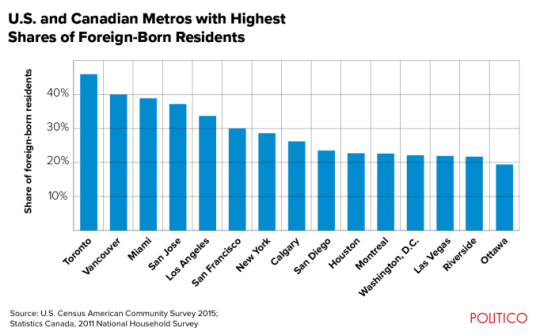
    Here is a chart showing the US and Canadian metros with the highest percentage of foreign-born residents:

    image

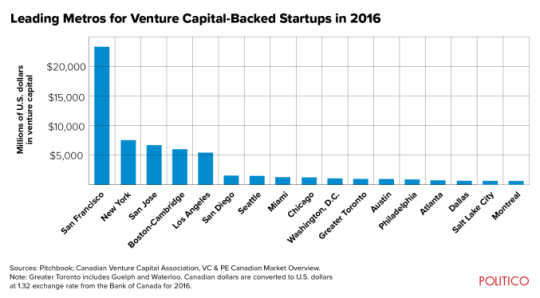
    And here is a chart showing which metro areas receive the most venture capital dollars (in millions of US dollars):

    image

    As to be expected, Toronto, Vancouver and Miami lead in terms of the percentage of foreign-born residents. Though, I would bet that Toronto’s foreign-born population is far more diverse than those of Vancouver and Miami.

    However, when you look at venture capital dollars invested, Toronto is nowhere near the top. Vancouver isn’t even on the list. And I suspect that some of you are surprised to see Miami sitting in between Chicago and Seattle (arguably a city that overperforms in tech relative to VC dollars invested). I was.

    Perhaps Trump will help with this by making Canada great again.

  • 280 characters

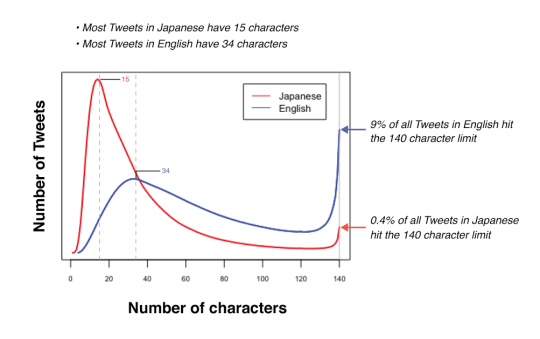
    Twitter is currently experimenting with longer tweets: 280 characters instead of its famous 140.

    One of the reasons they are doing this (besides the obvious goal of getting people to tweet more) is because different languages require a different number of characters in order to get the same message across.

    Here is a graph that Twitter published alongside their announcement:

    image

    I have never really given this any thought (perhaps because I don’t write or speak Japanese), but I find it interesting that Twitter’s arbitrary 140 character limit has been arguably impacting cultures differently. I wonder if there are subtle use case differences because of it.

    The other fascinating thing about this possible change is the backlash that is now mounting from users. People are freaking out, which I suppose some would argue is what most people do on Twitter anyways.

    But a similar thing is happening regarding Instagram after word got out that they were testing a new 4-photo grid (as opposed to the current 3-photo grid). 

    And let’s not forget that there was also a time when Instagram’s square cropped photos would have been considered sacrosanct. Most people have probably already forgotten about that.

    I mention all of this because, though it may seem small, this is actually a big change for Twitter. And change can be hard to accept, even if it doesn’t come in the form of an 8 storey condo building. It can also be hard to stand up when everyone is telling you that what you are doing is stupid.

    Maybe this is stupid, in which case the experiment will prove that out. Maybe it will reveal something positive that nobody could have predicted. Or maybe we’ll all just forget what life was like with only 140 characters.

  • My prediction for Amazon HQ2

    “Now the trick is that we gotta look like we don’t need this shit and they give us the shit for free.“ –Mike Peters

    This is a line from one of my favorite movies, Swingers. Short video clip here. Mikey and Trent are in a Las Vegas casino trying to play it cool. They’re looking to make a scene at a table and Mikey throws out this gem of a line. He knows that people want what they can’t have and that confidence matters.

    I was reminded of this line today after Amazon announced its HQ2 Request for Proposal (full RFP document here) and every city, from Chicago and Toronto to Philadelphia and Dallas, started swooning over the prospect of housing Amazon’s second headquarters in North America. 

    But to be clear, I do not think this is a bad idea. I actually think Amazon HQ2 is an incredible city building opportunity that would generate countless positive externalities for the selected city. I’m thrilled that Mayor John Tory will be personally “leading the charge” with respect to Toronto’s response.

    Over $5 billion in construction and as many as 50,000 employees making on average over $100,000 per year. Amazon is looking for about 500,000 sf of space in phase 1 (2019) and up to 8,000,000 sf in total. Based on the RFP, they seem to be pegging their capital investment at somewhere around $600 per square foot.

    If I’m being as objective as possible, I honestly believe that Toronto is the city to beat in his competition. I think it will come down to access to talent. Human capital is the lifeblood of a company and Trump’s immigration policies simply put U.S. cities at a disadvantage in this regard.

    Of course, Toronto is also awesome. So that’s my prediction: Amazon HQ2, Toronto.

  • Network effects for autonomous vehicles

    In my recent post about why I write about tech on this city building blog, I made a pithy comment about autonomous vehicles and why it is “largely a software challenge.” 

    The argument I was trying to make was that the hardware, similar to smartphones today, will likely become a commodity. More of the value will end up flowing to the firms that control the software.

    Benedict Evans has an excellent deep dive into this topic on his blog. The post is called: Winner-takes all effects in autonomous cars.

    Here’s an excerpt about hardware:

    To begin with, it seems pretty clear that the hardware and sensors for autonomy – and, probably, for electric – will be commodities. There is plenty of science and engineering in these (and a lot more work to do), just as there is in, say, LCD screens, but there is no reason why you have to use one rather than another just because everyone else is. There are strong manufacturing scale effects, but no network effect. [My link, not his.]

    And here’s his conclusion:

    So, the network effects – the winner-takes-all effects – are in data: in driving data and in maps.

    That said, it is still early days for autonomous vehicles. Who knows if these network effects will end up being highly defensible or weak. There are still lots of assumptions and questions at this stage.

    From a city building perspective, one of the major concerns with autonomous vehicles is that they could tempt us back to car-centric city planning. That would be a shame.

    Photo by Zachary Staines on Unsplash

  • Why I write about tech on my city building blog

    I had a friend ask me this week about how I decide what to write on this blog. His comment was that I tend to write about a variety of different topics. He wondered: Isn’t it better to focus on one particular niche?

    The simple answer is that I write about what interests me. And secondary to that is any concern around what will get the most clicks. In fact, I try not to fall into the trap of worrying about the latter. Sometimes it can be paralyzing to fixate on what will appeal most to the tens of thousands of people who read this blog on a regular basis.

    The reality is that my interests are much broader than, say, just design and real estate; though these two topics are clearly central. 

    I learned a long time ago while studying architecture and art history that what we make as a society is generally a product of the cultural milieu at the time. In other words, the built environment doesn’t happen in a vacuum. It is the physical manifestation of what we believe to be true at a particular moment.

    Today, it’s pretty hard to ignore the importance of tech. Think of some of the most valuable companies in the world right now: Apple, Google, Amazon, Facebook, and so on. Now, technology has always shaped our cities, but what makes this moment different is the decisive shift toward software.

    It’s arguably no longer about who can build the best mousetrap. It’s about who can build the best software layer on top of that mousetrap.

    In 2011, venture capitalist Marc Andreessen (previously the co-founder of Netscape) published a widely shared essay called, “Why Software Is Eating the World.” And over the past 6 years he has been proven to be very right.

    The 3 main points he aimed to make with that essay are as follows:

    1. Every product or service that can become software will become software.
    2. Every company will have to become a software company.
    3. The winning companies will be the best software companies.

    Depending on your industry, this may sound ludicrous to you. Certainly in 2011 it probably seemed that way. 

    But a perfect example of this phenomenon is the iPhone. The phone itself is manufactured in China, albeit where a lot of great hardware innovation is taking place. 

    But at this point, phones have become fairly commoditized. The profits that Apple makes from the iPhone disproportionately come from the software layer and the app ecosystem it has developed.

    You could make a similar argument with Tesla. Autonomous navigation – which most of us can agree will have a profound impact on cities – is largely a software challenge. 

    And so if you believe that autonomous vehicles will be a fundamental part of the future of mobility, then it’s not that hard to believe in point number three: the winning car company will also have to be the best car software company.

    Some industries have been less touched by tech and software – real estate being one of them. But if Andreessen is right and it’s not a question of if, but a question of when, then it behooves all of us to think about the potential impacts.

    I love how Andreessen ends this podcast discussion with Barry Ritholtz of Bloomberg and so I’m going to repeat it here to close out this post. He says: “There are no bad ideas. There are only early ideas.” 

    And that’s why I write about tech on my city building blog.

    Photo by Michal Pechardo on Unsplash

  • Lifelogging

    Swarm recently released version 5.0 of its mobile app. Blog post here. Instead of gamification (leaderboards and so on), the emphasis is now on lifelogging – a more personal collection of all the places you’ve been.

    Here’s what that looks like:

    The most notable change is a front and center map that shows you all of your check-ins. You can also zoom in and really explore where you’ve been, geographically. Swarm refers to it as a “virtual memory book.”

    Lifelogging is absolutely the main reason why I use Swarm and why it still finds itself on my home screen. One of the reasons I enjoy blogging is that it’s a public diary. Swarm is a modified version of that for me. So this change feels right.

    My other Swarm use cases are being able to share check-ins to Twitter and serendipitous encounters with friends.

    But the more I use Swarm the more I think that divorcing this use case from Foursquare (this happened in 2014) was a mistake. If Swarm is now about lifelogging (instead of just playful check-ins) and if Foursquare is about finding the perfect place to go out, then why not merge these experiences? 

    Tell me where I should be going, let me make lists of places I want to go, and then let me log it to my diary along with tips for other people.

    At the time of the divorce, the data seemed to suggest that very few people did both of these things within the consolidated app. People either checked-in or they looked for a place to go. Rarely did they do both.

    Perhaps that would be different with lifelogging.