Daily insights for city builders, delivered every morning at 6 AM ET. I’m Brandon Donnelly — a Toronto-based real estate developer and founder of Globizen. I’ve been writing here since 2013.

Tag: tech

  • The geography of innovation and equality of opportunity

    The Equality of Opportunity Project has a recent paper out called: Who Becomes an Inventor in America? The importance of Exposure to Innovation. Vox also has a summary of the findings, here.

    The overall goal of the project is to “use big data to identify new pathways to upward mobility.” And in this particular study, they discover that in America there are many “lost Einsteins” – people who have the ability, but not the opportunity.

    Not surprisingly, socioeconomic class, race, and gender play a significant role. Children from high-income families are 10x more likely to become inventors (measured in patents) as compared to children from low-income families.

    Geography, place, and environment also matter. Where and how a child grows up has a significant impact on future outcomes. If a child grows up in a city/network that exposes them to other inventors, it increases the likelihood that they too will invent. 

    Where a child grows up also has an impact on the types of inventions, even if the child move cities as an adult. For example, the study found that if a child grows up in Silicon Valley but moves to Boston as an adult, it is still more likely to author patents related to computers because that’s what it was exposed to as a child.

    These associations also impact in a gender-specific way. Women are more likely to invent in a particular technology if they grow up surrounded by similar female inventors. The presence of male inventors has no impact. This makes a powerful case for better gender diversity and strong role models.

    If you would like to read the full paper, click here.

  • Jeff Bezos’ regret minimization framework

    Who better to talk about on Black Friday than Amazon’s Jeff Bezos. Supposedly he’s now worth $100 billion.

    I just finished watching this short 60 Minutes clip about Amazon from 1999. If you can’t see it below, click here.

    [youtube https://www.youtube.com/watch?v=fjjUOemW-_Q?rel=0&w=560&h=315]

    Amazon was founded in 1994, so this was 5 years in. Already the company had gone public and had a market cap of somewhere around $30 billion.

    Now, keep in mind that this was right in the middle of the dot com bubble, but already Bezos was a billionaire on paper.

    What is clear from the above clip is just how obsessed Bezos was and is on the long game (”I don’t go in for carpe diem”) and on his customers. Here he is worth quite a bit, but driving around in a Honda Accord. 

    Bob Simons, the interviewer, pokes fun at him a few times for his reluctance to spend money. But Bezos says that it’s all about spending money on things that matter to customers and not spending money on the things that don’t.

    That’s customer obsession.

    P.S. The title of this post will make sense once you watch the video.

  • People you may know

    If you’ve ever wondered how Facebook figures out all of the people you may know, here is some reading material. 

    The short answer is that Facebook doesn’t just know the things you’ve told it about yourself, it also knows what other people have told it about you. 

    One of the ways in which this is done is through its so called “shadow profiles". These are profiles that get created when other people share information about you with Facebook. 

    For example, you may not want to share your work email address with Facebook, but if it’s sitting in someone’s phone and that person decides to share his/her address book with Facebook, then it could show up in your shadow profile.

    And if there’s a common data point, such a phone number, then Facebook can fairly easily link that work email address back to you and start suggesting people from your work that you may know.

    The scary part, of course, is that Facebook is getting your information without you explicitly sharing it with them. It could be coming from that person you gave your business card to at the bar.

    It goes to show you just how fierce the competition is for our attention. It may be an assault on our privacy, but more Facebook connections means a higher likelihood that we’ll stay engaged on the platform.

    Over the past year I have been growing increasingly intolerant of this demand for my time. Slowly but surely I have been turning off all nonessential notifications on my phone. 

    Very few now remain, which is why if you’ve been trying to reach me on Facebook, WhatsApp, LinkedIn or some other platform, and I’m not responding, it’s because there’s a good chance I’m not seeing the notifications.

    And let me tell, it feels liberating.

  • How a North Carolina casino created a case study on unconditional basic income

    Unconditional basic income is a popular idea these days, particularly in the tech community, as one way to respond to growing inequality. (Though, could our current levels of inequality just be the result of a larger economic cycle?)

    One of the obvious counterarguments is that free money will make people lazy. But there are a number of studies out there, including real world examples, that suggest this isn’t necessarily true.

    Wired recently published an interesting recount of one such example. 

    In the late 90′s the Eastern Band of Cherokee Indians in North Carolina opened up a casino. Many would argue that casinos are horrible as an economic development tool, but in this instance the roughly 15,000 tribal members were all promised an equal cut of the casino’s profits.

    The first payments worked out to about $595 each. But in 2016, each tribal member received approximately $12,000. 

    The operator takes 3% of annual profits as a management fee, and then the rest is funneled back into the community to cover things like healthcare and infrastructure. About half of the casino’s profits go toward these “per capita payments.”

    All of this has made for an interesting case study on what can happen when you distribute unconditional money to low-income households. 

    What researchers discovered was a slew of positive externalities ranging from not only higher household incomes and fewer people below the poverty line, but also better health outcomes and children staying in school longer.

    For the full Wired article, click here.

  • Uber Express POOL is kind of like public transit

    Uber is currently testing a feature in a few neighborhoods in Boston and San Francisco called Uber Express POOL

    Like the regular version of Uber POOL, this is a shared ride. But with Express POOL the app now automatically generates “smart spots” that are easy to drive to and close to the origin and destination of multiple passengers.

    So instead of a direct pick-up and drop-off, you now need to walk a few blocks to one of these dynamically created “smart spots.” In exchange for the added inconvenience, you get 25% off your fare.

    What’s immediately fascinating about this feature is that it further blurs the line between Uber and public transit. These “smart spots” are effectively low-volume and ephemeral transit stops that pop-up based on demand and then disappear.

    It makes the notion of a fixed stop and transit schedule, particularly in low usage areas, seem inefficient. Now imagine if we created some sort of visual marker on the street every time a “smart spot” was emerging based on demand.

    It is clear that Uber is trying to price these rides so that they are competitive with conventional public transit. And there’s no reason that this technology couldn’t also be applied to larger vehicles, such as buses.

    I find this fascinating. And it’s a perfect example of what we talked about in yesterday’s post. This is software and networks being layered on top of the built environment.

  • Planning dinner, smart cities, and privacy

    image

    This evening I attended the 27th Annual Toronto Planning Dinner. It’s an annual dinner for people in planning and development, put on by the University of Waterloo Planning Alumni of Toronto. Thank you Wood Bull LLP for the invite.

    The keynote speaker was Dr. Anthony Townsend. He is the author of SMART CITIES: Big Data, Civic Hackers, and the Quest for a New Utopia. I haven’t read it (yet), but his talk offered a preview of it and I think it would be of interest to all of you.

    It deals with many of the topics that we discuss on this blog, one of which is the interrelationship between our physical environment and the networks and software layers that we are now building on top of it.

    These layers have the potential to augment and enhance our cities (maybe make them smarter), but they also have the potential to do us harm. One important issue that Townsend brought up is that of privacy.

    Cities used to enable anonymity. 

    When essayist and art critic Charles Baudelaire wrote about “modernity” in 19th century industrializing Paris, it referred to an ephemeral and fleeting kind of urban environment. Pass someone on the street and you may never see them again. That must have felt sad at the time.

    Today we live in a fish bowl. 

    Networks connect us, check us in, ping us when we are nearby people we know, and help us find people to meet and date. And we already have devices, like Alexa, that spy on us in our homes so that companies can serve us targeted ads. (This is deplorable by the way.)

    Will the city of the future endeavour to do the same as we equip it with more “smarts”?

    I guess that’s why Townsend believes that privacy will define a big part of 21st century urbanism. There’s no doubt that it will be very important.

  • Self-parking cars

    I recently tested out BMW’s self-parking feature. I think it’s called parking assistant. But that doesn’t feel quite right, because it didn’t really assist. It actually did everything.

    As soon as you slow down and start driving past parked vehicles, the car automatically starts scanning and measuring the length and depth of available spots. You see this happening in realtime on the car’s display in plan view.

    Once it finds a suitable spot, all you have to do is basically stop and press a button. No need to steer. No need to accelerate or break. No need to turn your head. It all happens automatically.

    After the car had parked, I immediately got out to see what kind of skills it had. It was inches away from the curb on both tires and 100% parallel to the curb. 

    I have to admit that I did feel a tad uncomfortable letting the car do everything. I am so used to turning around and being in control. I don’t even have a backup camera in my car.

    But this feature is probably (I’m guessing) already more capable than many human drivers when it comes to parallel parking.

    For those of you in the know when it comes to cars, this may be old news. But I was super impressed. And it was a good reminder of what’s coming down the pike.

  • Five great surges of capital and technology, 1771-2017

    Carlota Perez is a professor that specializes in the social and economic impact of technological change. In 2002, she published an influential book called Technological Revolutions and Financial Capital: The Dynamics of Bubbles and Golden Ages.

    One of her arguments is that economic growth since the Industrial Revolution has occurred through a series of cycles and surges, ultimately culminating in a fifth great surge centered around information and telecommunications. This is our current economic environment.

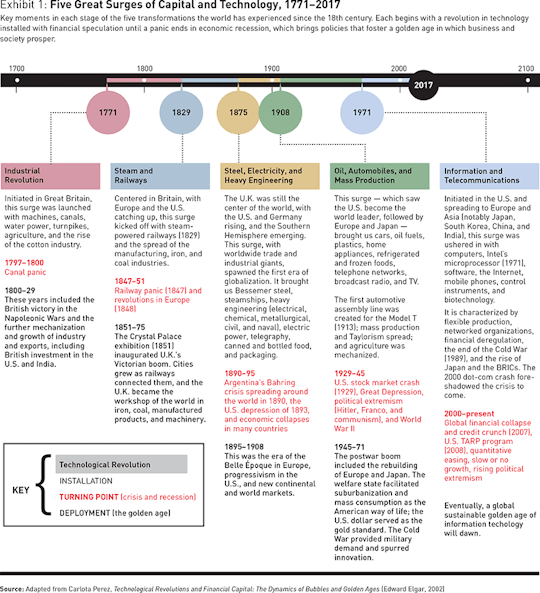
    Perez was recently interviewed by strategy + business and they published this diagram (if it’s too small, click through to the article):

    The five surges of capital and technology since 1771 are:

    1. Industrial Revolution
    2. Steam and Railways
    3. Steel, Electricity, and Heavy Engineering
    4. Oil, Automobiles, and Mass Production 
    5. Information and Telecommunications

    Number 4 – oil, automobiles, and mass production – is what produced widespread suburbanization, a middle class filled with homeowners, and new forms of retail employment. And I am sure that most of you would agree that it’s not quite over yet.

    According to Perez, each cycle has two phases: an installation phase and a deployment phase. This latter phase is a “golden age.” But in between these two phases is a turning point that is typically characterized by some sort of crisis and recession. 

    Her belief is that we are in this turning point right now. You see it with Brexit. The demagogues being elected. And more. If you buy this, the key question naturally becomes: How do we cross this chasm and enter our next golden age?

    What’s also important to keep in mind about this theory is that it means that what we are seeing today, socio-economically, is not in fact new. We’ve been through this before. I’ll end with this quote from the interview with Perez:

    In the 1920s, wealth distribution looked the same as it does today. The top 1 percent received 25 percent of society’s total income. By the 1950s it was down to 10 percent. Every installation period brings inequality until the state comes back actively to reverse it and relieve social unrest.

    So what’s happening today may be temporary and it may be history repeating itself. If you’re interested in this topic, you can read the full interview here.

  • Geography is no longer destiny

    image

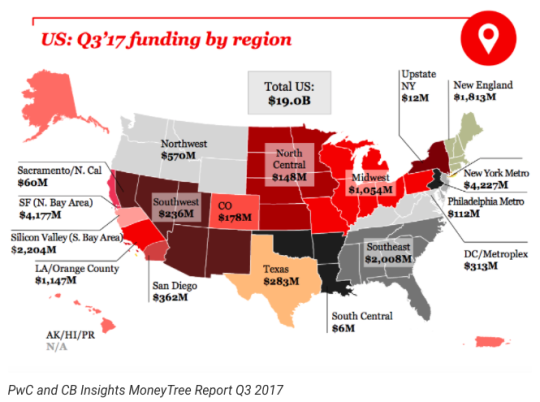
    The Q3 2017 Moneytree Report from PwC and CB Insights was recently released. It tracks venture capital trends in the US and globally. 

    Last quarter, US venture capital-backed companies saw $19 billion in total funding across 1,207 deals. Perhaps most notably for the US, funding in the NY metro area rose 57% to $4.227 billion and inched out the San Francisco Bay Area ($4.177 billion).

    But this was really because of two epic rounds to WeWork (NYC HQ) totalling around $2.5 billion. Also, Silicon Valley ($2.2 billion) is tracked separately to the San Francisco Bay Area in the report.

    Still, there’s a real sense that the New York tech ecosystem is on the rise and that it is probably furthest ahead in the US in terms of being able to catch up to California.

    Last week, MongoDB (NASDAQ: MDB) went public. Albert Wenger, who is an investor in the company, argued on his blog that this is an important milestone for technology companies based in New York. 

    It’s the first core technology company (instead of applied technology company) to go public in the city and it’s a big step forward in terms of demonstrating that “geography is no longer destiny.” 

    You don’t have to move to the Bay Area to win in tech.

  • Moving up the stack

    The new GoPro HERO6 is a miraculous little camera.

    It now films in 4k at 60 frames per second. It has great image stabilization. And the screen on the back is new for me and a real game changer. The creative possibilities are endless.

    But probably more importantly you can tell that GoPro is investing heavily in their software. They have to make it easier for people to share the content they create.

    They also know that their survival likely depends on some sort of software layer.

    At its peak, GoPro was trading at $86 per share. Right now, as I write this post, it’s $9.40. Some think the company will be sold within the next year.

    Here is a recent quote from Benedict Evans:

    As we saw with first GoPro and now perhaps Sonos, if you’re riding the smartphone supply chain cornucopia but can’t construct a story further up the stack, around cloud, software, ecosystem or network effects, you’re just another commodity widget maker.

    To borrow Marc Andreessen’s line: Software is eating the world.