Daily insights for city builders, delivered every morning at 6 AM ET. I’m Brandon Donnelly — a Toronto-based real estate developer and founder of Globizen. I’ve been writing here since 2013.

Tag: tech

  • Drone delivery in remote communities

    Toronto-based Drone Delivery Canada has just signed a $2.5 million agreement with the Moose Cree First Nation. This will bring the company’s drone delivery platform to the Moosonee and Moose Factory communities in northern Ontario (about 19 km south of James Bay).

    Here is an excerpt from a recent Techvibes article:

    “This agreement is representative of the large ‘Remote Communities’ market that we see penetrating over the next three to five years,” said Tony Di Benedetto, CEO of DDC. “The Remote Communities market is only one segment of the overall total addressable market in Canada. In addition to Canada, DDC is working with other customers around the globe to licence our FLYTE software and drone delivery technology.”

    DDC’s Sparrow drone is able to handle 5 kg (~11 pound) payloads and will be used to transport letters, parcels, medical supplies, and other general necessities. 

    This is a big deal for Moose Factory because the island can only be accessed by boat in the summer, ice road in the winter, and by helicopter during the rest of the year. And this is not a unique situation for remote communities.

    Suboptimal infrastructure and connectivity is a common problem and generally results in a higher cost of living, among other things. So this strikes me as something that should have meaningful impact on the quality of life in these communities.

  • My Focals by North fitting

    Over the weekend I went by the new North store on Ossington for the fitting of my new Focals by North glasses. According to Retail Insider, this is the first retail space in Canada that is entirely dedicated to wearable tech (shout-out to Hullmark and CBRE). Full disclosure: I am not being paid by North, but I was asked if I would accept a pair of Focals and provide my thoughts. So I will be doing that over the coming months on the blog.

    Previously known as Thalmic Labs, North is a Waterloo-based company that first attracted attention with the launch of a gesture-control armband known as Myo. What that product did was make digital interactions completely hands-free. It had strong use cases across medicine, music, and business. However, this past October the company announced that it would be moving on from Myo. Enter Focals by North. 

    Focals are custom-built eyewear with an integrated display that only the wearer can see. It is similar to, for example, BMW’s heads up display, and the idea is that it is a way for you to quickly get the information you want, without pulling out your phone and disengaging from the world. The ambition is human-centric technology that integrates seamlessly.

    Here is an example of what that display looks like (it is much better and cooler in person):

    image

    To control the display you use both your voice (the glasses have a microphone) and a 4-directional joystick called a Loop, which sits on your index finger like a ring and that you thumb. You can receive and send texts (voice to text), you can get turn-by-turn directions, you can view your appointments and the weather, and you can ask Alexa things.

    The first step in the ordering process is a fitting. And that’s what I did over the weekend. The glasses are all custom made and so they start by doing a full 3D scan of your head in a room that feels like the future. Once that’s done, you pick what frame you want, the color, and your sun clips (an essential accessory for day drinking in Trinity Bellwoods). Total cost: CAD 1,299.

    While exceptionally cool, it is premature for me to really comment on the tech at this point. I’m expecting my Focals in 8-10 weeks. But is it interesting to opine on the current state of eyewear tech.

    Most people believe that the problem with Google Glass was the fact that you had to be a Silicon Valley nerd in order to want to wear them out in public. They looked and continue to look ridiculous, which is why Snap went fashion first with their Spectacles. I have always found this product really intriguing. I want to use it. But I’ve stopped using Snapchat entirely and I don’t really have a strong use case for them.

    Snap’s Spectacles are about capture and content creation, whereas Focals are about discreetly feeding you information that you would otherwise have to pull out your phone (or watch) to view. There’s no camera on Focals. That’s not what they are about. But they are obviously fashion first.

    The question for me is whether the experience will truly be seamless and integrated, or if I’ll still be disengaged – gazing off into my glasses (space) while I ask Alexa to UberEats me a chicken shawarma wrap. I’ll let you know in about 8-10 weeks. If you’re looking for more on Focals by North, check out their website and this CNBC piece. Go Canadian tech.

  • International Blockchain Real Estate Association

    I was at a Proptech dinner earlier this week (graciously hosted by Venturon) and I was introduced to the International Blockchain Real Estate Association (also known as IBREA). I feel like I should have known about this group. They have over 5,000 members and host an annual summit focused on blockchain + real estate.

    They have several videos from this year’s summit up on their website – everything from blockchain for titles to the tokenization of real estate assets. There are also a number of industry working groups that have been set up, which bring companies together around specific problems and ambitions (such as, creating a universal property identifier).

    To get you started, here is Blockchain Real Estate 101. If you can’t see the video below, click here.

    [youtube https://www.youtube.com/watch?v=1WcLOcWyfHk&w=560&h=315]

  • Airbnb announces new Backyard initiative

    Airbnb has just announced a new initiative called Backyard, where it will be looking at new ways in which homes can be designed, built, and shared. They are, in a broad sense, becoming architects.

    The initiative has been in the prototyping phase for some time now, but the plan is to put forward some sort of product in 2019. Despite the name, the initiative won’t just be focused on small backyard cottages or accessory dwelling units.

    Here is an excerpt from Fast Company:

    “Backyard investigates how buildings could utilize sophisticated manufacturing techniques, smart-home technologies, and gains vast insight from the Airbnb community to thoughtfully respond to changing owner or occupant needs over time,” Gebbia says. “Backyard isn’t a house, it’s an initiative to rethink the home. Homes are complex, and we’re taking a broad approach–not just designing one thing, but a system that can do many things.”

    This is yet another example of tech and real estate coming together. But as I’ve mentioned before on the blog, I think eventually we’ll stop making that distinction; it will just become the way in which we build companies.

  • Evolution of online marketplaces

    I have written a lot about Opendoor over the past few years because it is one of the most promising “proptech” startups in operation today and I am obviously very interested in the impact of tech on the real estate industry. 

    I also have a fascination with online marketplaces. From the Greek agora to today’s mobile apps, the exchange of goods and services is a fundamental human activity. Uber, Alibaba, Instacart, Airbnb, Amazon, and Kickstarter are all marketplaces. I think sometimes people forget that.

    Andrew Chen, who is a general partner with the venture firm Andreessen Horowitz, recently published an essay on the future of online marketplaces, where he argued that what’s next is a reinvention of the $10 trillion service economy.

    Andrew posits that the internet has brought about 4 eras of marketplaces. They are:

    1. The Listings Era (1990s)
    2. The Unbundled Craigslist Era (2000s)
    3. The “Uber for X” Era (2009-)
    4. The Managed Marketplace Era (Mid-2010s)

    The listing era birthed marketplaces that were essentially online versions of the things that already existed offline. Craigslist, for example, simply took the classified section and put it on the internet.

    Over time, these online marketplaces began to focus on specific verticals (the unbundling of Craiglist) and they started to introduce services and features that were native to the internet and later to mobile. Uber obviously only works when everyone has a smartphone.

    Today we are living in the era of what Andrew calls the managed marketplace. Opendoor – to get back to the first paragraph of this post – is a managed marketplace. Instead of just connecting homeowners with buyers, they take on specific steps of the value chain. They buy and fix up the homes themselves.

    So what’s next? 

    Supposedly it is regulated services (2018-?). As of 2015, it was estimated that about 26% of employed people in the US carried some sort of license. These are healthcare practitioners, architects, engineers, real estate agents, financial advisors, trades people, and so on.

    And the argument is that a lot of how we regulate services today is a result of us creating them before the internet. We needed licenses and certifications to signal to us who was qualified and who was not. But now we have technology to help us do that, which is why this could be the next great era of online marketplaces.

  • The next 20 years

    image

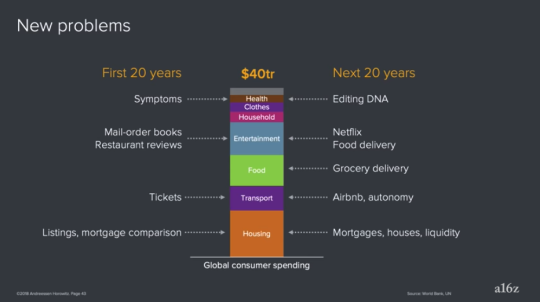
    Above is a screenshot from a presentation about the future of tech that Benedict Evans gave last week at venture capital firm a16z’s annual conference. And below is a video of the talk. If you can’t see it, click here.

    [youtube https://www.youtube.com/watch?v=RF5VIwDYIJk&w=560&h=315]

    The talk is positioned as “the end of the beginning.” In other words, here is where the internet and smartphones have taken us, but that’s just the beginning. Quote: “We used to do apartment listings [online] and now Opendoor will buy your home.”

    It’s only 24 minutes and well worth a watch.

  • US cities with the most corporate HQs

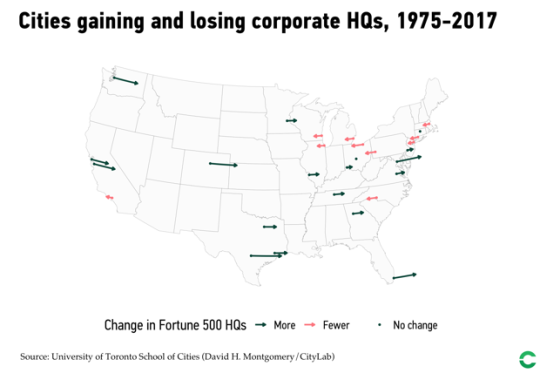
    The University of Toronto School of Cities recently looked at the changing economic geography of Fortune 500 companies across the US from 1975 to 2017. Here is a diagram of the results taken from CityLab:

    New York sits at the top with 70 corporate headquarters as of 2017. But the San Francisco Bay Area is now the second largest center with 35 headquarters – a testament to tech.

    The study does, however, omit service firms, as these weren’t tracked in Fortune’s list back in 1975.

    Also noteworthy is the specialization that has taken place across specific cities and regions. Here is another excerpt from CityLab:

    America’s headquarters geography reflects the substantial variation and specialization of the U.S. economy. New York leads in finance and business services, consumer services, and goods and materials. But Houston leads in energy, San Jose in tech, and Chicago in retail and wholesale. Chicago also ranks second in consumer services, and goods and materials, and Dallas takes third in energy. Other cities like Nashville and Minneapolis take third in consumer services, and goods and materials, respectively.

    The full article can be found, here.

  • HQ2 isn’t coming to Toronto

    So I was wrong. Amazon didn’t pick Toronto for HQ2. It instead picked Crystal City, Virginia (Washington) and Long Island City, NY (New York City). More on that, here, in the NY Times. Confession: My prognostication was at least partially about trying to create a self-fulfilling prophecy.

    In any event, it’s interesting to consider the locations that they did pick – as well as the fact that they ended up picking multiple cities. This was not part of their RFP. Though, many have convincingly argued that this process was over before it even began. HQ2 was always going to end up on the east coast, near one of Bezos’ homes.

    Nevertheless, urbanists such as Aaron Renn took the announcement as a direct repudiation of the American heartland. He believed that Amazon would be far more cost conscious in their decision making and ultimately elect for a lower cost locale in the middle of the country. Instead, the coastal hegemony won out. 

    Joe Cortright of City Observatory correctly predicted that Amazon would, for a few reasons, parlay their HQ2 search into multiple smaller locations (HQ2, HQ3, and so on). One of the reasons for this is that it gives the company more leverage when it comes negotiating subsidies on a go-forward basis. If NYC doesn’t want our next round of hires, we’ll take them to Washington.

    Looking at the locations, one of the first things I noticed is that both are just outside of their respective “downtowns” (across a body of water), as well as adjacent or on the way to an international airport. Crystal City is across the street from DCA and Long Island City is a 15 minute drive from LGA. Both are situated on top of higher order transit. Makes sense to me.

    Now, who wants HQ4?

  • Tech and the North American office market

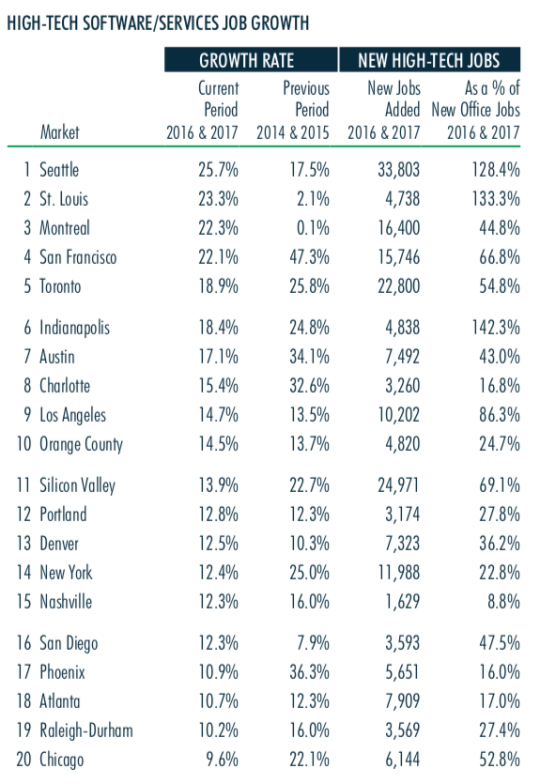
    CBRE recently published this report looking at the impact of the “high-tech software/services industry” on the North American office market. 

    Here are a few highlights:

    – Since 2010, tech has created ~1.1 million jobs in the US at an annual growth rate that is 3x the national average.

    – Seattle currently has the fastest tech job growth in North America. This is the first time in 7 years that San Francisco hasn’t been at the top of their list.

    – Silicon Valley, Toronto, New York, and Los Angeles all added more than 10,000 tech jobs from 2016 to 2017.

    – The biggest “momentum markets”, relying on 2016 and 2017 data, are Montreal, St. Louis, and Seattle.

    – Over the past two years (Q2-2016 to Q2-2018), Atlanta, Los Angeles, Orange County, Seattle, and Portland have all seen double-digit rent growth.

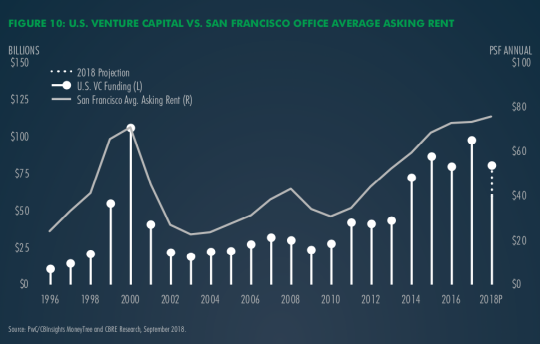
    One figure that also stood out for me was this one here showing the relationship between US venture capital investment and the average asking rent for office space in San Francisco.

    If you’d like to download the full report, click here. You’ll need to sign up for an account with CBRE, but it’s free to do that.

  • Transit tech lab launches in NYC

    image

    Earlier this month, the Metropolitan Transportation Authority (MTA) and the Partnership for New York City launched a new vertical accelerator dedicated to public transit. The mission is to make the city a global leader in this space.

    Applications are open until November 30, 2018 and they are looking for early and growth stage companies that address one or both of the following challenges:

    1. How can we better predict subway incident impacts and serve customers?
    2. How can we make buses faster and more efficient?

    Selected companies will go through an 8-week accelerator and, at the end of it, the most promising companies will partner with the MTA on a 12-month pilot. So it is an opportunity to potentially test your product(s) on the largest transit authority in the US.

    If you’d like to apply, you can do that here.

    Photo by Tim Gouw on Unsplash