Daily insights for city builders, delivered every morning at 6 AM ET. I’m Brandon Donnelly — a Toronto-based real estate developer and founder of Globizen. I’ve been writing here since 2013.

Tag: tech

  • Bye Tumblr. Hi WordPress.

    I finally did it. Over the weekend I ported this blog over from Tumblr to WordPress. I had been thinking about doing this for a while, but kept putting it off (1) because of the work involved and (2) because I was worried about my permalinks changing. About 35-40% of the visits to this blog come from organic search. I’m on the first page when you Google “real estate developer.”

    I had been using Tumblr since I first started writing this daily blog back in August 2013. But it started feeling increasingly limited. It isn’t great for longish-form blogs like this one and it is terrible at handling photos and other embedded content. (I plan to post more of my photography now.) The last straw for me was the inability to blog from a mobile device. I tried that over the weekend and it was bad.

    I was also starting to feel like the product was on the decline. Yahoo acquired Tumblr in 2013 for $1.1 billion. Tumblr hadn’t yet figured out how to effectively monetize its platform and Yahoo needed a cool social product in their portfolio. But that deal doesn’t seem to have gone as planned, at least not for Yahoo.

    So here I am on WordPress. I’m still working out some of the kinks, but I think we’re almost there. If you’re reading this post in your inbox, it should be business as usual. If you’re reading this post on the web, you’ll notice a few differences (I’m still fine tuning the design).

    Regularly scheduled programming will resume tomorrow now that we’re just about setup.

  • “Alexa, play some Miles Davis”

    Over the weekend I received an Amazon Echo as a gift. I set it up in my kitchen on Sunday morning and had it playing music and telling me the weather in no time. I also setup a couple of “routines” so that when I say things, such as “good morning”, it cycles through the weather, the news, and some other things that I might find valuable at the start of my day. It is pretty neat.

    The truth is that I have actually been avoiding voice assistants since they were first launched. As much as I consider myself an early adopter, I have been generally uncomfortable with the idea that my voice commands, and perhaps other things, are being stored by Amazon. There are ways to delete that history, but I am not yet sure if that’s enough for me. Am I going to be served an ad because of something I mention in my own home?

    Now that I’ve been trying it out for a few days, I will say that it is incredibly useful. I immediately see the value. I use it to control some of my lights. I ask it things when I’m cooking and my hands are dirty: “Alexa, how badly are the Raptors going to beat the Bucks this Thursday?” And I use it to play music. But is all of this a fair exchange for the creepy feeling that they create?

    I’m not sure. But it certainly feels like the future.

  • Non-load-bearing curtain wall

    image

    Liz Diller of Diller Scofidio + Renfro was recently asked by designboom about how her firm approached the design of Fifteen Hudson Yards (the first residential tower in New York’s Hudson Yards).

    The firm had never designed a high-rise before. So while their typical approach would be to analyze program, here they were heavily informed by the views – both in and out from the site – as you move up the tower.

    The 88 storey tower transitions between two footprints. The base matches the street grid of the city, but as you move up the tower it transforms into a cloverleaf – allowing panoramic views of the city.

    It is a somewhat similar approach to what has been proposed by Studio Gang for One Delisle. Except for the transformation here is to a multifaceted cylindrical shape (a hexadecagon is what has been drawn).

    From the late 19th century when Chicago began to pioneer the modern skyscraper, architects and engineers have been thinking about how you treat a tall building as you move from top to bottom.

    Chicago architect Louis Sullivan responded to this challenge with his tripartite approach to design. He believed that tall buildings should be characterized by three main divisions: a base (bottom), a shaft (middle), and a cap (top).

    The technological innovation that allowed this thinking to flourish was the non-load-bearing curtain wall. Once the exterior walls of a tower no longer supported the actual building, architects then had the freedom to really experiment.

    This remains true to this day, but we no longer need to confine ourselves to only three parts. New technologies now allow for more.

    Today we have parametric modeling and other design tools that allow us to create new geometries and transitions; forms that would have been pretty complex to draw up in the past. 

    In the case of Fifteen Hudson Yards, every floor plate from 20 something and up is slightly different. I wonder what Louis would think of this.

    Image: Timothy Schenck via designboom

  • Real estate startup Knock raises $400 million

    I have been writing about the real estate startup Opendoor for many years here on the blog. Another promising startup in this space is Knock, and today it was announced that they just raised a $400 million Series B round (led by Foundry Group).

    They share some similarities with Opendoor, but they are also different in that their focus is on home trade-ins. They tell you what your current home is worth, help you find a new home, and then coordinate “a seamless swap.” For more on how they work, go here.

    One of the ways in which they are similar to Opendoor is that they front the cash for new home purchases. In the case of Opendoor, they buy your home with the plan of selling it in the future. And with Knock, they buy your home with the understanding that your old home will get sold.

    It is certainly a more capital intensive model compared to the way that home sales are handled today. But many investors are clearly betting that it is exactly what is needed to change the status quo. 

    (Credit to Jeremiah Shamess for sharing the above news with me today.)

  • Mobility at CES

    CES is underway right now in Las Vegas. About 200,000 people are in attendance. 

    Since tech and mobility are today closely intertwined, the show has become an important platform for the automative industry.

    Here is a video showcasing BMW’s new iNext concept (expected by 2021):

    [youtube https://www.youtube.com/watch?v=x9-f3cALABk&w=560&h=315]

    It is based on level 3 autonomy, which means the car will do mostly everything, but you need to be ready to take over at any time.

    The video is interesting because it begins to show you what becomes possible when you no longer need to pay attention to the road. It is a bit like flying (but hopefully more enjoyable). 

    And here is a video of Bell’s new urban air taxi, which is called Nexus (expected by the mid-2020s):

    [youtube https://www.youtube.com/watch?v=1o4d8N-A1G8&w=560&h=315]

    This is the company’s first concept. But they’ve been working with Uber since 2017 to develop a network of flying taxis for cities.

    Finally, flying cars.

  • iPhone as a Service

    At the beginning of this year – January 2nd to be exact – Apple revised its earnings guidance, downward. It was the first time in 15 years that the company had to do this. 

    Tim Cook’s letter to shareholders, which can be found here, focuses a lot on China and its “economic deceleration.” But M.G. Siegler of 500ish Words believes that a greater pivot could be underway. His piece can be found here. It’s a good read.

    Firstly, Apple’s current growth period is probably over. And secondly, the company is likely going to need to diversify away from high margin hardware/software sales and continue to grow its Services business (something that Microsoft has, ironically, already done).

    Here is an excerpt from M.G. Siegler’s essay (Apple’s Precarious and Pivotal 2019):

    The iPhone has simply been too good of a business. And it’s hard to see what tops it. Certainly in the near term. If Services is to carry Apple in the future, it will likely be only after years of relatively stagnant iPhone revenue growth mixed with a rising overall market. In other words, time and the broader world will have to catch up. And then Apple can have their “Microsoft Moment” — a services-based resurrection of growth.

    As Tim points out in his letter, most of Apple’s Services revenue is tied to its installed base, as opposed to current period sales (also: less exposure to China). Last quarter that number was $10.8 billion – a new record.

    So what we may see in the near future is the end of outright phone purchases and instead some sort of iPhone as a Service (or iPaaS). Pay Apple every month in perpetuity; always have the latest iPhone.

    Of course, Apple has many other irons in the fire. Apple Watch has turned out to be a big business and the company is said to have 2,700 “core employees” working on its autonomous driving project. 

    Maybe some of these businesses will also end up as Services.

  • And we’re back

    Welcome to 2019.

    I am currently in transit and catching up on some internet reading and email on my way back to Toronto.

    At this time of year it is, of course, common to reminisce (or lament) about what happened over the last year, as well prognosticate what may come.

    Over the last few years, I have done a bit of that on the blog. But I clearly didn’t do that this year while in Brazil (and away from any semblance of a workspace).

    So here’s what others have been writing and thinking about over the holidays:

    – 2018’s tech trends and tribulations in 14 charts. RecodeLink

    – 2018 was the year of the YIMBY. CityLab. Link

    – A cool girl’s guide to Toronto. Vogue. Link

    – Amazon’s annual Christmas press release. Link

    – Best travel posts of 2018. Design Milk. Link

    – Here’s (Almost) Everything Wall Street Expects in 2019. Bloomberg. Link

    – Here’s what to expect in cybersecurity in 2019. TechCrunch. Link

    – Naive to hope Toronto can change in 2019? That means we have work to do. Shawn Micallef. Link 

    – The 10 largest US venture rounds of 2019. TechCrunch. Link

    – What is going to happen in 2019. Fred Wilson. Link

    – Will a recession hit in 2019? Alan Murray. Link

    – Year in search 2018. Google. Link

  • Neural machine translation

    I have been using Google Translate a lot on this trip. Few people here in Rio de Janeiro speak English.

    It is an incredible app that also works without cell service. You just download whatever language(s) you need to your phone.

    There’s a conversation feature that allows you to go back and forth with someone in real time (almost). 

    There’s a camera feature that is invaluable for translating restaurant menus.

    And there are a number of smaller features that I have also found really useful. 

    For example, if you rotate your phone into landscape mode, it will show you your translation in big text like a flash card.

    It looks like this (trust me it is useful):

    imageimage

    I also just learned that, since November 2016, the Translate app has been using a neural machine translation system developed by Google.

    It is capable of understanding and translating complete sentences, and that has reduced translation errors by about 60% compared to the previous system.

    Rather than translate word-by-word or phrase-by-phrase, Google’s NMT network encodes the “semantics of sentences.”

    To learn more about GNMT, click here.

  • Maple Valley? No.

    At this time of year, I am always amazed by the number of mass emails that I receive from unknown people and companies. They have my email address, clearly, and yet I only receive one email a year from them – a happy holidays email. I am not opposed to holiday cheer. I love Christmas. But if you’re looking to build any sort of meaningful rapport with an audience, my sense is that you ought to send more than one email a year.

    In other news, the Economist published an article this past week talking about how Toronto is attracting disaffected (Indian) tech workers from the US and, more particularly, Silicon Valley. It is largely a story of immigration and diversity. But at the end of it, the Economist also reports that some people are now calling Toronto, Maple Valley. Toronto immediately reacted to this moniker – negatively.

    Nobody refers to Toronto as Maple Valley. And these sorts of names are stupid. In the 1990s, the Flatiron District in Manhattan started being called Silicon Alley (at least by some). That name was also stupid. New York is New York. And Toronto is Toronto. If you’re going to assign a nickname, it should not be derivative. And in the case of Toronto, you probably also want to avoid kitschy Canadian stereotypes.

  • Uber to go public in 2019

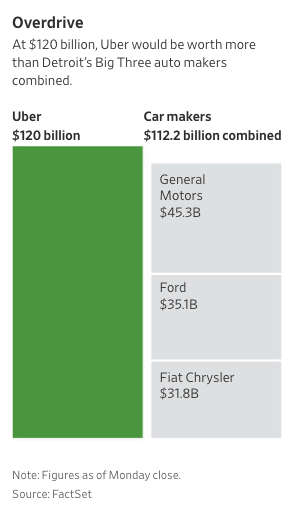
    Last week it was announced that Uber had confidentially filed for an IPO (right after Lyft did the same). It could go public as early as Q1 of next year. And supposedly, a valuation of $120 billion is being tossed around. The company last raised money in August of this year (from Toyota) at a $76 billion valuation.

    image

    Here are a few other interesting figures from a WSJ article published in the fall:

    – Uber has indicated that it doesn’t expect to be profitable for at least another 3 years. This year it is expected to hit between $10 and $11 billion in revenue, compared to $7.78 billion last year.

    – First Round Capital invested about $1.6 million in Uber’s first two fundraising rounds (2010 and 2011). If the company does in fact reach a valuation of $120 billion in the public markets, that early investment will be worth $5 billion. (First Round sold some of their shares to SoftBank in January and I’m not sure if the above figure accounts for that.)

    – Over 50 companies have invested in Uber since its founding, not including a slew of individual investments from people like Jeff Bezos of Amazon.

    On a related note, Fred Wilson, who is far more knowledgeable on this topic than I, recently published a post talking about the relationship between the private and public markets and what could happen to (tech) valuations in 2019. 

    It’s a good follow-on read to the above.

    Figure: WSJ