Daily insights for city builders, delivered every morning at 6 AM ET. I’m Brandon Donnelly — a Toronto-based real estate developer and founder of Globizen. I’ve been writing here since 2013.

Tag: tech

  • Policies for the leisure state

    image

    Andrew Kortina and Namrata Patel recently published an intriguing essay called, Kinky Labor Supply and the Attention Tax.

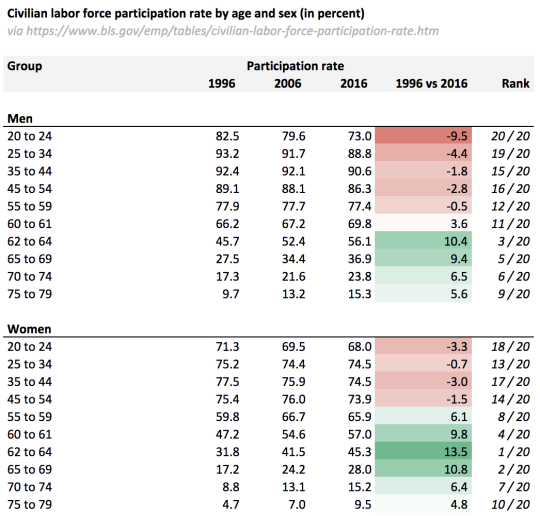
    They begin by talking about declining labor force participation rates, particularly among young men. Remember that the participation rate is distinct from the unemployment rate. Here is a chart from the essay:
    image

    Participation is down for young people, but up for older people. This is perhaps signaling that older demographics still need to work in order to maintain certain needs and/or a particular lifestyle.

    The possible explanations for this declining rate among young people are interesting. The authors argue that it is a combination of the declining cost of media entertainment content and the amplification of social status signaling, among other things.

    The declining cost of online content has meant that this form of leisure activity has become incredibly cheap, if not entirely free (beyond the mostly fixed cost of an internet connection). So there’s always something enjoyable to do.

    At the same time, the authors argue that once people make enough money to satisfy basic needs, there becomes a tradeoff between trying to make more money and simply spending more time on leisure.

    Historically, the motivator to make more money has been arguably associated with social status signalling through conspicuous consumption. But with the advent of social media, we are all now signaling globally, instead of just locally.

    Due to increased competition, the argument is that people are now feeling demotivated by all the conspicuous consumption that they see online. It is simply too difficult to compete. The Gini coefficient is too high.

    So why not just spent more time on leisure?

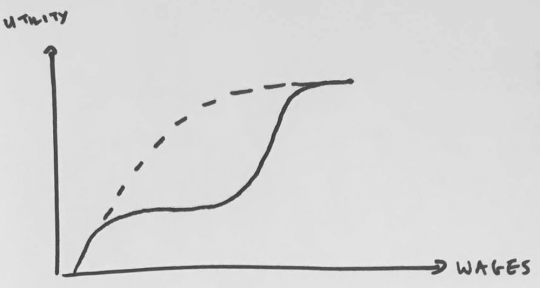
    One potential policy implication is that raising the minimum wage wouldn’t be enough to spur increased labor force participation. Labor isn’t responding in the same way to wage increases. There would need to be a much more significant increase in income for that to happen – hence the “kinky labor supply curve.”

    One view of the status quo is that media companies are aggregating human attention and selling it at a discount–far below minimum wage–to advertisers in a massive arbitrage on human capital. So, the state could set the price of an hour of human attention at the minimum wage rate, and charge media companies 12% (the federal income tax rate on minimum wage) of that wage rate for each hour of human attention they consume.

    One possible solution is an attention tax. But their takeaway is that this lost productivity will more than likely be made up for with technology, which could ultimately translate into something we are already seeing: increased inequality.

    Check out the essay here. It’s an interesting read.

  • Create things people love

    I just finished listening to this podcast about venture capital and consumer products. One of the underlying questions is whether we are currently in a “consumer downturn.” Rebecca Kaden of Union Square Ventures (USV) talks about the importance of “platform shifts” for venture returns. These are moments where a new technology hits the marketplace and there’s a corresponding mass consumer adoption. When and where will that next shift occur? Maybe it’ll be in real estate.

    I like the discussions at 10:00 and 13:50. The first deals with the importance of non-paid customer acquisition strategies for consumer products. Rather than relying on bought attention, you really need organic growth strategies, which is often an indication that people are passionate about your product. This is arguably more important when you’re fundamentally reliant on massive growth/scale, but whether we’re talking about software or a home, I still believe it’s paramount. Create things people love.

    The second point is about commerce, Amazon, and how USV avoids investing in companies that are unlikely to ever win against Bezos. Kaden’s position is that Amazon’s advantage is and has been more executional than structural. They are simply really good at doing things better. But Amazon wins at logistics, speed, and value. They are not as focused on experience, entertainment, and discovery. And people still want that.

    I’ll stop there. If you can’t see the podcast below, click here.

    [soundcloud url=”https://api.soundcloud.com/tracks/507691569″ params=”color=#ff5500&auto_play=false&hide_related=false&show_comments=true&show_user=true&show_reposts=false&show_teaser=true&visual=true” width=”100%” height=”300″ iframe=”true” /]

  • The vertical farmer

    Bloomberg is running a video series right now called Next Jobs. It is a look at the careers of the future. Episode four is about a vertical farmer named Katie Morich and a startup called Bowery Farming, which does this out of a nondescript building in New Jersey. 

    The video focuses more on Katie’s life and less on vertical farming. But it did introduce me to Bowery Farming, which I am intrigued by. So I thought I would share both the video and the company. It is a compelling pitch: local production; ideal conditions; no pesticides; and software that optimizes it all.

    [youtube https://www.youtube.com/watch?v=AGcYApKfHuY&w=560&h=315]

  • What motivates us

    Earlier this week it was announced that Instagram founders Kevin Systrom and Mike Krieger have resigned from the company. Supposedly it had to do with weakening independence from the parent company, Facebook. But I’m not really in a position to comment on the specifics.

    Fred Wilson wrote a good post about the news this week. The point he makes is that it is extremely rare for founders to stay on, at least for extended periods of time, after their company has been acquired. So it is actually quite remarkable that Instagram’s two founders stayed on for 6 years.

    But what I really want to talk about today is this quote from Fred’s post

    “The truth is that many entrepreneurs don’t make for great corporate citizens. Entrepreneurs like to be in charge, to be able to move quickly without a lot of friction, and they like to feel a deep sense of ownership in what they are working on.”

    It stood out to me for two reasons. One, because I agree with it. And two, because it reminded me of Daniel Pink’s book, Drive: The Surprising Truth About What Motivates Us. His overarching argument is that motivation is intrinsic and that we are best driven by the following: autonomy, mastery, and purpose.

    That sounds pretty similar to the things that entrepreneurs also seem to like.

  • Uber to invest $200 million in Toronto

    Uber CEO Dara Khosrowshahi was in Toronto today, where he announced that the company plans to invest more than $200 million over the next five years to expand the autonomous vehicle research lab that it already has here in the city. 

    The Toronto outpost of Uber’s Advanced Technologies Group (ATG) – which is its only international outpost – is led by renowned University of Toronto professor, Raquel Urtasun. She is also the cofounder of the Vector Institute for Artificial Intelligence and splits her time between Uber and UofT.

    With this investment, Uber also expects to open its first engineering facility in Canada and grow its local headcount to 500, up from the 200 or so it has today. Some of these hires will be local. Some will be international. And some will be transplants from Uber’s other offices.

    Also notable about the announcement is that Khosrowshahi mentioned that he thinks fully autonomous vehicles roaming the streets of our cities is a good 10 years away. But I wonder if that isn’t political PR speak intended not to spook its drivers. So are we closer to the mid-2020′s?

    Either way, as a proud Torontonian and UofT alumnus, I was happy to see this announcement. I think it’s far more exciting than the Apple event that took place earlier this week.

  • Tridel unveils smart condominium in South Core

    A few weeks ago, Canadian developer Tridel unveiled its first “smart condominium” at Ten York – a recently completed 69 storey building in the South Core neighborhood of Toronto. Above is an archive photo of the building under construction. I chose this one because its siting between the Gardiner Expressway (left) and Harbour Street (right) is also noteworthy.

    Smart anything is one of those tech buzzwords that is, I know, starting to feel vapid. But Tridel has done some interesting things here with their Tridel Connect platform (a collaboration with SmartONE Solutions). And if you happen to also be in the business of designing and constructing multi-family buildings, I think you’ll find it to be a useful case study.

    At Ten York, you can now use your phone as a key fob. People buzzing up are shown to you on your wall pad so you can confirm identity. The suite entry doors use digital locks, which means you use an access code instead of a key. Additional codes can be created for family and friends or for service providers like dog walkers and cleaners. You’re also given a log of who has come and gone. And of course there’s an automated parcel delivery system.

    If you’d like to see all of the features in the live, I suggest you take a look at the “b-roll video” that was included as part of their press release. Tridel is excellent at implementing new technologies and I know that they frequently reserve test suites in their projects to try some of them out. This is a great thing for the industry and for consumers.

    Image: Tridel

  • A more distributed startup geography

    The Economist recently argued that Silicon Valley’s innovation hegemony is waning and that it is a product of two factors: there appears to be more innovation happening elsewhere (good news), but that innovation in general also seems to be harder to achieve (bad news). Here is an excerpt from the article:

    Other cities are rising in relative importance as a result. The Kauffman Foundation, a non-profit group that tracks entrepreneurship, now ranks the Miami-Fort Lauderdale area first for startup activity in America, based on the density of startups and new entrepreneurs. Mr Thiel is moving to Los Angeles, which has a vibrant tech scene. Phoenix and Pittsburgh have become hubs for autonomous vehicles; New York for media startups; London for fintech; Shenzhen for hardware. None of these places can match the Valley on its own; between them, they point to a world in which innovation is more distributed.

    Part of the problem, of course, is rising costs in the Bay Area. Everything from the cost of living to the cost of operating a business. The article cites a recent survey where nearly half of all respondents said they are planning to leave the Bay Area in the next few years. This is up from 34% only two years ago.

    I don’t doubt that rising costs are causing some people to look to other cities, as well as other countries in the case of draconian visa policies. But I am suspect of the claim that we’ve heat peak “innovation” – however you want to define that.

  • Is Tesla the new iPhone?

    image

    Benedict Evans just published a great post on his blog about “Tesla, software and disruption.” I recommend a full read. In it, he tries to answer whether Tesla is really “the new iPhone” and if it will be as disruptive to the car landscape as some/many people think.

    In his line of thinking, electric (as opposed to an ICE vehicle) feels a lot more like a sustaining innovation, rather than a disruptive innovation. In other words, it something that incumbents will be able to incorporate. So it will not change the “basis of competition.”

    The more critical aspect is instead autonomy. Here are two snippets from the piece:

    All of this takes us to autonomy. Electric is compelling but will probably be a commodity, whereas Tesla’s improvements on top of electric may not be commodities but are not necessarily decisive. Autonomy changes the world in profound ways (I wrote about this here), and it’s a fundamentally new technology that doesn’t look at all like a commodity. And Tesla is doing this, too. Sort of.

    In this competition, Tesla’s thesis is that the data it can collect from its cars will give it a crucial advantage. The only reason that anyone is interested in autonomy today is that the emergence of machine learning (ML) in the last 5 years probably gives us a way to make it work. Machine learning, in turn, is about extracting patterns from large amounts of data, and then matching things against those patterns. So how much data do you have?

    But even if we are to all agree that autonomy is the “disruptive innovation”, it is not yet clear who will get there first. Maybe it is Tesla. Maybe it is Waymo. Regardless, many or most people seem to agree that it will arrive in 202x.

    Image: Tesla

  • Public access at Martin’s Beach

    I just learned about the ongoing legal dispute on Martin’s Beach (south of San Francisco) through this New York Times article

    To briefly sum it up, tech billionaire Vinod Khosla bought a 53-acre beachside village known as Martin’s Beach in 2008. On the land is about 47 beach houses, a shop that sold ice cream at one point in its life, and a road that provides the only access to the beach. The road is private, but over the years and before Khosla purchased the property, it provided both parking for and access to the beach. 

    After acquiring the property, the county told Khosla that he had 2 options with respect to the road:

    (1) Keep it open (there’s a gate that controls access). And charge no more than $2 a car for parking, which was the rate charged in 1972.

    (2) Apply for a Coastal Development Permit to change how the access works.

    Khosla opted to do neither and in turn the residents of Martin’s Beach sued him. He’s been in a legal battle ever since. But according to the New York Times, he has about $3 billion sitting in his war chest. For him it is both a matter of principle and a matter of protecting property rights.

    Not surprisingly, tech billionaire fighting to keep people off a public beach makes for a sensational headline in the media. The NY Times argued that every generation has some sort of rich Californian fighting to privatize the waterfront. Khosla is this generation’s “beach villain”.

    But beneath the headlines lies a fascinating legal debate that you can read more about through a blog post that Khosla published earlier this year. For you property lawyers out there, I would be curious to hear your thoughts in the comment section below.

  • Five year anniversary

    Today is the five year anniversary of this daily blog. That’s over 1800 posts. 

    It’s almost hard to believe that it has been that long. It seems like just yesterday I was on year 2 or 3. But at the same time, it’s almost hard for me to remember a time when I didn’t blog every day. I guess we’re calling it a habit at this point.

    One of the most common questions I get regarding this blog is: “Do you pre-write posts?” The answer is never. Okay, almost never. Sometimes I’ll pre-write a post if I know I’m going to be on a plane for 12 hours and I won’t make the timezone cutoff. But generally as a rule I don’t.

    Part of the reason I don’t is because it breaks the habit. This is something I do every day. And I like that routine. I also want the posts to be timely and I want to be able to write about things that may be on my mind that day.

    Momentum is a powerful thing. And when you’ve been doing something for a number of years, and especially something as public as this daily blog, there’s a powerful incentive to keep doing it. That’s how streaks work.

    However, in the world of development, five years is perhaps not that long. It’s maybe one project. Streaks take a lot longer to establish.

    This summer One Delisle by Studio Gang went public and you’re now starting to see (bright neon) teasers for Junction House. Both of these projects are many years in the making. The Junction House story started in early 2016.

    So I reckon that this blog needs at least another five years so that there’s enough time for the really juicy stories to surface. I’ll endeavor to do exactly that. 

    Thanks for reading and making this community what it is. See you tomorrow.