Daily insights for city builders, delivered every morning at 6 AM ET. I’m Brandon Donnelly — a Toronto-based real estate developer and founder of Globizen. I’ve been writing here since 2013.
Gas prices are up. And here is a chart to support this statement:
If I were trying to be as sensational as possible, I would likely leave things here. But since that is generally not what I try and do with this blog, here is another chart showing gas prices over a longer time horizon.
Shown this way, gas prices don’t seem as crazy. In fact, we’re only now returning to where prices were back in 2008.
That said, these swings do impact things. And it is interesting to consider how these impacts might be felt differently across different cities.
So here is one more chart from City Observatory looking at the average number of miles driven per person prior to COVID:
One way to think about this chart is that it generally speaks to built form. Compact cities with higher densities and greater access to public transport, generally translates into people driving less.
The result is something that City Observatory refers to as a “green dividend.” Less driving, means you save money on cars and gas. And so when gas prices go up, so does your green dividend.
Of course, if you were to get really serious about calculating your green dividend, you’d also want to look at your housing costs, as land prices tend to decline as you sprawl outward.
Ultimately, this is a trade off between housing costs and transportation costs (both direct and indirect, such as the cost of your time).
But I think that there should be another dimension to this green dividend and that is the environmental benefits of less vehicle miles travelled. That too, of course, can be measured.
This is an interesting article talking about the price of carbon and where it will need to go if we are to get to zero carbon emissions by 2050. The current price of carbon on the EU’s Emissions Trading System is around $59 per tonne. But according to the OECD, carbon will need to be closer to $150 per tonne by 2030 to keep the world on track with its sustainability goals. What this means is that if you emit carbon, it will get more expensive to do that.
The article also suggests that there is talk of a minimum price on carbon that would slowly increase over time. This would provide greater certainty to investors who are buying/trading carbon, while at the same time encouraging a broader push away from carbon emissions. This proposal has been backed by the Net-Zero Asset Owner Alliance, which is a group of companies that collectively represent about $6.6 trillion of assets under management.
I think it is clear that we are headed in this direction. But it is going to be an expensive transition. Take, for example, the case of new buildings. Many/most cities now have sustainability goals that similarly increase — become more stringent — over time. The thinking is that this gradual transition allows the development industry to incrementally adapt. Makes sense.
However, there are real challenges. Generally speaking, these new targets increase the cost of building. The result is a set of opposing forces. We want more sustainable buildings, but we also want more affordable housing. The problem is that the former often works against the latter, even though it is the right thing to do. And so it is not only about the industry catching up to new targets, it is also about the market catching up through higher rents and higher sale prices.
My view is that offsets and subsidies are important to rebalancing some of these forces. Because without them, it is likely that we are doing things that run counter to each other.
Porsche released its first electric car back in 2019. It was the 2020 Porsche Taycan, which was fairly similar to the Porsche Panamera sedan in terms of price, performance, and styling, except that it was fully electric. So if you were in the market for a very expensive sedan, it was more about whether or not you wanted an electric vehicle or a vehicle with an internal combustion engine (ICE).
In the quarter in which it launched (Q4 2019), the Taycan ended up only representing about 7% of Porsche North America’s overall sedan sales. But by the second quarter of the following year it was nearly 50%. And in the first quarter of this year (2021), it was over 80% of their sedan sales. That was fast. Pretty soon, I would imagine there will be no point in even making the Panamera.
Now, the Panamera and Taycan aren’t exactly mainstream vehicles. But I found the above chart (which is from Bloomberg Green) interesting in that it feels like an all-things-being-equal kind of question. If you happen to be in the market for a six-figure Porsche sedan — and all things are kind of equal — would you rather an electric model or one that runs on gas? Already most people are choosing the former.
Google Earth has a feature called Timelapse that combines millions of different satellite images to show you how the world has changed over the last 37 years — sometimes for the better and sometimes for the worse. It’s a feature that’s been out for a few years, but they just made it available in 3D. Some of you may have also missed the feature if you don’t normally use Google Earth. So here’s an overly wondrous video (also embedded above) showing off the new feature, and here is a dedicated site that allows you to quickly try out Timelapse in 2D. Dubai’s “coastal expansion” is one of the places you can quickly land on and its growth over the last few decades is always mind boggling to see. But of course, there are also many other important Timelapses that should be viewed. A number of them speak to our environmental impacts on the world.
Koto Design, which I have written about before on the blog, has just announced both a partnership with Plant Prefab and two new home designs. Koto is based in the UK and is a designer of small and energy neutral homes and cabins. Plant Prefab is based in the US and is, according to Koto, the first prefabrication company entirely dedicated to sustainable building practices. This partnership — called Koto LivingHomes — now means that Koto’s designs are available for delivery in the US.
The smaller of the two new designs is the Yksi House. It consists of two stacked volumes (pictured above) and is about 1,000 square feet. The ground floor has two bedrooms and the second floor houses the main living area. This allows the exposed roof areas of the lower volume to serve as outdoor spaces. You also naturally get better views from up top, which is one of the reasons why this configuration is so common across many vernaculars.
If you’d like to play around with the Yksi House in 3D (directly in your browser), you can do that over here. It’s a wonderfully simple design. I know that the building industry has been talking about and experimenting with prefabrication for many generations (and it has never stuck), but I can’t help but think that as beautiful products like these become far more accessible and affordable, we might finally make it happen.
Elon Musk recently posted this Twitter survey asking if we, the people, would like “super safe, Earthquake-proof tunnels under [our] cities to solve traffic.” It was leading in that the “no” response was, “No, I like traffic.” And it was initially vague in that it wasn’t clear how these tunnels would be used. Though, most of us could probably guess. Elon later added in the thread that these road tunnels would be for zero emission vehicles only and they would be limited to EVs (from all auto companies, not just Tesla). Finally, Elon stated that these tunnels are not intended to replace other solutions, such as light rail, rather to supplement them.
At the time of writing this post, nearly 1.5 million people had responded to the survey and about 67% of them said “definitely” to Earthquake-proof tunnels. Elon’s reaction: “Stop whining, subway Stalinists, the people have spoken.” Notwithstanding the majority, this is a divisive topic and the reactions are mixed. City planner Brent Toderian responded by saying that this “solution” would merely result in more cars, more driving, and more emissions. Steve Jurvetson, on the other hand, argued that this would be the cheapest way to add lanes and prepare for the inevitable EV-only future. (Steve sits on Tesla’s board and recently launched a venture fund that, among other things, invests in sustainable mobility.)
The crux of this divide is a view about how cities should work. And it often becomes like dogma. Is it optimal for us to all be driving around in individual vehicles — EV or not? Will autonomous vehicles actually help solve the traffic problem? Or is building on the backbone of mass transit the only way to properly design a big and efficient city? Whether it’s lip service or not, Elon seems to acknowledge that both cars and transit are important, and that both can work together to supplement each other.
What is clear to me is that cities, at the scale of say Tokyo, wouldn’t function nearly as efficiently if it weren’t for their extensive fixed rail networks. At the same time, there are many cities (or portions of cities) that do not have the prerequisite population and employment densities to support this same level of transit investment. And that has created a strong pull away from transit (and active transport such as cycling) toward private vehicles. Sprawling cities signal to people that they should probably be driving. This is one of the reasons why land use should never be separated from mobility discussions.
How autonomous vehicles change all of this remains to be seen. Though I do think it will make cars less private and more public transit-like. Studies show that most of us are pretty good at coming up with incremental improvements to the things we already know and understand. i.e. This is how I would make this car better. But we’re far worse at coming up with and predicting tectonic shifts in the landscape. And autonomy is probably one of those shifts. But as long as our built form remains heterogeneous, I am inclined to believe that a mixture of mobility solutions will be needed. Maybe that means car tunnels. Or maybe it doesn’t.
MIT’s Self Assembly Lab and Invena (which is an organization based out of the Maldives) are trying to invent a system of underwater devices that naturally harness wave energy to restore and/or create new beaches, sandbars, and islands. The hope is that this line of thinking could be scaled up and eventually used a response to sea level rise, as well as other coastal challenges.
With over 40% of the world’s population supposedly living in a coastal area, this is a problem that will need to be addressed. Already we are seeing these concerns start to rear their head in the real estate markets of some particularly vulnerable cities. The team installed their first field experiment in the Maldives this past February and a second one is expected in Q4-2019.
For more information on the “Growing Islands” project, click here.
I was reading today about how DroneBase has partnered with FLIR Systems to offer infrared and thermal imaging missions. FLIR actually invested in DroneBase. For those of you who aren’t familiar with DroneBase, they operate the largest drone network in the world and have a wide variety of services geared toward the real estate industry.
This news is noteworthy because infrared thermography cameras allow you to see and measure the thermal energy emitted from objects — such as buildings. For the real estate industry, or even for individual homeowners, it would allow you to quickly visualize things like leakiness (lack of air tightness), water damage, and so on.
These kinds of scans already exist, but putting thermal sensors on drones has the potential to make this technology much more scalable and cost effective. I am sure we will be seeing more of this. And when we do, I bet we’ll discover that many buildings don’t actually perform all that well from an energy standpoint.
When I was shopping for a new car last year I gave serious thought to buying an electric vehicle. In fact, it is what I initially set out to do. But I couldn’t find a model that I liked and I didn’t feel like the charging infrastructure was in place for me to go on snowboarding trips to places like Quebec or Vermont. So I went with an ICE vehicle. But we all know it is only a matter of time before we hit that tipping point, which is why 100% of the parking spots at our Junction House project will be ready for an electric vehicle charging station.
According to a recent briefing from the International Council on Clean Transportation (ICCT), there were 3.1 million electric passenger vehicles in use around the world at the end of 2017. Almost all of them (98%) were located in China, Europe, Japan, and the United States, and nearly half of them (44%) were located in just 25 cities. Shanghai leads the world (or at least it did at the end of 2017) with 162,000 cumulative sales since 2011. This represents 5% of all global electric vehicle sales during this time period.
The footnote to this is that most of Shanghai’s electric vehicles are actually plug-in hybrid electric vehicles, whereas in the case of Beijing — which is second only to Shanghai in terms of cumulative sales — it is virtually all battery electric vehicles. Digging even deeper, if you look at the share of electric vehicles sales in each city, it becomes clear that, on a per capita basis, the real leader is actually Norway. Between 40-50% of all cars sold in Oslo and Bergen were electric in 2017.
What is clear from these leading cities is that there are supportive policies and incentives in place to accelerate the adoption of electric vehicles. The chicken-and-egg dilemma, which is what I ran into, is that you really need the installed charging capacity. The ICCT estimates that the top 25 electric vehicle markets have about 24x the available charging per capita compared to other cities. That certainly helps.
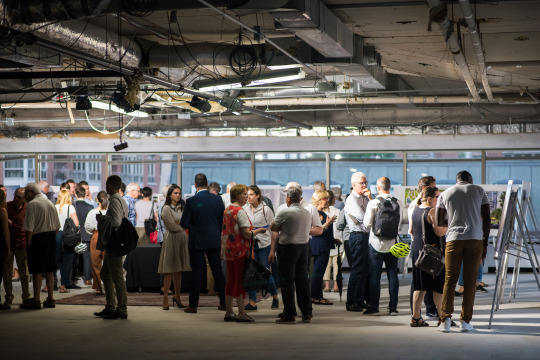
Now that things have quieted down from last night, I would like to say that we are thrilled by the response to One Delisle and the broader ideas for the block. There was a lot of positivity last night at the open house and today the project team received countless emails and messages from people telling us that they are excited and/or looking forward to working with us over the coming years. Many were from the local community.
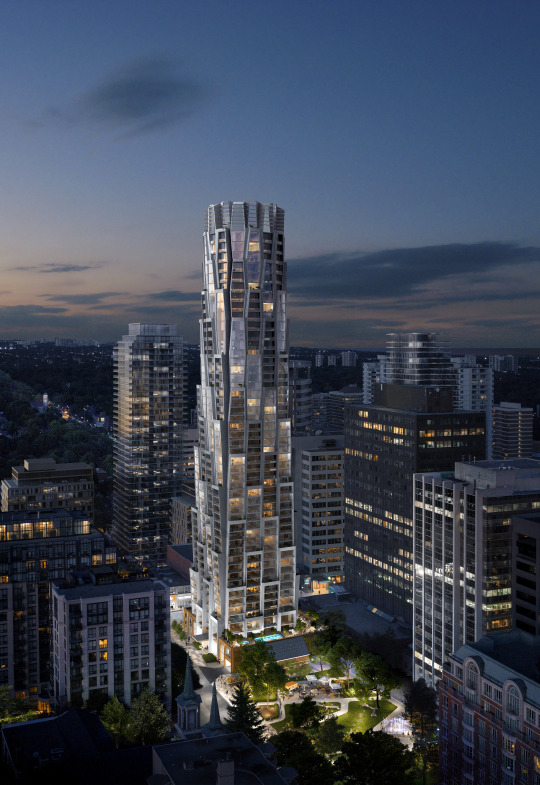
Following yesterday’s Globe and Mail piece by Alex Bozikovic, One Delisle was also covered in Urban Toronto (read the comments), designboom (they’re allergic to capital letters), ArchDaily, Canadian Architect, Dezeen, The Architect’s Newspaper, and probably other places that I am missing. The comments have been interesting to read and there seems to be a fatigue around boring glass boxes. This project team does not want to do that.
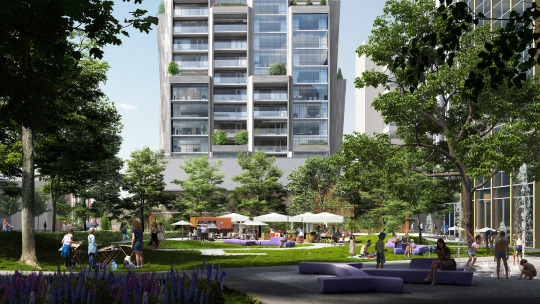
Though the project has been making the rounds, there are two images that I don’t think have been widely shared and so I would like to do that today (below). Both were presented at last night’s open house. And they are intended to show the relationship between One Delisle and Delisle Park, which is proposed to be revitalized and expanded by ~50% as part of the project’s block and enhanced public realm strategy. Credit to ADHOC Studio for these renderings.
In fact, it is important to keep in mind that while a lot of attention is being paid to the architecture of the building, there’s a broader city building strategy that is attached and integral to it:
Revitalize and expand Delisle Park by 50%
Add residential uses to a block of office buildings
Reduce the number of vehicular access points across the block from 5 to 3 in order to improve traffic flows in the area
Create below-grade vehicular connections across the block to consolidate and legitimize access/loading and once again improve traffic flows in the area
Significantly widen the sidewalk along Yonge Street to eliminate existing pedestrian pinch point
Significantly widen the sidewalk along Delisle Avenue to strengthen connection to Delisle Park
Introduce pedestrian laneway with art canopy to connect St. Clair Avenue West back to Delisle Park
Create a unified and consistent public realm across the block and provide retail animation along its edges
Retain Art Deco facade along Yonge Street
Target the 2nd tier of the Toronto Green Standard (voluntary sustainability target)
Continue to explore the feasibility of district energy solutions across the block to take advantage of the different energy demand curves for office, retail, and residential uses
Once again, a big thanks to the ~300 people who came out last night – in the rain – to engage with the project team. And a big thanks to the full project team who worked tirelessly to prepare for this week’s community open house. But as was said on Thursday night, in many ways this is really just the beginning. To stay informed about the project and to provide your feedback to the team, stay tuned to yongedelisle.ca.