Daily insights for city builders, delivered every morning at 6 AM ET. I’m Brandon Donnelly — a Toronto-based real estate developer and founder of Globizen. I’ve been writing here since 2013.

Tag: sustainability

  • Low-carbon cement

    By some measurements, cement production alone is responsible for about 8% of human-caused carbon dioxide emissions every year. And so there is an imperative to find suitable low-carbon alternatives. Here is what is currently happening in the US (via Grist):

    On Tuesday, Terra CO2 Technology was picked to receive a $52.6 million federal grant to build a new manufacturing plant just west of Salt Lake City. The company has devised a method that turns common minerals into additives that can help replace Portland cement — a key component in concrete, and one of the most carbon-intensive materials in the world.

    In addition to this new facility, the company is set to start construction on its first plant in the Dallas-Fort Worth area:

    The project is expected to break ground in January 2025 and begin shipping out materials by late summer 2026, Yearsley said. The facility will be capable of producing up to 240,000 metric tons of SCM [supplementary cementitious materials] per year when completed, or enough to serve roughly half of the local metropolitan market.

    And all of this is part of a broader initiative by the US Department of Energy:

    The Utah facility is one of 14 projects provisionally selected this week to receive $428 million in total awards from the U.S. Department of Energy’s Office of Manufacturing and Energy Supply Chains. The initiative, which is funded by the Bipartisan Infrastructure Law, aims to accelerate clean energy manufacturing in U.S. communities with decommissioned coal facilities. Officials said the projects are expected to create over 1,900 high-quality jobs across a dozen states.

    For the rest of the article, click here.
  • Density vs. infrastructure in Liberty Village

    A beautiful new 43-storey rental building was just approved in Toronto’s Liberty Village neighborhood. More info about the project can be found, here. Not surprisingly, some people in the community were against it. Here is a recent article that blogTO published talking about people who live in high-rises not wanting a new high-rise next to them.

    One argument that is being made is that the neighborhood is already full. It has reached its density limit. We also hear this about the City of Toronto as a whole. But we know this isn’t true. Architect Naama Blonder recently did a study that found we could fit another 12 million people within our boundaries with more efficient land use policies.

    This particular site in Liberty Village is also about 400 meters from a future subway stop on the Ontario Line. So it is exactly where we should be putting more density. The problem today is that the area is suffering from a massive infrastructure deficit. The road network is inadequate and the King streetcar hasn’t been prioritized.

    It’s no wonder the area feels full. But the reality is that there are lots of examples of highly livable neighborhoods from around the world with much higher population densities. The difference is that they have the right infrastructure, the right public realms, and the right modal splits.

    Liberty Village will get there as well and it’s already underway. For a preview of the future, check out the City of Toronto’s Public Realm Strategy for the area. It was published in April 2024 and it includes things like new streets, new mid-block connections, and new parks. It is what the area needs and it’s exciting to see it happening.

  • Turn off the AC

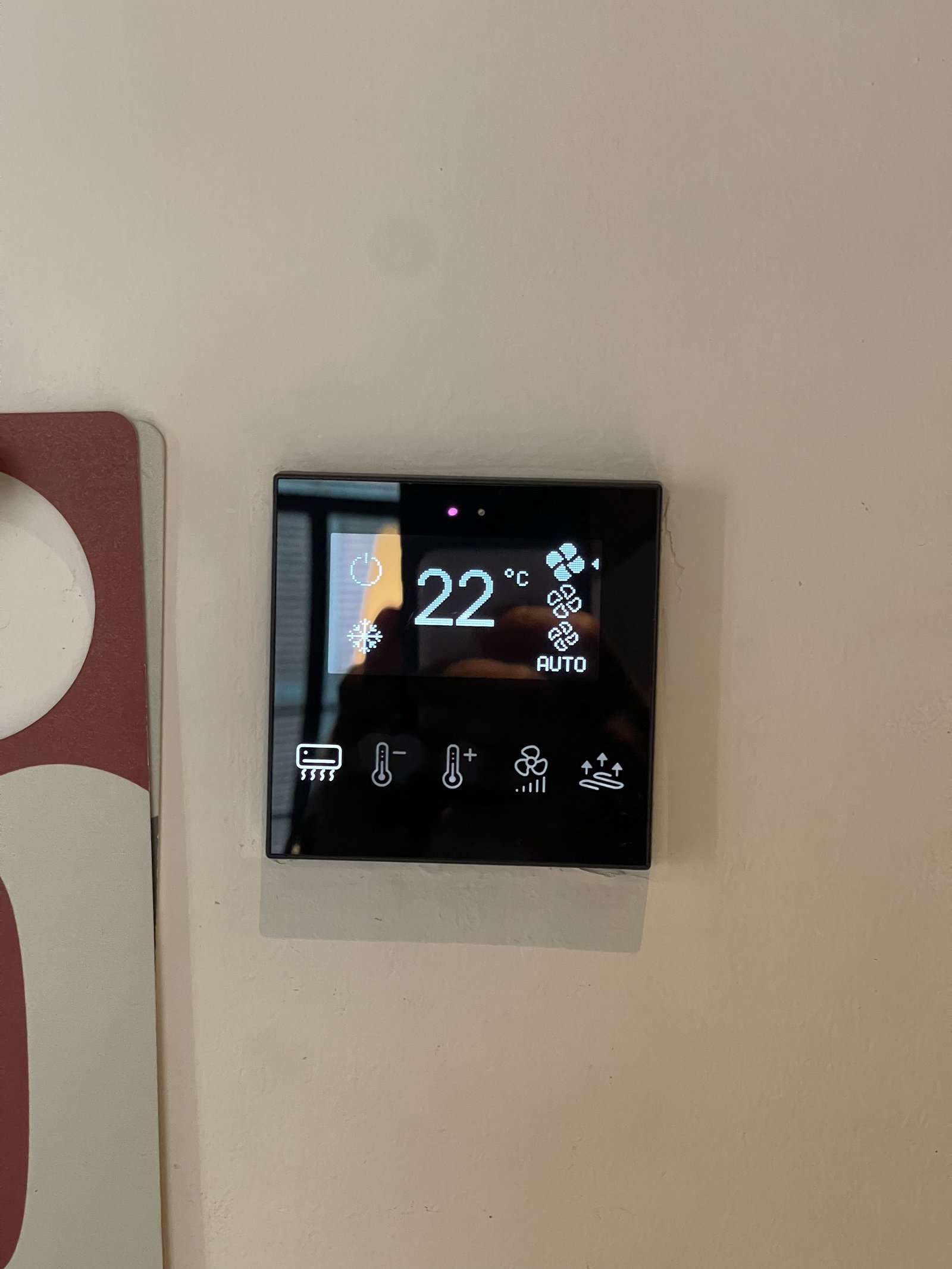
    We just checked into our hotel in Palma and one of the first things I noticed is that as soon as you open any of the windows/doors, the AC automatically turns off. A message on the thermostat then alerts you that it will come back on once you close the windows. I haven’t yet figured out how this particular hotel room is sensing that things are open, but it’s relatively easy to do this at home through smart thermostats and sensors like these. I make a real concerted effort to do this manually, and so it’s great to see it automated in a hotel room, where people are naturally going to care less about wastage. Europe is so far ahead of North America when it comes to energy efficiency.

  • Ontario should have more solar energy

    I have a very close friend (Peter Vogel) who is in the solar business. He runs business development for a company called Otter Energy. And by volume, I believe they are the largest in Ontario. Since 2009, they have installed over 350,000 panels.

    So when Peter and I hang out, I get the benefit of learning about solar. And he is great at reminding me that installing panels on the roof of buildings in Ontario makes a ton of sense from both an environmental and financial standpoint.

    Generally speaking, the amount of benefit you will see depends on the building’s ratio of roof area to overall building area. Low-rise buildings with a lot of roof area (think industrial assets), are absolute no brainers. But it can also work very well on many other asset classes, including mid-rise multi-family.

    Here are some high-level figures that he recently walked me through:

    • As a rule of thumb, solar in Ontario typically generates between 12-14 kWh’s per year per square foot of roof area (usable flat roof).
    • The average payback period for an install is usually somewhere between 4.5 to 7 years.
    • However, on income producing properties, the permanent decrease in operating expenses and the corresponding increase in net operating income (NOI) will increase your asset value on day one.
    • Consider spending $100k on solar panels to increase your NOI — through lower electricity costs — by $10k. If you were to then capitalize this increase in NOI by 5%, it would mean your asset value has right away increased by $200k. If the cap rate for this asset is even lower, say 4%, the increase goes up to $250k.
    • These multiples can get even better with larger installs. Here are some numbers from a real-world 100,000 sf commercial building in Ontario. In this case, the solar system cost about $800k (net) and resulted in annual operating cost savings of about $140k. This means, that at a 5% cap rate, the owner spent $800k to increase the value of their asset by $2.8 million on day one.
    • Of course, in addition to all of this, you get long-term energy cost certainty. That’s worth something too.

    The business case is compelling. So I think more building owners should be looking at solar. We are certainly looking at it from a development perspective. If you’re interested in learning more, feel free to reach out to my friend. There are a lot of details that help strengthen the case for solar, including depreciation allowances and tax credits.

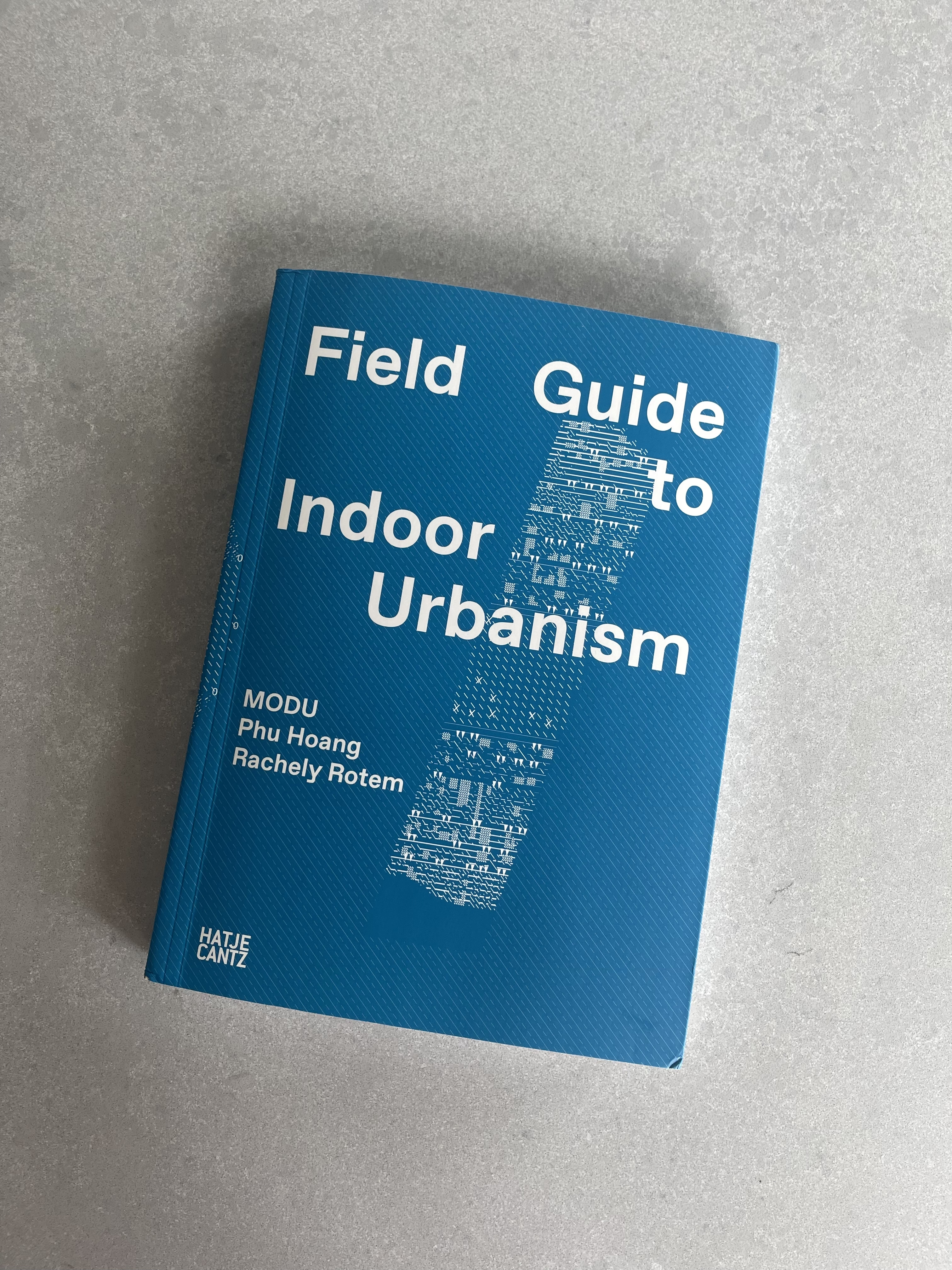
  • Field Guide to Indoor Urbanism

    A few months ago, one of my old professors from architecture school — Phu Hoang — reached out to me through this blog. That’s one of the benefits of writing publicly — it becomes your calling card. In this case, it had been at least 16 years since I was in his design studio.

    We connected over a call. He told me about his and Rachely’s firm, MODU Architecture. And he let me know that he’s no longer teaching at Penn. He is now the Head of Architecture of the Knowlton School at Ohio State University.

    Then, following the call, he was kind enough to send me a copy of his new book, Field Guide to Indoor Urbanism:

    The typical approach to modern building design is to have clearly defined boundaries between interior and exterior spaces. The outside is the outside. And the inside is a climate-controlled space that is, for the most part, sealed to the outside.

    Most of us spend the vast majority of our lives in these latter spaces. In fact, since the advent of modernism and the International Style over a century ago, the general idea has been that these spaces can and should be mostly the same.

    HVAC systems make it so that you don’t really need to worry about context or the environment. What works in Toronto can work in Phoenix. You just need to dial up your cooling loads.

    This is so much the case that whenever I’m in a city with a fairly benign climate, such as somewhere in California, I always find myself fascinated by the fluidity between interior and exterior spaces. It’s such a foreign concept to me that it stands out: “Wait, how is this not sealed?

    Indoor urbanism, on the other hand, makes the argument that this binary approach is the wrong way to think about spaces. Here’s an excerpt from a recent Metropolis article about MODU:

    They call this approach “indoor urbanism,” which privileges the blurred boundary between what has traditionally been considered interior space and exterior space. This in-between space–straddling open and closed, artificial and natural–deserves architects’ keen attention, especially as the planet warms. “Indoor urbanism recognizes that architecture and cities are situated on an environmental continuum, as a matter of degrees rather than absolutes,” write Hoang and Rotem in Field Guide.

    Examples of this thinking can be found throughout their work. This project in Jackson, Wyoming is one of my favorites both because I love Jackson and because it’s a cold and snowy place. And yet, even in this climate zone, their design includes for several “semi-exterior areas” that serve to connect you to nature.

    This is a decidedly different way to think about architecture and urbanism. But as our climate crisis intensifies, it’s only going to become more relevant.

  • Does above-grade parking kill street life?

    Here’s an unproven hypothesis that you can all challenge me on: many or most people only care about the environment while it is convenient to do so. Said oppositely, once it becomes inconvenient to care about the environment, we tend to start prioritizing other objectives.

    The example I have in my mind right now is parking. Now, to be clear, cars are not the best mobility solution for the environment. But let’s assume for a minute that you need parking and you have only two available options: below-grade parking or above-grade parking.

    The former is worse for the environment. If you were to look at the embodied carbon in below-grade parking versus above-grade parking, it would be higher. So from an environmental perspective, you want above-grade parking.

    It also makes for more flexible spaces. It’s hard to convert below-grade parking to much else. Again, this strengthens the environmental case, because now you’re building something that can be repurposed in the future.

    However, unless you’re forced to only build above-grade parking (as is the case in Miami), many/most cities tend to shun it. The most common objectives are (1) that it’s unsightly, and therefore needs to be wrapped with occupiable spaces, and (2) that it kills street life.

    What this suggests is that (1) and (2) are seen as being more important than the environment. And I think this is noteworthy in its own right. But here’s the other thing: this is arguably a false dichotomy. I mean, does above-grade parking necessarily kill street life?

    The above two street view images are from 1111 Lincoln Road in Miami Beach. It’s a parking structure and area of the city that I have visited many times. And I have to say, the street life seems fine to me. What do you think?

  • Which is more “sustainable”?

    These two residential buildings:

    Or this one here?

    Both are located in the Porto Nuova district of Milan.

    And from what I could tell when I walked by them yesterday, they’re pretty comparable. They have similarly deep balconies. And they even appear to have the exact same exterior cladding.

    Of course, the big difference is that the former — the celebrated Bosco Verticale — has about 800 trees, 4,500 shrubs, and 15,000 plants sitting on its 3.3m cantilevered balcony slabs. It also has an elaborate irrigation system that services said greenery.

    Okay, so which is more “sustainable”?

    First impressions would suggest that it’s the former. Trees and green things are good for the environment. So putting trees on a tall residential building must also be good, right? Maybe.

    The main counterargument is that it requires a lot of additional work to get trees, shrubs, and plants onto a tall building. You need more concrete, more structural reinforcing, an irrigation system (maybe not always?), and a way to maintain everything going forward.

    In this case, all of the greenery is a common element, and so it’s maintained by the building and not by any of the individual residents. Among other things, this preserves a uniform aesthetic.

    But all of these additional materials increase the building’s embodied carbon. And so there’s an important question to consider: Do the benefits of putting trees up in the sky outweigh the impacts of actually doing it?

    This is one of the great debates surrounding this project, and it’s a good reminder that being more sustainable isn’t so simple. There’s a lot to balance, and there are countless details to figure out.

    However, innovation does require iteration. And already there are new iterations of the Bosco Verticale, such as this one in Paris, that plan to swap concrete for mass timber construction.

    So even more trees in the sky. That’s probably a good thing.

  • Which is the most important when it comes to new housing?

    If you can’t see the Twitter poll below, click here:

    At the time of writing this post, affordability was number one, followed by design and beauty, and then sustainability.

    Some of you were right to point out that these options are not always mutually exclusive. Affordability and sustainability, for instance, can be mutually reinforcing.

    Building in walkable and transit-rich neighborhoods where parking is not needed is both good for overall affordability (parking is usually a loss leader) and better for the environment.

    But in other cases, sustainability costs more. Triple-glazed windows might perform better than conventional double-glazed, but they’re also more expensive.

    Now, as a general rule, I believe in working hard to find the mutually reinforcing opportunities. How can we check all of the boxes and not have to compromise?

    But sometimes there’s no other option. So it is interesting to see how people answer the above question. Not surprisingly, affordability is top of mind.

    Which would you pick?

  • What am I paying more for?

    So here’s the thing. The whole reason we are all talking about how to build more sustainably is that there isn’t often a quantifiable ROI for doing so. If building a net-zero building cost less than building a regular building, everybody would be building one. But that is not the case, which is why our industry, and others, are grappling with how to justify the added costs, even though we all know it’s absolutely the right thing to do.

    The questions we are asking ourselves look something like this: If I spend X% more on this build, what kind of rent premium could I command? And in some cases this premium is quantifiable and in some cases it matters a great deal. For instance, in the case of a new office building, you might need to spend the extra money so that you can attract the right tenants. While in other cases/asset classes, you might feel as if there’s no rent premium and nobody will ever pay more.

    But I like how Seth Godin thinks about it in this recent post: people never pay extra. If you’re paying more for an electric car, for example, you aren’t actually paying extra. What you are paying is a price that you feel is fair for what you are receiving. And what is it that you’re receiving? Well, in this case, you’re getting an electric car, but you’re also buying in Seth’s words, “sustainability, community awareness, cachet, status, safety, quiet, and the feeling of being an early adopter.”

    These things have value to some people. And as long as you can deliver on your promises, extra isn’t extra at all. But perhaps more importantly, this early adoption can help encourage change. Electric cars are becoming cheaper and cheaper, and I think it’s pretty clear that they will soon replace combustion engine vehicles. This model of starting at the top of the market and then moving down seems to have worked.

    Now, the auto industry isn’t perfectly comparable to the building industry. They have been good at improving productivity and bringing down costs, and we have been awful at it. Depending on how you measure it, construction productivity growth over the last half century is sitting somewhere between flat to some negative number. But I don’t think this dubious achievement changes Seth’s message. Think about what you’re offering. Maybe extra isn’t extra.

  • Three in four Americans believe it’s better for the environment if houses are built farther apart

    Living in a low-density place with lots of greenery and open space can feel like a pretty “green” way to live. Maybe you’ve even got a little garden where you grow delicious tomatoes. And indeed, a lot of people seem to think this is the case. According to this recent YouGov poll (which surveyed 1,000 Americans), 75% of US adult citizens believe that “it’s better for the environment if houses are built farther apart.” The number drops slightly to 68% for Democrats, but we’re still talking about a clear majority.

    Most experts will tell you that the opposite is, in fact, true. One of the best ways to be green is to live in a high-density urban setting and get as far away as you can from the natural environment so that you don’t screw it up. There are multiple reasons for this, but it generally comes down to the fact that cities use land and other resources far more efficiently on a per capita basis. Smaller living spaces, fewer cars, more things that are shared, and so on.

    The reason why this isn’t so obvious is that per capita thinking is perhaps harder to grasp. Living in the countryside certainly feels more green than living in the middle of New York City. But what if the 8.5 million or so people in New York City suddenly decided to sprawl outward into the countryside to consume more housing (that would then need to be heated and cooled), and then started driving everywhere (in lieu of taking transit, cycling, and walking)?

    This would be a less green outcome. It’s about the collective here, not what feels nice and green for any one individual.