Daily insights for city builders, delivered every morning at 6 AM ET. I’m Brandon Donnelly — a Toronto-based real estate developer and founder of Globizen. I’ve been writing here since 2013.

Tag: san francisco

  • What should San Francisco do with the Tenderloin?

    image

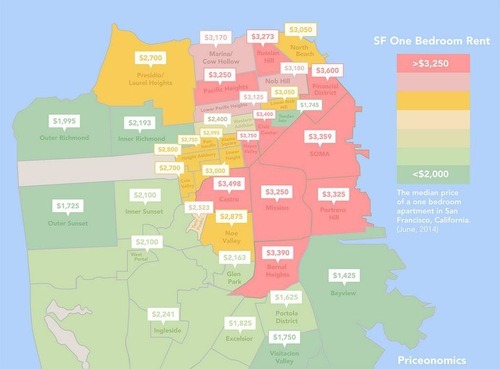
    Recently Priceonomics posted a piece on San Francisco’s “rent explosion.” In it, was the infographic above showing the median rental rate for a 1 bedroom apartment in the city. The most obvious takeaway is that San Francisco is real expensive. In the core of the city, you’re easily looking at $3,000 per month.

    That is with one exception: the Tenderloin (the green area just northwest of SOMA in downtown). The first time I ever visited San Francisco, I actually stayed on the outskirts of this area, which is a neighborhood well known for seediness, homelessness, crime, drug trade, strip clubs, and so on. And it was actually named after a similar neighborhood in New York that was also a center of vice in the late 19th and early 20th centuries.

    But when I saw this diagram, I immediately asked myself: How could it be that the Tenderloin was holding out so well against the forces of gentrification? How is this island of seediness being preserved in the center of downtown? Particularly in a city like San Francisco where there’s a perpetual housing supply shortage and lots of wealth. The Tenderloin has some of the lowest rents in the city.

    So I tweeted the good folks at Priceonomics and they responded with this article. It’s a few pages long, but the reasoning seems to come down to the following: active community groups that fought to keep developers out of the area (and that also own many of the buildings), downzoning, and a high percentage of rooming houses. According to that same article, the Tenderloin contains approximately 100 single room occupancy residential hotels (or SRO’s as they’re called). These were initially built to house the city’s transient and seasonal population after the great fire of 1906.

    So it would appear that there are some significant barriers to entry.

    But at the same time, it generally seems like a bad idea to concentrate poverty, homelessness, drug users, and so on. Interestingly enough, the article talks about how when the Bay Area’s transit system went on strike for a period of time, the supply of drugs actually dried up in the Tenderloin. This underscores how regional the drug business is, but also makes me think that dealers are almost surely benefiting from the clustering of their client base.

    In any event, this is a much larger problem than just a real estate development one. I don’t know what the solution should be, but I’m pretty sure that things are being made worse by concentrating everything in one neighborhood and by rising income inequality in the city. Inequality seems to lead to all kinds of negative externalities and, from my experience, mixed-income neighborhoods perform better than 100% poor ones.

  • Further evidence that laneway housing is going to happen

    image

    Earlier this week Fast Company ran a piece talking about “the next big thing in urban planning” – backyard cottages. As the name suggests, backyard cottages are basically accessory dwellings built in the backyards of existing single family homes. And the idea is that they’ll provide new affordable housing options in competitive and supply constrained markets such as the Bay Area in California.

    While somewhat different than laneway housing–which you probably know I support here in Toronto–they do share many similarities. We’re talking about the intensification of our residential neighborhoods at the scale of the single family home. And the potential benefits go beyond just affordability. It would also make our communities more sustainable, more walkable, and more conducive to transit.

    But there are challenges. I don’t know about the Bay Area, but many municipalities don’t allow a “house behind a house” and many communities don’t want to see their neighborhood itensify. However, we are seeing companies, like New Avenue, emerge to help homeowners navigate the process of building a backyard cottage. This company in particular claims to have worked with over 90 homeowners. 

    So I think we’re going to see more, not less, of these types of housing solutions. Vancouver is already doing it. And so is Portland

    Now here’s a question for you. If you owned a house in a single family neighborhood, would you be fussed if your neighbor erected a backyard cottage or laneway house? I’d love to get your opinion. Let me know in the comment section below.

    Image: New Avenue

  • Opendoor.com raises $9.95M to make selling your home as easy as a few clicks

    image

    If you’re a regular reader of ATC, you’ll know that I’ve been following the startup Opendoor.com for a few months now. I first wrote about it when it was codenamed Homerun and I just recently wrote about them as preface to a real estate survey I was conducting.

    Well, about an hour go it was announced that they’ve just raised $9.95M in venture funding from everyone and their grandmother. Here’s the list of investors (via TechCrunch):

    Paypal co-founder Max Levchin, Former YouTube and Facebook CFO Gideon Yu, Eventbrite co-founder Kevin Hartz, Y Combinator’s Sam Altman, Quora CEO Adam D’Angelo, Yammer co-founder David Sacks, Angelist’s Naval Ravikant, Yelp CEO Jeremy Stoppelman, Box CEO Aaron Levie, Initialized Capital’s Harjeet Taggar, Garry Tan and Alexis Ohanian, Former Twitter vice president Elad Gil, Blippy co-founder David King, Flixster co-founder Joe Greenstein, Angel investor Mike Greenfield, Quora co-founder Charlie Cheever, Path’s Dave Morin, Facebook vice president Dan Rose, Trevor Traina, Resolute Ventures’ Mike Hirshland, Caffeinated Capital’s Ray Tonsing, Felicis’ Aydin Senkut, True Ventures’ Om Malik, Thrive Capital’s Josh Kushner, Crunchfund’s Michael Arrington (who disclaimer: founded TechCrunch) and SV Angel.

    Not surprisingly, there are quite a few people who see an opportunity in the $20 trillion US residential real estate market – which I think is a good thing. This is a space that–despite its size–hasn’t seen an awful lot of innovation.

    There still isn’t a lot of information about the product, but there’s a clear focus on creating liquidity in the marketplace. Despite being located in San Francisco, the company will be launching in 3 markets outside of California – where liquidity isn’t as great for homeowners.

    The goal is to transform the typical 90 day selling process into a few clicks online. Homeowners submit their home to the platform and then Opendoor makes an instant offer to buy. Done.

    What I wonder then is if it’s going to be an arbitrage play. They buy the homes below market (because they’re offering total liquidity) and then they turn around and sell them at market.

    Do you have any guesses as to their business model?

  • The future of the architecture profession

    image

    Yesterday I had a really interesting conversation with somebody about the future of the architecture profession. We spoke about how Joshua Prince-Ramus of REX believes that architects have marginalized themselves as a result of shying away from liability. We spoke about how architecture schools need to teach more about about business and making money. And we spoke about why I decided to never practice architecture and instead become a developer.

    At the end of it all, he came to more or less the same conclusion that I did in this post. He felt that as more and more trained architects choose to become developers, that maybe the future will be firms that vertically integrate both architecture and real estate development. For those of you not in the building industry, this is fairly uncommon practice today. Typically, developers retain the services of an architect to design their buildings and do not handle this in-house.

    But there are firms that do. DDG out of New York and San Francisco is one example. Although there’s a subtlety worth mentioning. According to their website, they say that they often act as the “design architect” for their projects. This means that there would still need to be an “architect of record”, whose name would appear on the building permit and who would ultimately end up shouldering the liability for the design.

    You see, a bifurcation has happened even within the architecture profession itself. You have “design architects” who may or may not be licensed, but do a lot of the fun design work upfront for a project. And you have production oriented firms that actually produce the technical drawings needed for construction. The fees are generally higher in the latter case (unless maybe you’re a starchitect), but the work is less creative.

    The emergence of these two streams of architecture is precisely what Joshua Prince-Ramus is talking about when he says that architects have marginalized themselves by shying away from liability. He believes that architects are reducing themselves to designers and stylists, from master builders. So his argument is that architects need to reinsert themselves into more of the building process.

    What I’ve been suggesting is that architects should become owners. They should insert themselves into the development process. And the reason I feel this way is because I worry about the tendency for production and construction to just be farmed out to the lowest bidder. Design and development, on the other hand, are high value creation items.

    Truthfully though, I don’t really know which option is better for the profession in terms of relevance. I know which one I’m most interested in, but that could just be a personal preference. What do you think?

    Image: The Red List

  • The changing nature of how and where we work

    image

    Yesterday I came across a post called, The Workplace of the Future, by venture capitalist Tomasz Tunguz. In it, he references a book called, Cubed: A Secret History of the Workplace, and talks about the changing nature of how and where we work.

    What’s immediately interesting to think about is how recent the modern workplace really is:

    The information worker is a relatively new concept. Peter Drucker coined the term in the 50s. By then companies had already developed new ways of housing information workers. The very first information workers were accountants hunched over “Bob Crachit” desks in the back rooms of factories. Booming railroad companies demanded more organization and created offices within the new skyscrapers along the Chicago skyline. With these new offices came stacks of paper and folios, and cabinets in which to file them. Then, the Mad Men wrought an era of typewriters and mahogany corner offices. Next, Bell Labs invented the suburban office park, moving offices from the city as part of post-war suburbanization and in the 70s, Herman Miller crafted the now-ubiquitous cubicle, which was called the “Action Office” when it launched. Oh, the irony.

    It’s also interesting to think about how quickly things seem to be changing. Up until quite recently, everybody seemed to be singing the virtues of the open office plan. However, today, more and more companies are shying away from that kind of space planning:

    In 2011, the organizational psychologist Matthew Davis reviewed more than a hundred studies about office environments. He found that, though open offices often fostered a symbolic sense of organizational mission, making employees feel like part of a more laid-back, innovative enterprise, they were damaging to the workers’ attention spans, productivity, creative thinking, and satisfaction. Compared with standard offices, employees experienced more uncontrolled interactions, higher levels of stress, and lower levels of concentration and motivation. When David Craig surveyed some thirty-eight thousand workers, he found that interruptions by colleagues were detrimental to productivity, and that the more senior the employee, the worse she fared.

    Today, the most radical changes are appearing in startup offices around the world and are being driven by a desire to have spaces that embody their unique corporate cultures. This means everything from cool brick-and-beam architecture to bike racks in the office to flexible rooms and spaces that encourage mobility throughout the day. And to further reinforce these cultures, companies are creating positions like Chief Culture Officer and Chief Vibe Officer.

    But as I’ve said before on ATC, the other big shift is simply location and the return to cities. More and more startups, for example, are choosing San Francisco over Silicon Valley and it’s because the city is where young people want to live. It’s increasingly where the talent is. This has already brought about many changes in workplace design, but it likely bring about many more. 

    Image: Airbnb’s San Francisco Office

  • Are the suburbs really cheaper?

    image

    Smart Growth America released a report this month called Measuring Sprawl 2014. It’s an update to a report they did back in 2002 and it’s worth a read if you’re into urban planning. You can download it here

    The report looks at 221 metro areas in the US and develops a “sprawl index ranking.” The higher the number, the more compact the metro area. Not surprisingly, New York tops the list with San Francisco coming in second. But more interesting are the correlations they discovered. As you go up their sprawl index ranking (that is, as the cities become more compact), they found the following:

    • People have greater economic opportunity in compact and connected metro areas.
    • People spend less of their household income on the combined cost of housing and transportation in these areas.
    • People have a greater number of transportation options available to them.
    • And people in compact, connected metro areas tend to be safer, healthier and live longer than their peers in more sprawling metro areas.

    If you’re a follower of smart growth, then some of these will sound familiar. But they’re worth repeating and I’d like to focus on the second one for a minute (not to undermine the importance of living longer). Conventional wisdom dictates that as you sprawl out from the center of a city, the cost of housing drops. And indeed, that’s what they found. There’s a correlation between density and housing costs, and more compact cities generally have more expensive housing.

    However, they also found that the percentage of income spent on transportation is much less in compact metros:

    Each 10 percent increase in an index score was associated with a 3.5 percent decrease in transportation costs relative to income. For instance, households in the San Francisco, CA area (index score: 194.3) spend an average of 12.4 percent of their income on transportation. Households in the Tampa, FL metro area (index score: 98.5) spend an average of 21.5 percent of their income on transportation.

    But here’s where it gets interesting: they found that transportation costs dropped faster than housing costs increased as metro areas became more compact. Meaning if you consider both housing costs and transportation costs in aggregate, it’s actually cheaper to live in more compact areas. From what I can tell, they’re also only considering direct transportation costs and not indirect costs such as the time people waste sitting in traffic. 

    Either way, it’s something to consider the next time you’re thinking about where to live and how much you should be willing to spend on housing. That cheaper suburban home may not be as cheap as it seems.

    Photo by Aythami Perez on 500px

  • Entrepreneurship as economic development strategy

    It’s no secret that a lot of cities out there want to become the next Silicon Valley (or San Francisco, since a lot tech companies seem to be now setting up shop there instead). With the shift towards a knowledge/information/networked economy (pick your favorite name), cities around the world are betting that entrepreneurship is going to be the key to future economic growth.

    As an example, I was reading yesterday about a Buffalo-based business plan competition called 43North. It’s allegedly one of the biggest business plan competitions, ever:

    With $5 million in cash prizes, including a top award of $1 million, six $500,000 awards and four $250,000 awards, 43North is setting out to turn the best new business ideas from around the globe into reality.

    In addition to cash, winners will receive mentoring and free office space for a year. But while the competition is open to anyone in the world, you have to relocate to Buffalo for a minimum of one year if you win. 

    It’s a bold move. $5 million is a lot of money. But it strikes me as a step in the right direction to reinvent a city that was once the 8th largest in the US. I’m a big believer in the power of entrepreneurship.

    But 2 considerations do come to mind.

    The first is that this move can’t, or at least shouldn’t be, purely about business and economics. To create an entrepreneurial hub, I think you need to also ensure that you have a city that young people would love to live in.

    I’m not saying that Buffalo isn’t one of those cities (I don’t know it well enough to comment), but I am saying that it should be part of any economic development strategy. Why do you think more and more startups are moving from Silicon Valley to San Francisco?

    The second is that I worry we may end up with too many cities trying to become the next Silicon Valley. The industrial economy allowed for the creation of a certain number of thriving metropolitan regions (see: The Rust Belt).

    But I’m not so sure the networked economy will require as many. I could be wrong, but the data seems to suggest that we’re heading towards a spikier economic landscape—both within cities and across nations.

    In any event, here’s my question for the community: Would you move to Buffalo?

  • Why the Gardiner East should be torn down

    Warning: This post turns into a bit of a rant near the end 🙂

    Since 2009 (well, much earlier actually), Toronto has been trying to figure out what to do with the eastern portion of the elevated Gardiner Expressway (the portion from Jarvis Street to the Don Valley Parkway). The process used to help make this decision is called an Environmental Assessment (or EA) and that’s what is currently underway. But it’s a painstakingly slow process.

    Recently though, a third public meeting was held in order to solicit feedback on the various design solutions and so there’s been a renewed interest in this city building issue. Since the beginning, my position has been that we should tear it down. And in this post I’m going to explain why I think that is exactly what the city should do. 

    But first, a bit of background.

    The EA started by identifying four “Alternative Solutions” to the problem of the Gardiner East. And they are: 

    1. Maintain the elevated expressway (Basically do nothing)
    2. Improve the urban fabric while maintaining the existing expressway
    3. Replace with a new above or below grade expressway
    4. Remove the elevated expressway and build a new boulevard

    They then went out and assigned these solutions to a bunch of architects and designers—whom are some of the world’s best—and asked them to come up with specific design proposals. These proposals are available online and that’s part of what the public has been commenting on.

    City Council seems to generally want the Gardiner down, but there are some naysayers. 

    Rob Ford doesn’t want it removed (option #1) because it’ll add to driver commute times (no surprise there) and Councillor Denzil Minnan-Wong is worried that tearing it down will just lead to another wall—a wall of waterfront condos.

    But I think these views are terribly shortsighted and I’ve made my position clear by submitting a formal response through the City’s public engagement portal. To explain my view here on Architect This City, I thought the best way would be to simply share my answers. So here they are.

    What do you like?

    [slideshare id=22945545&sc=no]

    I can honestly say that I love my city. I was born in this city. And I was raised in this city. This city has given me so much, which is why I feel so compelled to try and give back to it. It’s also the reason why I’m first to defend it when people talk about how great this or that city’s waterfront is and how much ours sucks. I mean, I know ours sucks. But we’re fixing it.

    We have a lot of great plans in the pipeline for our waterfront, but there’s a remaining obstacle: our elevated expressway. Boston buried theirs. And San Francisco transformed theirs into a magnificent public space. What are we going to do with ours? Now is the time to be bold and not settle for the status quo. That’s too easy. We need to remove the eastern portion of the Gardiner Expressway today and the design proposal by Field Operations offers a brilliant way to do it.

    Not only is removing the Gardiner the most cost effective solution ($470M, versus $870M to maintain, $865M to improve and $1.4 billion to replace), but it’s also the most desirable from a city building standpoint.

    The Gardiner is not the only barrier. We also have the rail lines. So while repurposing the Gardiner might be doable in isolation, we simply have too much friction standing between us and the lake. We need to remove the barriers that we can. It’s for this precise reason that Field Operations spent so much time worrying about the north-south connections. And I think their “architectural sleeves” are a really interesting way to solve this problem.

    At the same time, timing is an important consideration. As the surrounding East Bayfront area develops, it’s only going to become more costly to remove this stretch of the Gardiner. If we’re going to do this, now is the time.

    Finally, I think it’s important to note that Field Operations is the landscape architecture firm behind the wildly successful High Line in New York. So what we have is a firm that made a name for itself repurposing an old elevated rail line, telling us that our own elevated structure is worthless and uninspiring. Think about that for a minute. Should we really be spending more money to salvage the Gardiner East?

    What concerns do you have?

    That we’re getting hung up on commute times as one of the key decision making criteria. It’s a red herring. Let’s face it: irrespective of whether we tear down the eastern portion of the Gardiner or not, Toronto is fucked from a transportation and infrastructure standpoint. We’re sitting on decades of disinvestment and some of the longest commute times in North America.

    Field Operations put it well when they said that the tearing down of the Gardiner East needs to be thought of as a paradigm shift. We have a 25-year transportation plan waiting to be funded. Let’s go out and do that instead of trying to sacrifice our waterfront so that suburban commuters can save a few minutes. Let’s give them a shiny new train instead. They’ll like that.

    Either that or Torontonians need to stop talking about how great Chicago’s waterfront is, because we can do it too. Now is our chance.

    What advice do you have for the Project Team as the study moves into the next phase?

    Don’t listen to Rob Ford.

  • Mapping where people run

    I’ve been meaning to write this post for about a week now. I stumbled upon a set of maps via FlowingData that used public running data to plot where people run in various cities around the world. And since I love maps, I couldn’t resist.

    Here’s Toronto:

    Here’s New York:

    Here’s San Francisco:

    And here’s Philadelphia:

    For the full set of maps, click here.

    What’s interesting is how people tend to gravitate towards the water rather than the parks. In the case of Toronto, High Park is barely touched, which may have something to do with the fact that it’s too far from downtown. The data could also be skewed based on the type of people who make their running data available and where they happen to live.

    Either way, a neat set of maps.

  • Why Toronto should stop complaining about all its condos

    Below is my latest post from the TAS blog. You can find it cross-posted here.

    Last week I wrote a post on my personal blog about housing policy in San Francisco. My argument was that the backlash against the tech community (for allegedly driving up real estate prices) is actually misdirected and that housing policy should be the target. 

    The reasoning behind this is simple: More people are moving to San Francisco than new housing is being provided. And so regardless of whether you have tech workers or not, you have an environment where the rich are always going to outbid the poor for housing.

    If you look at the numbers from the past 2 decades, San Francisco on average builds 1,500 new housing units a year. And yet the city gained approximately 25,000 new people between 2010-2012 (that’s roughly 8,300 people per year). So what you have is a perpetual housing supply shortage.

    To correct this problem, San Francisco needs to start building. And I’m stealing this idea from Harvard economist Edward Glaeser, who wrote an article on this very same topic back in December of last year for Bloomberg (and a book called Triumph of the City). His argument was that “the surest way to a more equitable housing market is to reduce the barriers to building.”

    Now, if you compare San Francisco’s situation to Toronto’s, we’re almost on the opposite end of the spectrum. Toronto doesn’t have a problem building. We’re building lots. So much so that it’s become fashionable to joke around and complain about all the condos going up in this city.

    But it’s important to remember that all of these condos are making us a relatively affordable city by global standards. We have more people moving to this city every year than San Francisco and yet home prices are less. We’re also less expensive than Vancouver, where there are strong natural barriers to building, namely water and mountains.

    So rather than complain, I’m going to be the contrarian. I like seeing new housing built. I like knowing that the neighborhoods I love in this city are becoming home to more and more people.

    At one point, my home (which is in the St. Lawrence Market) was a “new development” and somebody could have fought and opposed it. But it was allowed to be built and I was allowed to move in. I’m thankful for that. And so my plan is to be just as gracious to the next person who wants to join the neighborhood.