Daily insights for city builders, delivered every morning at 6 AM ET. I’m Brandon Donnelly — a Toronto-based real estate developer and founder of Globizen. I’ve been writing here since 2013.
At the beginning of this year I wrote a post about a mobile tracking app called Moves that I had heard about through my friend Sachin Monga. He had just published a beautiful set maps showing where he physically spent his time in both Toronto and San Francisco.
His post spurred me to download the app and at the end of my post I promised to share my own set of maps once I had collected enough data points. It’s only been about 3 weeks, but already my maps are starting to fill out, so I thought I would do a release.
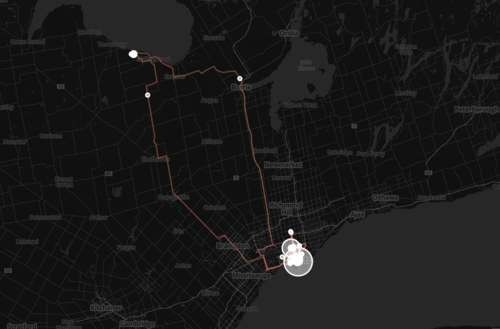
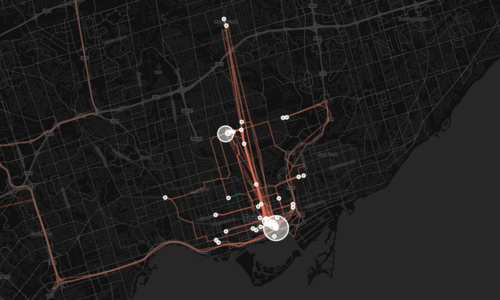
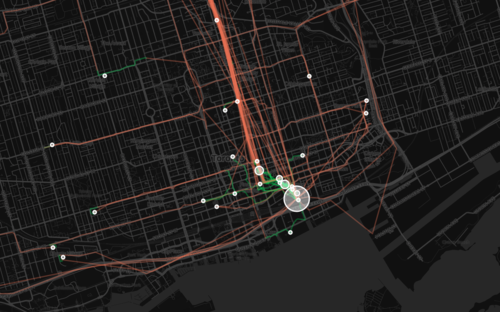
The orange lines represent transport of some sort (car, subway, streetcar, and so on) and the green lines represent walking. I don’t cycle very often in the winter (I know, I’m a fair-weather cyclist), so you won’t see any of those lines just yet. However if I posted a map from the summer, I know it would look completely different.
Here’s a first one showing a regional scale:
Here’s a second one showing the city of Toronto:
And here’s a third one showing mostly downtown:
What’s interesting about these maps is how much you can tell about me and the way I move around the city.
For one, there’s a good chance I ski or snowboard given that I’m driving up to Collingwood, Ontario in the winter. You can also see how heavily dependent I am on the Yonge subway line, which is the thickest orange line in the middle of downtown. It’s also interesting to see how localized I am within my neighborhood (St. Lawrence Market). I walk to get groceries. I walk to the gym. I walk to coffee. And the list goes on.
This is fairly typical for people living in urban neighborhoods, but it would be interesting to see where it applies in the city and where it begins to fall apart. I would also imagine that there’s a correlation to the area’s Walk Score, although this (Moves) might actually be a better measure since it’s usage data.
Either way, imagine what cities could do if they had this sort of data for every resident. They would be able to see precise resident flows and then determine exactly where transit and infrastructure investments should be made instead of politicking to determine where they should be made.
What he’s talking about is the phenomenon of design agencies being gobbled up or “acqui-hired” by product firms such as Facebook and Google. The latest of which is (or was) Toronto-based design agency Teehan+Lax. The partners have closed up shop and are in the process of moving to San Francisco to join Facebook Design.
But what he’s really talking about is the pull from services to products.
When you’re a services firm, you do work for outside clients and they pay you for that work. But there are only so many hours in the day, which is why the marginal cost of taking on new clients is relatively high – to scale up you generally need lots more people.
On the other hand, when you’re a software company creating products, the marginal cost of serving additional customers is almost nothing. Sure, there are some variable costs, but the impact to your cost structure is not nearly as significant as when you’re a services firm. That’s how a company like Instagram can be bought for $1 billion with 30 million users and only 13 employees.
So products are a bit of a holy grail in some circles. You can achieve greater scale. You can focus on fewer projects as opposed to jumping around from client to client. And you can make a lot of money.
But it’s often easier said than done. Back in 2012, Teehan+Lax wrote a great post where they talked about the allure of products and the challenges they faced in trying to build their own:
37Signals* was the worst thing to happen to services businesses trying to make products. They fucked it up for all of us, because they made it. For those of us old enough to remember, 37Signals was a services company like Teehan+Lax. They had clients and did work for hire. Of course, 37signals isn’t a services company anymore. They make amazing digital products and their success is enviable. (*37Signals became Basecamp)
So why is it so hard to transition from services to products?
Clayton Christensen, the father of disruptive innovation, says, “you can’t start a disruptive business from inside an incumbent one.” The incumbent business will always take the resources from the disruptive one. He argues that if you want to create a disruptive business you need to isolate it from the incumbent business. The disruptive business needs its own values, processes and resources to be successful.
Regardless of whether you’re trying to build something disruptive or not, amazing products are hard to build. They take focus.
But what’s also interesting about services and products is that there’s a parallel in the world of architecture and real estate development. As an architect, you’re basically a service provider. You have clients and they pay you for the work that you do. However, as a real estate developer, you offer a product: physical space. The cost structures are not nearly as beneficial as with software, but it’s a product nonetheless.
And similarly, we’re already starting to see some developers bring architecture in-house. Will we see more of this in the future? Will there be a similar pull from services, to products?
I’ve written about the Tenderloin neighborhood in San Francisco before. It’s an infamous neighborhood in the center of the city that has for decades resisted gentrification (which was the topic of my post).
But as the technology sector continues to urbanize, many fear that it’s only a matter of time before it does eventually gentrify. A new nickname has even emerged for the neighborhood: the Twitterloin.
However, a local nonprofit called the Wildflowers Institute is trying to ensure that gentrification doesn’t erase the cultural assets currently housed in the neighborhood. Through a project called “Hidden Gems”, the group is literally knocking on doors to find active artists within the community (many of whom live in single rooms) and then supporting them through fellowship programs and other investments.
What’s fascinating about their approach is that they are actively seeking out the informal activities taking place within the community – activities that would otherwise be hidden and then potentially lost. Once discovered, they then do a number of mapping exercises to keep track of this data.
As somebody who believes city building will become a lot more data driven in the future, I think this is a really interesting initiative. And as gentrification pressures continue to increase in San Francisco, I’m sure this information will help guide the discussions. You can’t account for something you don’t know exists.
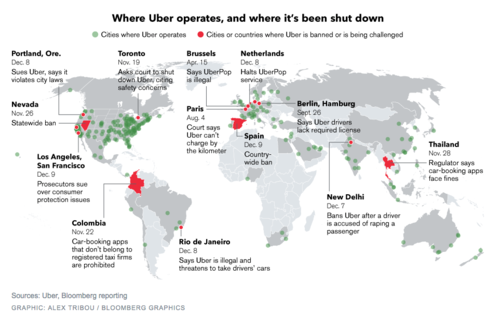
Earlier this month, Bloomberg published this map showing where Uber operates and where it’s been banned (or is being challenged). You can click on the map for a larger version.
Uber operates in about 250 cities across the world. But it’s being challenged in a lot of them, including Portland, San Francisco, Los Angeles, Toronto, Rio de Janeiro, Paris, Berlin, as well as others.
I don’t want to dismiss any of the safety concerns that have arisen lately, because those are very serious and they need to be addressed. Life safety is paramount. But I continue to believe that banning a service that many people clearly want to use isn’t the right solution.
On top of that, I think it could lull many of the local taxi communities into a false sense of security about the future. Uber is moving incredibly quickly. UberX launched in Toronto in September of this year. And UberPOOL – their new carpool service – is likely next.
With these releases, Uber is working towards a specific vision for the future: Their goal is to eliminate the need for private vehicle ownership. Should they be successful, this will not only impact taxis, but also car manufacturers and urban mobility in its entirety.
So as difficult as it might seem right now, I think urban leaders would be better served trying to figure out how to harness these innovations. Cities have been trying for decades to get people out of their cars. Uber wants to do the same.
A few days ago I wrote a post talking about what happens when you demolish an urban highway. It was a link to an article giving 5 examples of cities that have removed their urban highways and benefited.
After I wrote the post, a number of people responded on Twitter. Some thought it was a great idea and gave examples of other cities, such as Detroit, that are thinking about doing the same. But others responded and said that I was out of line. And that while it might work in some cities, it simply isn’t a viable option in cities like Toronto.
So as somebody who believes we should be taking down the Gardiner Expressway, I thought it would be worthwhile to revisit the topic and provide a bit more information.
To be clear, I’m not suggesting we remove the Gardiner and replace it with nothing. My belief is that we should replace it with a broad surface street that would still move lots of cars, but that would make our waterfront much more open and accessible to everyone.
So how is this feasible?
Again it comes back to the concept of induced demand. Back in 2009, two economists from the University of Toronto and University of Pennsylvania – which are actually both of my alma maters – published a study called The Fundamental Law of Road Congestion.
In it they discovered something really fascinating: there’s a near perfect relationship between new roads and highways built and the total number of miles driven. In other words, as cities increased road capacities (during their study period of 1980 to 2000), the amount of driving went up just as much.
What this should tell you is that trying to build your way of out road congestion is usually a losing proposition. That’s why every large city has a traffic problem. Try and think of one that has solved this. And as much as it might seem intuitive to tell people at cocktail parties that your city simply needs to build more roads and highways, it’s typically not that simple. (In my view, the solution is road pricing.)
The other really interesting thing that this study revealed is that it works both ways. When you reduce road capacity, drivers start to disappear. People choose to live closer to where they work. People choose transit. People go into the office at different times. People make all sorts of different decisions in response to this road change, just as they do when there are more free roads available to them.
So within a reasonable band (obviously you can’t remove all roads), there is no perfect amount of road capacity. If you added another lane to your highway, it would be full. If you took away a lane, it would end up equally full. That’s why removing the Gardiner Expressway isn’t lunacy.
Instead, it actually makes a lot of sense:
It’s the cheapest solution (compared to repairing it or burying it)
It would free up money for transit and other mobility solutions
It would make our waterfront more open and accessible
It would beautify our downtown
It would increase land values all along the waterfront
And since we’re still in the early days of developing our eastern waterfront, now is the time to do it. The longer we wait, the harder it’ll get and the more expensive it’ll get.
So I hope that the leaders in this city will think long and hard about this as opposed to immediately assuming we need an elevated highway to keep this city moving. The last time I checked, it doesn’t work so well in its current state.
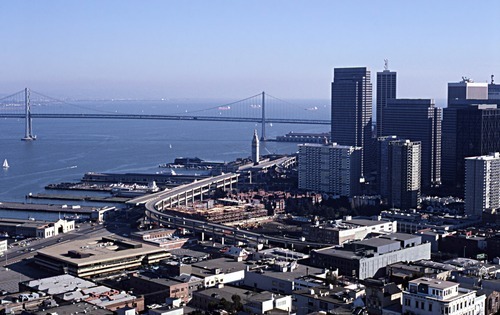
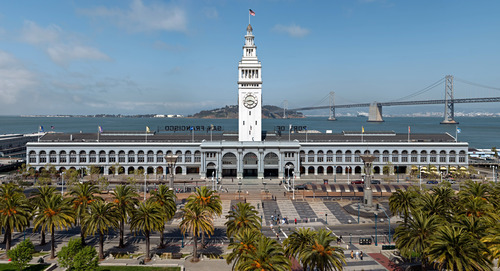
Images: Before and After the Embarcadero Freeway in San Francisco (via Gizmodo)
It’s a link to an article talking about 5 cities – New York, Milwaukee, Seoul, Portland, and San Francisco – who all demolished an elevated highway that used to run through their downtowns.
To be completely fair, some of these cities didn’t really have a choice. San Francisco’s Central Freeway was so badly damaged in an earthquake that it had to be closed. But it doesn’t make the lessons any less relevant.
In all of these cases, the elevated highways were taken down and never replaced with another highway. Some were turned into large boulevards. Others were turned into parks. But in none of the cases was a new road of similar capacity built.
Intuitively it might seem like this would cause utter chaos. I mean, where were all of these cars going to go?
But that didn’t happen. Instead, demand redistributed itself. Car volumes dropped dramatically. More people took transit. Some people took other routes. And some people traveled at different times. Oh, and nearby property values all went up.
And the reason this happened is because of something that economists call induced demand (I’ve written about it before, here). What it means is that as you increase the supply of some valuable good (such as free highways), more of that good becomes demanded.
In other words: more free highways = more cars on the road.
So if you’re a city – like Toronto – with an elevated highway running through your downtown, you should give this some serious thought. The outcomes aren’t as bad as you might think. In fact, they’re quite good.
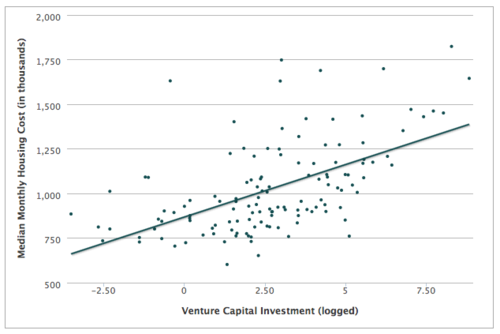
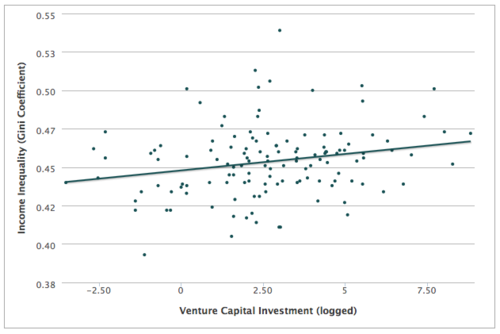
Earlier this week Richard Florida published on article on CityLab talking about the relationship between tech innovation (in cities) and inequality. Specifically, the article deals with the correlation between venture capital investment and a variety of factors, such as monthly housing costs, wage and income inequality, and so on.
The intent of the piece was to address the growing backlash against tech workers – in places like San Francisco – who have become the symbol for the growing gap between the rich and poor.
The strongest correlation appears to exist between venture capital investment and housing costs. As the amount of venture capital goes up, so do housing costs – which probably shouldn’t surprise you. The rich start outbidding the poor for housing. Note: The two outlying dots at the top right, in the graph below, are Silicon Valley and San Francisco.
But when it comes to inequality, the relationship isn’t so clear. For wage inequality, there seems to be a relationship. But for the broader income inequality measure, the relationship is fairly weak. Here’s the graph:
So this is not as black and white as it might seem. Regardless, Florida ends the piece with the following statement (that I think is spot on):
It’s time to stop pointing fingers and get on with the far more important task of harnessing the urban tech revolution to create a new urban middle class and a more inclusive urbanism—one in which many more workers and residents can participate, and one from which many more can benefit.
The answer is not to stop innovating. That would be counterproductive. We should be be encouraging innovation, but at the same time figuring out how best to harness it for society as a whole.
Tomorrow, I’ll touch a bit more on how we might go about doing that. I have a post planned that I think will tie in really nicely to this discussion. So stay tuned.
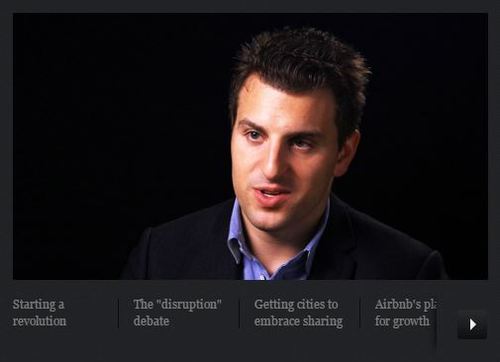
McKinsey recently put out a great interview with one of the founders of Airbnb, Brian Chesky, talking about the relationship between his company and cities. I thought it was fascinating. Click here to watch the video.
If you don’t feel like doing that, I’ve also pasted the interview transcript below and bolded some of the really interesting takeaways. Let us all know what you think in the comment section below.
It’s a currency of trust, and that used to live only with a business. Only businesses could be trusted, or people in your local community. Now, that trust has been democratized—any person can act like a brand.
Airbnb is a way that you can, when you’re traveling, book a home anywhere around the world. And by anywhere, I mean 34,000 cities in 190 countries. That’s every country but North Korea, Iran, Syria, and Cuba.
The reason we started was I was living with my roommate, Joe, in San Francisco, and I couldn’t afford to make rent. That weekend, the International Design Conference was coming to San Francisco. All the hotels were sold out. Joe had three air beds. We pulled the air beds out of the closet, we inflated them, and we called it the “Air Bed and Breakfast.”
The reason it’s grown so fast is, unlike traditional businesses, we don’t have to pour concrete. The infrastructure and the investment was already made by cities a generation ago. And so all of a sudden, all you needed was the Internet.
The ‘disruption’ debate
I never really loved the word “disruption,” because it suggests that maybe it’s the kid in a class who was disruptive, who probably didn’t add a lot to class. I think that we have a lot to add to society.
Over time, cities have gotten so big that the sense of community has gotten lost. And I think once you know everyone, that community can reemerge. And as far as our relationship with cities, we can’t succeed without a city. Or we can’t really thrive without a city. We don’t want to thrive in spite of a city. And I think if we work together, it’s going to be amazing. I think the people win. And I think if we don’t work together or if we fight, the loser isn’t really us or the city—it’s the people in that city.
Getting cities to embrace sharing
Fundamentally, the idea of the sharing economy is going to be great for cities. It means that people all over a city, in 60 seconds, can become microentrepreneurs. And they can be empowered. And they can make an income. Now, this is amazing, but it’s also complicated because there are laws that were written many decades ago—sometimes a century ago—that said, “There are laws for people and there are laws for business.” What happens when a person becomes a business? Suddenly these laws feel a little bit outdated. They’re really 20th-century laws, and we’re in a 21st-century economy.
It’s probably going to be a fair amount of work to revise some of the laws and rethink the way cities and platforms work together, but I think that work is worth it. Because what cities don’t have to do is invest billions of dollars in infrastructure to create jobs. Whereas historically, to create opportunities, cities would need massive projects and investments, these jobs only require the Internet. Now what they need to do is navigate the legal framework, which is typically outdated. We want to work with the cities. We’re not telling them that their laws are terrible. The world continues to change. Laws must continue to adapt for that world.
We want to help cities understand what our world looks like so they can modernize the laws to make sense. We’re not against regulation. We want to be regulated because to regulate us would be to recognize us.
Airbnb’s plans for growth
We want travelers to be able to book homes anywhere. Anywhere includes Asia. Asia’s a nascent market for us. Number two, we’re also looking at other use cases. Airbnb started as a way for travelers to find a budget way to vacation in a city. But now we’re starting to see people who aren’t on a budget. They want a much more high-end experience. And the third is that at the end of the day, if you’re traveling to Tokyo, you’re not traveling to Tokyo to stay in a home or a hotel. You’re traveling to Tokyo—if you’re on vacation—because you want to have an experience. And we’d love to do more to make that experience special and memorable.
The future of sharing: Your free time
I don’t think people would view the jobs created in the sharing economy as jobs. I don’t even know if they get counted as jobs when the White House has a new jobs report. They are jobs. As far as I can tell, people are working, they’re making income, and they depend on that income. Half of our hosts depend on it to pay the rent or mortgage. Maybe it’s a new kind of job. Maybe it’s like a 21st-century job. Tom Friedman talks about how in the future people may not have jobs. They’ll have income streams.
I believe that the sharing economy broadly can probably provide tens of millions of jobs or income streams for people all over the world. This is going to have a pretty big effect on the economy, mostly a good one.
The sharing economy started by democratizing and creating access to probably two of the biggest assets people have: their homes and then their cars. But I think the whole idea of ownership is changing. When my parents were young, owning things was a privilege, and there was a sense of romance to owning a house, owning a car.
Today’s generation sees that ownership also as a burden. People still want to show off, but in the future I think what they’re going to want to show off is their Instagram feed, their photos, the places they’ve gone, the experiences they’ve had. That has become the new bling. It’s not the car you have; it’s the places you go and the experiences you have. I think in the future, people will own whatever they want responsibility for. And I think what they’re going to want responsibility for the most is their reputation, their friendships, their relationships, and the experiences they’ve had.
So I think the biggest revolution will be in the biggest asset of all. The biggest asset is not a house. It’s not a car. It’s people’s time. People’s time may start with just gigs: waiting in line for you, delivering something for you. Over time, I think it’s going to move upmarket. And eventually, menial tasks become real trades, and real trades become art forms.
Somebody may say, “I cook a great brunch. I wonder if people would enjoy having brunch at my house?” And you could be able to book a brunch at someone’s house, instead of at a restaurant. That person isn’t trying to create a restaurant, they’re just allowing someone to have brunch. They build a reputation. One day, that person can be a Michelin-rated chef in their house.
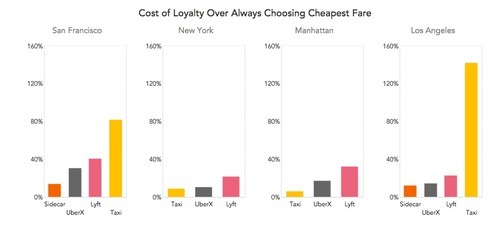
This morning I woke up to a post from venture capitalist Fred Wilson talking about the cost of loyalty when it comes to local transportation markets. More simply, it was a cost comparison between regular city taxis and ride sharing services such as a UberX, Lyft, and Sidecar in San Francisco, Los Angeles, and New York.
The way to understand this chart is to think about it as the answer to this question (from whatsthefare.com): If I were to take 1,000 rides over my lifetime with one individual service, how much more would I pay than if I compared prices and always picked the cheapest option?
What you should immediately see is that regular taxis are far more expensive in San Francisco and Los Angeles compared to all of the ride sharing services. In the words of Fred Wilson: “That is crazy. They are going to go out of business in those markets with that pricing.”
In my words: They are fucked.
I wonder where Toronto would place against these cities. My gut tells me that we would be closer to San Francisco than New York. And if that is the case, I think you can figure out what that means.
I thought this would be an interesting post given yesterday’s point about our cities being multi-modal. We urbanites have many more options at our disposal than we did only a few years ago. And if they’re cheaper and more convenient, we’re going to use them. I think that’s a good thing.
I’m always on the lookout for great websites and communities dedicated to cities. And today, thanks to a friend of mine, I found a new one called City Observatory. It’s my new favorite site for city geeks.
I’m looking forward to digging into more of their articles, but I did already take a look at the first report they published, which is called: “The Young and Restless and the Nation’s Cities”. Click here to download the PDF.
What the report talks about is a demographic group that they refer to as “Young and Restless”, and which they define as being 25-34 years old and having a 4-year degree. And they focus on this group because they see it as critical to driving local economic development.
They’re the next generation who are going to start those companies and drive growth and innovation. And since the data shows that as people age, they become less willing to relocate (which intuitively makes sense), cities today are quickly realizing that they need to capture this group of smart people while they’re still restless (i.e. mobile).
So if this is important, which cities (in the US) are winning right now? Here are the top 10 cities via City Observatory:
Washington D.C. 8.1%
San Francisco 7.6%
Boston/Cambridge 7.6%
San Jose 7.5%
Denver 7.5%
Austin 7.0%
New York 6.6%
Minneapolis 6.6%
Raleigh 6.5%
Seattle 6.1%
The percentage represents the portion of the population that’s 25-34 years old and has a 4-year degree. I’ve just listed the cities here, but in reality they reference the entire metro areas.
Do any of the cities on this list surprise you? None are surprises for me. It’s more or less what I would have expected to see, except maybe for the absence of Chicago (it’s 12th according to this ranking).