Daily insights for city builders, delivered every morning at 6 AM ET. I’m Brandon Donnelly — a Toronto-based real estate developer and founder of Globizen. I’ve been writing here since 2013.

Tag: rotman school

  • The neutral rate and housing supply

    Below are two interesting excerpts from this recent Globe and Mail interview with Tiff Macklem (the current governor of the Bank of Canada of the former dean of the Rotman School).

    The first has to do with where he believes the “neutral rate” will be in the foreseeable future. He believes it will be higher than where it has been in the past:

    We have different models we use to estimate the neutral rate [the central bank’s estimate of where its policy rate would settle if the bank were neither trying to stimulate nor restraining the economy]. … Those models, based on the data we have, still suggest a neutral rate in the range of 2 to 3 per cent.

    When we look forward, and we look at a number of the forces, it seems more likely that the neutral rate is going to be higher than that … [rather] than lower than that. We don’t have that data yet. But there are a number of factors.

    More people are retiring. The labour market looks like it could be sort of structurally tighter going forward. Globalization has at least stalled, if not reversed. That could create more cost pressures. We’re going to need a lot of new investment in cleaner technologies if we’re going to meet our emissions-reduction targets. When I say ‘we,’ it’s the world – so that’s going to affect global real interest rates.

    So when you look forward, it seems more likely that the neutral rate is higher, not lower. And the message is that households, businesses, governments, the financial system, they need to be prepared for that possibility.

    The second is about his view on Canadian housing:

    The fundamental issue in the housing market, and this has been an issue in Canada for 10 years, at least, is structurally the demand for housing is growing faster than the supply. And so yes, interest rates go up, the housing market will slow. But it’s only going to slow so much because there is a sort of structural shortage of supply relative to demand.

    I think what you’re seeing is that with supply growing less than demand, the housing market has started to tick back up, housing prices have started to tick back up. That’s something we need to take into account in monetary policy. But we’re not targeting the housing market. We have one target: CPI inflation.

    These two forces are opposing ones. Higher rates create downward pressure on home prices. But, as we all know, a structural housing supply problem does the opposite. Where these two forces balance out is anybody’s guess. But as Tiff mentions above, his concern is not home prices; it is inflation.

    I am not an economist, but my view is that the broader real estate market is still going through its reset. There will be more pain and less housing supply overall in the short-term. Risk and leverage are still being unwound and that takes time. It also sucks.

    Because of this, I think if you ask most people today, they will likely tell you to wait: “We haven’t yet hit the bottom of the market.” This is likely true. But I have zero ability to time the bottom of a market. And at the same time, the future does feel a lot more knowable compared to a year ago.

    My philosophy is more akin to what I blogged about earlier in the week: If it’s cheap, if the thesis is sound, and if you have the ability to think long-term, then these downturns are when you want to buy. And that is how I’m starting to feel about things right now. This includes everything from real estate to NFTs.

    Disclaimer: This is not investment advice.

  • What would you do if you were Mayor?

    Let’s assume that you’re Mayor of your city and that, for whatever reason, you have no need to pander to voters. You’re a benevolent dictator. You can do whatever you think is best overall for the city and it will just happen. What would you do? This is more or less the question I asked on Twitter this morning, and I think it’s only fair that I answer my own question. So here is a non-exhaustive list of items that came to mind while thinking of Toronto:

    • Substantially increase the pay of public sector workers throughout the city and bonus them based on measurable outcomes. Forget things like time limits on development applications; instead align incentives. For example, if we’re trying to get more shovels in the ground on affordable housing, incentivize people based on building permits issued. I’ll never forget what Roger Martin told me while I was at Rotman. When he became Dean of the school, Rotman was a whatever business school that wasn’t faring all that competitively in the rankings. One of the problems he discovered was that the school’s professors were getting paid far less than those at Wharton, Harvard, Stanford, and so on. So if you were a star, why would you ever want to teach at Rotman? He immediately matched the salaries of those top-tier schools and then, not surprisingly, the top-tier talent arrived. You get what you pay for.
    • Immediately price roads and congestion, and direct, to the fullest extent possible, the funds toward transit and cycling infrastructure. At the same time, the planning and building of transit would be depoliticized. There would be a reccurring funding stream and a plan that we’re continually building out. Minimize protracted debates. Never stop building. There’s a lot of talk this mayor election about solving traffic congestion. I have yet to see a plan that will actually work. Accurately pricing congestion likely won’t be popular, but I can guarantee you that it will be highly effective.
    • Ensure that property taxes are sustainably covering the costs of operating the city and then, at a minimum, peg all future increases to CPI.
    • Make any new housing development less than 12 storeys as-of-right. That would mean, no rezoning process and no site plan approval; just straight to building permit.
    • Empower the private sector to build affordable housing through incentives and subsidies. Affordable housing isn’t feasible to build on its own, which is why nobody is doing it. Inclusionary zoning also won’t get us there. Make developers want to build it and they’ll do it.
    • Liberalize licensing and cut red tape to empower small entrepreneurs across the city in various industries. A perfect example in my mind is street food. Toronto is the most diverse city in the world with some of the best restaurants, and yet the only thing you can buy on the street is a stupid hot dog. If we empowered small entrepreneurs to setup shop on our streets, we would easily have the best street food scene in the world. And I am positive that there are countless other latent opportunities in this city that are being held back by dumb and archaic rules.
    • Make dramatic improvements to our public realm with an eye toward becoming the most beautiful and livable city in the world. Finally pedestrianize Kensington Market, remove the elevated Gardiner Expressway, make it so that we can swim in the Lake, build beautiful public washrooms all across the city that are actually open and aren’t gross, and the list goes on. And yes, “beauty” should be requirement so that we don’t end up with shit like this.
    • Focus on art, design, culture, and innovation as central pillars of Toronto’s brand. Miami is a good example of what this approach — along with favourable taxes and nice weather — can do for a city. I’ve said this before, but here’s just one example: Toronto is in many ways the birthplace of the cryptocurrency Ethereum. Why is nobody talking about this? Why are we not celebrating and leveraging this? It’s a missed opportunity. Broadly speaking though, I think just having and doing three things can be effective in promoting new ideas for these pillars: have reasonably affordable housing, be a city that young people want to live in, and remain open and tolerant to immigrants.
    • Stop thinking of the night-time economy as a nuisance and instead think of it as a powerful economic development tool. I recently responded to this “night economy survey” that the City of Toronto released and the obvious bias is that nighttime things are seen as a terrible nuisance. In other words, “tell us how do we make all of this less annoying for grouchy voters.” My response was to extend last call to 4am and to start thinking of it as an opportunity to draw in young people, tourists, and whoever else. This complements my previous point.

    This is, again, a completely non-exhaustive list. But if I had to summarize the overall ambition, it would be to make Toronto a truly exceptional and remarkable city. We should never be happy with mediocrity.

    What else would you do? Leave a comment below.

    Photo by Aditya Chinchure on Unsplash

  • Harvard announces new Master in Real Estate degree

    The Harvard Graduate School of Design (GSD) just announced a new 12-month degree called the Master in Real Estate (MRE). Here’s a short excerpt about the program:

    The MRE program is designed to train future practitioners to address new and urgent realities facing the built environment and cities today. Whether undertaken by for-profit businesses, not-for-profit organizations, or public entities, real estate occupies a pivotal role in determining how the places where we live, work, and play are equitable, environmentally sustainable, and appealing, in addition to being productive for the economy.

    The key takeaways are that this is a graduate program being designed for aspiring real estate entrepreneurs and that it will live within Harvard’s Graduate School of Design. So there is an implicit recognition that the world of real estate doesn’t need to run counter to the pedagogical goals of a design school.

    Anyone who went to architecture school will tell you that real estate is often viewed as the “dark side.” Either you commit yourself to the pure world of architecture and design, or you sell out and seek profits in the world of real estate. But I have always considered this to be a false dichotomy.

    Real estate is a fundamental component of how we shape our built environment. And so if one’s ambitions are to improve the built environment — which is something that architecture schools do teach you — why should the delivery vehicle matter? Shouldn’t we be encouraging people to optimize for maximum benefit?

    I completed my undergraduate degree in architecture. But very early on I had the feeling that I was only getting one piece of a larger picture. And so I went to the University of Pennsylvania for graduate school and completed a degree that combined both architecture and real estate. My goal was to figure out a way to combine both passions. Maybe I’d become the next Jonathan Segal.

    Penn was very open to cross-disciplinary studies at the time (this was the mid-2000s), but there was still a gaping divide between the school of design and the business school. Walking across campus meant taking off one hat and putting on another. There wasn’t a lot of overlap.

    After school, I returned to Toronto and started working in development. I then decided to pursue my MBA part-time, which really wasn’t necessary for my career, but was probably driven by some sort of insecurity I felt at Penn. I was the outsider design student (with funny glasses I might add) trying to keep up with Wharton MBAs.

    I went back to the University of Toronto for my MBA and thoroughly enjoyed it. But I still couldn’t understand why there was such little overlap between the design school and the business school when it came to matters of the built environment. The real estate courses at Rotman were also extremely limited at the time.

    So I started talking to faculty members: What would it took to create a joint real estate program that lived somewhere between the design school and the business school? I offered to help and I tried to press upon everyone that this was a gaping void and a huge opportunity. Canada was falling behind in terms of real estate education. It was time to step up.

    The answer I got was generally always twofold: (1) Rotman’s real estate courses were already good enough and (2) it’s pretty hard to start a new program at the University. You have to do a bunch of things, one of which includes finding money. So, sorry.

    Harvard’s new Master in Real Estate degree is the kind of program I had in mind. So I’m happy to see others taking action. And I ultimately think it will be a good thing for our cities.

    If you’d like to apply, you can do that starting this fall.

  • The compound effect

    This evening I was at my alma mater, the Rotman School, for a conversation between Roger Martin (the former dean of the school) and Canadian-Jamaican billionaire, Michael Lee-Chin. Michael is one of the most disciplined, consistent, and charismatic people I have never met. (The soothing Jamaican accent probably doesn’t hurt.)

    One of his points this evening was about compounding. Not just compound interest, which is what many of you are probably thinking, but compounding in life. The thing about compounding is that the real benefits come later on. That’s why personal finance people will tell you that the key to financial freedom is to start saving and investing early on.

    The problem with this is that, well, the real benefits come later on. And it can be frustrating when the rewards don’t seem to match the efforts. That’s why grit is so important and why some have suggested that it is a far better predictor of future success than things like IQ or a GPA score. There’s no substitute for hard work.

    In the development business, projects tend to take a long time. We started working on Junction House back in 2016 and here we are now in 2019 planning for construction. So I thought this evening was a good reminder that there’s lots of value in long-term goals and that more of us (including companies) should be thinking along these lines.

  • A year in review — 2015 on Architect This City

    Thanks to this blog, it’s pretty easy for me to go back and look at what I was doing and thinking throughout the year. That’s one of the benefits of writing a daily blog/journal. And as is usually the case, 2015 was a year of ups and downs.

    For my annual ski and snowboard trip with the guys, we went to Banff (Alberta) and Revelstoke (BC). But we got stuck with unseasonably warm weather in the west (the opposite of what’s happening this winter) and I got injured on day 3. That put me in the emergency room and knocked me out of snowboarding for the rest of the season – as well as from the gym for a number of months.

    Shortly after that I also got struck with some family health issues. That was pretty scary for a good solid month, but in the end, everything seems to have worked out. What a relief.

    Towards the end of March, I did a brand partnership between Architect This City and Porter Escapes, which brought me to Quebec City for a weekend. That was a lot of fun and gave me the opportunity to be a real flâneur in one of the most interesting cities in Canada.

    In April, I left my real estate development job at TAS and shortly after I joined CAPREIT (TSE: CAR.UN) to help build out their (real estate) development platform. Previously their/our focus had just been on acquiring existing rental assets. But now it is time to build.

    Later this month I also participated in the Toronto filming of a documentary called Waterfront Cities of the World. That was a lot of fun. But come to think of it, I don’t think I ever watched the final video.

    In May, I started lobbying hard for the removal/replacement of the eastern portion of the Gardiner Expressway East here in Toronto. If you’ve been reading this blog since the summer, I am sure you remember this period. With the help of a colleague of mine, I even started a petition that ended up getting presented at City Council.

    But in June, Toronto City Council voted to demolish and then rebuild the elevated expressway along our waterfront. I am still surprised by that. What a shame.

    In July, we (CAPREIT) announced our first joint venture development project. A mixed-use project – 506 rental apartments on top of about 160,000 square feet of retail – in Toronto’s Liberty Village. 

    In August, I went back to Philly to relive my Penn days. I do that every couple of years just to make sure that Bob and Barbara’s is still offering up “The Special.” The Special is a can of PBR and a shot of Jim Bean for $3. It’s famous in Philly, but it always sounds like a far better idea the night before, as opposed to the morning after.

    In this same month I also hit the 2 year mark here on Architect This City. That’s 2 years of getting up every single day and staring at a blank blog post screen and thinking of something insightful to say. 

    The following month on September 11 (I’ll never forget this date), I got laser eye surgery. More specifically, I got custom wavefront LASIK. And today it’s pretty hard to imagine that I used to have to reach for my coke bottle glasses as soon as I woke up every morning.

    Later in September, I also gave a talk at my alma mater, the Rotman School of Management, to a delegation of about 70 urbanists from Portland. It was an honor to be invited alongside rockstars such as Richard Florida and Jennifer Keesmaat.

    In October, I featured a guest post from the former mayor of Toronto, John Sewell. I don’t often do guest posts on my blog, but John had just published a new book and I thought it would be a good way to change things up here. John and I aren’t necessarily on the same page with many urban issues, but we did agree on the Gardiner East.

    For the remainder of October, it was basically just the Jays.

    In November, I spoke at a Product Hunt event focused on real estate + tech. It was incredibly encouraging to see so many entrepreneurs here in Toronto focused on the intersection of real estate and tech. There are lots of opportunities in this space and I am sure that there are many success stories in the making right now. Toronto is the perfect place for real estate + tech innovation.

    And finally, in December, I crossed something off my bucket list and attended Art Basel Miami Beach. I have wanted to go for well over a decade; pretty much since I started studying art history in undergrad. I don’t know what took me so long.

    Oh, I also announced that I was writing a book on becoming a real estate developer

    What a year. I can’t wait for 2016. 

    What do you have on your to-do list for next year?

  • But what about integrative thinking?

    After yesterday’s post about speed, price, and quality, a friend of mine from Rotman emailed me and said: but what about integrative thinking?

    When I was doing my MBA at Rotman and Roger Martin was the dean, integrative thinking was a significant part of the curriculum and the messaging for the school. 

    Here’s how Roger explains it:

    Over the past six years, I have interviewed more than 50 such leaders, some for as long as eight hours, and found that most of them share a somewhat unusual trait: They have the predisposition and the capacity to hold in their heads two opposing ideas at once. And then, without panicking or simply settling for one alternative or the other, they’re able to creatively resolve the tension between those two ideas by generating a new one that contains elements of the others but is superior to both. This process of consideration and synthesis can be termed integrative thinking. It is this discipline—not superior strategy or faultless execution—that is a defining characteristic of most exceptional businesses and the people who run them.

    So what my friend was getting at is why – when it comes to speed, price, and quality – do you only get to “pick any two?” Doesn’t that go against the rules of integrative thinking? Isn’t that a failure to look for a more holistic and integrated solution?

    It’s a great point. And it’s a thought that crossed my mind while I was writing yesterday’s post. The fact that “something had to give” made me second guess myself.

    In general, I’m a believer in integrative thinking. I think there are lots of opportunities to create new hybrid solutions and models that are superior to what might exist today.

    But what I was getting at yesterday was perhaps a bit more low level in thinking.

    Let’s say for instance you’re a developer constructing a new building and you and your construction manager are in the process of tendering for curtain wall. You receive 3 bids back and 2 of them are roughly the same, but one them is $5 million cheaper.

    My immediate thoughts would be: Why is that one bid so much lower? Did they bid on the same scope? Are they missing something? Will the curtain wall arrive on-site on time? And if it does, is it going to leak like a sieve?

    I’ll be the first to admit that the construction process is fraught with inefficiencies and ready for integrated solutions. I’m certain that the trade-offs between speed, price, and quality could be better managed.

    But more often than not, a rock bottom price usually means that something did in fact give. After all, great integrative thinking is a pretty rare trait.

  • The most segregated cities in North America

    The Martin Prosperity Institute here in Toronto just released a new research study called Segregated City: The Geography of Economic Segregation in America’s Metros

    The report looks at the physical sorting and separation of advantaged and disadvantaged groups within cities. And it did so across 70,000+ Census tracts in the US and in terms of 3 different dimensions: income, education, and occupation.

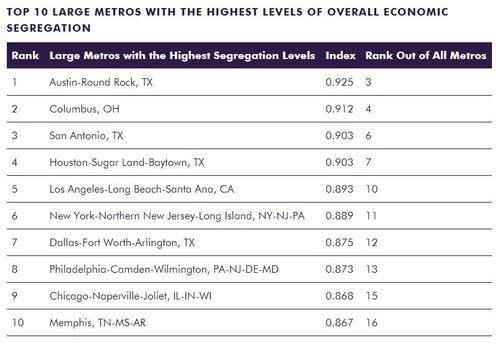
    Here are the most segregated “large metros” in the US:

    image

    Table Source: MPI

    And here are some of their broader findings – taken verbatim from page 9 of the study (click here for the full report):

    Economic segregation is positively associated with population size and density. It is also positively correlated to two other sets of factors that follow from metro size and density: how people commute to work and the breakdown of liberal versus conservative voters.

    Economic segregation tends to be more intensive in high-tech, knowledge-based metros. It is positively correlated with high-tech industry, the creative class share of the workforce, and the share of college grads. In addition, it is associated with two key indicators of diversity, the share of the population that is gay or foreign-born, which tend to coincide with larger, denser and more knowledge-based metros.

    Economic segregation is connected to the overall affluence of metros, with positive correlations to average metro wages, income, and economic output per capita.

    Race factors in as well. Economic segregation is positively associated with the share of population that is black, Latino, or Asian, and negatively associated with the share that is white.

    Economic segregation is associated with income inequality and even more so than with wage inequality. Its effects appear to compound those of economic inequality and may well be more socially and economically deleterious than inequality alone.

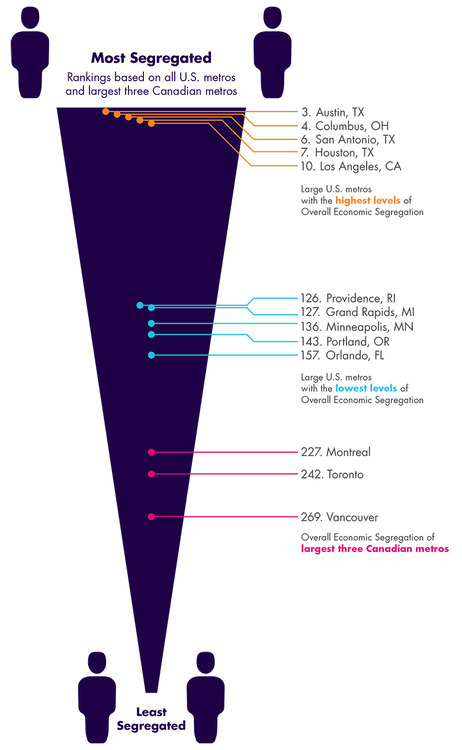
    The research team also looked at how Canada’s 3 largest metros – Toronto, Montreal, and Vancouver – compare to those in the US in terms of segregation. 

    The finding was that Canadian cities are overall less segregated than US cities, but that it should still be considered an area of concern. The most segregated of Canada’s 3 largest metros was found to be Montreal.

    image

    Image Source: MPI

    My view is that our economy is going through a profound shift right now. We’re transitioning from the industrial age to the information age. And in its wake, we’re seeing a number of disruptions, one of which appears to be rising inequality and segregation. 

    That’s not to say that I think this transition is a bad thing (I don’t think it is), but I do think we should be carefully considering and designing our future.

  • STEM + Art = STEAM

    image

    Most of you have probably heard of the STEM subjects. STEM stands for Science, Technology, Engineering, and Mathematics. These academic fields have been the focus of many federal governments around the world as they have been seen as the key to driving innovation.

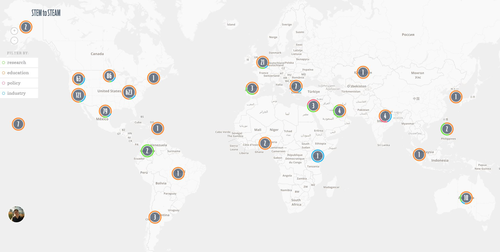
    But what you may not have heard of is something called STEAM. I hadn’t heard about it until this morning. STEAM is an initiative being led by the Rhode Island School of Design to integrate art and design into national agendas pertaining to STEM. STEM + Art = STEAM.

    Here’s a snippet from RISD:

    The goal is to foster the true innovation that comes with combining the mind of a scientist or technologist with that of an artist or designer. RISD offers endless examples of how art and design education teaches the flexible thinking, risk-taking and creative problem solving needed to solve today’s most complex and pressing challenges – from healthcare to urban revitalization to global warming.

    I couldn’t agree more with this initiative. As somebody who thought a lot about how to combine design and technology in my own career, I believe that there are huge benefits to a multidisciplinary approach to problem solving and innovation. In fact, it’s one of the reasons I decided to go to Rotman for my MBA (see Business Design).

    So if you feel the same way, I would encourage you to add yourself and/or your company to the “STEM to STEAM map” that RISD has created. Click here to do that.

  • The unmet demand for real estate education in Canada

    image

    I continue to be amazed by the unmet demand for real estate (development) education here in Canada.

    Following yesterday’s post on the real estate development process, I received a few emails from readers asking about the best university programs (MBA, MRED, etc.) and the best approaches for becoming a developer.

    I also had a good conversation on Twitter, which covered off some details that I had left out from my post (for simplicity) and which resulted in me suggesting that a real estate development school needs to be started here in Toronto:

    //platform.twitter.com/widgets.js

    //platform.twitter.com/widgets.js

    Now, part of the reason things are the way that they are, I think, is because the real estate industry has been historically dominated by private rich families. People didn’t go to school to learn how to be developers. They learned by doing and that was then passed down to the next generation. All it took was chutzpah.

    But as the real estate industry continues to institutionalize and become run by pension funds and large publicly traded companies, I think the point of entry will also become increasingly institutionalized. And that’s where dedicated real estate programs will continue to come in. 

    I’ve spoken to a few people at the Rotman School – where I did my MBA – and there doesn’t seem to be a huge interest in a dedicated program such as a Master of Real Estate Development (they already offer real estate courses). It’s more of a “longer term” strategy. 

    But I think that’s a mistake.

    I’m confident there’s strong demand from the student side, so hopefully a wealthy donor will step forward to help make this happen. The University of Toronto has both a great business school and a great architecture school. That feels like a great recipe for a first-in-kind joint degree offering.

    Image: Urban Learning (via Flickr)

  • The MFA is the new MBA

    Harvard Business Review recently published a conversation between Roger Martin – who is the former dean of the Rotman School – and Tim Brown – who is CEO of the global design firm IDEO. The title of the talk is “Capitalism Needs Design Thinking.” But I decided to call this post something else after reading Roger say this:

    My friend Dan Pink argued in an HBR piece in 2004 that the MFA is the new MBA. I wrote to Dan to say that if that’s the case we have a problem because America pumps out a mere 1,500 MFAs a year versus 150,000 MBAs. Thirty MFAs per state per year is just a rounding error. This is one of the reasons I was so keen on transforming business education. It’s a huge infrastructure: 27% of all graduate students in America are in an MBA program. If they’re all being taught how to analyze things to death, that’s going to affect how they’ll shape the future of business.

    But what this conversation is really about is the future of democratic capitalism, which is why I think it’s a nice tie-in to yesterday’s Architect This City post about startups and inequality.

    I’m very worried about the fact that in America we’ve now gone 24 years without the median household income rising — it was the same in 2013 as it was in 1989. That’s unprecedented in American history. The longest that’s ever happened before is when it took just under 20 years to recover, after the Great Depression. This long period of stagnation has coincided with the top 1% of the economy doing spectacularly.

    And so while it’s easy to point fingers at the tech community and say that it’s to blame for rising income inequality, the reality, I think, is that there are other more fundamental issues that need addressing. Roger and Tim believe that design thinking can help. Here’s another great snippet from the former:

    I think the way that government generally works is to think, think, think, think, and then finally create legislation that brings about some change, and then they ignore their legislation and say okay, we’re finished with that. Then people go and figure out how to game that legislation, and the government doesn’t do anything about it. Whereas if they had a design view of it, they’d say when they passed a bill, that’s just the best idea we’ve got now, we have to go see how it works in practice, and then fix it. That’s just not the mentality.

    Technology is having a profound impact on the world. And it’s something that is very visible. But part of the challenge is that governments aren’t keeping up. They are almost never out in front.

    So when something new comes along, like Airbnb or Uber, the reaction is to just stop it. It doesn’t conform to the rules and regulations currently in place, and so it shouldn’t exist.

    But as Roger and Tim point out, maybe we need to look at our rules and regulations as simply part of an iterative process (like designers do). Because if we did that, maybe we’d be better equipped to transfer the benefits of innovation over to society as a whole.

    Image: HBR