Daily insights for city builders, delivered every morning at 6 AM ET. I’m Brandon Donnelly — a Toronto-based real estate developer and founder of Globizen. I’ve been writing here since 2013.

Tag: rotman school

  • Toronto seeks injunction to stop Uber

    image

    One evening this past spring I was leaving a Rotman School event at Liberty Grand on the west side of Toronto. There aren’t a lot of taxis coming through this part of the city, so I figured I was going to have to wait while I hailed one from my phone. But as luck would have it, one happened to be pulling up just as I walked out of the hall.

    As he drove up and rolled down the window, I told him that I was going to the St. Lawrence Market area and that I needed to pay by credit card (I was trying to be a nice guy and avoid the inevitable fight when he was dropping me off). He responded by saying, “My machine is broken. Can’t you pay with cash?” I told him, “No, unfortunately I don’t have any cash on me. I need to pay with credit card.” He then rolled up his window and drove up closer to the entrance of the hall.

    Faced with this scenario, I did what most people would probably do nowadays: I pulled out my phone so that I could hail either an Uber or a Hailo cab (I’m sad that Hailo has since left the North American market). I decided on Hailo (it was cheaper until UberX came along) and ordered a car.

    But within a few minutes, the same taxi with the broken credit card machine circled back around, rolled down his window, and told me that his machine was now working and he would take me to the St. Lawrence Market. Knowing exactly what had happened, I said to him, “Wooooow, that’s funny that within the span of a few minutes your machine has magically started working again.” He wasn’t happy with that response.

    Now, we all know why he didn’t want to take my credit card. He didn’t want to pay the fees and he wanted the cold hard cash. And who can really blame him for wanting to maximize his profits. But for the end user, this experience sucks. When it’s 2 in the morning and all you want to do is go home to bed, you don’t care about the few dollars he’s trying to save. You just, want, to go, home.

    And that’s one of the reasons why Uber (and previously Hailo) is having such a huge impact on the market. Even before UberX arrived (the cheaper alternative), lots of people were more than willing to pay the Uber premium. And they continue to pay their controversial surge prices. But that’s because the experience is so much better than what’s offered today.

    We all know that Uber is under a lot of fire for what they do, but Toronto mayor Tory is 100% right in saying that ridesharing and peer-to-peer taxis are here to stay. Toronto may be seeking a court injunction to stop the service in this city, but I would agree that it’s likely going to be a big waste of money. The cat is already out of the bag.

    What’s happening here is no dissimilar to what happened with Napster. A court order may have forced the company to shut down, but it didn’t maintain the status quo for the music industry. That industry went, and continues to go through, a lot of change. So a better option, would be for everyone to sit down together and figure out what the future of the taxi industry is going to look like. Because I can guarantee you that it’ll continue to change.

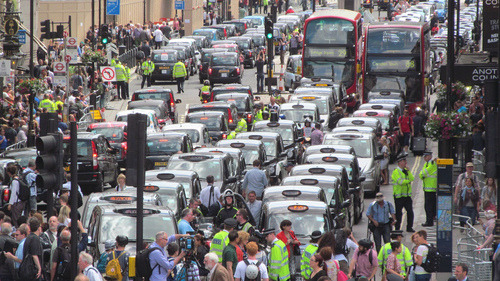
    Image: Anti-Uber protest in London (Flickr)

  • From utility to fear and greed

    image

    Roger Martin – who is the former dean of the Rotman School of Management and one of my favorite business thinkers – recently published a post on the Harvard Business Review blog called: The Dark Side of Efficient Markets.

    In it, he makes an interesting distinction between what he calls use-driven markets and expectations-driven markets, the latter of which is assumed to be the more efficient one:

    In the natural evolution of markets, as markets become more efficient, they turn from being use-driven to expectations-driven — like equities, real estate, or derivatives based on both.

    The example he starts off with is that of corn. In its simplest form, this market is about farmers growing corn, taking it to a local market, and then selling it to real humans who will then go home and eat it for dinner. Simple. And this is what he means by a use-driven market.

    But as markets grow and evolve, you have middle agents or market makers that insert themselves between buyers and sellers, suppliers and consumers. They help create greater marketplace liquidity and generally help buyers and sellers find each other and transact.

    However, as this happens, Roger argues that the game eventually shifts from being use-driven to expectations-driven. Now people buy, not necessarily to consume, but to invest, resell, and generally speculate on future values. In other words, they stop buying the corn to eat it. And instead buy it (or sell it) because of what they think it might be worth at some point in the future.

    Now, his argument is that even though this latter stage is considered to be more “efficient”, there’s a dark side to it: increased price volatility. When people are buying, not because they need something, but because of future expectations, it can lead to big price swings. And that’s because the market is now being driven by fear and greed, as opposed to utility. Interesting. 

    But I want to talk about something a bit different today. I agree with him, but I want to look at it from a different angle.

    What I’m instead curious about after reading his article are the following:

    • Are these non-use-driven markets really that “efficient”?
    • Is this a natural market evolution only because we had no other choice and no other distribution options?
    • And how does the internet change this natural evolution?

    Efficient markets are supposed to be based on perfect information. Buyers and sellers know the same things, prices accurately reflect intrinsic value, and all that other good stuff. But while this may be more true in some markets – such as perhaps the stock market – I would argue that it’s far from the truth in others.

    The real estate market in my view is actually an imperfect market. There’s lots of missing information and there’s overall poor transparency. And I’m sure this also leads to big distortions in the market. So I find it difficult to classify the real estate market as an efficient one – though it may still have a dark side.

    I also don’t think you can talk about markets, today, without talking about the internet. One of the most interesting things for me is how it’s completely rewriting distribution between buyers and sellers, producers and consumer.

    In the old days, we needed middle actors because it wasn’t cost effective to distribute on your own. If I wanted to write about cities every day, I would have had to get picked up by some newspaper or publication. But today (for better or for worse), I and anybody else can self-publish for basically no cost. The same goes for videos on YouTube, short-term spaces on Airbnb, and so on.

    Now, I’m not exactly sure how the changes taking place in marketplaces will ultimately play out in the financial markets, but I do think there’s room for our markets – the simple act of people buying and selling stuff – to get a lot more “efficient”. And as that happens, maybe the dark side won’t be as dark anymore.

    Image: Flickr

  • Does the world need a Global Parliament for Mayors?

    Earlier this month a team consisting of Benjamin Barber (who is author of If Mayors Ruled the World: Dysfunctional Nations, Rising Cities), Richard Florida (who is Director of the Martin Prosperity Institute here at the University of Toronto), and Don Tapscott (who is a leading authority on innovation) released a research report advocating for a global network of cities that they’re calling a “Global Parliament for Mayors.”

    Here’s a snippet from the press release:

    “Nation-states work together through multi-lateral agreements and global institutions in an effort to solve global problems. But states have limitations, and their cooperative efforts in our new era of interdependence and globalization are increasingly insufficient and even ineffective and outmoded,” say the three prominent researchers. A Global Parliament of Mayors represents a new type of governance network – one with enormous potential.

    “Our proposed parliament would operate as a global urban network with a vibrant online community that collaborates on key issues 365 days a year,” they say. “Multi-stakeholder governance has come of age and is now fully independent from control by any government, or governmental organizations like the UN.”

    And if you dive into their report, you’ll find the following 5 reasons for why they believe a Global Parliament for Mayors (GPM) makes sense:

    1. Global migration to cities. Most people live in cities, so it makes sense to concentrate problem-solving capabilities there.
    2. Urban predisposition for problem-solving. Cities are entrepreneurial, close to the people and richly connected to a wide variety of stakeholders. They have a history of cooperation and pragmatic problem-solving. 
    3. A need for experimentation with new governance models. Traditional models of state-based global governance have struggled to advance effective solutions to many global problems, so there is an urgent need to experiment with new models. The GPM is the most promising. 
    4. Digital networks. Online collaboration technology makes it possible to operate a largely virtual parliament that would not only be more cost-effective, but more transparent, inclusive and productive.
    5. Digital citizens. There is a large, educated and motivated population of digital citizens that could be tapped to improve urban governance.

    In principle, I agree with the direction. And I feel that way because of the two major shifts outlined above: More people are living in cities (a trend that all urbanists talk about ad nauseam) and digital networks are having a disruptive effect on the way we run companies and live our lives.

    I’ve talked before about how the internet is causing a decentralization of value creation (see Airbnb, YouTube, and so on) and so I think it only makes sense that our governance structures will inevitably go through a similar transformation.

    The governance models that we are living with today were put in place during a time when the world was a different place. At one point, nation-states were the de facto way to effectively organize ourselves on a global stage – probably because there wasn’t any other reasonable alternative.

    But today, we are connected and interdependent in entirely new ways. And so the opportunity in front of us is to create a governance structure that leverages the progress and innovation that’s happening in cities, everywhere.

    If cities are our most important economic unit, then mayors are arguably some of our most important leaders. So it behooves us to figure out how to give them the frameworks and forums to best do their job.

  • MBA

    image

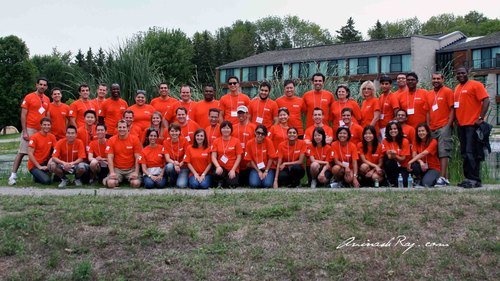
    Today was my MBA convocation at the University of Toronto’s Rotman School. Though I actually finished my degree last year (with a bit of fast-tracking), I had to wait until today in order to formally graduate with the rest of my cohort. I did what’s called the 3-year morning MBA. What that means is that I took most of my classes at 7am.

    The picture above is from our weekend retreat right before we started the program (I’m in the back row in the middle). It was taken in the summer of 2011. That feels like eons ago. It has been a tough slog.

    So today I’m taking the day off from writing about cities. Instead, I’m just going to enjoy the day off and the closing of this chapter in my life. An MBA is something I had been planning on doing even while I was in architecture school–so it’s nice to be able to check it off. But as I told my parents today after convocation: you ain’t seen nothing yet.

  • New ideas need old buildings

    In reading a recent Financial Times article called, Are creative people the key to city regeneration?, I was reminded of a famous line from the late urbanist Jane Jacobs: “New ideas need old buildings.” What she meant by that is the following:

    Cities need old buildings so badly it is probably impossible for vigorous streets and districts to grow without them…. for really new ideas of any kind—no matter how ultimately profitable or otherwise successful some of them might prove to be—there is no leeway for such chancy trial, error and experimentation in the high-overhead economy of new construction. Old ideas can sometimes use new buildings. New ideas must use old buildings.

    And what she was effectively getting at is that we live in a world obsessed with historical data and precedence. To use the words of business thinker Roger Martin: “The enemy of innovation is the phrase ‘prove it.’” Because, if it’s never been done before, how can you prove it? You can certainly imagine it. But you can’t prove it.

    If you’re in the business of building buildings, convincing your lender to give you the money to build something that’s never been done before, is an almost impossible sell. That’s not the way it works. Which is why Jane Jacobs famously said that “new ideas need old buildings.”

    We’ve seen this story play out in countless cities around the world. The creatives move into an scuzzy neighborhood, make it cool and then investment follows. The neighborhood has been proven. But for this cycle to continue, we need a continuous stock of derelict buildings and undesirable neighborhoods, or at least areas that offer the same kind of affordability and flexibility to creative entrepreneurs.

    Often these circumstances have been the result of failure. The proven ideas that got the buildings built in the first place became no longer relevant. And so the buildings were left to expire. But in many global cities, these kinds of areas are an endangered specifies. However, it’s in our best interest to make sure that we don’t lose our creativity alongside them.

  • Do homes need to become more of a product?

    Yesterday evening I moderated a panel on innovation in real estate at the Rotman School. The panelists included Subhi Alsayed (Innovation Manager at Tridel); Michael Lio (President of buildABILITY Corporation); Alison Minato (VP of Sustainability at The Minto Group); and Tad Putyra (President and COO, Low Rise Development at Great Gulf).

    Though the general consensus was that the real estate industry is terrible at innovation, it was comforting to hear that a number of both low-rise and high-rise developers are working on and/or towards building “net zero” homes. A net zero home is a home with no net energy consumption. What this means is that the home produces as much as energy as it consumes.

    The general strategy with these homes is to design the building so that it’s as energy efficient as possible (as in R-40 walls and triple-pane glazing) and then use renewable energy sources (such as solar) to fulfill any remaining energy needs. Of course, the next step would be homes that actually produce more energy than they consume so that they become net contributors to a city’s energy grid. But let’s not put the cart before the horse.

    There are a number of challenges to achieving this goal—one of which is on the consumer side. Many of the panelists mentioned that consumers simply don’t care enough about building performance and energy efficiency. Instead of worrying about air tightness, they’re worried about cosmetic things, like granite countertops and hardwood floors. That’s not to say that these pieces aren’t important, but they’re only one aspect of a home.

    So what’s the solution? Do developers and home builders need to get better at consumer education? Or should utility companies be the ones shouldering this responsibility? After all, improving energy performance means lower utility costs.

    One thought that came to mind (and I’m testing this for the first time with the Architect This City community), is that maybe homes need to become more of a product. Today, developers often market projects and communities ahead of themselves. But maybe that’s not the best way to drive innovation within the real estate industry.

    For example, think about how car brands segment the market. When you buy a Mercedes, you expect a certain level of performance and quality. You probably don’t know about every little technological innovation in the car, but you assume that they’re pretty damn good.

    With a new home on the other hand, you’re buying (insert generic name) on the Park or the Residences of (something regal sounding). The developer’s brand is secondary. And maybe that’s the wrong approach. Maybe it’s making consumers believe that the only thing that matters is whether you’re getting stainless steel appliances and granite countertops.

    Maybe consumers need to know whether or not they’re buying from the Mercedes developer or from the Ford Pinto developer. After all, consumers make decisions based on heuristics. They need to be able to say to themselves:

    “This home is $50,000 more, but it’s from the Mercedes developer so I can justify it. I’ll have less problems in the future, I’m sure.”

    Instead, consumers are saying to themselves:

    “This home is $50,000 more. Why is that? They both have stainless steel appliances and granite countertops. I’ll just go for the cheaper one.”

    I refuse to believe that the real estate industry can’t be as innovative as other industries. There’s always a way. We just need to figure it out.

    What are your thoughts?

  • Transitioning from architecture to development

    A few years ago during a class at the Rotman School when we were all introducing ourselves, I had a professor ask why all architects seem to want to become developers. He asked it because there were 3 architects (or at least architect-trained) in the class who were either currently working in development or planning to move into development following their MBA.

    Indeed, it is pretty common for architects to make this jump. So much so that I’m often asked (as recently as last night) about how I made the transition from architecture to development. Given the frequency of this question, I figured it would be worthwhile to turn my response into a blog post—particularly since I did make the decision to write more about what it means to be a developer.

    The first thing I should say is that I’ve never really worked as an architect. I interned at an architecture firm one summer, but that’s about it. I’m not licensed as an architect and I have no plans of ever becoming licensed. Therefore, I’m technically not allowed to call myself one, which is why I often say “architect-trained.”

    However, this doesn’t mean that I didn’t face a certain degree of stigmatization while I was completing my Master of Architecture and looking for my first real estate job. The real estate community often perceives architects as being impractical, fanciful and generally poor with money and business.

    Part of this, I think, has to the with the fact that design schools often don’t like to talk about making money. It’s taboo. Design is supposed to be something purer and grander than money. Maybe that’s why it’s not uncommon for even the most famous of architects—such as Louis Kahn—to die deeply in debt.

    But I think this perspective is bullshit. Which is why I spent every single one of my electives during my Master of Architecture over at the business school taking finance, economics and real estate classes. I was determined to be just as good as the MBAs at “the numbers.” And even became a teaching assistant for a real estate economics class.

    So my first piece of advice to architects looking to make the transition to development is that you need to overcome the perception that you don’t understand money and business. You need to demonstrate that you can crunch numbers and that you know how to make money for investors.

    This could mean getting an MBA or Master of Real Estate Development, taking extracurricular classes, starting a blog, or just convincing somebody in real estate to give you a chance so that you have it on your resume. Whatever it is, you need to reposition your personal brand so that it no longer says architect.

    This is important because, from my experience, if a real estate company is used to hiring people with business degrees, then it’s going to be tough to get them to pay attention to you and your architecture degree. They just don’t understand the value that you might be able to bring to the organization (and you do bring value).

    My second piece of advice is to find developers who have an architecture background and specifically reach out to them. There are lots of us. They’ll be sympathetic to your background and will probably give you more time of day. But you’ll need to come prepared with the right tool chest. Demonstrate to them that you have the skills necessary to be a developer (see above).

    As I’ve said before, developers are, in many ways, a jack of all trades. So the more you can master all of those trades, the more likely you’ll get some hiring manager to take a risk on you. But when you do finally make that transition, I believe that you’ll be better for it.

    Not only because architects understand the building process, but because architects are trained to have an inherent sense of responsibility for the built environment. We get upset when building are ugly and public spaces suck. But we also know what will make them better.

    The way I see it, by becoming a developer you’re really just learning how to execute on your ideas. It’s one thing to know what makes a building beautiful, but it’s another thing to go out and raise the capital and build the damn thing.

    So I don’t regret any of my architecture degrees. I got so much out of them. And I firmly believe that design is only going to become more important. Designers, after all, are the new rock stars. We just need a few more business and entrepreneurship classes in architecture schools.

  • Competitiveness and currency

    The Globe and Mail published an article yesterday morning called, “Why a lower loonie is (mostly) good for Canada.” It talks about the recent decline of the Canadian dollar from parity last May to roughly USD $0.92 today. But that the drop is essentially because of a rising US dollar. 

    Irrespective of what’s causing the devaluation though, the article takes the tone that it’s generally good for the country:

    “On net, this could be seen as a good thing because it’s making Canadian goods and services more competitive,” said Michael Devereux, a professor at the University of British Columbia’s Vancouver School of Economics.

    But this viewpoint always gets me concerned. 

    Canadian goods and services shouldn’t be competitive because they’re cheaper; they should be competitive because they’re the best damn good and services in the world. And so my fear with statements, like the one above, is that it almost makes us believe that a weak dollar is a prerequisite for competitiveness. It’s not.

    In fact, research done by Professor Walid Hejazi at the Rotman School has shown that a weak Canadian dollar actually lowers productivity levels and creates a disincentive for innovation. Why bother to innovate when you can always get your goods and services to market at a lower cost than your competitors?

    Thankfully, the outgoing Senior Deputy Governor of the Bank of Canada (and upcoming Dean of the Rotman School), Tiff Macklem, has acknowledged this perspective. In a talk at Queen’s University last January, he said:

    “What should Canadian businesses do? First, don’t count on a weaker Canadian dollar. Hoping for a weaker Canadian dollar is not a business plan. A sustainable export strategy cannot rely on expectations of a more favourable exchange rate, since Canada is likely to remain an attractive investment destination.”

    That sounds like good advice to me.

  • Real artists ship

    Last night at 10pm I finished my last MBA exam, ever.

    I’ve spent the past 2.5 years completing my MBA part-time at the Rotman School (at the University of Toronto). Since I had already done a 3-year masters (I know, it’s a lot of school), I had decided that my opportunity costs were simply too high and I wanted to remain working.

    But in order to do that, it meant I had classes from 7-9am and then went to work for the day. This past semester I had those morning classes 3 times a week. It’s made for an intense 2.5 years, especially when you add in group meetings, tutorials and other commitments.

    But as much as I’m happy to be finished the program (I fast tracked to finish a semester early), there’s always something bittersweet about closing one chapter and moving onto another.

    Since 2011, being a “MBA student” has been part of my personal brand. I would talk about the classes I was taking, and I would try and apply what I was learning to what I was doing in real life—both professional and personal. Believe it or not, I once had a debate with a Baptist Minister over the discount rate I used in one my calculations for a lease agreement.

    And while I have learned a lot through almost 6 years of graduate education in both Canada and the US, this is in many ways only the beginning. When I was younger I used to tell myself that my 20s should be about formal education, exploring, and crafting my identity, and that my 30s should be about execution.

    Well now it’s time to execute. In the words of the Steve Jobs: “Real artists ship.