Daily insights for city builders, delivered every morning at 6 AM ET. I’m Brandon Donnelly — a Toronto-based real estate developer and founder of Globizen. I’ve been writing here since 2013.

Tag: real estate

  • The growth of branded residences

    A branded residence is, as the name suggests, a residential building with a known branded attached to it. Historically, these have tended to be hotel brands. But it really just needs to be any brand that people know, care about, and will pay a premium for. So it could also be a fashion brand, a car brand, or whatever else.

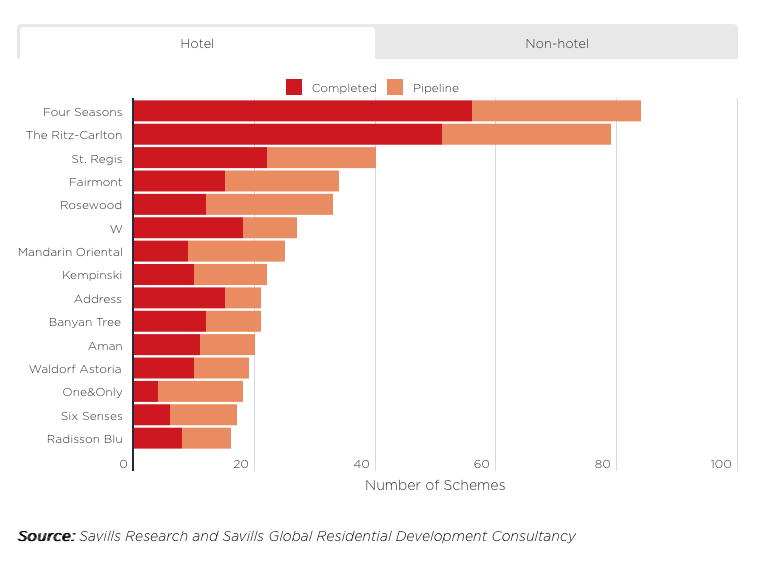
    This is a growing segment of the residential market. According to UK-based Savills, there were only 15 or so of these “schemes” in the 1990s (the UK uses scheme in lieu of project, which always sounds conniving to me), but by the end of this decade they expect the pipeline of branded residences to exceed over 1,200.

    I would also argue that projects designed by celebrated architects and/or designers are a form of branded residence. And this is not being captured in Savills’ number above.

    Whatever your definition, today, the branded residence capital of the world seems to be Dubai, which feels right. And the biggest brands, by what appears to be a long shot, are Four Seasons and Ritz-Carlton (hotel side), and YOO and Trump (non-hotel side). Here are the full rankings from Savills:
    This is an interesting part of the real estate business for a few reasons. One, it makes sense. A New Balance shoe that gets co-branded with Aimé Leon Dore unlocks additional value for both sides. ALD has a brand that certain people care about. So, of course the same would be true of real estate paired with the right brand.

    Two, it’s a growing market, and I think this is aided by the fact that development is an intensely local business — so it can be hard to grow a globally-significant brand on your own. Sometimes you just need to borrow someone else’s.

    And three, it’s usually a less risky approach to getting your name on buildings. Branded residences typically operate on a licensing model, which means developers pay for the right to use the brand. The brand may also capture some of the upside in the form of a percentage of sales. That’s less risky than putting up your own money.

  • Rent control and road pricing — economics is the study of choice

    Yesterday’s post tried to pit politics against the realities of how we know cities and economics work. So today, I thought I would share a set of memos from Howard Marks (of Oaktree Capital) titled Economic Reality, Political Reality (which he refers to as an oxymoron), and Shall We Repeal the Laws of Economics?

    In this last one, he specifically talks about things like price gouging (starting with the grocery industry) and apartment rent controls. Each is worth a full read when you have the time, but here I’ll leave you all with a few city building-related thoughts.

    Marks describes economics as the study of choice. And within these choices, there are many complicated moving pieces and second-order consequences. Take, for example, rent control in New York City. What rent control does is stop the free market from being able to freely set rents. The result:

    A person in favor of this arrangement would argue that it maintains affordability and diversity. What it means in purely economic terms is that some people who couldn’t afford to live in New York City if rents were set by free-market forces are able to live there if they’re lucky enough to secure an apartment with regulated rent. But other people who would like to live in New York City and can afford higher rents can’t do so because there are no apartments for them. And lastly, landlords that have apartments that are somehow unregulated can command higher rents than would be the case if additions to the supply of apartments weren’t being discouraged. It’s a matter of personal philosophy whether this is good or bad. But clearly, the laws of economics and the actions of free markets aren’t at work in New York City. Someone in government is making the decisions.

    Much like inclusionary zoning in the case of new housing, the tradeoffs with regulated rents are that you get (1) less overall housing supply and (2) more expensive prices for the people that can pay market rents.

    You could argue, as Marks suggests, that these are acceptable outcomes; but regardless of your opinion, there are real consequences to this policy decision. There’s no such thing as a “free lunch” in economics, and consequently there’s no such thing as no-cost affordable housing. The question is: Who pays?

    Going back to the topic of traffic congestion from yesterday’s post, Toronto’s general reluctance to implement any form of road or congestion pricing is also an economic choice. We have priced our roads so cheaply that demand is always going to outstrip supply. And this is expected. What we are experiencing today is a natural market outcome.

    Targeting bike lanes as part of the problem is meant to counter this by increasing road supply. Less bike lanes means more space for cars, right? But the second-order consequence of this choice is that you push people off their bikes (which take up less road space) and into cars (which take up more road space). So demand is also likely to increase.

    The stark reality of solving traffic congestion is that it will require greater change. It will mean fewer people driving, more people taking transit and biking, and the people who do continue to drive will have to pay more for it.

    Of course, this is not what any politician wants to talk about. As Marks says: “In the world of politics, there can be limitless benefits and something for everyone. But in economics, there are only tradeoffs.” The tradeoff we have decided to make is cheap roads in exchange for crippling traffic congestion.

  • Money and beauty

    I’ve told versions of this story before, but I was reminded of it again today.

    When I was in grad school studying both architecture and real estate, I used to walk back and forth across campus and jump between two very different kinds of academic experiences. On the one side of campus, it was taboo to talk about money. And on the other end, the only important thing to talk about was money. (I am exaggerating in both cases, but I think only slightly.)

    Given that I was studying and genuinely interested in both, this always felt like a weird false dichotomy. I mean, why not care about, you know, multiple things? But that’s generally not the way it was. Talking about money tainted the purity of design. And talking about things like design and beauty felt out of place and less serious in a room where cap rates were being debated and serious financial models were being honed.

    This is not to say that nobody was thinking across disciplines. I was in a joint program, after all. I can also remember attending a lunch & learn where a student asked a seasoned real estate executive what he should study in addition to finance. The response he got was something along the lines of, “the furthest thing from finance. Study something that will give you a different perspective on real estate.”

    I remember this really resonating with me — probably because I was searching for breadcrumbs to make me feel like less of an outsider at Wharton. Still, this came across as a unique perspective at the time.

    Knowing how money stuff works is absolutely fundamental. (We need to teach more of it in schools to young people.) And as a developer, it all starts with managing risk, executing (i.e. doing what we said we would do), and being an honest steward of other people’s money. Don’t do this, and you likely won’t be a developer for very long.

    But then, what else? What unique insights can we bring to the assumptions that feed a finely honed model? Fast forward to today and this is now the basis for how the Globizen team aims to look at real estate opportunities. We want to cover all ends of campus. And that means we are more than okay talking about unserious things like design and beauty.

  • Over-building and then under-building: Is Toronto headed for a severe shortage of new rental housing?

    As we know — because here’s the data — this is the current state of affairs:

    The GTA condo market is in a state of economic lockdown. The math doesn’t make economic sense from both the demand side (investors) and the supply side (developers), leaving the market at a standstill.

    The above excerpt is from a recent CIBC Capital Markets article by Benjamin Tal (CIBC) and Shawn Hildebrant (Urbanation). And what it ultimately means is that the supply of new condominiums in the GTA is falling and will continue to fall for the foreseeable future. Below are two charts, from the same article, that show that.

    Because of this, I actually think that, if you need or want a place to live, right now is a near ideal time to buy a condominium, especially if it’s from developer inventory (in an already completed project) or it’s a resale. Of course, most people won’t want to do this because they’d rather buy when most other people in the market want to buy. This is how markets tend to go.

    It has been a while since the GTA has gone through one of these real estate cycles, but it is typical: developers are prone to both over-building and under-building. It simply takes too long to build a building, and so it is natural for there to be moments when supply and demand don’t exactly line up.

    Pre-selling condominiums is — in theory only — supposed to protect against too much overbuilding. But as we have spoken about many times before, it can be challenging for end users to buy a new home so far in advance. And so the new condominium market has come to rely on investors who want to buy early and then either sell later or rent later.

    According to the above article (and MLS data), the share of newly completed condominiums used as rentals reached a peak of 34% in 2023. So a third of new condos. My gut tells me that the actual number is much higher. Many rentals never reach MLS. Overall, I think it’s very safe to assume that the majority of new condominiums are owned by investors.

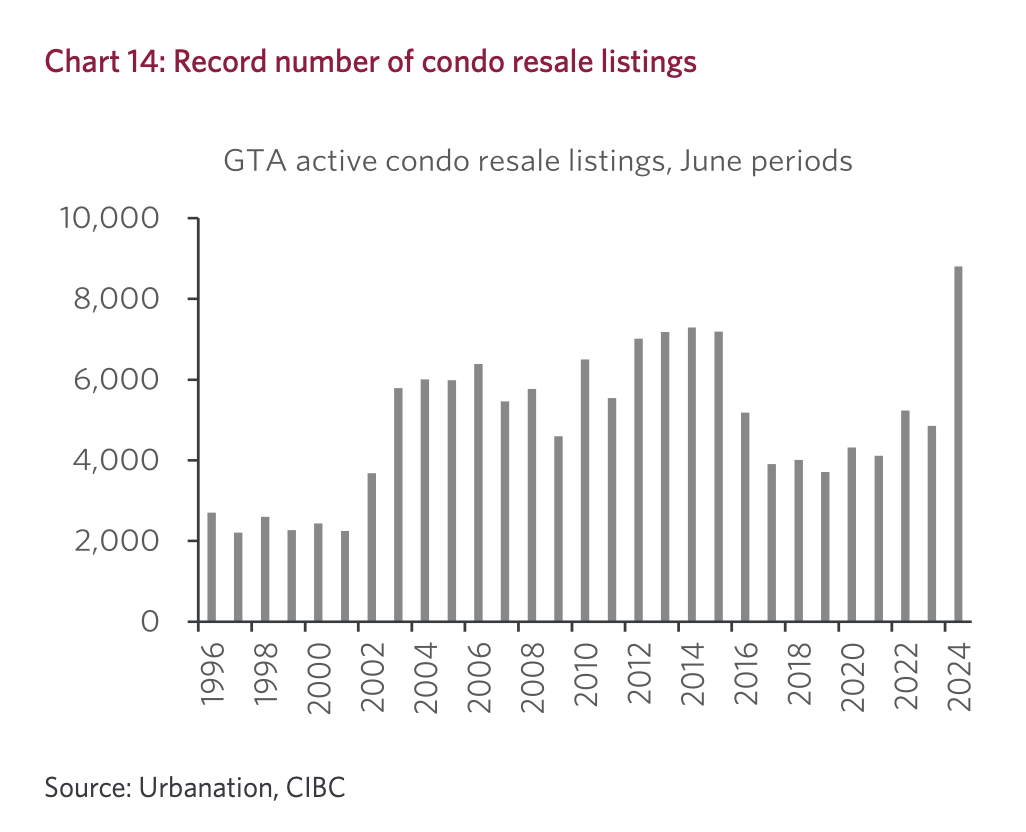
    But right now, fewer investors want to own condominiums, which is why the number of resale listings has spiked this year:

    This is, again, why I think right now is an excellent time to buy a condo. You know, be greedy when others… Regardless, this inventory will need to get absorbed and that will ultimately happen. Some of it will go to end users and some of it will go to investors who can make sense of the rental math and/or want to take a long view on Toronto. But if more goes to the former, we will be losing a lot of new rental housing.

    At the same time, while all of this is going on, construction starts are likely going to remain depressed (chart 3 above). It’s impossible to know how long this lasts, but at some point we will reach a moment in the cycle where we are under-building new housing. Maybe we’re already there. Development simply can’t turn on fast enough when demand spikes. There will almost always be a lag.

    So, since the majority of new condominiums have been serving as new rental housing, there’s a strong case to be made that at some point we will run into a potentially severe shortage of rentals. Condo investors are sometimes vilified in the media, but we will soon find out what happens when you take a big chunk of them out of the housing market.

  • 1,688 new condominiums were sold last quarter in the Toronto region

    Urbanation just released its Q2-2024 condominium market survey for the Greater Toronto & Hamilton Area (GTHA), and we should probably talk about some of the data:

    • The new condominium market reported 1,688 sales in the quarter. Outside of Q2-2020 (the pandemic), this is the lowest in the past 20 years. Note: This number is self-reported by developers.
    • Of the 3,625 homes launched for pre-sale during the quarter, only about 17% got absorbed/sold. That’s about ~616 homes, which isn’t very much when you spread it out across the region’s projects.
    • Unsold inventory increased to 25,893 homes. Urbanation equates this to 34 months of supply, versus a more “balanced level” of 10-12 months. This number breaks down to 15,157 homes in pre-construction projects, 9,788 homes in projects under construction, and 948 homes in recently completed buildings.
    • This is higher than Urbanation’s 20-year average, but the way I see it is that the ~15k homes in pre-construction projects could very quickly evaporate. If those projects don’t get to construction (and most probably won’t in the short term), then that inventory will disappear from the market. On the other hand, the ~11k homes under construction or recently completed is a hard number. These homes exist, or will soon exist, and they’ll need to get absorbed at some point.
    • There are also going to be homes that are currently sold, but where buyers ultimately say “yeah, I’m not going to be able to close.” So there will be some non-zero percentage of homes that will need to be reabsorbed. I don’t know what this percentage will be, but if it’s something like 5%, that’s not nothing. (See below for the number of condominiums under construction right now.)
    • Not surprisingly, average asking prices for unsold homes only declined about 2.6% over the past year. Prices have remained markably sticky. And this is how you know that development happens on the margin. Because developers are infinitely better off selling homes and starting construction, compared to holding lots of unsold inventory and starting construction, whenever. The fact that developers aren’t dropping prices to sell more homes demonstrates that they can’t. They’re hitting the floor of financial feasibility.
    • Finally, last quarter saw 727 new condominium homes start construction. In theory, this could have been a single tall building, though that probably wasn’t the case. As new starts fall, the number of condominiums under construction will naturally also fall. The current number is 87,508 homes, which is almost 19,000 less than a year ago. I expect this number to keep coming down.
  • Toronto approves new Rental Housing Supply Program

    This past week, Toronto City Council approved the launch of a new affordable housing initiative called the Rental Housing Supply Program. Here’s the agenda item if you’d like to dive into the details and read some of the supporting reports. There are a number of components to the program, and one of them is a subsidy that will be administered by way of a forgivable interest-free loan:

    Subject to the adoption of the Rental Housing Supply Program, the City will continue to support RGI and affordable rental homes through the allocation of up to $260,000 per eligible affordable rental and RGI home. This is the maximum allowable funding allocation under the Rental Housing Supply Program. Actual funding per project will be determined based on the evaluation of applications on a site-by-site basis, in consultation with the Chief Financial Officer & Treasurer, and based on project parameters and additional sources of funding that can be leveraged to support the project’s financial viability. These funds will be provided as interest free forgivable loans to eligible and approved projects and will be tied to milestones and requirements in agreements with housing providers.

    Total funding for the program is $351 million. And the intent is that these funds will be distributed in the near term to 18 affordable housing projects in the city, all of which are expected to start construction sometime between now and the end of 2025. In total, this is anticipated to create about 6,000 new affordable rental homes. That’s a good thing.

    Now, I don’t know anything about these projects. I don’t know if $260k is the right figure. And I don’t know if a forgivable interest-free loan is the exact right mechanism to deliver these funds. But what the program does do is recognize this: Deeply affordable housing cannot be built without some form of subsidy.

    Developers are often criticized for only building expensive housing. But the reality is that developers are, for the most part, takers of market pricing. In other words, we can’t just decide to build for less. We can reduce build and finish quality to get costs down, but at a certain point, the cost to build is the cost to build.

    And if that cost to build isn’t what the market would view as affordable, then you’re not going to get there without a subsidy. No developer is going to build if their expected revenues are less than their costs. Directionally, that’s what this new program appears to recognize.

  • Approved but unbuilt

    Recent data from the City of Toronto indicates that there were approximately 106,000 new residential units completed between 2019 and 2023. That averages to about 26,500 homes per year.

    At the same time, Toronto is reporting that 258,397 units are currently approved for development and that 436,421 units are currently under review. The former means that the projects have been approved and that a building permit has been applied for or has been issued. And the latter means that the units are still under review or under appeal.

    These feel like staggering numbers. If we were to use the same completion rate as 2019-2023, it would take over 26 years to build these 694,818 new units (homes approved + under review).

    However, I think it’s safe to assume that not all of these homes will be built; at least not in the short term. Many (perhaps most) of these projects are simply going to evaporate in the current market environment. They’re unfinanceable.

    Because that’s the thing, zoning approved does not necessarily equal built and occupied. And right now, in this market, these two things feel like they’re diverging. Toronto grew by about 207,000 people between 2019 and 2023. And it built about half of this number in new homes.

    When we look back at the next four years, I suspect that this housing supply number will be noticeably lower. This is despite the staggering headline numbers.

  • Please sire, may I give you free land?

    This is an aerial photo of the construction site at One Delisle:

    Currently, we are on hold and waiting to pour a number of columns on the ground floor because the city has not yet issued our above-grade building permit. And the reason the city has not issued our above-grade building permit is because we have not yet conveyed our parkland dedication land to the city. Frustratingly though, we have been ready to convey this land for over a year! We simply need the city to allow us to give them this free land. To date, we have meticulously documented at least 3-pages of follow-ups and back-and-forth emails as we try our best to do this.

    I’ve been doing this long enough that this isn’t surprising or unusual. But it remains deeply maddening. Younger people on the team can’t believe that this is par for the course. On top of this, the city continues to charge interest on the fees that are payable upon issuance of the first above-grade building permit. The result is an insane dynamic where the city can delay things as long as it wants and then charge us, and all other developers, interest on its own delays! I mean, is it any wonder that housing keeps getting more expensive in this city?

    During the last mayoral election, some candidates were quick to promise that, if elected, the city itself would start building affordable housing. This, I’m sure, sounded good to most. Toronto needs more affordable homes. But for all of us involved in the building of buildings, it was frankly impossible to imagine. If the city takes this long to accept free land from developers, how could it possibly build anything?

  • Homes per acre

    I spent three years living in Philadelphia for grad school and one of the things that I appreciated the most was its walkability. I walked and took transit everywhere. Much of this has to do with the grid system that was laid out for the city in the 17th century. But there are also lots of more recent developments that help to reinforce this fabric.

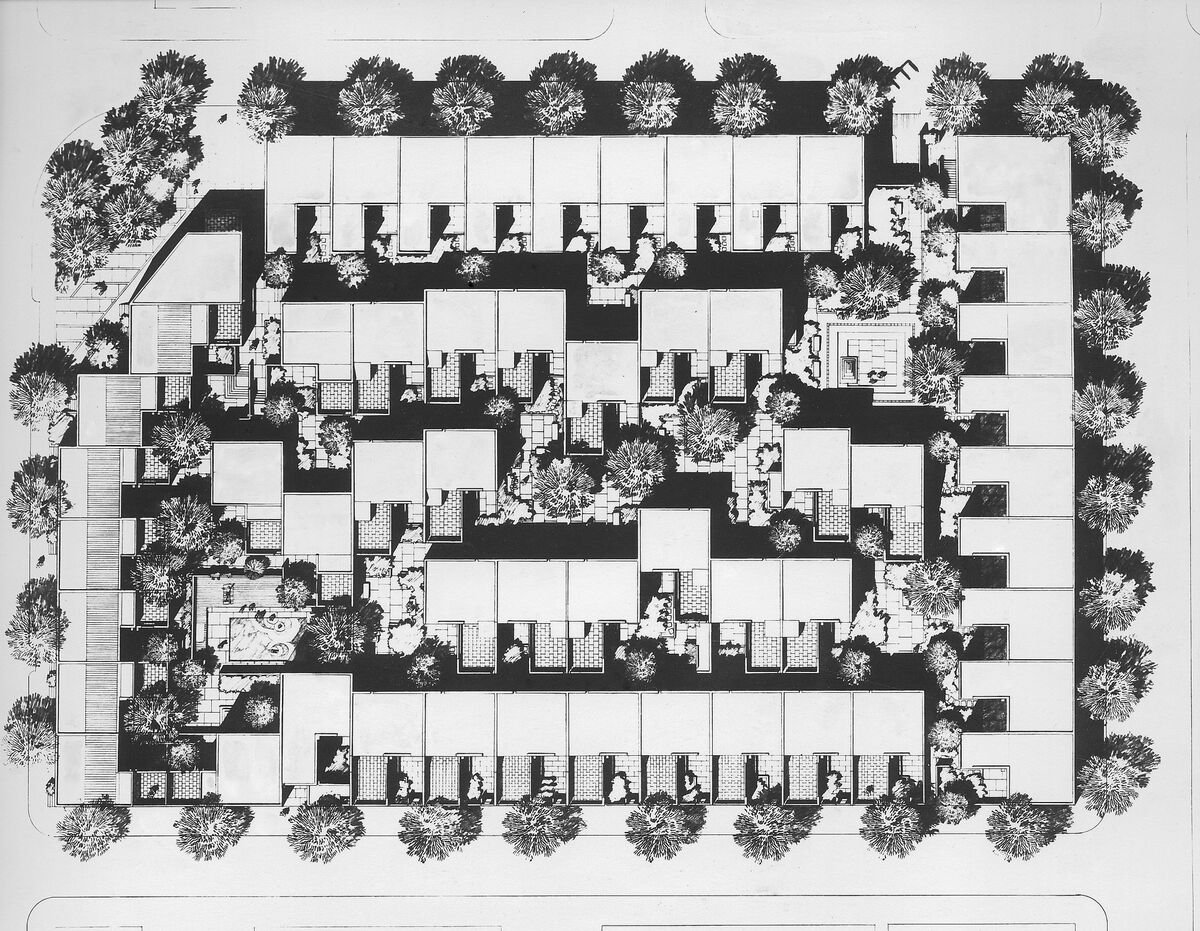
    CityLab, for example, just published this article on Penn’s Landing Square, which is a housing complex in Philadelphia’s Society Hill neighborhood. Built in 1970 and designed by Canadian-American architect Louis Sauer, the modernist complex occupies an entire 2.37-acre block and contains an assortment of 118 low-rise homes, many of which are connected through small interior laneways.

    Here’s the site plan:

    In addition to its handsome architecture, what is noteworthy about Penn’s Landing Square is that its site plan makes it quite a dense low-rise development. At 118 homes, this translates into just under 50 units per acre. CityLab estimates that this means the development holds about 174 people per acre (~412 people total), which would make it more dense than Stuyvesant Town in New York (~158 persons per acre).

    However, this is based on the assumption that there are almost 3.5 people living in each of these homes. While generally large, I don’t know if this is the case. It would be higher than the average US household size. But regardless, from a unit per acre standpoint, it remains a great example of dense, family-oriented, and grade-related housing.

    For fun, let’s compare this to a more intense form of infill development. Our Junction House project, for instance, contains 151 homes and sits on a 0.48-acre piece of land. This translates into about 315 units per acre. I don’t know off hand the average number of occupants per household, but I reckon that, given our larger average suite size, we should be on the higher end compared to most mid-rise condominiums. So I would say that we are probably 400+ people per acre.

    It’s unfair to compare a single development to an entire neighborhood, such as Stuyvesant Town. Circulation and other open spaces will necessarily pull down your average density. But these individual development examples do speak for themselves. There are many parts of North America where you might find 1 home or a handful of homes per acre of land. At Penn’s Landing Square, this number is 50 units per acre. And at Junction House, it’s 315 units per acre.

  • The US is building a lot of apartments right now

    As of November 2023, it was estimated that there were 988,000 homes under construction in multi-family buildings containing 5 or more units. This is in comparison to 680,000 single-family homes, according to US Census data. (Looking at the below graph, it’s also interesting to see how the supply of single-family homes dropped off after the global financial crisis and multi-family apartments took off.)

    All of this means that in 2024, the US is on track to complete more apartments than it has in many many decades. In fact, exactly similar to what we experienced here in Toronto, if you want to find a comparable multi-family supply number, you need to go as far back as the 1970s (see below). Of course, the US had fewer people back then, and so on a per capita basis, it was building more housing.

    Still, all of this new supply is having an impact. Apartment List recently published its national rent report, over here. And overall, it found that:

    Rent increases are currently being moderated by a robust construction pipeline expected to deliver a decades-high number of new apartment units in 2024.

    More specifically, they found that the cities with the most supply are now seeing the largest rent declines:

    Many of the steepest year-over-year declines remain concentrated in Sun Belt cities that are rapidly expanding their multifamily inventory, such as Austin (-7.4 percent year-over-year), Raleigh (-4.4 percent), and Orlando (-3.9 percent).

    If you’re an apartment developer, this is not what you want to see. It means that increased competition is creating downward pressure on rents and that vacancy rates are probably rising. But if you’re someone looking to rent an apartment, this is exactly what you want to see. You want more affordable housing. And so, as a consequence, you want more homes to be built. Because when supply outstrips demand, this is what you get.

    Charts: Apartment List