Daily insights for city builders, delivered every morning at 6 AM ET. I’m Brandon Donnelly — a Toronto-based real estate developer and founder of Globizen. I’ve been writing here since 2013.

Tag: phoenix

  • Zillow exits algorithmic home-flipping business

    Things are happening in the algorithmic home-flipping business right now.

    A few weeks ago I wrote about Zillow pausing this part of its business. It was then later revealed that the company was set to take a loss on many/most of the homes that it had purchased through this “iBuying” division. In October, it listed some 250 homes in Phoenix and on average they were priced about 6.2% below what they had bought them for.

    So it is perhaps no surprise that today the company announced that it will be the exiting the business of buying high and selling low. Turns out this isn’t good for business.

    But does this mean that the model doesn’t work or that Zillow simply didn’t have its algorithms tuned correctly? Following the news, competitor Opendoor took to Twitter to reassure everyone that the digitization of real estate is still well underway:

    https://twitter.com/Opendoor/status/1455650519804829696?s=20

    Opendoor also announced today that it will be expanding technical hiring into Canada — starting first with Toronto. The plan is to hire upwards of 100 people over the next several years. Presumably this is about access to talent, but presumably it also means that Opendoor is looking toward one day expanding into Canada.

    Stay tuned.

    Disclosure: I continue to be long $OPEN.

  • A completely car-free neighborhood in Arizona

    The New York Times recently published this interesting piece about Culdesac and the completely car-free community that they are building just east of Phoenix in Tempe, Arizona (a place that is not generally known for its walkability). Culdesac calls itself the first “post-car real estate developer in the United States.” And so their Culdesac Tempe project has been designed to house 1,000 residents and exactly 0 cars.

    When the first phase is completed next year, residents will be restricted from having a car within the community and they’ll also be restricted from parking on any nearby streets. (This second stipulation was done to assuage concerns that a zero parking community would create a spillover effect in the surrounding area.) Instead, residents of Culdesac Tempe will rely on their local amenities, as well as on transit (it’s on a light rail line), biking, ride-sharing, and other forms of urban mobility.

    While this may seem kind of crazy for sprawling Arizona, the company’s thesis is both clear and clever. The future of American cities needs to be the kind of walkable urbanism that you find in places like the northeast. But at the same time, the fastest growing cities in the United States are generally in the Sun Belt. What they are doing is building walkable urbanism in the places where people clearly want to live.

  • Algorithmic home buying expands to Los Angeles

    Algorithmic home buying companies (or iBuyers) have now started to expand into Los Angeles. If you recall, most of these companies started in smaller markets where the homes are more homogenous, relatively inexpensive, and generally less liquid. Places like Phoenix.

    By tackling the second largest housing market in the US (after New York City), the algorithms of Opendoor, Redfin, and Zillow will now need to content with an older housing stock, greater variability, and higher values.

    All of these companies have increased their maximum offer price. The sweet spot for algorithmic home buying has typically been in the $150,000 to $300,000 range. Last year, two-thirds of all homes bought by iBuyers were in this range. I can’t imagine that gets you very much in LA.

    I keep expecting these companies to scale into something more beyond just iBuying and flipping. Perhaps we will see that happen once they establish themselves in country’s biggest markets.

    Photo by Josh Rose on Unsplash

  • Who is going to buy the homes vacated by Baby Boomers?

    The Wall Street Journal estimates that, from now until about 2037, roughly 21 million homes in the United States will be vacated by seniors. To put this number into perspective, it’s about 25% of the US for-sale housing stock and more than double the amount of new homes that were sold during the 1998 to 2008 housing boom. That number was about 10 million (see below).

    This is part of the normal cycle of housing, but in this particular instance, there’s concern that the new generation won’t be there to backfill these homes, or least not in the same way. For one, there are more boomers than there are Gen Xers. So right away there’s a potential gap. But on top of this, the next in line don’t appear to necessarily have the same preferences in housing type and location.

    As someone who would fall into the 65.9 million birth bucket highlighted in deep mustard (had I been born in the US), I can tell you that I am far less interested in many of the housing products (real estate speak) / typologies (architect speak) popularized by the generation ahead of me. Whether my opinion is representative is, of course, debatable.

    Anecdotally, I can also say that I know many boomers who have started making real estate decisions based on the assumption that demand for certain types of housing will be tepid going forward. This is not to say that some of these communities won’t be able to reposition themselves if it comes to that. But there is uncertainty.

    Images: WSJ

  • The Central Arizona Project

    Phoenix is the 5th largest city in the United States. It has a city proper population of about 1.6 million people and a metro area population of close to 5 million. It is also one of the fastest growing cities in the US.

    But being the desert city that it is, its population consumes more water than its natural aquifers can support. Which is why there is something called the Central Arizona Project (CAP).

    Approved in 1968, the CAP diverts water from the Colorado River into the state of Arizona. The system is 336 miles (or 541 km) and it runs from Lake Havasu to Tucson, via Phoenix.

    Here is an aerial image of the canal from Wikipedia Commons:

    And here is a system map from CAP:

    Today, it is the single largest water source (and consumer of power) in Arizona, serving about 80% of the state’s population. This obviously makes it invaluable. It delivers on average about 1.5 million acre-feet of water per year. (Acre-foot = Acre of area x one foot in depth.)

    I was reading about this project today and I found it fascinating. Maybe some of you will too.

  • People are camping out in Opendoor’s homes

    Inc. Magazine just did a profile on Opendoor, which is a company that we have, of course, talked a lot about on this blog and that I continue to follow closely.

    It’s interesting to read about some of the challenges that they’ve been having as a result of their frictionless open houses. Since all you need is a smartphone, the company has been having the ongoing problem of people camping out in their listed homes. Sometimes for weeks. They’ve been working to address this by restricting the hours (6AM to 9PM) and by installing motion detectors. I am sure they will figure it out.

    The company is also having to be careful in terms of how it positions itself alongside realtors. There are many livelihoods at stake here. Here’s an excerpt from the article:

    During interviews, Wu has chosen his words carefully when discussing Opendoor’s potential to replace Realtors. “The reality with Realtors today,” he said on stage at the Startup Grind Global Conference in Silicon Valley in February, “is their role is shifting from project management–especially in our ecosystem, where we’re automating a lot of the processes–to advisement.”

    Fred Wilson (venture capitalist) has argued many times before on his blog that business model innovation is far more disruptive than technical innovation. I think it’s valuable to keep that in mind in the context of this discussion.

    Opendoor continues to charge a commission fee (sometimes a higher one than is typical), but it also makes money on the flipping of homes and it has plans to vertically integrate other aspects of the real estate business.

    Will that do it?

  • Why Phoenix is ground zero for algorithmic home buying

    I have been writing about algorithmic home buying on the blog since Opendoor launched back in 2014.

    I don’t have anything new to report on that today, but this recent article from the WSJ is interesting in that it talks about why Phoenix, in particular, has become ground zero for algorithmic home buying, as well as for institutional investors looking to buy cheap rentals.

    Across Opendoor, Offerpad, and Zillow, nearly 500 homes are now being purchased — largely by software — in Phoenix each month:

    One of the reasons why Phoenix is well suited to these platforms is that the housing stock is cheap and fairly homogenous. (The WSJ calls it “stucco sprawl.”) This makes it easier for the algorithms to put a value on the homes.

    A big chunk of the housing stock is also relatively new. Just over 36% of it was built in 2000 or later. And it tends to trade fairly often. Below is the percentage of homes in 2018 that were resold within a year of purchase.

    It’s also worth noting that Arizona is a non-recourse state, meaning you’re typically not personally liable if you default on your home mortgage. You simply hand back the keys. So it’s viewed as a fairly risk tolerant state, which may be one of the reasons why Phoenix’s median home price chart looks like this:

    I’ll end with this quote from the article: “It’s the dawn of e-commerce for real estate,” said Zillow Chief Executive Rich Barton. “Phoenix is ground zero.”

    Charts: WSJ

  • Algorithmic home buying — what’s the end game?

    Bloomberg recently published a good summary of Zillow’s business and their move into algorithm home buying and flipping. (They are trying to avoid the “flipping” moniker because of the negative connotations associated with it.)

    Zillow started buying homes directly from owners last spring. They charge the seller between 6-9%, so more than using a typical agent, but inline with their competitors. There’s clearly a segment of the market willing to pay a premium for the added convenience.

    The thinking used to be that discount brokerages were the way to disrupt the housing market. This is the opposite strategy.

    Interestingly enough, Zillow felt that they needed to make this pivot with their business model. It used to be about selling ads. They were definitive in that they were not a disruptor of real estate agents.

    But now:

    If getting an offer from an iBuyer became a crucial step in the selling process, they worried, Zillow could lose its audience and its advertising base. What’s more, market researchers kept finding that consumers said they’d pay a modest premium to get a cash offer. “People expect to press a button and have magic happen,” says Rascoff, a 43-year-old former Expedia executive who’d earlier started the travel search engine Hotwire, which he sold to Expedia for $700 million. Getting into the business of buying homes directly, Rascoff says, was “the only way to remain in a leadership position.”

    Here is a map of the companies in this particular space and the cities in which they operate:

    Some investors aren’t sold on this strategy and have begun short selling Zillow (according to the Bloomberg article). I keep getting the sense that there’s a greater end game in the cards here. It is about building up A (algorithmic home buying and flipping) in order to unlock B.

    But what’s B — a new end-to-end transactional model for the housing market?

  • Decline of children in some, but not all, parts of Chicago

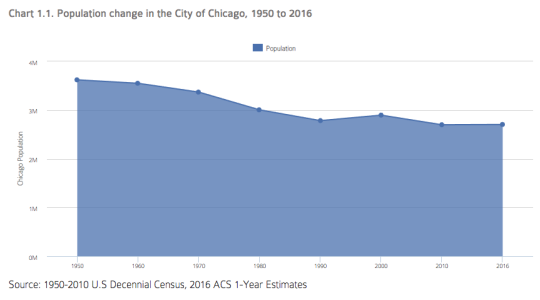
    The Institute for Housing Studies at DePaul University recently published this overview of the “socioeconomic factors affecting demand for housing in Chicago.”

    Here is the change in population in the City of Chicago from 1950 to 2016:

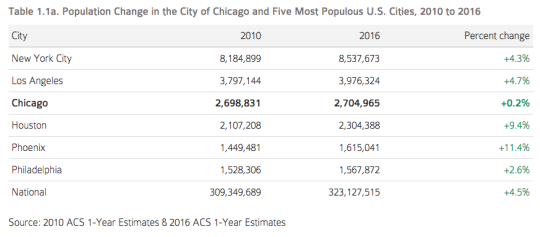
    And here is a comparison between Chicago and the five biggest cities in the US. Note the “sun and sprawl” phenomenon. Also note that the list below is for city proper boundaries.

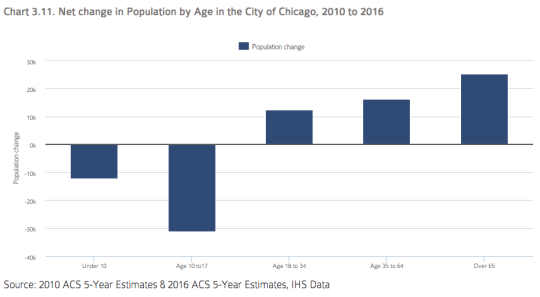
    One particularly interesting set of stats is the decline of children (population under the age of 18) in the city:

    Since 2010, the city has lost over 40,000 children and teenagers. 

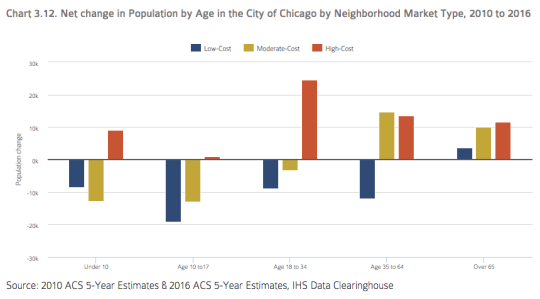
    But, if you break it down by neighborhood market type, it is the low-cost and moderate-cost neighborhoods that lost the population. The high-cost neighborhoods were up.

    The study posits that the old trend of moving to the suburbs after you have kids may not be for everyone – provided, of course, that you have the means. And it goes beyond Chicago. DC is predicting a 25% increase in K-12 students within the District.

    For the rest of the charts, click here.

  • A more distributed startup geography

    The Economist recently argued that Silicon Valley’s innovation hegemony is waning and that it is a product of two factors: there appears to be more innovation happening elsewhere (good news), but that innovation in general also seems to be harder to achieve (bad news). Here is an excerpt from the article:

    Other cities are rising in relative importance as a result. The Kauffman Foundation, a non-profit group that tracks entrepreneurship, now ranks the Miami-Fort Lauderdale area first for startup activity in America, based on the density of startups and new entrepreneurs. Mr Thiel is moving to Los Angeles, which has a vibrant tech scene. Phoenix and Pittsburgh have become hubs for autonomous vehicles; New York for media startups; London for fintech; Shenzhen for hardware. None of these places can match the Valley on its own; between them, they point to a world in which innovation is more distributed.

    Part of the problem, of course, is rising costs in the Bay Area. Everything from the cost of living to the cost of operating a business. The article cites a recent survey where nearly half of all respondents said they are planning to leave the Bay Area in the next few years. This is up from 34% only two years ago.

    I don’t doubt that rising costs are causing some people to look to other cities, as well as other countries in the case of draconian visa policies. But I am suspect of the claim that we’ve heat peak “innovation” – however you want to define that.