Daily insights for city builders, delivered every morning at 6 AM ET. I’m Brandon Donnelly — a Toronto-based real estate developer and founder of Globizen. I’ve been writing here since 2013.

Tag: night mayor

  • What would you do if you were Mayor?

    Let’s assume that you’re Mayor of your city and that, for whatever reason, you have no need to pander to voters. You’re a benevolent dictator. You can do whatever you think is best overall for the city and it will just happen. What would you do? This is more or less the question I asked on Twitter this morning, and I think it’s only fair that I answer my own question. So here is a non-exhaustive list of items that came to mind while thinking of Toronto:

    • Substantially increase the pay of public sector workers throughout the city and bonus them based on measurable outcomes. Forget things like time limits on development applications; instead align incentives. For example, if we’re trying to get more shovels in the ground on affordable housing, incentivize people based on building permits issued. I’ll never forget what Roger Martin told me while I was at Rotman. When he became Dean of the school, Rotman was a whatever business school that wasn’t faring all that competitively in the rankings. One of the problems he discovered was that the school’s professors were getting paid far less than those at Wharton, Harvard, Stanford, and so on. So if you were a star, why would you ever want to teach at Rotman? He immediately matched the salaries of those top-tier schools and then, not surprisingly, the top-tier talent arrived. You get what you pay for.
    • Immediately price roads and congestion, and direct, to the fullest extent possible, the funds toward transit and cycling infrastructure. At the same time, the planning and building of transit would be depoliticized. There would be a reccurring funding stream and a plan that we’re continually building out. Minimize protracted debates. Never stop building. There’s a lot of talk this mayor election about solving traffic congestion. I have yet to see a plan that will actually work. Accurately pricing congestion likely won’t be popular, but I can guarantee you that it will be highly effective.
    • Ensure that property taxes are sustainably covering the costs of operating the city and then, at a minimum, peg all future increases to CPI.
    • Make any new housing development less than 12 storeys as-of-right. That would mean, no rezoning process and no site plan approval; just straight to building permit.
    • Empower the private sector to build affordable housing through incentives and subsidies. Affordable housing isn’t feasible to build on its own, which is why nobody is doing it. Inclusionary zoning also won’t get us there. Make developers want to build it and they’ll do it.
    • Liberalize licensing and cut red tape to empower small entrepreneurs across the city in various industries. A perfect example in my mind is street food. Toronto is the most diverse city in the world with some of the best restaurants, and yet the only thing you can buy on the street is a stupid hot dog. If we empowered small entrepreneurs to setup shop on our streets, we would easily have the best street food scene in the world. And I am positive that there are countless other latent opportunities in this city that are being held back by dumb and archaic rules.
    • Make dramatic improvements to our public realm with an eye toward becoming the most beautiful and livable city in the world. Finally pedestrianize Kensington Market, remove the elevated Gardiner Expressway, make it so that we can swim in the Lake, build beautiful public washrooms all across the city that are actually open and aren’t gross, and the list goes on. And yes, “beauty” should be requirement so that we don’t end up with shit like this.
    • Focus on art, design, culture, and innovation as central pillars of Toronto’s brand. Miami is a good example of what this approach — along with favourable taxes and nice weather — can do for a city. I’ve said this before, but here’s just one example: Toronto is in many ways the birthplace of the cryptocurrency Ethereum. Why is nobody talking about this? Why are we not celebrating and leveraging this? It’s a missed opportunity. Broadly speaking though, I think just having and doing three things can be effective in promoting new ideas for these pillars: have reasonably affordable housing, be a city that young people want to live in, and remain open and tolerant to immigrants.
    • Stop thinking of the night-time economy as a nuisance and instead think of it as a powerful economic development tool. I recently responded to this “night economy survey” that the City of Toronto released and the obvious bias is that nighttime things are seen as a terrible nuisance. In other words, “tell us how do we make all of this less annoying for grouchy voters.” My response was to extend last call to 4am and to start thinking of it as an opportunity to draw in young people, tourists, and whoever else. This complements my previous point.

    This is, again, a completely non-exhaustive list. But if I had to summarize the overall ambition, it would be to make Toronto a truly exceptional and remarkable city. We should never be happy with mediocrity.

    What else would you do? Leave a comment below.

    Photo by Aditya Chinchure on Unsplash

  • Amsterdam wants fewer drunk and annoying people

    Back in 2014, Amsterdam became the first city to have what is referred to as a “night mayor.” And at the time, including here on this blog, this was generally viewed as a pretty progressive thing to do. It recognized that there is an important nighttime economy and that, with the right leadership, it be harnessed for broader economic development purposes. As a result, many cities followed suit and appointed their own night mayors. (Toronto did not, despite my repeated posts.)

    But fast forward to today and things feel different. Night mayors aren’t talked about as much in city building circles. And Amsterdam is actually trying to limit overall tourism growth. It is working to relocate its Red Light District to outside of the city center and it hopes to reduce the amount of people who come to the city just to misbehave. To be clear, it still wants tourists; it just wants more people who do things like go to museums:

    The Netherlands’ capital plans to launch a deterrence campaign later this month aimed at tourists who go wild during their visits. In addition to new ads, the city has proposed rules in its infamous Red Light District, such as a ban on smoking marijuana in the street, earlier weekend closing times for bars, clubs and sex-work establishments and reduced alcohol sales. 

    Amsterdam’s liberal rules for drugs and prostitution have long attracted travelers looking to let loose, but officials say they are taking it too far and harming the quality of life for residents. 

    This is an interesting situation because usually the problem is, “how do we get more tourists to come and visit our city? Should we maybe build a casino or a Ferris wheel or something else equally as big?” Instead, the problem here is, “we have way too many drunk and annoying tourists. How do we swap them for more cultured visitors?” Of course, one solution is to just tell people that they are annoying and that they should stop coming. And that’s generally what the ad campaigns plan to do.

    An alternative approach might be to celebrate all of the other things that one can do in Amsterdam.

  • New ideas like buildings people don’t want

    There is a very common story that plays out in cities. It starts with an area that has seen disinvestment and is probably a little seedy and/or dangerous . This creates an environment where rents and real estate as a whole are relatively inexpensive. New, cool and creative businesses start to move in (attracted by said inexpensiveness) and the area begins to turn around. Eventually it becomes suitable for institutional-type investors, and this ultimately leads to everything becoming expensive as a result of demand outstripping supply. Gentrification complete.

    The great irony of this story is that you sometimes, or oftentimes, lose the very things that made the area cool and interesting in the first place. Here is an example from Miami:

    The result has been a property speculation boom that, when combined with the city’s relatively low wages, put many businesses and residents on the street. Asking rents for industrial space, for instance, went up by 53 percent in the last year alone. Nobody can afford to buy, let alone rent, adequate space for a music venue because so much land has been snapped up by outside investors with a predilection for grand, “world-class urban” designs

    And for some areas, it is arguably the result of a careful and deliberate plan that was put in place nearly two decades ago:

    Teele’s commissioner district in the early 2000s included both Park West and the historically Black neighborhood of Overtown. At the turn of the millennium the area was blighted and crime-ridden thanks to years of racist, regressive policy decisions from segregation to redlining. His plan was simple but incredibly effective. He spearheaded a campaign to revitalize the area by granting a limited number of 24-hour liquor licenses to clubs like Space. Dozens of venues rose up on and around 11th Street, including vast, multi-room clubs like Metropolis, live venues like Studio A and Grand Central, and more intimate spots like Vagabond. Sporadic police raids also gave the area a druggy, dangerous reputation, inadvertently raising its allure. 

    This reoccurring arc has led some people to conclude that cities and/or areas seem to want to follow a kind of binary outcome: they’re either dying or they’re too successful. Why can’t we just have urban homeostasis? I don’t think this is necessarily always the case. Cities go through cycles just like any other market. I also know that it’s complicated. But I do feel strongly that we need to be mindful that part of what makes cities such wonderful places is that they are factories for new ideas and creativity.

    I can’t remember when or exactly how he said it, but YouTuber Casey Neistat once described New York City as an incredible island (Manhattan?) where misfits from all over the world come to do whatever the hell they want. And that part of the reason for this is that nobody cares what you do, because everyone is just so damn busy. You could certainly argue that New York isn’t what it used to be. But the lesson here remains the same: Cities are at their best when they allow humans to create, build, experiment, and express themselves.

    And oftentimes a great place for that is in a space that nobody else wants.

  • Interview with the mayor of Amsterdam, Femke Halsema

    Back in 2014, Amsterdam became the first city to have what is called a “night mayor.” The role of a night mayor is what the name suggests. They are intended to be the chief executive officer of a city’s nighttime economy. And so it was and it continues to be recognition that the night can be an important economic development tool.

    This seemed to work out well for Amsterdam, which is why many other cities quickly followed suit with their own night mayor elections. During this time, a number of us here in Toronto also started advocating for our own nighttime CEO. (FYI, here is a link to the current night mayor of Amsterdam.)

    But fast forward to today and the tone seems to have changed in Amsterdam. The city’s daytime mayor, Femke Halsema, is now actively concerned about over-tourism and, in particular, the way that some tourists behave when they check-in to Amsterdam.

    Here’s an excerpt from a recent interview that she did with Bloomberg:

    We have to tackle two problems. The first problem is what I’d call the London problem: Our city is becoming too expensive. That is also part of being an international city and having many expats living here. But it has consequences for the middle classes. It’s very difficult to find a house in Amsterdam except for the highest incomes, so our middle class — teachers, police officers, people working in health care — are leaving the city. We’re very alert about it. For a city to survive in the long run you need social stability and people from middle or lower classes to also feel at home.

    Our second problem is the Venice problem: The people who live here become estranged especially in the city center, because it’s no longer part of their city. We have to find a new balance, in being a home for people from Amsterdam and at the same time welcoming international visitors and tourists.

    More specifically, the Venice problem seems to be a problem of behavior:

    It’s not a form of tourism we welcome or don’t welcome — it’s a form of behavior. What we do not welcome is people who come here on a vacation from morals. They express a form of behavior they would not express at home. People coming here to lose their morals is a problem for us.

    It is for this reason that the city is hoping to relocate its red light district to outside of the city center. The intention is not to get rid of it, or for the city to turn its back on its long history of tolerance, but it does want to move it somewhere else in the hopes that Amsterdam will become more associated with culture than hedonism.

    But does moving it actually change any behaviors? If one were to develop a purpose-built “erotic center” from the ground up, is it even possible to make it more integrated with the broader city (minimize the Venice problem) and, to use the mayor’s words, make it more chic than what currently exists?

    These are all exceedingly tough city building questions that can’t really be untangled from questions of morality.

    For the full Bloomberg interview with mayor Halsema, click here.

    Photo by Azhar J on Unsplash

  • Legendary literary hangouts in New York City

    The New York Times’ recent celebration of the city’s “legendary literary hangouts” is an important reminder of one of the great features of city life. Cities have a way of mixing different people together and inspiring the creation of great things. And sometimes that happens rather informally. (That’s one of the reasons why there’s tremendous value in the nighttime economy.) Tina Jordan writes: “You might think of them as solitary creatures, furiously scribbling or typing alone, but as long as there have been writers in New York City, they have socialized together in an assortment of bars, restaurants, apartments and clubs.”

    For the full thing, click here.

  • What intersection in Toronto would you say is the epicenter of the nighttime economy?

    When I was a lot younger and growing up in Toronto, the place to go out at night was in the Entertainment District, centered around Richmond St West and Adelaide St West. This is where all of the bars and clubs were. Thinking back, the concentration of nighttime activities in this area was pretty incredible.

    Those of you who are familiar with Toronto will know that this area isn’t the same nighttime epicenter that it once was and that it’s been this way for many years. The scene shifted westward and down to King St. It also went from larger clubs and venues to smaller bars, restaurants, and lounges. Tastes change, I guess.

    So if you had to choose one intersection to be the epicenter of nightlife in Toronto right now, I think you could easily argue that it’s King St West and Portland St. (Disagree with this take? Leave a comment below.)

    But why this intersection? Why did the nighttime economy land right here?

    Part of it was surely development pressures in the Entertainment District, which forced a broader move. I also think that these areas tend to become victims of their own success. Clubs and bars generate a lot of noise and that makes some people grouchy.

    But I think you could also argue that the intersection of King and Portland has some very specific urban qualities that lend itself to becoming a kind of heart for nightlife.

    It helps that it is the only north-south street that intersects King between Bathurst and Spadina. However, I think the more important point is that both Bathurst and Spadina are fairly broad arterial avenues (certainly that is the case for Spadina). These intersections aren’t as hospitable to pedestrians and so they create a natural break in “the strip.”

    The result is that Portland, which is a much smaller street, became the heart. The intersection feels much more like an urban room. Leave one bar and another one is right in front of you. That’s one of the things about cities. Intimate spaces, rather than big ones, are often what attract people.

  • Ride hailing in Toronto

    Earlier this year, the University of Toronto Transportation Research Institute (UTTRI) published this report on the impacts of ride hailing services in the City of Toronto.

    And then today, the Ryerson City Building Institute leveraged it to opine on how “on-demand tech” might improve transit going forward. That’s how I discovered it.

    What is clear from the report is that ride-hailing services — which they refer to as Private Transportation Companies (PTC) — are driven by two dominant use cases: 1) going out at night and 2) commuting to and from work.

    Friday and Saturday nights are by far the busiest periods for PTC travel, with the peak usually happening around midnight on Sunday morning. About 13,100 trips per hour, mostly concentrated in the core.

    Overall, it is estimated that Toronto does about 176,000 daily PTC trips (as of March 2019). That places it behind New York and Chicago in terms of the size of the market. But Toronto also didn’t complete its first PTC until 2014. Here’s a comparison chart:

    Another diagram that I found interesting was the proportion of shared ride trips by neighborhood. It shows that much of the inner suburbs are hailing shared rides — sometimes as high as 45% of all trips. This is interesting because it is people effectively gaming the system.

    Because the population densities are lower in the suburbs than in the core, you’re a lot less likely to get paired with other riders when you select that option. So what tends to happen is that you end up getting a private ride for the price of shared ride. I know I’ve played the odds before.

    If you’d like to download a full copy of the report, click here.

  • The first North American night mayor

    With Mirik Milan (Night Mayor of Amsterdam) speaking at the upcoming NXT City Symposium here in Toronto, I figured it was time to revisit the topic of night mayors. If you’re new to this topic and/or the blog, you can get yourself up to speed here (scroll down).

    Firstly, this idea is clearly spreading and it just crossed the pond. Last month on August 24, 2017, New York City Council voted to create the “Office of Nightlife.” It’s a small start. The office will have an annual budget of $300,000. But that’s okay.

    As far as I know, NYC is now the first major North American city with government humans focused on leveraging the benefits of the nightlife industry.

    For the record, my post “Why Toronto needs a night mayor” was published in March 2016. It was obvious that the idea was already spreading throughout Europe and I was hoping that this city (Toronto) take notice and decide to lead within North America. New York City decided to do that instead.

    Secondly, CityLab published an article today called how to be a good night mayor. It is about what NYC can learn from the European cities who are already experimenting with this kind of office. Perhaps my favorite is the recommendation to “reflect your own city’s DNA.”

    Of course, having a night mayor is one thing. Making it highly effective is another. In that regard, it is still early days for North American night mayors, and night mayors in general. Who will truly lead?

    Photo by Alina Grubnyak on Unsplash

  • Job Opportunity: London Night Czar

    The City of London is looking for a “Night Czar” to help shape and grow the city as a 24-hour destination. Here’s a snippet from the job posting:

    “The Night Czar will champion the value of London’s night time culture whilst developing and diversifying London’s night time economy.

    Working with the Mayor, the Night Time Commission, local authorities, businesses, the Metropolitan Police Service, Transport For London and other agencies, the Night Czar will create a vision for London as 24-hour city and a roadmap showing how the vision will be realised. The Night Czar will have proven leadership ability, public profile and convening power, plus a thorough understanding of the night time economy and the ability to work in a political environment.”

    I think 2016 will turn out to be the year of the “night mayor.” This trend is really picking up momentum in Europe, as more and more cities look to capitalize on their night time economies.

    The job will pay £35,000 per year for 2.5 days of work per week. The closing date for the application is Monday, September 12, 2016. If you’d like to apply, you can do that here.

    I’ve been writing about this trend all year. Hopefully a decision maker in Toronto is reading this.

  • Monocle’s Top 25 Liveable Cities — 2016 Edition

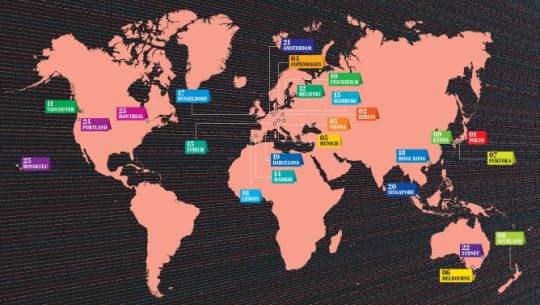
    Monocle’s annual survey of the top 25 most liveable cities in the world was just released. It’s now in its 10th year. I found it in my inbox this morning and it was a good reminder that it was about time I renewed my subscription. I’ve been a regular reader of Monocle since 2007, but I let my membership lapse last year.

    Of course, any sort of list like this is going to be subjective. It all depends on the methodology you use. Still, their annual survey is an interesting way to see what each city is up to and where the tides are going. This year Monocle put extra weighting on each city’s nightlife. If you’re not a subscriber, here’s a short video you can watch. It will give you a rundown of all the cities. (I was happy to see Montréal creep onto the list. Incredible city.)

    This focus on the night is something that I’ve been writing about a lot both on this blog and elsewhere. It’s an idea that’s picking up momentum around the world as an economic development strategy. But for whatever reason, uptake seems to be slower here in North America.

    I like how architect Anna Dietzsch puts it in this video. She says that Rio may have the beaches, but Sao Paulo (where she’s based) has the night. That’s exactly how cities should be thinking about this opportunity. It used to be that cities thrived almost entirely because of location, waterways, transport, and other natural features (example: Buffalo). But increasingly, it’s becoming about things like nightlife.

    Vancouver may have the mountains, but Toronto has…

    Image: Monocle