Daily insights for city builders, delivered every morning at 6 AM ET. I’m Brandon Donnelly — a Toronto-based real estate developer and founder of Globizen. I’ve been writing here since 2013.
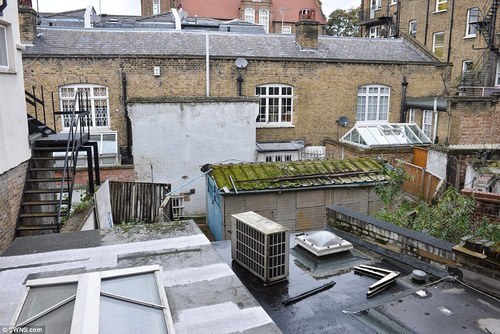
The garage shown above (with the pseudo green roof) is located in the Chelsea neighborhood of London. It measures about 11’ x 7’ and it – along with the site it sits on – is about to go up for auction.
It’s expected to go for more than £550,000 according to the DailyMail UK, which would make it the most expensive garage ever sold in the UK. The site area is 535 square foot – about the size of an average 1 bedroom condo in Toronto.
Below is an aerial view of the site. It basically looks to be residual land.
But as awkward as this site might appear, the expected value is being driven by the fact that planning permissions were granted to turn it into this:
It’s a 2 bedroom house that feels a lot like a laneway house. It certainly fits the description of “a house behind a house”, which is often how laneway housing gets described here in Toronto.
I wanted to share it because it supports my belief that, sooner or later, Toronto will come around to laneway housing. As property prices rise and affordability continues to erode, people will – quite justifiably – start looking in all sorts of new places for a decent urban home.
Many thanks to my friend Adrian for sending me the link.
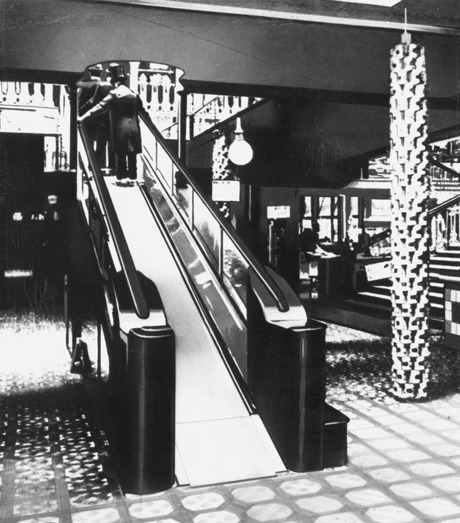
On Wednesday, November 16th, 1898, Harrods department store in London opened up the first escalator – or moving staircase as it was called – in England. The first escalator-like machine in the world had actually been patented many decades before in the US, but this was the first real application in England and likely one of the first in the world.
At the end of the 1800s, this was a big deal. Victorian England had never seen or experienced anything like this before and people were genuinely concerned about its use. More specifically, people worried what such a rapid change in elevation would do to the body. It was believed that it could discombobulate your inner workings. People were unnerved.
Which is why when it was first introduced at Harrods, people were offered brandy and other substances at the top of the escalator in order “to revive them after their ordeal.” Riding an escalator was no small feat for these people.
Now to us today, this sounds ludicrous. Most of us probably ride a few escalators a day. They’re ubiquitous. But I tell this story because I think it clearly underlines how disruptive the new and unknown can feel, and how difficult it can be for us to accept sometimes.
If you go back throughout history, you could easily replace escalators for many other new technologies: the printing press, the automobile, the internet, and so on. And in some cases we were wrong to worry, and in other cases we were right to worry.
Cars, for example, have had a pretty dramatic impact on our lives and the way we build our cities. And since the very beginning, they had no shortage of critics. But does that mean we should have never invented the car? I don’t think so.
As I said earlier this week week, the goal in my mind is to find the right balance between preservation and progress. Just as we shouldn’t be so quick to erase our architectural history, we shouldn’t be so quick to erase our way of life.
But at the same time, it’s important to remain open minded to what’s coming. I’m optimistic about the future. Change can be a great thing, even if it may feel as uncomfortable as riding an escalator for the first time. Maybe you just need a bit of brandy to calm your nerves.
I’ve just launched a set of city tees over at shopATC. To start, there are 4 cities (Toronto, New York, Vancouver, and London) and each one is available in either black or (ATC) orange. They’re printed on a super soft American Apparel tee and cost only $30 each. I picked the cities based on readership levels. I hope you like them.
One of the reasons I’m so fascinated by cities is that it’s becoming increasingly more important to get them right. From about 1831 to 1925, London was the largest city in the world. Its population went from somewhere around 1.5 to 2 million people to nearly 7.5 million. London surpassed Beijing as the largest city and was then surpassed by New York.
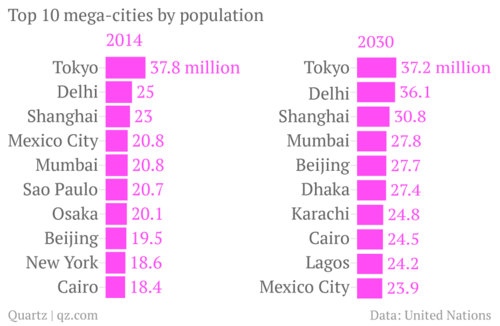
Today our largest cities are significantly bigger. Tokyo has almost 40 million people and London doesn’t even make the top 10. But there’s also a broader shift taking place. According to a new report by the United Nations, most of the world’s largest cities will be in Africa and Asia by 2030. Here’s a chart from Quartz:
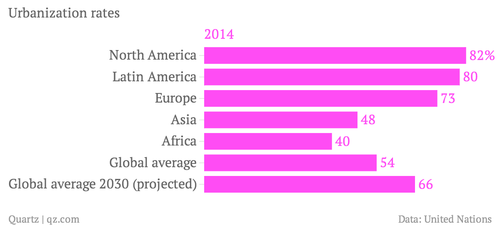
And the reason for this shift is because Asia and Africa are newly urbanizing, whereas the rest of the world has already urbanized. In North America, over 80% of people already live in cities.
But even though Asia and Africa are following a trend that has already taken place in the rest of the world, it doesn’t mean we should assume we know what we’re doing. Having spent time in cities like Dhaka, I can attest to the many challenges that these mega-cities are facing and will continue to face as people flood in from the rural areas looking for economic opportunities.
So while it’s important that we talk about strategies for reviving cities like Detroit – which has a population somewhere around 700,000 – 800,000 people – we should also keep in mind that we have some significant challenges ahead of us in terms of creating a sustainable urban planning agenda for the world.
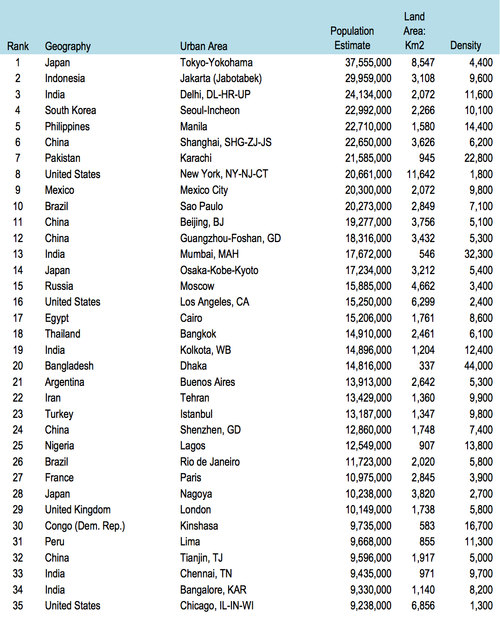
Without a question, we are living in an urban era. More people now live in cities than anywhere else on the planet and I’ve repeatedly argued that cities are our most important economic engine. As a result of these demographic and economic shifts, we’re seeing megacities at a scale the world has never seen before. Below is a list of the top 35 largest urban areas in the world.
The top urban area is Tokyo-Yokohama, with a population of roughly 37.5 million people. That’s almost the same as the state of California and is more than the entire population of Canada, which sits at just over 35 million people. London, which, during the 2nd half of the 19th century, would have been the largest urban area in the world is now the 29th largest.
But at the same time, London arguably remains the most important global city–a title that can only really be rivalled by New York. Which raises an important distinction. One that Aaron Renn clearly identifies in this recent article for New Geography: Just because a city is a megacity, doesn’t mean it is or will ever be a global city. In fact, Renn argues that many of the world’s largest megacities will never “turn the corner” and become leaders of the global economy.
For that to happen, he believes that the city needs to belong to a country on the rise:
Moscow was the capital of the Soviet Empire. New York and Los Angeles came of age when America was the rising, and ultimately dominant, economic colossus. It’s the same for Paris and London, two borderline megacities, which rose as imperial capitals.
But how much of this is driven by the country and how much of it can be driven by the city itself, upwards? Could it be the city that ultimately empowers the country to rise? I ask these questions because Renn frames his argument as if “national hyper growth” is the only prerequisite that will allow the struggling and underdeveloped megacities to pull themselves up and into the developed world.
But the problem is that there’s no clear path to prosperous maturity for these megacities. They are so huge, and their problems so immense that they are difficult to even conceptualize, much less do something about. The amount of needed infrastructure provision alone – water, sanitation, drainage, transport, telecom, electricity, parks, schools, etc. – is staggering. And that doesn’t even touch arguably more difficult problems like corruption and good governance. Absent national hyper growth – a la Japan or Korea – of a level that creates a plausible claim to being the world’s rising economic power, or the proceeds of empire, it seems unlikely any of these cities will ever succeed. By contrast, smaller cities have a much more addressable problem space.
Now, I don’t disagree that the problems in these cities seem almost insurmountable. I’ve been to places like Dhaka, Bangladesh. I’ve witnessed first hand the challenges facing megacities in the developing world.
But to assume that these cities are lost causes without the nation itself lifting it up, seems almost self defeating and overly pessimistic. It also strikes me as a bit of a chicken and egg scenario. Because if cities are our economic engine, then “national hyper growth” seems difficult without also getting our cities right.
What comes first?
Yes, there are and will be reforms that need to happen at the federal level but, at the same time, I think there’s a lot that can and should happen from the ground up. Perhaps that’s part of the reason Singapore has been so successful. As a city-state, its reforms were both top down and bottom up.
I want to believe that with the right reforms, policies, and leadership, any country can create a framework in which its cities are able to thrive. And that it’s not just the result of imperial rule or some other circumstance. From good and transparent governance to developed financial markets, there are many things that cities need to truly prosper. But when you get it right, the results can be remarkable.
The video starts in 1918, where the vast majority of households (77%) rented. As of 2011, this number has reversed. 64% of households in England and Wales now own their home.
If you compare this housing trend to what happened in the United States and Canada, you’ll see a similarity. Although, the US was ahead in terms of promoting homeownership. They reached 50% ownership somewhere in the mid 1940s, whereas England and Wales didn’t reach this number until around 1971.
All of this is an interesting reminder that our obsession with homeownership is a relatively new one. But it’s also not a universal one. The homeownership rate in Berlin is 15.6%, and it’s only 49.5% in London. People in big cities tend to rent more.
Cities need old buildings so badly it is probably impossible for vigorous streets and districts to grow without them…. for really new ideas of any kind—no matter how ultimately profitable or otherwise successful some of them might prove to be—there is no leeway for such chancy trial, error and experimentation in the high-overhead economy of new construction. Old ideas can sometimes use new buildings. New ideas must use old buildings.
And what she was effectively getting at is that we live in a world obsessed with historical data and precedence. To use the words of business thinker Roger Martin: “The enemy of innovation is the phrase ‘prove it.’” Because, if it’s never been done before, how can you prove it? You can certainly imagine it. But you can’t prove it.
If you’re in the business of building buildings, convincing your lender to give you the money to build something that’s never been done before, is an almost impossible sell. That’s not the way it works. Which is why Jane Jacobs famously said that “new ideas need old buildings.”
We’ve seen this story play out in countless cities around the world. The creatives move into an scuzzy neighborhood, make it cool and then investment follows. The neighborhood has been proven. But for this cycle to continue, we need a continuous stock of derelict buildings and undesirable neighborhoods, or at least areas that offer the same kind of affordability and flexibility to creative entrepreneurs.
Often these circumstances have been the result of failure. The proven ideas that got the buildings built in the first place became no longer relevant. And so the buildings were left to expire. But in many global cities, these kinds of areas are an endangered specifies. However, it’s in our best interest to make sure that we don’t lose our creativity alongside them.
If you’re a regular reader of Architect This City, you’ll know that I’m a supporter of congestion and road pricing. Any valuable good or service, such as a road, that’s offered for all intents and purposes as free, will never be able to keep up with demand. You need to price it.
However, the political risk associated with implementing something like this has made it such that few cities around the world have done it. London and Singapore are the two most common examples.
The more populist solution is to simply build more roads and highways, even though study after study shows that this doesn’t work. If it did, we would have already solved the problem of traffic congestion. And we most certainly haven’t.
Which is why I’m excited about a new startup that recently launched called Urban Engines. Their solution is twofold. It’s based on incentives and on treating people and cars in cities as sensors that feed back data into their network. Here’s a brief video. If you can’t see it below, click here.
The data piece is almost a no-brainer (provided they can get the data). The more data we can collect about the way people and cars move in a city, the more they’ll be able to optimize and manage the flows. The possibilities are endless.
But what I found really interesting is their incentives based approach. Typical road pricing methods are, one could argue, a punitive approach. As traffic increases so does the price of the road. (I like to look at it as efficient pricing.)
With Urban Engines, their approach is the opposite: it’s to reward people–through money and lotteries–for driving during off peak times. It’s smart because selling a reward program to cities will be a lot easier than selling a new charge.
Overall, this a great example of how startups are stepping up to solve some of our most important societal problems. For more information on Urban Engines, check out their website and this writeup on CityLab.
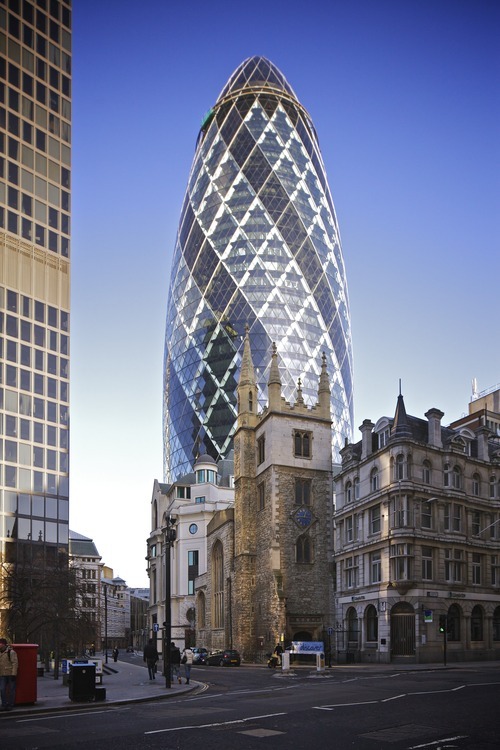
Late last month it was announced that the 30 St. Mary Axe tower in London–also affectionately known as the Gherkin–had gone into receivership. The reason was a mismatch of assets and liabilities, specifically currency losses:
A fund managed by IVG Immobilien AG, once Germany’s biggest real estate company, and London-based Evans Randall Ltd. bought the Foster + Partners-designed tower from reinsurer Swiss Re Ltd. for 600 million pounds ($1 billion) in 2007. Part of the IVG fund’s loan was in Swiss francs, which have gained about 63 percent against the pound over the last seven years, increasing the amount owed to the point that it breached rules on how much debt could be held against the property.
But what I found interesting while reading Bloomberg and Monocle, and learning about the loan default, is that there seems to be a lot of people in London that really don’t like this tower. Shaped like a giant pickle, it’s been the brunt of many lewd jokes, I’m sure.
However, within the architectural community, the Gherkin tower is generally revered as a pretty awesome piece of architecture. It’s a highly sustainable building that employs a number of natural ventilation and passive heating and cool techniques. It’s estimated to consume half the energy of a “typical” office building.
And certainly, I hear lots of people criticize the building here in the city. Often, they mention how much wasted space the angular walls generate, which makes me wonder why we have so many people living in the suburbs when there are so many space conservationists among us.
Personally, I love the Crystal. And I also love the Gherkin. They’re big and bold and they piss a lot of people off. Good, I say.
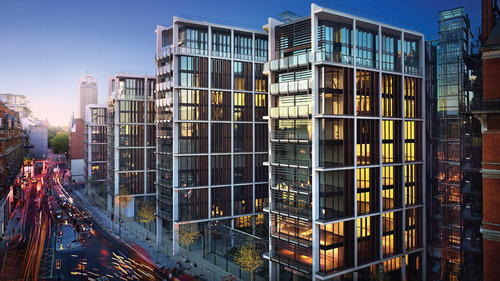
Yesterday evening I was reading the Spring Summer Candy GPS Report put out by London-based property developer Candy & Candy. If you’ve never heard of Candy & Candy, then I guess you haven’t been in the market for a £60m apartment. Candy & Candy are the developers behind One Hyde Park in London, which is said to be the world’s most expensive residential development.
But what is interesting about a project like One Hyde Park is that it’s really only possible in a global city, like London, that attracts a massive amount of foreign investment. A project like One Hyde Park is a possibility of globalization, not a result of local employment numbers.
Which is why if you take a look at the Candy GPS report, you’ll see that their interest is in tracking the habits of ultra-high-net-worth-individuals (UHNWIs)–those with wealth exceeding US$30 million. Last year, the world was estimated to contain almost 200,000 of them, with a combined wealth of almost $28 trillion. This number is expected to rise to $40 trillion by 2020.
Now, you may not be in the market for the most expensive apartment in the world, but I thought it would be interesting to talk about where this money is coming from and which cities it’s going into–at least when it comes to real estate.
The top 3 countries for UHNWIs investing in real estate are Germany, Japan and the United States, respectively. The US has the most ultra rich people, but they have a lower propensity to invest in real estate compared to Germany. Nonetheless, these are the countries that dominate.
But who are the recipients of this money?
Well, first of all, it’s going into cities. But it’s flowing into a small number of them. Cities representing 5% of the world’s population are said to attract over 50% of the real estate investments made by the richest people on the plant.
According to Candy GPS, the top cities are Hong Kong, London, Moscow, Singapore and New York, respectively. Hong Kong sits at the top, largely because of money flowing in from mainland China, but London is said to have the broadest investment reach.
So there you have it, a quick overview of where the ultra rich buy real estate.