Daily insights for city builders, delivered every morning at 6 AM ET. I’m Brandon Donnelly — a Toronto-based real estate developer and founder of Globizen. I’ve been writing here since 2013.

Tag: london

  • Red stripes, iceberg homes, and laneway houses

    This morning I was reading a CityLab article talking about a homeowner in London’s wealthy Kensington neighborhood who painted her house in red stripes after the city and her neighbors derailed her renovation plans. I’m thinking it is supposed to be symbolic of government “red tape.”

    She had hoped to add a two-floor “mega-basement” to her home, which is curiously enough a thing in London due to how restrictive traditional home expansions can be. Locally they are called “iceberg homes.”

    What’s interesting about this phenomenon is that it shows you how far people will go to find and/or create the space they want in the neighborhoods they want to live in. Kensington is an incredibly wealthy area and so one has to assume that she is not without other housing options.

    As another example, here’s how the article describes her house:

    The candy-striped home in question, for example, is actually a mews house, a kind of outbuilding running along an alley behind a great house, originally intended as a place to tidy horses, carriages and maids away from the main residence.

    So not only did she want to create an “iceberg home”, but she wanted to do so in what was previously a back alley. In Toronto, this home would be called a laneway house.

    What this tells me is that as real estate values rise, people will naturally start to seek out overlooked spaces to repurpose. They will look for some way to carve out a home. And it’s for that reason that I think laneway housing is an inevitable outcome here in Toronto.
  • Ace Hotel coming to Toronto’s Fashion District

    https://500px.com/embed.js

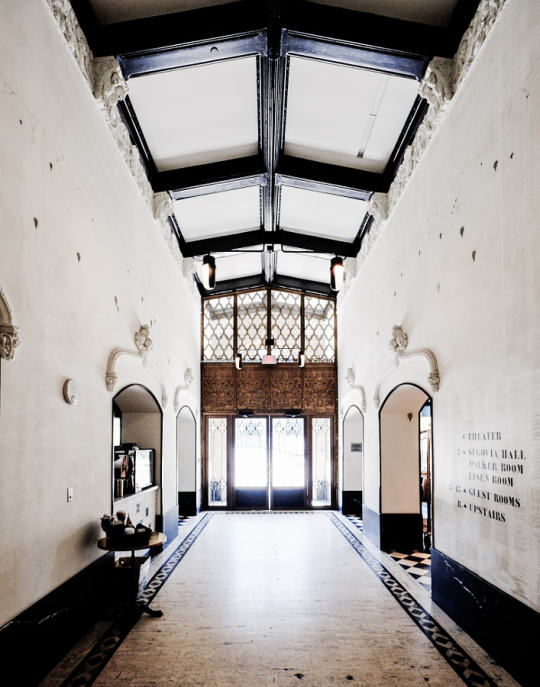
    The word on the street right now is that Ace Hotel will be opening up a location in Toronto’s Fashion District at 51 Camden Street

    Unlike its other outposts around the world, which entailed the renovation of a historic building, this one will be a new build. And according to HotelChatter, Shim-Sutcliffe Architects have been retained for the project.

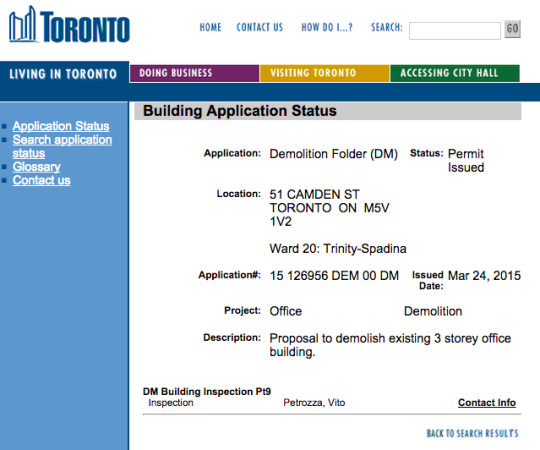
    Already a demolition permit has been issued for the existing 3 storey office building:

    image

    For those of you who may not be familiar with the Ace Hotel brand, the first hotel opened in Portland in 1999 when 3 friends transformed a halfway house into an affordable hotel for creative types. 

    Since then, the hotel has expanded to New York, Los Angeles, Seattle, Palm Springs, as well as many other cities, and has become a kind of cultural institution for the creative class.

    I’m excited that they have (allegedly) picked Toronto for their next property and I’m excited that Shim-Sutcliffe will be (supposedly) designing it.

  • Art and apartments

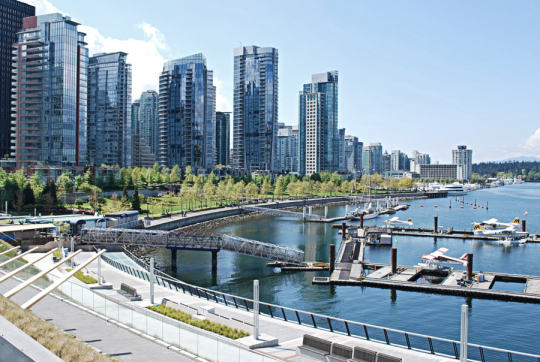
    Photograph Vancouver by Marc M on 500px

    Image Source: Vancouver by Marc M on 500px

    According to a recent Bloomberg article, this is where the rich are putting their money today:

    “The two greatest stores of wealth internationally today is contemporary art….. and I don’t mean that as a joke, I mean that as a serious asset class,” said Fink. “And two, the other store of wealth today is apartments in Manhattan, apartments in Vancouver, in London.”

    In case you wondering, Laurence Fink is the founder and CEO of BlackRock Inc., which today is the largest asset manager in the world. They have over $4.77 trillion in assets under management according to their website. That’s a mind boggling number.

    And if you read the Bloomberg article cited above, you’ll see that this interest in both art and apartments represents a shift away from gold as the de facto safe haven.

    “Historically gold was a great instrument for storing of wealth,” the chairman of BlackRock Inc. said at a conference in Singapore on Tuesday. “Gold has lost its luster and there’s other mechanisms in which you can store wealth that are inflation-adjusted.”

    What’s interesting and probably most relevant to the Architect This City community though is this investment focus on apartments.

    When people talk about a possible housing bubble in Canada they often cite house prices to median household income as a key ratio. The question then becomes: How can house prices be such a high multiple relative to local incomes?

    That’s relevant, but it’s not the entire story for cities like New York, London, and Vancouver. That ratio alone assumes that real estate isn’t a global investment vehicle. And for some people people it is exactly that.

  • Introducing The Spaces

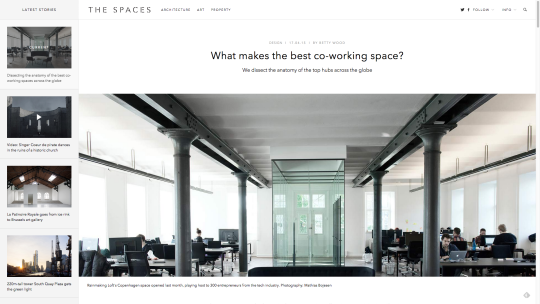
    image

    At some point in the past, I preregistered for a site called The Spaces. I don’t remember doing it, but I’m sure that the site seemed promising when I landed on it and so I gladly handed over my email address. I’m always on the lookout for new and interesting things.

    Today that site has (soft) launched. And if you like architecture, design, art, and/or property, I am certain you will love it. I am already a fan.

    Based in London, The Spaces is about exploring the new ways in which are we living and working. Spaces ranging from residences to coworking spaces and everything in between. It’s about unique and progressive spaces and the people behind them. I love the concept.

    Since this is still a soft launch, I am sure the team is looking for feedback from the market. So if you have some, please share it in the comment section below. I will make sure they read it.

    Click here to check out The Spaces. Happy Friday all 🙂

  • The high cost of poor land use

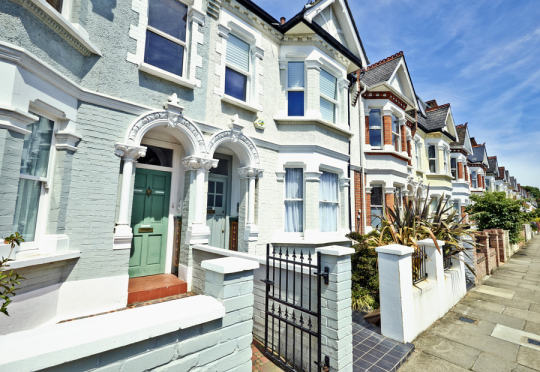
    Photograph London street of early 20th century Edwardian terraced houses by Bombaert Patrick on 500px

    London street of early 20th century Edwardian terraced houses by Bombaert Patrick on 500px

    Over the weekend The Economist published an interesting article called, Space and the city: Poor land use in the world’s greatest cities carries a huge cost. The argument is that land isn’t scarce. It’s the land use policies we have created that are artificially limiting supply and driving up real estate values.

    In fact, land is not really scarce: the entire population of America could fit into Texas with more than an acre for each household to enjoy. What drives prices skyward is a collision between rampant demand and limited supply in the great metropolises like London, Mumbai and New York. In the past ten years real prices in Hong Kong have risen by 150%. Residential property in Mayfair, in central London, can go for as much as £55,000 ($82,000) per square metre. A square mile of Manhattan residential property costs $16.5 billion.

    And part of the reason this has become so prevalent is because of the shifts we’ve seen in our economy and the great return back to cities.

    In the 20th century, tumbling transport costs weakened the gravitational pull of the city; in the 21st, the digital revolution has restored it. Knowledge-intensive industries such as technology and finance thrive on the clustering of workers who share ideas and expertise. The economies and populations of metropolises like London, New York and San Francisco have rebounded as a result.

    So how do we get better at meeting real estate demand in our cities? The Economist has two suggestions.

    One:

    First, they should ensure that city-planning decisions are made from the top down. When decisions are taken at local level, land-use rules tend to be stricter. Individual districts receive fewer of the benefits of a larger metropolitan population (jobs and taxes) than their costs (blocked views and congested streets). Moving housing-supply decisions to city level should mean that due weight is put on the benefits of growth. Any restrictions on building won by one district should be offset by increases elsewhere, so the city as a whole keeps to its development budget.

    Two:

    Second, governments should impose higher taxes on the value of land. In most rich countries, land-value taxes account for a small share of total revenues. Land taxes are efficient. They are difficult to dodge; you cannot stuff land into a bank-vault in Luxembourg. Whereas a high tax on property can discourage investment, a high tax on land creates an incentive to develop unused sites. Land-value taxes can also help cater for newcomers. New infrastructure raises the value of nearby land, automatically feeding through into revenues—which helps to pay for the improvements.

    These recommendations will probably be unsettling for a number of people. 

    I would imagine that many communities would prefer to have planning and growth decisions happen bottom up, as opposed to top down. But I think there’s some truth to this recommendation and I don’t think it has to mean completely excluding bottom up feedback. Communities and individuals are naturally going to look out for their own self-interests. And so I think many would agree that there’s value in having a holistic urban strategy in place.

    Recommendation number two pertaining to land value taxes is a loaded one. So I’m going to save my specific comments for a dedicated post on LVTs. 

    But I will say that I don’t think trying to squeeze landowners into development via taxes is the most efficient and immediate way to address supply shortages. In advance of this, we should be examining the current barriers to development. Because we’re talking about hyper competitive global cities with perpetual supply deficits. And I don’t believe the problem is incentive-based. The problem is finding sites. The problem is finding ways to build.

    What do you all think? This is an interesting topic of discussion.

  • The value in small retail spaces

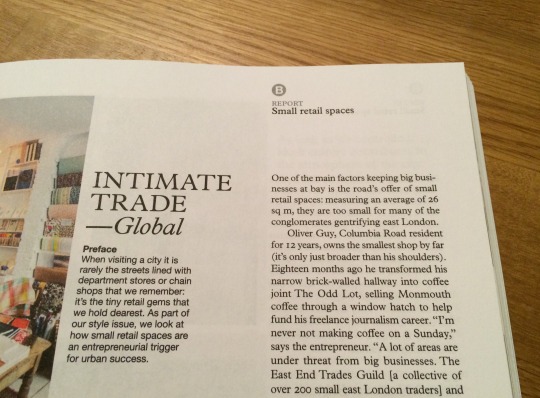
    image

    This month’s issue of Monocle is centered around fashion, style, and retail. And one of the most interesting pieces is a report on small retail spaces. 

    The argument (which you can read in the preface shown above) is that micro retail spaces are incredibly important for entrepreneurship and urban vitality. Because if all a city has is large retail spaces, then you’re creating impossible barriers for new retail startups. The rents simply become too high.

    It’s on page 79 in case you have this month’s issue or want to go pick it up.

    After reading the article, I immediately thought of 2 posts that I recently wrote on related topics. The first is “Incubating new ideas in cities” and the second is “The hard things about retail.”

    In the first post, I questioned how cities might be able to encourage and incubate new ideas alongside new development and buck the Jane Jacobian truism that new ideas require old buildings. And in the second post, I expressed my concern for a micro retail condo complex here in Toronto that appears to be struggling.

    But maybe that micro retail complex is on to something (just with the wrong tenure: condo instead of rental). Maybe it’s as simple as starting with great urban design and small (affordable) retail spaces. 

    It seems to be working for Columbia Road in London, Knez Mihailova in Belgrade, and Tower Theater in Los Angeles (the 3 examples that Monocle gives).

  • Two thoughts on reviving post-industrial cities

    image

    Yesterday Adam Radwanski of the Globe and Mail published an interesting article called, Rust Belt revival: Lessons for southwest Ontario from America’s industrial heartland

    The article talks about some of the things that the Rust Belt is doing to revitalize their cities and the lessons that many cities in Ontario – which are facing similar fates – could learn from. It’s worth a read.

    I’m not going to summarize his article, other than to say that some of the key points were around tax increment financing, tax incentives, University connections, a DIY/entrepreneurial culture, and the American tradition of philanthropy – which Radwanski points out is probably the least imitable for Canada.

    And it’s this last point that I would like to focus on first. The US has a deep history of people getting rich and then giving back – certainly more so than in Canada in my opinion.

    If you think about the resurgence of cities such as Detroit, you’d be hard pressed not to think of people like Dan Gilbert. He has become the poster boy for Detroit’s resurgence by moving his companies to downtown and buying up most of the office buildings. If and when Detroit comes back (I think it’s a when), Gilbert will easily be one of the biggest beneficiaries.

    Now, you could argue that this is made possible because of greater income inequality, but there’s something to be said about powerful individuals acting on intrinsic passion. Gilbert is investing in Detroit because he personally wants to see his home city come back. And that’s hard to replace.

    The second point I would like to focus on has to do with this snippet:

    With oil’s current slide, Canada really can’t afford for it to remain a drag – and in fact there is some expectation that Ontario will instead reclaim its old role as the leader of Canada’s economic growth. Its premier, Kathleen Wynne, recently expressed optimism that plummeting oil prices and a sinking dollar will prove a boon to manufacturing. “I don’t wish for low oil prices and a low dollar for Alberta,” she said earlier this month. “But at the same time, we want our manufacturing sector to rebound. So if that [low oil price] helps, then that’s a good thing.”

    I don’t know what context this was said in, but I continue to feel strongly that we cannot rely on low oil prices and a low Canadian dollar for Ontario’s competitiveness. That is a terrible business model, and an unsustainable one. We need to figure out ways to create value and grow the economy without relying on currency differentials and other macroeconomic factors. Radwanski is right to point that out in his article.

    So let’s hope we don’t let any short term benefits go to our head. There’s lots of exciting work to be done.

    Image: Old Detroit auto factory via Flickr

  • How open are you to experiences?

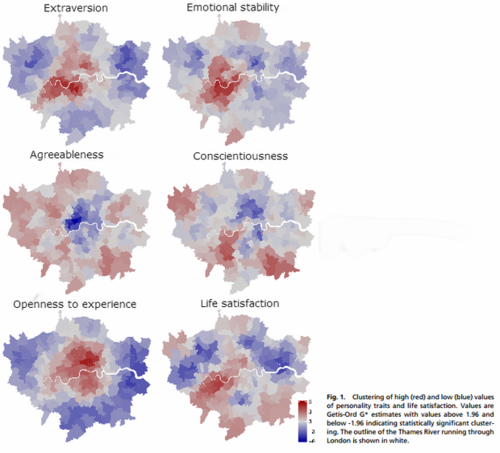
    This morning Richard Florida published an interesting CityLab article that talks about how different personality types cluster within cities. The study he references was done by a team of psychologists that surveyed 56,000 people in the London metro area.

    Here is a summary of what they found (darker red indicates higher concentration of each personality trait):

    image

    Probably the most interesting personality trait is the “openness to experience” one, as there appears to be a clear divide between people who live in the center of London and people who live in the suburbs.

    Here’s how Florida describes it:

    The most clustered personality trait the researchers found was “openness to experience” (bottom left map), which is concentrated in the center of London. Openness to experience, according to a wide body of psychological studies, is associated with creativity, innovation and entrepreneurship. This type is concentrated in higher density neighborhoods, with higher housing prices, more ethnic and religious diversity and higher crime ratesMeanwhile, the blue concentrations at the periphery indicate that there are fewer people open to experience in metro London’s suburbs.

    It’s fascinating to think about the role of psychology in city building. It’s not something we often talk about, but it’s there.

    I live downtown and I would definitely classify myself as extraverted and open to experiences. How would you classify yourself?

    Maps via CityLab

  • Making city planning cool again

    image

    This morning my friend Mackenzie Keast – who is famous and was on the radio in Toronto today talking about The Laneway Project – sent me an interesting article from the Guardian talking about the marginalization and growing irrelevance of city planners. It’s called: For the sake of our cities, it’s time to make town planning cool again.

    The gist of the article is as follows:

    While the cult of the star architect has soared over the decades and property developers have displaced bankers as the new super-rich, the figure of the local town planner has become comic shorthand for a certain kind of faceless, under-whelming dullard.

    But what really stood out for me are the following two things. First, that people are genuinely interested in cities. I would say that it’s almost trendy to be into cities these days.

    Urbanism may have displaced cultural theory as the favoured subject of the academic hipster, but talented young men and women rarely consider becoming town planners.

    And second, that we’ve made it difficult for these same interested people to participate in the planning process.

    Planners have become simultaneously under-respected and over-professionalised. Their training and practice too often leaves them able to communicate effectively only with other planners and professionals, working in an abstract language that alienates them from people. People are occasionally allowed into the professional planner’s world, but in highly mediated terms dictated by the profession.

    This stands out for me because I think that architecture is in a somewhat similar position. I often joke that the more architecture training someone has, the more likely they’re going to like buildings that the rest of the world doesn’t. It all becomes quite insular – just like the Guardian is arguing with respect to planning.

    And that may in fact be the reason for the marginalization of both planners and architects (minus the few starchitects that have a distinct brand and can command a premium). If the general public doesn’t like what you do or understand how you create value, why should they care?

    I’ve written before about the future of the architecture profession, as well as the reasons for why I decided to never practice architecture. So I won’t repeat it all here.

    But I will say that it had nothing to do with me not loving architecture. Because I do and always will. Instead, it was about recognizing that professions are not set in stone. Just like pretty much everything else in this world, they can and will be reinvented.

    Image: The Guardian / PA

  • In search of affordable housing

    Earlier this week I stumbled upon this entertaining article from the Guardian talking about how expensive housing is in London. The author’s tongue-in-cheek suggestion was to setup a new miniature London in the middle of nowhere where everyone could flock for affordable housing, but where many of London’s attributes could be exported: “We can all refuse to wear socks and sell each other overpriced cocktails in jam jars.”

    All joking aside, the article is yet another reminder that big global cities are expensive places to live. And in these cities, one of the most precious commodities is, quite simply, personal space. That’s why a garage in London can sell for £550,000 and why a 35 square foot storage cage in New York can sell for $75,000

    But affordable housing is not the reason why people want to live in places like London and New York. If it were, they wouldn’t be coming. Instead, they come for lifestyle, wealth creation, and the dating market – among other things. However, at a certain point, usually when they form families and start to need/want more space, they start looking around.

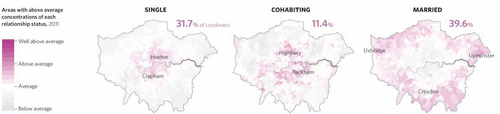
    Here’s an infographic via the Atlantic showing how relationship status impacts where people tend to live in London. The purple areas indicate an “above average concentration” of a particular relationship status. As you can see, single people tend to live in the core of the city, and when they get married, they move out to the periphery. Intuitively, this probably makes sense to you.

    image

    However, I’m always curious as to whether this trend happens more because of consumer preference (people don’t want to raise kids downtown) or because of economic necessity (they can’t afford anything beyond a shoe box apartment). Because if it is largely out of economic necessity (and the Guardian article would suggest it is), then we’re not creating the inclusive cities and neighborhoods that all city builders like to talk about.

    So how do we get better at this?

    In my view, and I’ve argued this before, the first step should be about improving supply. That is: get more housing built. And the way to start doing that is to make land available and improve the approvals process for new developments. In a recent McKinsey report, they referred to my first point as “unlocking land.”

    “Land cost often is the single biggest factor in improving the economics of affordable housing development. It is not uncommon for land costs to exceed 40 percent of total property prices, and in some large cities, land can be as much as 80 percent of property cost.”

    The reason this is important is because most big cities operate with massive supply deficits. There simply isn’t enough housing. And so if you can address that at a fundamental level, you can actually do a lot to start improving affordability.