Daily insights for city builders, delivered every morning at 6 AM ET. I’m Brandon Donnelly — a Toronto-based real estate developer and founder of Globizen. I’ve been writing here since 2013.

Tag: investing

  • Toronto announces nothing plan to create more rental homes

    Yesterday, the City of Toronto announced that it would be “unlocking” 7,000 new rental homes — including 1,400 deeply affordable homes — by doing two key things:

    • Waiving development charges on rentals
    • Providing a 15% reduction on property taxes

    And by their estimates, the value of these benefits would be roughly $58k per new rental home:

    Great news, right?

    But wait, there’s a catch. If you read the details, you’ll see that in order for a project to be approved under this program, there is also a requirement to deliver at least 20% of the homes as affordable rentals.

    So let’s look at what this could mean.

    Here is a chart comparing a market rental suite at $3,000 per month to a more affordable one at $1,500 per month:

    MarketAffordableVariance
    Face Rent$3,000 $1,500 ($1,500)
    Suite Size$600 600 
    PSF Rent$5.00 $2.50 ($3)
    Annual PSF Rent$60 $30 ($30)
    NOI Margin70%70%$0 
    Annual Net Rent$42 $21 ($21)
    Cap Rate4.50%4.50%$0 
    PSF Value$933 $467 ($467)
    Per Unit Impact($280,000)
    20% of Units($56,000)

    Both are assumed to be 600 square feet. In the case of the market suite, the per square foot (PSF) value is estimated at $933 psf, and the affordable suite is estimated at $467 psf. This represents a halving of the value (which makes sense because I halved the rents).

    On a per unit basis (again, we’re assuming 600 sf), this is a loss in value of about $280k. But since only 20% of the units would need to be “affordable”, I multiplied this number by 0.2. The result is a per unit loss of approximately $56k.

    What this means is that we’re basically doing a whole bunch of stuff to get right back to the same place. Like, hey, we’re not building enough rental housing and we’re certainly not building enough affordable housing — because the development margins are so dangerously thin — so here’s a credit of $58k per unit. But at the same time, here’s a bill for $56k per unit.

    What’s the point, besides making it sound like we’re doing something to create more housing? This program will do absolutely nothing to spur the creation of new rental housing.

  • How much is development land worth?

    As we have talked about many times before, the best answer to this question is that it’s worth whatever money is left in your pro forma once you’ve accounted for everything else. This is what is called the “residual claimant” in a development model. And it means you start with your revenue, you deduct all project costs, including whatever profit you and your investors need to make in order to take on the risk of the development, and then whatever is left can go to pay for the land.

    This is the most prudent way to value development land; but of course, in practice, it doesn’t always work this way. In a bull market, the correct answer to my question might be, “whatever most market participants are willing to pay.” And sometimes/oftentimes, this number will be greater than what your model is telling you, meaning you’ll need to be more aggressive on your assumptions if you too want to participate. (Not development advice.)

    Given that determining the value of land starts with revenue, one way to do a very crude gut check is to look at the relationship between land cost and revenue. This is sometimes called a land-to-revenue ratio. And historically, for new condominiums in Toronto, you wanted a ratio that was no greater than 10%. Meaning, if the most you could sell condominiums for was $1,000 psf, then the most you could afford to pay for land was $100 per buildable square foot.

    However, this is, again, a very crude rule of thumb. I would say that it’s only really interesting to look at this after the fact. Because in reality, things never work this cleanly. For one thing, there is always a cost floor. Don’t, for example, think you can buy land in Toronto for $80 pbsf and sell condominiums for $800 psf, because this will not be enough to cover all of your costs. You will lose money.

    Secondly, there are countless variables that have a huge impact on the value of development land. Things like a high required parking ratio, development charges and other city fees, inclusionary zoning, and so on. All of these items are real costs in a development model, and so they will need to be paid for somehow.

    Typically this happens by way of higher revenues (in a rising market), a lower land cost (in a sinking market), or some combination of the two. But in all of these cases, it means your land-to-revenue ratio must come down to maintain project feasibility. This is why suburban development sites typically have a lower ratio — too much loss-leading parking, among other things.

    Of course, there are also instances where the correct answer could be a land-to-revenue ratio approaching zero, or even a negative number. In this latter case, it means your projected revenues aren’t enough to cover all of your other costs, excluding land. For anyone to build, they will require some form of subsidy. And this is basically the case with every affordable housing project. They don’t pencil on their own. (For a concrete example of this, look to the US and their Low-Income Housing Tax Credits.)

    So once again, the moral of this story is that the best way to think about the value of development land is to think of it as “whatever money is left in the pro forma once you’ve accounted for everything else.” Because sometimes there will be money there, and sometimes there won’t be.

    Photo by Jannes Glas on Unsplash

  • Over-building and then under-building: Is Toronto headed for a severe shortage of new rental housing?

    As we know — because here’s the data — this is the current state of affairs:

    The GTA condo market is in a state of economic lockdown. The math doesn’t make economic sense from both the demand side (investors) and the supply side (developers), leaving the market at a standstill.

    The above excerpt is from a recent CIBC Capital Markets article by Benjamin Tal (CIBC) and Shawn Hildebrant (Urbanation). And what it ultimately means is that the supply of new condominiums in the GTA is falling and will continue to fall for the foreseeable future. Below are two charts, from the same article, that show that.

    Because of this, I actually think that, if you need or want a place to live, right now is a near ideal time to buy a condominium, especially if it’s from developer inventory (in an already completed project) or it’s a resale. Of course, most people won’t want to do this because they’d rather buy when most other people in the market want to buy. This is how markets tend to go.

    It has been a while since the GTA has gone through one of these real estate cycles, but it is typical: developers are prone to both over-building and under-building. It simply takes too long to build a building, and so it is natural for there to be moments when supply and demand don’t exactly line up.

    Pre-selling condominiums is — in theory only — supposed to protect against too much overbuilding. But as we have spoken about many times before, it can be challenging for end users to buy a new home so far in advance. And so the new condominium market has come to rely on investors who want to buy early and then either sell later or rent later.

    According to the above article (and MLS data), the share of newly completed condominiums used as rentals reached a peak of 34% in 2023. So a third of new condos. My gut tells me that the actual number is much higher. Many rentals never reach MLS. Overall, I think it’s very safe to assume that the majority of new condominiums are owned by investors.

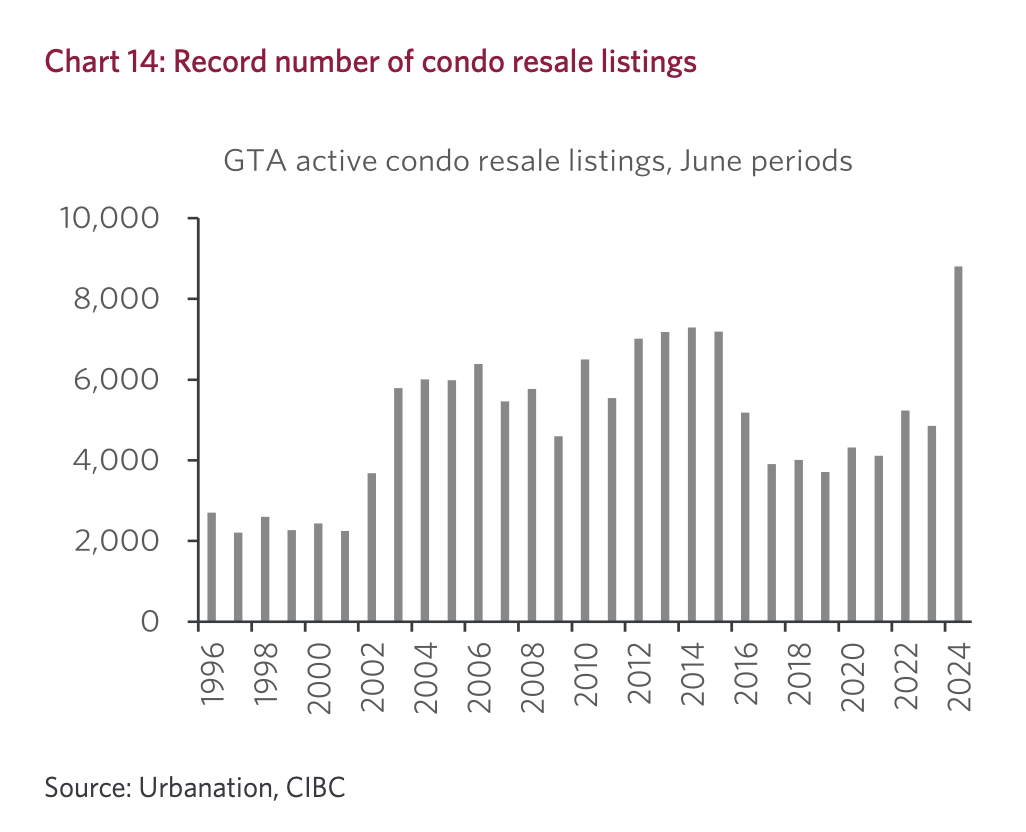
    But right now, fewer investors want to own condominiums, which is why the number of resale listings has spiked this year:

    This is, again, why I think right now is an excellent time to buy a condo. You know, be greedy when others… Regardless, this inventory will need to get absorbed and that will ultimately happen. Some of it will go to end users and some of it will go to investors who can make sense of the rental math and/or want to take a long view on Toronto. But if more goes to the former, we will be losing a lot of new rental housing.

    At the same time, while all of this is going on, construction starts are likely going to remain depressed (chart 3 above). It’s impossible to know how long this lasts, but at some point we will reach a moment in the cycle where we are under-building new housing. Maybe we’re already there. Development simply can’t turn on fast enough when demand spikes. There will almost always be a lag.

    So, since the majority of new condominiums have been serving as new rental housing, there’s a strong case to be made that at some point we will run into a potentially severe shortage of rentals. Condo investors are sometimes vilified in the media, but we will soon find out what happens when you take a big chunk of them out of the housing market.

  • The US is building a lot of apartments right now

    As of November 2023, it was estimated that there were 988,000 homes under construction in multi-family buildings containing 5 or more units. This is in comparison to 680,000 single-family homes, according to US Census data. (Looking at the below graph, it’s also interesting to see how the supply of single-family homes dropped off after the global financial crisis and multi-family apartments took off.)

    All of this means that in 2024, the US is on track to complete more apartments than it has in many many decades. In fact, exactly similar to what we experienced here in Toronto, if you want to find a comparable multi-family supply number, you need to go as far back as the 1970s (see below). Of course, the US had fewer people back then, and so on a per capita basis, it was building more housing.

    Still, all of this new supply is having an impact. Apartment List recently published its national rent report, over here. And overall, it found that:

    Rent increases are currently being moderated by a robust construction pipeline expected to deliver a decades-high number of new apartment units in 2024.

    More specifically, they found that the cities with the most supply are now seeing the largest rent declines:

    Many of the steepest year-over-year declines remain concentrated in Sun Belt cities that are rapidly expanding their multifamily inventory, such as Austin (-7.4 percent year-over-year), Raleigh (-4.4 percent), and Orlando (-3.9 percent).

    If you’re an apartment developer, this is not what you want to see. It means that increased competition is creating downward pressure on rents and that vacancy rates are probably rising. But if you’re someone looking to rent an apartment, this is exactly what you want to see. You want more affordable housing. And so, as a consequence, you want more homes to be built. Because when supply outstrips demand, this is what you get.

    Charts: Apartment List

  • Toward more rental housing

    The Greater Toronto and Hamilton Area is expected to see 6,821 new rental homes completed this year. This is a “multi-decade high”, according to Urbanation’s latest rental report. Indeed, you need to go back to the 1970s to get rental supply figures of this magnitude.

    A big part of this has to do with the fact that we are now taxing rental housing less. Toward the end of last year, the federal government removed their portion of the HST on new rental housing and, then in November, the province of Ontario followed with theirs.

    This was “a big first step” for the industry, according to leading apartment developers like Fitzrovia.

    But there’s another reason that many developers are now looking to purpose-built rentals: fewer people are buying new condominiums. And if you can’t presell condos, well then you’re going to need to find another path forward for your land.

    However, flipping over to rental is not necessarily a panacea. The margins are generally razor thin (+/- 50 bps). It requires more and different capital (typically). And you need to believe in some fairly non-consensus assumptions (high rent growth, low cap rates, etc.).

    It’ll be interesting to see how many developers are able to successfully flip over to rental and how sustained this rental supply number will be.

  • Investors vs. end users

    Over the years, we have spoken a lot about the role that investors play in Toronto’s pre-construction condominium market. In the media, they are often spoken about pejoratively. They are seen as being a well-capitalized group that outbids end-users for a limited supply of new housing.

    But on the other hand, we know that (1) they have been a major contributor to new rental housing in this city (they filled the gap after we decided in the 1970s that we didn’t like purpose-built rentals) and that (2) they play an important function in getting new housing financed.

    For better or for worse, we know that, without an investor market, there would have been far fewer new homes constructed over the last cycle. Pre-sales are generally always a prerequisite for a construction loan. And the fastest, and therefore safest, way to get pre-sales is/was to target investors.

    But the world has changed since then. Investor demand has diminished. So much so that you could argue that the opposite is now true.

    I was speaking to my friend Christopher Bibby this morning and he reminded me that end-users, who are passionate about specific projects and neighborhoods, are the more resilient demand base during a downturn. Because if you need a place to live, you need a place to live.

    Perhaps it’s no coincidence that every single sale that we have had at Junction House this year has been to an end-user who moved in.

  • The risk of not taking risk

    One simple definition of risk is that it’s the “possibility of loss or injury.” And that’s generally how most of us think about it — it’s a bad thing that needs to be managed, minimized, and sometimes avoided all together.

    While true, this recent memo by Howard Marks is a good reminder that risk is also indispensable. Or, put differently, there’s risk in not taking enough risk. This is true in business and finance, but it’s also true — as Howard argues — in chess, in sports, and in many other aspects of life:

    The paradox of risk-taking is inescapable. You have to take it to be successful in competitive, high-aspiration arenas. But taking it doesn’t mean you’ll be successful; that’s why they call it risk.

    By definition, it means that you will be wrong sometimes. Because if you couldn’t possibly be wrong, then it wouldn’t be a risk. It would be a known. And known things exist in our world in a very different way than uncertain things. Superior performance, as a gross generalization, demands uncertainty.

    So what’s the solution? Calculated risks:

    You shouldn’t expect to make money without bearing risk, but you shouldn’t expect to make money just for taking risk. You have to sacrifice certainty, but it has to be done skillfully and intelligently, and with emotion under control.

  • France’s rental ban on energy-inefficient homes

    One of the things that you’ll notice on real estate listings in France is an Energy Performance Diagnostics (EPD) rating. In French, it gets reversed, and so it’s a DPE (diagnostic de performance énergétique). What it tells you is how much energy the dwelling (or building) consumes and how much greenhouse gas it emits. And it is a requirement on all real estate listings and for all dwellings, except those that are occupied for less than 4 months per year. The output of this diagnostic is a rating from A (best) to G (worst).

    According to FT, this is how primary residences in France rank today:

    Less than 5% of homes are rated A and B (the most energy efficient). And many more are rated G and F. Beyond just being energy inefficient, this is potentially a problem because there are penalties and restrictions for the lowest rated homes, one of which is that you are not allowed to rent out the property. Right now and as of January 1 of this year, the upper consumption limit is 450 kWh per square meter per year. Go above this and the home becomes ineligible.

    This number is also planned to reduce over time:

    • January 1, 2023: Rental ban on properties with G+ energy label
    • January 1, 2025: Rental ban on all properties with G energy label
    • January 1, 2028: Rental ban on all properties with F energy label
    • January 1, 2034: Rental ban on all properties with E energy label

    Now here’s what this is thought to mean for overall rental supply:

    By 2028, 5.2mn homes rated F and G, or 17 per cent of total housing stock, will become ineligible for rental. By 2034, all E properties will also be excluded, amounting to about 40 per cent of homes.

    This raises an interesting question: Is it more important to have energy-efficient homes or to have greater overall supply? Now obviously the goal and ideal scenario is both; lots of affordable homes that are also energy efficient. And presumably, one of the objectives of this rental ban is to stick/carrot owners into investing in energy measures. But it’s not exactly obvious as to how many owners will be able to renovate their homes in time, and how many homes will become ineligible for rent. This will be an interesting policy to watch as it plays out.

  • Fundamental and enduring

    I admire Warren Buffet’s humility:

    In the physical world, great buildings are linked to their architect while those who had poured the concrete or installed the windows are soon forgotten. Berkshire has become a great company. Though I have long been in charge of the construction crew; Charlie [Munger] should forever be credited with being the architect.

    This is an excerpt from his recent letter to Berkshire Hathaway shareholders, which, this year, he opens up with an obituary to his late partner, Charlie Munger.

    I don’t agree with everything Warren says and writes. He, for instance, doesn’t seem to like crypto and streetcars. Though, surely, he’d really dig my CryptoParisian.

    That said, I never miss his letters and his thinking has been broadly instrumental in how I tend to think about real estate.

    If you take his description (same letter) of what Berkshire does, and replace businesses with properties, this is what you get:

    Our goal at Berkshire is simple: We want to own either all or a portion of [properties] that enjoy good economics that are fundamental and enduring. Within capitalism, some [properties] will flourish for a very long time while others will prove to be sinkholes. It’s harder than you would think to predict which will be the winners and losers.

    This is a good way to think about real estate.

  • An overview of rental housing in France

    Rental housing in France is both heavily regulated and supported through dedicated public funds. Here’s a high-level overview of what that means (via this 2021 Brookings case study by Arthur Acolin):

    • Homeownership rates in France went from 35% in 1954 to 56% in 2001
    • As of 2018, 58% of French households own, 40% rent, and the remaining 2% supposedly get free housing from either their employer or a family member
    • Not surprisingly, younger households are most likely to rent (the figure is > 60% for people aged 18-29)
    • Household size seems to play a major factor in how likely people are to live in public housing
    • France has some 4.5 million public housing units and 17% of all households live in them (which represents about 43% of all renter households)
    • Within the unsubsidized rental market, 93.5% of households live in homes owned by individual investors (this is as of 2013) and only about 3.5% live in homes owned by institutional investors
    • This is pretty typical of Europe, where multi-family isn’t an established real estate asset class like it is in North America; so for those of you who like to hate on individual condo investors, check out France
    • In the decade between 2010 and 2020, 28 metro regions in France adopted some form of rent control and, in a few markets, like Paris and Lille, there are also maximum rents that can be charged for specific housing types

    If you’re interested in rental housing, Brookings also has articles covering the US, Germany, Spain, Japan, and the UK. They can be found here.