Daily insights for city builders, delivered every morning at 6 AM ET. I’m Brandon Donnelly — a Toronto-based real estate developer and founder of Globizen. I’ve been writing here since 2013.

Tag: detroit

  • How to revive the American Heartland

    “Every unemployed American is a failure of entrepreneurial imagination.” -Edward Glaeser

    At the end of September, economist Edward Glaeser returned to the Manhattan Institute to deliver the 2017 James Q. Wilson Lecture. If you’re a regular reader of this blog, you may remember that he was there in 2016 and delivered a presentation called “The End of Work.” 

    This year’s talk continues that theme, but focuses on joblessness and economic stagnation in the US Heartland. 

    The solutions he puts forward are based on a very simple economic model for growth that he refers to as “rules and schools.” Simply put: The rules of a place need to support business and entrepreneurship and the people need to be educated.

    One example he gives is of a woman in Detroit who was trying to start a food truck business but had to wait 18 months for a permit. There’s no reason that should happen. He blames the insider restaurant lobby for working to keep competition at bay. The rules are bad. We have similar problems here in Toronto with our food trucks. I think it’s wrong.

    He also pokes fun at the Bilbao effect. Yes, Frank Gehry created a beautiful piece of architecture. But did it lower the unemployment rate?

    The last thing I’ll mention are his comments regarding Amazon HQ2 because I like how he frames it. 

    Firstly, Amazon is going select a city that doesn’t need Amazon. It’s going to go where there’s already abundant human capital. 

    Secondly, “smokestack chasing” is not the right economic development strategy. The key questions should be: How will this benefit our human capital and how many new firms could it create?

    If you have an hour, check out Ed Glaeser’s talk. If you can’t see it below, click here.

    [youtube https://www.youtube.com/watch?v=e8LvHpRCUYk?rel=0&w=560&h=315]

  • The post-Wall techno music of Berlin

    image

    I’ve written about Berlin many times before on this blog. It’s such a fascinating case study for me because of its history, its urban development patterns, and its famous techno scene.

    Last month, Nick Paumgarten wrote a piece in the New Yorker, called Berlin Nights, where he dives into the city’s club culture and its reputation as the cradle of techno music. 

    But in doing that, he is necessarily forced to talk about the once divided city and its unique “post-Wall” condition. When the Wall came down, the East became – as a result of its under-utilized built form – a breeding ground for the pent up energy and creativity of the West.

    Here is an excerpt that speaks to the importance of those empty spaces and sparsely populated neighborhoods:

    The post-Wall abundance of derelict building and excess housing was decisive. “Empty spaces allowed there to be a club culture,” Robert Henke said. “With no empty space, you get a closed-at-2 a.m., restrictive-alcohol culture.” At first, the reclamation seemed slapdash, improvisational, anarchic, as squatters took over buildings and neighborhoods and set off a period of cultural ferment. But the powers that be had been dreaming up developments for years before the Wall came down, and now—amid a boom in real-estate speculation and investment (everyone spoke of the Swedes)—empty space, and the sense of wildness that comes with it, has become harder to come by. “Flats are getting more expensive,” Hegemann said. “But we still have many free spaces. This is the secret for why Berlin is still alive.”

    And here is the story of one such building:

    Some empty spaces have completed their life cycles. One afternoon, I visited the old Reichsbahnbunker, a five-story fortress of reinforced concrete built by the Nazis in 1942 as an air-raid shelter. The Soviets turned it into a jail for P.O.W.s. Then it was used to store bananas and other tropical fruit. It was abandoned. In the nineties, it became an infamous techno night club, the Bunker. No ventilation, no fire exits. The government eventually shut it down. In 2003, an advertising executive and his wife bought the building and converted it into a museum to house their collection of contemporary art. They also built a glass-and-steel penthouse on the roof, to house themselves. Now the collection is open to the public, by appointment only. I joined a tour one afternoon. The guide, a young art student with a sweet monotone, took us into a cell-like space featuring giant manipulated photographs of the night sky, by Thomas Ruff, and explained that it had been the original dark room of Berlin. “It was very extreme,” she said. “It was hot, damp, loud, and dark. It was said to be the hardest club in the world. I’m sure you can imagine the things.” She gave a coy smile.

    If you’re interested in cities and/or electronic music, the essay is well worth a read.

  • Collective action problem

    I like this excerpt from City Observatory:

    “More broadly, this paper reminds us of the salience of stigma to neighborhood development. Once a neighborhood acquires a reputation in the collective local consciousness for being a place that is risky, declining, crime-ridden or unattractive, it may be difficult or impossible to get a first-mover to take the necessary investment that could turn things around. The collective action problem is that no one individual will move ahead with investment because they fear (rationally) that others won’t, based on an area’s reputation. A big part of overcoming this is some action that changes a neighborhood’s reputation and people’s expectations, so that they’re willing to undertake investment, which then becomes a self-fulfilling prophecy.”

    It’s taken from an article called: Getting to critical mass in Detroit. The article itself is a response to some of the criticism circulating around that Detroit’s rebound is lopsided toward downtown. But Joe Cortright argues

    (rightly)

    that this is indeed the way to go about it. Concentrate efforts. Establish a critical mass. And then expand from there.

    What I like about the above excerpt is that it’s a reminder that optics, storytelling, and identity all have an important role to play in city building. It’s also a reminder that momentum can develop in either direction and that neighborhood reputation’s can get exaggerated.

  • Detroit tests new QLINE streetcar

    Detroit has started testing its new streetcars on Woodward Avenue. Quicken Loans bought the naming rights to the line, so it’s now officially called the QLINE. If you’re British, this name probably won’t instil feelings of rapidity.

    Here’s a recent tweet from M1-Rail (click here if it doesn’t show up below):

    //platform.twitter.com/widgets.js

    Note how the train is running curbside.

    There’s lots of debate about the economic benefits of streetcar/LRT over other transit solutions such as BRT. But if you’re a regular reader of this blog, you’ll probably know that I am a supporter of light rail.

    In the case of Detroit, I also think there’s symbolic importance to bringing back light rail to the core of the city. The last Detroit streetcar was shut down in 1956.

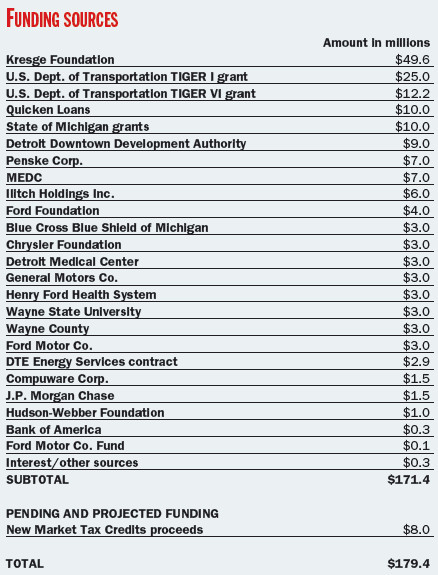
    It’s also worth mentioning how the streetcar line was funded. Below is a breakdown of funding sources dated 2014.

    image

    There may have been some changes since then, but it’s positive to see the public and private sectors come together, alongside a large infusion of philanthropic money (The Kresge Foundation).

    Many of the companies on the above list sponsored individual stations. The cost to do so was $3 million, which is why you see that number show up a few times. Compuware and JP Morgan Chase shared a station at $1.5 million each.

    Is this a transit funding model worth replicating?

  • The Shinola Hotel, Detroit

    Hotels play such an interesting role within cities. They are public-facing in a way that many other uses are not and they invite a mixing of different people – everyone from transients to locals. It is therefore no surprise that they can serve a variety of different roles. They can be cultural hubs. But they can also be places in which to misbehave.

    When the Drake Hotel opened up on the west side of downtown Toronto in 2004, I remember it feeling far out. It was on the edge of that which was interesting at the time. But it quickly anchored West Queen West with its cultural and nightlife offerings. And today, we could be about to see the exact same story repeat itself in the east end with the new Broadview Hotel.

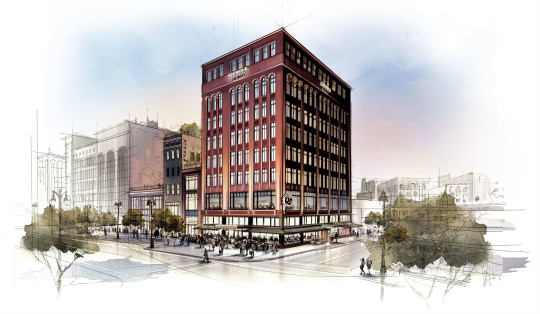
    It’s for these reasons that I was both excited and curious to learn that Bedrock (real estate company) and Shinola are in the midst of launching a new boutique hotel concept in Detroit. It is called The Shinola Hotel. It will be located at 1400 Woodward Avenue. And it will be all about the city of Detroit. They expect it to open sometime in the fall of 2018.

    What I am about to say may be an availability bias talking, but there seems to be a push by many companies into the hotel space. In 2015, Equinox Fitness announced that it would be opening its first hotel in 2018 at Hudson Yards in New York. And just last month furniture retailer West Elm announced that it would be opening a first set of hotels in both Savannah and Detroit. (Go Detroit!)

    West Elm sells furniture. Equinox operates gyms. And Shinola makes and sells watches, bikes, and leather goods. But all of them are now in the hotel space. What other new hotel brands have I missed?

    Image: Shinola

  • Mapping the creative soul of US cities

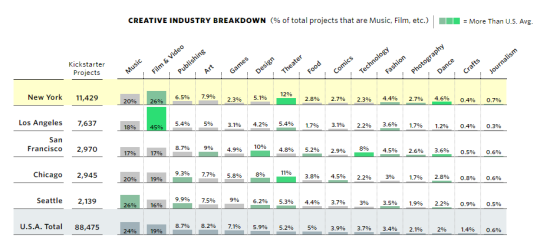
    Polygraph (visually-driven essays) has a great piece called, The Entire History of Kickstarter Projects, Broken Down by City. What they did was look at 88,475 Kickstarter projects to map the various creative communities across the US.

    Here’s a snapshot (you may need to zoom in):

    image

    In general, Kickstarter in the US sees a high concentration of music projects (24%) and film & video projects (19%). But where it gets interesting is to see which cities over-represent in certain categories.

    New York = film & video, theater, and dance

    Los Angeles = film & video (not surprisingly 45% of all projects)

    San Francisco = design and tech

    Chicago = theater

    Detroit = music

    Nashville = music (76% of all projects!)

    They also measured the size of each project (number of backers) and created these neat bubble diagrams:

    image

    Above is New York. Red is music. Orange is film. And yellow is theater.

    I also like their explanation for why they did this project:

    Pretty much all existing attempts to map creative communities use census and jobs data. But creative efforts are often side-hustles. They’re garage/basement/cottage industries that will not appear in a census.

    It’s true. This data should be a much better capture of each city’s creative soul.

  • The rise of tech outposts

    What happens when wages and real estate prices become too high in a city? Companies start growing in lower cost locations. We’ve all seen this before. 

    Fred Wilson recently blogged about this “spillover effect”, citing a New York Times article talking about the growth of tech offices in Phoenix. As someone who sits on the board of many technology companies, he was noticing a thematic trend:

    “A big theme of board meetings I’ve been in over the past year is the crazy high cost of talent in the big tech centers (SF, NYC, LA, Boston, Seattle) and the need to grow headcount in lower cost locations.”

    We talk a lot about housing prices on this blog, and so I think it’s useful to see how this, along with high wages, also impacts companies. The two are interrelated.

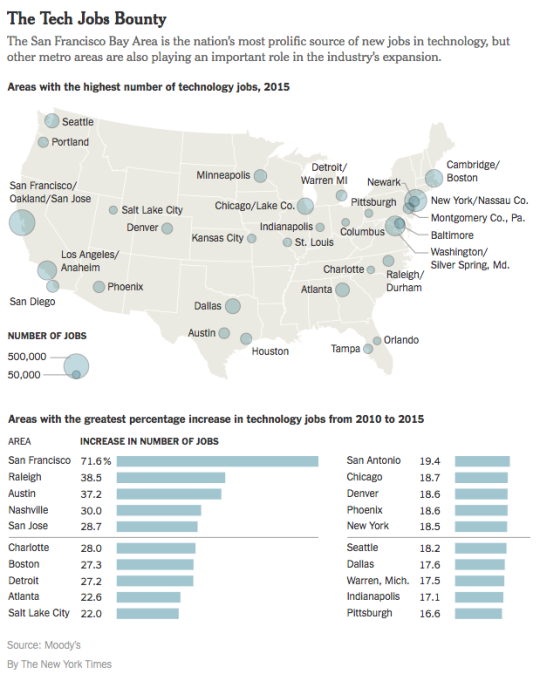
    Below is a chart from the NY Times article showing the US cities with the highest number of technology jobs and the most growth from 2010 to 2015. 

    San Francisco is in a league of its own. But overall, the growth is in tech and many cities are adding lots of technology jobs. Look at Detroit and Boston right beside each other (Detroit obviously has a smaller starting base). And look at how Miami is nowhere to be found.

    Of course, one interesting question is whether these new outposts – such as Phoenix – can truly come into their own and carve out a niche:

    “We don’t want to be San Francisco’s back office — we need more creators here,” said Scott Salkin, a founder and the chief executive of Allbound, which is based in Phoenix, makes sales software and has offices down the hall from Gainsight’s.

    Even with the high cost of living, it’s hard to supplant the coastal hegemony. That’s where people go to chase riches. As comedian Daniel Tosh likes to say, “the middle of the country is for people who gave up on their dreams.”

    Though for some, living in a place like Denver or Salt Lake City and snowboarding every weekend is a better outcome than living in a studio apartment and commuting an hour to work.

  • Detroit on the move

    image

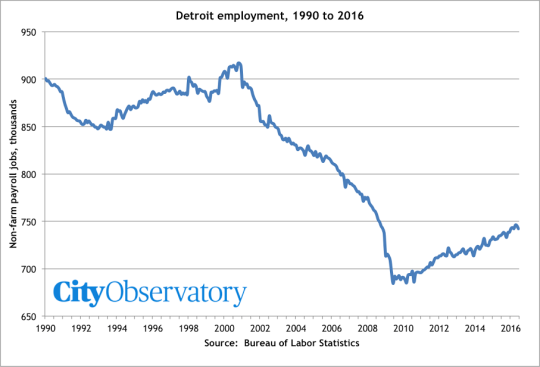
    Between 2001 and 2010, Detroit lost more than 200,000 jobs. It went from over 900,000 jobs to a low of about 690,000 jobs. All of this was happening while the United States was experiencing – up until 2008 at least – an economic growth cycle.

    But we all know that Detroit is now a city on the move. According to City Observatory, Detroit has exhibited 5 consecutive years of job growth. And 2016 looks to be no different. Since bottoming out, Detroit has added more than 50,000 jobs.

    The above chart is based on federal data for Wayne County, Michigan. It includes Detroit, Dearborn, and Livonia, but does not include any other counties within the Detroit metro area. (The above chart and stats are all via City Observatory.)

    Of course, the big question is: Has Detroit made the requisite structural changes to its economy to keep this trend line continuing or is this simply a case of a rising tide lifting all boats?

    I have visited Detroit basically every two years since 2009 and you can certainly feel the change, even in that short period of time.

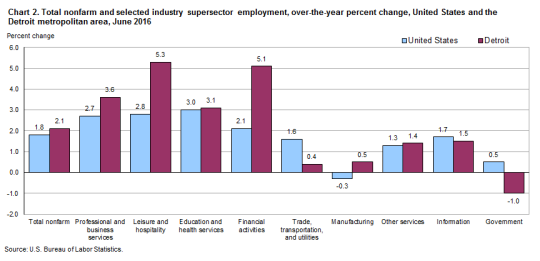
    And if you look at total non-farm employment growth over the last year (June 2015 to June 2016) for the entire Detroit metro area, you see that some of the fastest growing industries include: professional and business services (+14,200 jobs); leisure and hospitality (+10,500 jobs); education and health services (+9,300 jobs); and financial activities (+5,500 jobs). In fact, many of these industries are growing faster than national averages.

    In case you were wondering, manufacturing added 1,200 jobs and government lost 1,800 jobs.

    I’ve heard some people complain that the city, at least downtown, is now too controlled by one entity (Dan Gilbert). But that’s probably what had to happen to really kickstart the city’s renaissance. Somebody had to seed it before you could get the cool coffee shops, bars, restaurants, and coworking spaces.

    There’s still heavy lifting to do, but the data suggests that the city is now headed in the right direction.

    What are your thoughts? Also, if any of you are working on interesting projects in Detroit, I would love to hear from you.

  • Knowledge is more important than space

    I don’t always agree with economist Edward Glaeser, but I really enjoyed the talk that he gave at the Vancouver Urban Forum back in 2012 (at least part 2 of it). I came across it on Twitter today and, since it only has about 300 views, I figured that some of you also haven’t seen it.

    The argument he makes is that knowledge and education are the bedrock of cities. And since we continue to cluster in cities, despite all of our technological advances, knowledge is clearly more important than space. One of the ways he defines cities is by their lack of space and the closeness of the people.

    Of course, this isn’t anything new. If you’ve read his book Triumph of the City, you’ve heard all of this before. But that didn’t stop me from enjoying his talk. It’s a great overview of declining transportation costs, locational advantages, agglomeration economies, the importance of urban density, the impact of small and large firms in a city, and so on.

    I also really liked this idea that knowledge is worth more than space. So if you have 20 minutes and you want to get geared up about cities, have a watch.

    Click here if you can’t see the video below.

    [youtube https://www.youtube.com/watch?v=zg7aITkTNe8?rel=0&w=560&h=315]

  • Lessons on the transforming city

    image

    Last week, Detroit hosted the 24th annual Congress for the New Urbanism. The theme was: The Transforming City. 

    I wasn’t there, but I would have loved to attend. So many interesting things going on, but so little time. Attention is scarce.

    For those of you who also did not attend, below is a copy of a speech that was delivered by Carol Coletta – senior fellow at the Kresge Foundation’s American Cities Practice. I found it on City Observatory

    The speech does a great job of addressing many of the common misconceptions that people have about cities. I can tell you that I heard many of them just this past weekend.

    Also, if you aren’t familiar with The Kresge Foundation, they are a large private philanthropic foundation based in Troy, just outside of Detroit. You might not recognize the name, but Kresge is the K in Kmart.

    And now Carol Coletta…

    ———————————————————

    Could there be a more apt place to observe “The Transforming City” than Detroit?

    On behalf of Rip Rapson and my colleagues at the Kresge Foundation, welcome to Detroit. If you travel to Detroit regularly, as I have over the past 15 years, you see that Detroit changes quickly.

    The speed of change here sometimes takes your breath away.

    How many of you have walked the Detroit Riverfront or ridden the Dequindre Cut?

    Visited the expanding Eastern Market?

    Seen the Q Line construction on Woodward?

    Eaten a meal at Selden Standard or Wright & Company, one of those meals so special that it deserves its own social media channel?

    Walked the streets of downtown or Midtown and discovered Great Lakes Coffee, City Bird, or the El-Moore Lodge?

    Or met Claire Nelson at the Urban Consulate, or any one of Detroit’s arts and civic innovators responsible for some of the most exciting urban work in the country?

    This is the Detroit you can see right outside this theatre.

    But there is another Detroit, one that is harder to see. It’s the Detroit that feels threatened by the pace of change in the city, suspicious of newcomers eager to be part of the change, and wondering when their loyalty to Detroit will be rewarded.

    Such feelings are not unique to Detroit. Every morning my Google Alerts brings a new batch of headlines from around the country detailing the gentrification battles.

    Because “new urbanism” is the butt of some of this criticism, I want to spend the next few minutes unpacking the myths and the realities of gentrification and what those of us who care about great places can do about it.

    First, let me share some numbers.

    In 1970, about eleven hundred urban Census tracts were classified as high poverty.

    By 2010—40 years later—the number of high poverty Census tracts in urban America had increased from 1100 to more than 3,000. (3165)

    The number of people living in those high poverty Census tracts had increased from 5 million to almost 11 million. And the number of poor people in high poverty Census tracts had increased from 2 million to more than 4 million.

    So over a 40-year period, the number of high poverty Census tracts in America’s core cities had tripled, their population had doubled, and the number of poor people in those neighborhoods had doubled.

    Given that record, I’ll bet a lot of people are hoping for a little gentrification– if gentrification means new investment, new housing, new shops without displacement.

    The idea that places might benefit from gentrification runs against the popular narrative. But here’s the really startling fact: only 105 of the eleven hundred Census tracts that were high poverty in 1970 had rebounded to below poverty status by 2010. That’s only ten percent! Over 40 years!

    A similar study of Philadelphia by Pew found almost exactly the same result in that city’s neighborhoods. There, ten times as many poor neighborhoods (164) experienced real declines in income as experienced gentrification since 2000.

    It is the lack of gentrification that we rarely count and never see. The deterioration happens too slowly for us to notice. But it doesn’t mean the deterioration isn’t devastating. In fact, the high poverty neighborhoods of 1970 lost 40 percent of their population in 40 years.

    You could make the case that poor people are displaced from poor neighborhoods because of their poor schools, their lack of jobs, their more chaotic public spaces, their lack of opportunity.

    Understand, this is not the fault of the people who live there. This is a public policy failure.

    But… when a combination of government intervention, philanthropic support, community development, and market forces combine to change a place as quickly as Detroit—even when that change means new residents, new jobs, and new places to live—it also rightfully generates concern.

    See, we are conflicted about change. Many of us wish we could fix place in time.

    But neighborhoods do change. You know that. You change them. And when change results in mixed income neighborhoods—in other words, when we achieve investment without displacement — it’s good for everybody.

    The research on this is quite clear: The ability of people to improve their economic status from one generation to the next is strongly correlated with mixed-income neighborhoods.

    Many of the public policy interventions to achieve economically integrated neighborhoods have supported poor people moving to wealthier neighborhoods. But that is an expensive, slow political slog that is hard to scale.

    But what if we flipped that script? What if… we could lure people with financial options about where they live to disinvested neighborhoods—resulting in the kinds of places that enable opportunity?

    And what if we also made a special effort to insure that the people remaining in low-income neighborhoods—people without options about where they live—what if an extra effort were made to insure they benefited from new people and new investment in their neighborhoods?

    The research tells us that mixed-income neighborhoods benefit poor people naturally. But can we double down to accelerate those benefits?

    Think of it this way: Can we get gentrification with broadly-shared benefits.

    I think so. But it’s not easy. Remember: Only 10 percent of high poverty neighborhoods “gentrified” over the past 40 years. And today we have triple the number of high poverty neighborhoods than we had 40 years ago.

    Clearly, mixed income neighborhoods won’t happen if we don’t work at it.

    So how can we do that?

    First, let’s acknowledge that, for the first time in 50 years, the market is moving in our favor. People (and jobs) are moving to cities. We need to see that as the opportunity it is to get mixed-income neighborhoods and not fear good, thoughtful development.

    That means we can’t let NIMBYs win the day. The same people who complain about high prices also complain when developers show up to build more supply. We have to make the connection between supply and demand for the protesters and the press.

    But attention must be paid to creating more mixed income housing. Our success on this has been mixed, and I’m struck by the comparison on methods used in NYC and in Portland, Oregon’s Pearl District to create more affordable housing in mixed income settings.

    As City Observatory reported today, The City of New York, one of the nation’s hottest housing markets, has had inclusionary zoning for the past 10 years. And over that time, the city has produced an average of 280 units per year for a total of 2800 units.

    In contrast, Portland took a very different approach. Portland used additional property tax revenue from construction in one neighborhood to subsidize affordable housing. Using just a third of such revenues from The Pearl District (along with Low Income Housing Tax Credits), Portland has built more than 2300 units of affordable housing—almost as many units as the much larger New York.

    Portland’s Pearl District is an example of a desirable neighborhood. The cost of desirable neighborhoods goes up. And it is the fear of rising costs, new investment, (and sometimes a changing demographics) that spawned the “just green enough” movement.

    Think about that: Disinvested neighborhoods lack access to parks and quality public space. But wait! Let’s not make it too nice for fear it will attract new investment. That’s craziness born out of legitimate frustration when prices start going up.

    The fact that buyers and renters are willing to pay more for quality neighborhoods means we need to build more of them, not fewer of them.

    How do we do that at scale?

    When Paul Krugman or—the American electorate willing—the next president calls for new investments in infrastructure to stimulate the economy, will we be ready with a plan that defines infrastructure as something more than roads and bridges?

    Why can’t “infrastructure” include new and redesigned parks and libraries, neighborhood community and cultural centers, trails and gardens—a reimagined civic commons? That’s the defining line I want to hear from our next president. I want so many desirable neighborhoods that people will have good choices at all price points.

    The way we live today is changing so fast. We are decoupling and recoupling. We have mothers raising kids alone, and people delaying childbearing—some forever—who want to help. We are sharing jobs, cars and homes. We are retiring later and living longer. And our lives, increasingly, are lived in public.

    We need to ready our cities for these changes. We need to figure out how to revalue what exists and give new life to the material, the buildings, the neighborhoods, the cities and the people we too often discard and write off.

    Equity does not sit in opposition to a thriving, appealing city. It is central to it.

    This is the work of CNU. This is your work. And that’s why I’m happy to be with you here in Detroit to celebrate and learn alongside you this week. Thank you for inviting me.