Daily insights for city builders, delivered every morning at 6 AM ET. I’m Brandon Donnelly — a Toronto-based real estate developer and founder of Globizen. I’ve been writing here since 2013.

Tag: detroit

  • Young people are driving a lot less

    As a kid growing up in the suburbs, I got my driver’s license the day I turned 16. Being able to drive was a big deal. But we know that this desire to drive has been changing in profound ways. Here’s some recent stats on the percentage of licensed drivers in the US by age (taken from the WSJ):

    In 1983, about 46% of 16-year-olds had a driver’s license. By 2014, this number had dropped to 24.5%, which is the lowest it has been in recent years, and was probably impacted by the broader economy. As of 2017, this number was up to about 26%.

    If you’re a car company, I would imagine that these are pretty important numbers. They represent the top of the sales funnel. Most people probably like to have a driver’s license in hand before they go out and buy a car.

    Supposedly, some people in Detroit are betting that young people will still eventually buy a car. And when they do, it’ll be a nice big one like an SUV or a truck. But, the data suggests that it is not just young people who are eschewing driving.

    Here’s some data from the University of Michigan Transportation Research Institute (via NPR), looking at the proportion of licensed drivers in the US by all age categories:

    While the biggest drop has certainly happened among younger generations, licensing is still down for older cohorts. Based on these numbers, we don’t hit parity until somewhere around 50 to 54 years old.

    And the only cohorts where licensing has increased significantly are when people reach over 55. Over 70 is up by a huge margin — more than the drop among 16 year olds — which is probably a symptom of people living longer.

    Some of this decrease among young people can probably be attributed to delayed family formation and people living in denser urban environments, where it is more convenient to get around without a car. But I don’t think that’s all of it.

    Which suggests to me that the race to autonomy is a pretty important one to win.

  • New Toronto architecture bike tour

    I have a friend visiting from Detroit this weekend. We went to architecture school together at Penn. But unlike me, he decided to become a full fledged architect.

    Not surprisingly, he wants to see some new Toronto architecture while he’s here. I say new because he has seen the classics. So I mapped out a short bike route this morning. It’s more or less a downtown loop that starts in the St. Lawrence.

    First we head west to the Queen Richmond Centre West by Allied Properties REIT (developer) and Sweeny&Co (architect). After that I’d like to show him the main drag of King West and point out two buildings by Saucier + Perrotte Architects and CORE Architects. I don’t think Unzipped Toronto is open yet.

    Next it is north to One Spadina Crescent – home of the Daniels Faculty of Architecture, Landscape, and Design. This is one of if not my favorite new building in the city right now.

    After that I figure we’ll cruise east along the Bloor bike lanes and look up at 1 Bloor East. Then it is back south to check out the River City collection by Urban Capital (developer) and Saucier + Perrotte Architects (they are getting good face time on this tour).

    Then we’ll do what every good new Toronto architecture bike tour should do and end with a drink on a rooftop patio somewhere. Maybe we’ll check out the Broadview Hotel. I like the neon in the lobby bar.

    If I missed anything critical, let me know.

    Photo by Tiffany Nutt on Unsplash

  • Detroit. Move here. Move the world.

    As part of the Amazon HQ2 bid process, a number of cities produced videos. I only discovered them today and so maybe some of you also missed them when they were released last fall. There are videos from Detroit, Boston, Pittsburgh, Philadelphia, Dallas-Fort Worth, Las Vegas, Louisville, Atlanta, and maybe others that I am still missing. 

    Some of the videos are bad. (I’ll let you make your own judgement calls.) I like the idea behind Atlanta’s video, which is the journey of someone named Georgia physically delivering their bid to Seattle. And Philadelphia’s video made me feel really nostalgic about my time there. Those were some great years. 

    But my favorite video is Detroit’s video. It feels authentic. The footage is outstanding. And it feels powerful. Though it is probably too long. It was a good reminder that I’m overdue for a visit. So here is Detroit’s video. If you can’t see it below, click over to YouTube.

    [youtube https://www.youtube.com/watch?v=DO4J_PC1b5M&w=560&h=315]

  • The biggest challenge in revitalizing the Rust Belt

    image

    Jason Segedy, who is the Director of Planning and Urban Development for the city of Akron, Ohio, recently penned a two-part series in the American Conservative about urban revitalization in the Rust Belt. Part two is specifically about the importance of new housing in “cities left for dead.”

    As I was reading through the piece, my first thought was that it would be a good follow-up to yesterday’s post on “winner-take-all-urbanism.” The contrast between alpha cities like San Francisco and Rust Belt cities like Akron is stark.

    The former city can’t build housing fast enough. And the latter city was forced to implement a citywide, 15 year, 100% residential property tax abatement program just to induce new investment. Any and all new housing is eligible.

    But as I got further down the article, I was struck by something else. I was surprised to hear Segedy say that, rather than market forces, community opposition is “perhaps the biggest challenge of all” when it comes to delivering new housing in these markets.

    Here is a longish excerpt that I would encourage you to read:

    Although you might think that people living in neighborhoods with a large number of abandoned houses and vacant lots would be thrilled to see new houses being built, you might be surprised to learn how often this is not the case. Sometimes neighbors prefer to have the vacant lot remain as green space. Sometimes they worry that the new housing will not be expensive enough, and will bring their property values down. Other times, they worry that the new housing will be too expensive, and will bring their property values (and taxes) up.

    When it comes to new housing, everyone is a critic. I have heard people complain that housing which they will never live in is too dense; that housing which they will never purchase is too expensive; that housing which they will never be inconvenienced by will generate too much traffic; and that housing which they will never look at is not architecturally appealing.

    After 23 years as an urban planner, I can honestly report to you that, contrary to popular belief, most people are strongly in favor of heavy-handed and draconian government regulation of private property—as long as it is someone else’s private property, and not their own.

    Residents and community activists who are opposed to new housing often demonize the real estate development profession as being “greedy”, overlooking the fact that their own home was developed by a developer, built by a builder, and sold by a realtor—most likely for a profit. This isn’t to argue that every development professional is a white knight, but it is important to remember that the vast majority of people who work in the real estate and construction sectors are not the enemy of neighborhoods. Without them, there would be no neighborhoods.

    According to Segedy, Akron has lost 32% of its peak population. Cleveland has lost 58%. And Detroit has lost 64%, leaving almost 1/3 of its land parcels vacant. (These are 2017 figures.) Surprisingly, this doesn’t appear to change how many people feel about new development. 

    No more new housing. We’re full. Unless, of course, that housing is for me.

    Photo by Nolan Issac on Unsplash

  • Urban American life before the car

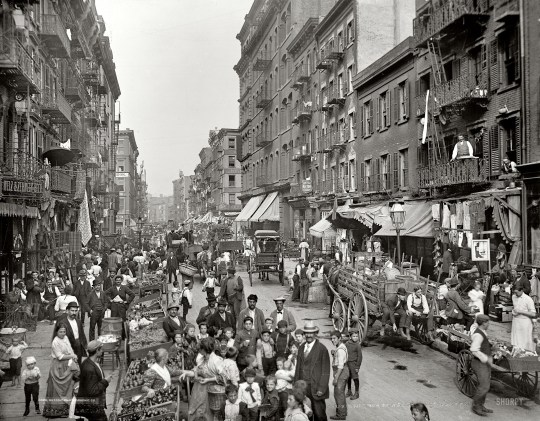
    This morning I stumbled upon an old (2013) post from Rebel Metropolis that documents urban American life through street photos taken before the automobile. 

    Above is Little Italy, New York City, 1900. All of the photos in the post are from Shorpy

    The photos are beautiful architecturally and from a photography standpoint. But as is pointed out in the post, they also speak to a different kind of street:

    What’s more, the street here is not purely the thoroughfare – it is the essential common gathering place for demonstrations, for buying and selling food, for children to play in, for celebration, for lingering and people watching.

    That sounds like a great street. And now I am off to start my day. Because I have meetings all around the city today, I’ll be driving to the office. 

  • The Siren opens in downtown Detroit

    Three years ago I wrote about the design and development firm, ASH NYC. What attracted me to them was how they were vertically integrating design, development, property management, and even hospitality management.

    Well they have continued to grow and this spring they opened up a new 106 room hotel in downtown Detroit called The Siren. It is located in the Wurlitzer Building, which the firm purchased back in 2015.

    With The Siren, ASH NYC also introduced their first-ever furniture line. It goes to show you just how focused they are on design and on the details. Surface Magazine did a good feature on the hotel, and the firm, here.

    The other thing, which I think is very cool, is how they paid tribute to the late and great Detroit street photographer, Bill Rauhauser. Check out the culture section of The Siren website to see what I mean.

    So if you’re planning to be in Detroit or are looking for an excuse to be in Detroit, maybe check out The Siren.

    Image: Christian Harder via Surface Magazine

  • Playoff time in the city

    I just finished watching the Raptors beat the Pistons in overtime to clinch a playoff berth. This is, by far, the earliest in the season that they have ever done that. They are also the first team in the NBA to do that this year. And this is after being down 17 tonight.

    The Raptors feel like a different team this year. They have the grit and toughness to come back and squeak out games like they did tonight. Seeing DeRozan run the floor and throw it down with less than 10 seconds left in the game is a powerful display of that. They are finding ways to win.

    As of today, FiveThirtyEight is giving the Raptors a 55% chance of making the finals. That would be a franchise first. And a 17% chance of winning the title. I am really enjoying watching the best Raptors team that this city has ever seen. And I’m looking forward to playoff time in the city. It transforms this place.

  • Why Detroit lost the Amazon HQ2 bid

    Dan Gilbert – billionaire Detroit promoter and owner of the Cleveland Cavaliers – penned this statement in response to the city’s failed Amazon HQ2 bid. He chalked up the loss to reputational hangover:

    We are still dealing with the unique radioactive-like reputational fallout of 50-60 years of economic decline, disinvestment, municipal bankruptcy, and all of the other associated negative consequences of that extraordinarily long period of time.

    This was the “elephant in the room”, though his statement is primarily centered around both talent and transportation – the two critical and lacking ingredients that allegedly disqualified Detroit.

    He ends by stressing the importance of physically visiting Detroit 2018. That is the only way, he says, people will fully appreciate the change and momentum that has taken hold in the city. (I experienced Detroit 2016 so I guess I’m overdue.)

    In response to this, Aaron Renn wrote this follow-up post suggesting that Dan take a page out of Tony Hsieh’s playbook. Tony is the founder of Zappos and the Downtown Project in Las Vegas. 

    To bring people to downtown Las Vegas, Tony – somewhat famously – rented 50 apartments in one of the only high-rises, called them “crash pads”, and offered them out for free to people who wanted to come and check out what was happening in downtown Vegas and with the Downtown Project.

    That’s certainly one way to lower the friction. 

    Equally interesting to me about this strategy, though, is that it was presumably necessary (he did it, right?) just to bring people to another part of Vegas, let alone another city altogether. 

    Full disclosure, I’ve never been to Vegas. But I understand that many people visit the place. So for me it speaks to the kinds of inducements that may be necessary just to revive or kickstart a place.

    Photo by Matthew Brzozowski on Unsplash

  • Where the young and educated are moving to in the US

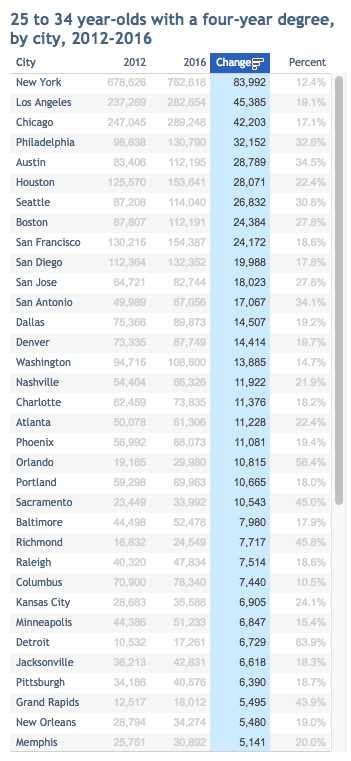
    City Observatory tracks something that they call “The Young and Restless.” It refers to the segment of the US population that is between 25-34 years old and has a bachelor’s degree or higher.

    We know that people in this age bracket tend to be relatively mobile and that the likelihood of moving decreases as people age. So it’s a potential leading indicator for the city regions of the future. It also adds a bit more nuance to the urban vs. suburban growth debate. 

    According to City Observatory, between 2012 and 2016 the number of 25 to 34 year olds with a 4-year degree living in one of the 53 largest largest cities in the US increased by 19%. This is compared to a 4% increase in the overall population in these cities.

    This increase in young well-educated adults is also happening 50% faster in the largest cities. So the young and educated still seem to be demanding city living, even if the world is arguably still suburbanizing.

    Below is a snapshot of City Observatory’s latest data. I’ve sorted the list by total change in population (2012 to 2016). Happy to see Philadelphia near the top. If you do it based on percentage, Detroit wins with a 64% increase.

    For the full list of cities, check out City Observatory.

  • Land use restrictions and upward mobility

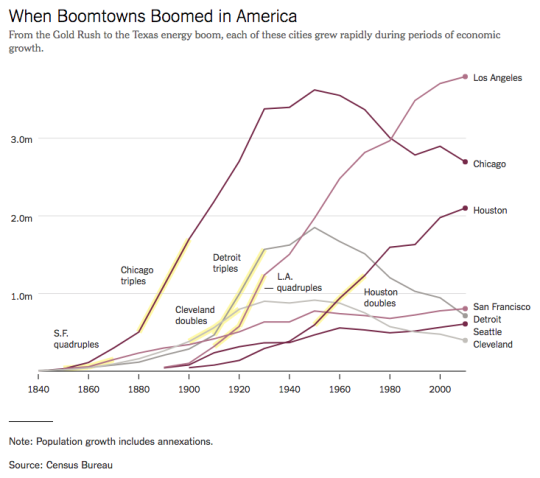
    Throughout US history, economic growth has typically spurred an “enormous reallocation of population.” Here is a graph from a recent New York Times article called: What Happened to the American Boomtown?

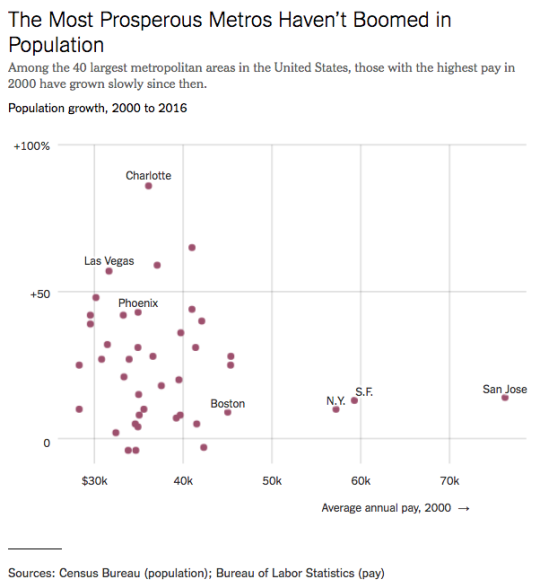
    The argument, here, is that restrictions on development have made it so that the most prosperous cities are actually the slowest growing cities in terms of population. Here is a chart, from the same article, comparing population growth to average annual pay:

    And here is an excerpt:

    But these productive places aren’t growing as fast now as economists believe they should — and as they would if they didn’t impose so many obstacles on new development. Since the 1970s, land use restrictions have multiplied in coastal metros, making it harder to build in, say, San Jose, Calif., than in Phoenix. And the politics of development have become tense, too. In the Boston suburbs, the Bay Area, Brooklyn and Washington, people who already live there have balked at new housing for people who don’t.

    We often talk about the impact of land use restrictions on supply and overall housing affordability. But here is an argument that it could also be impacting upward mobility.