Daily insights for city builders, delivered every morning at 6 AM ET. I’m Brandon Donnelly — a Toronto-based real estate developer and founder of Globizen. I’ve been writing here since 2013.

Tag: detroit

  • Rental apartment expansion in Detroit

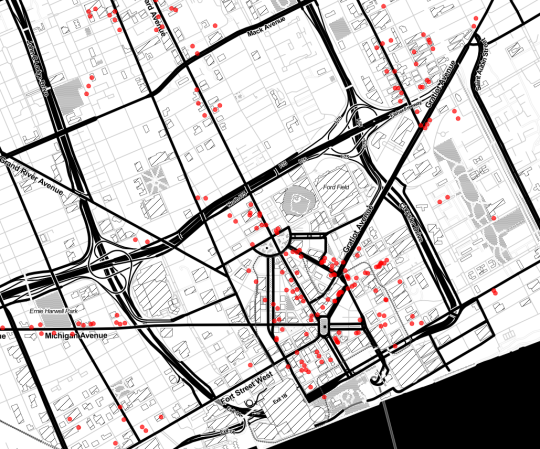
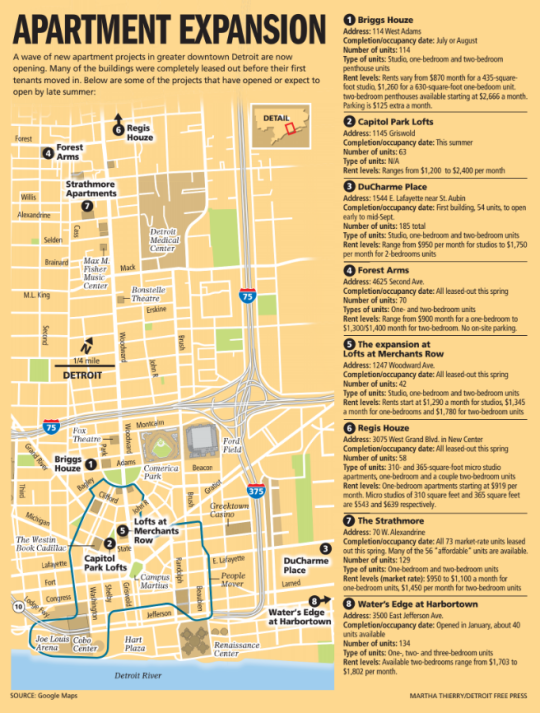
    The Detroit Free Press recently published a summary of some of the new rental apartments coming online in and around downtown Detroit. Here’s the map that they published along with their piece:
    image

    Based on this article, demand is outstripping new supply and rents are starting to push above $2 per square foot. This strikes me as a solid number given that there are also for sale lots/houses in the city going for $10,000.

    Going back to some of the posts I have written about rental apartment development in Toronto, you might remember that $3 psf is roughly our magic number given current cost structures.

    In some special circumstances you might be able to get a project off the ground with rents closer to $2 psf, but that’s an exception to the rule. There are many areas in the Toronto region with $2 psf rents and few, if any, new rental apartments.

    But Detroit is obviously a different city, as is every real estate market.

    Land would be cheaper. Many of these new rental apartments are conversions of existing buildings (which were probably bought for cents on the dollar). And I wouldn’t be surprised if there are tax abatements and other incentives to encourage more development. 

    I also wonder if people in the city aren’t being at least partially drawn to multi-family buildings because of the safety and security benefits. That’s something that certainly came up when I was in Detroit last weekend.

    Regardless, this is a good news story for Detroit, which is not always the story you hear people telling of the city.


  • Towards car-free living

    Right now, there’s an apartment building in San Francisco that is trying to encourage car-free living by offering residents a $100 per month credit that can be used for Uber and/or for public transit. Prospective residents can even get a $20 credit to go check out the community. (The program is a partnership with Uber.)

    The reason this leasing strategy caught my attention is because we’re at a point where city builders are now trying to recalibrate themselves to this new emerging world. 

    When I was at the Land & Development conference earlier this month, one developer brought up this exact point. He more or less asked: If you’re starting development on a new building today and you’re expecting approvals in 2 or so years and completion in another 3 or 4 years, what do you think the state of cars/driving will be at that point? Should you really be building all that underground parking?

    These are great question. And they highlight one of the challenges of development. It takes a long time to bring new supply to the market and a lot can change during that time period. My sense is that we are pretty clearly seeing downward pressure on driving and car ownership.

    That said, this isn’t the case in every city or in all parts of a particular city. I just got back from a trip to a Detroit where it’s pretty hard to imagine the city being oriented around anything but the car. But in cities like San Francisco and Toronto, car-free living is already a reality for many people and so we need to respond to that.

    How do you see yourself driving, or not driving, in the next 5 to 10 years?

  • Photoblog: Cranbrook Schools

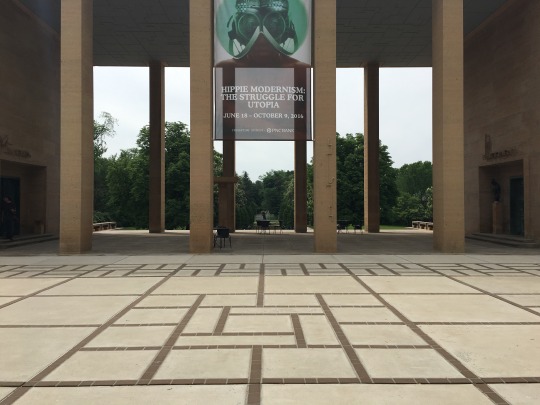
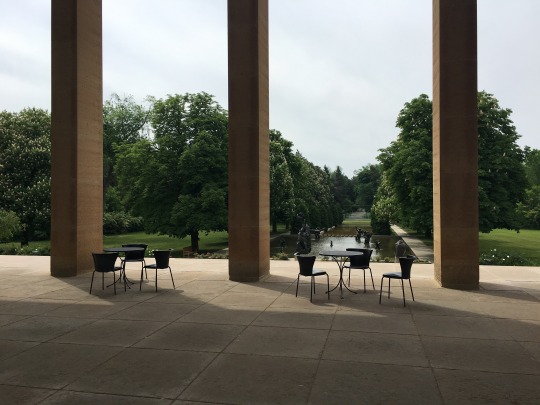
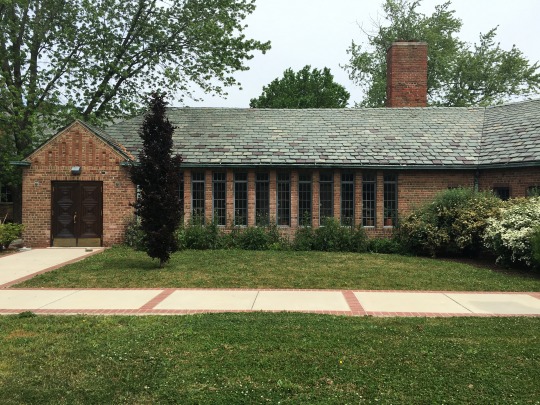
    My spring allergies have gotten the best of me today. So instead of a regular post, I’m going to share some of my photos of the Cranbrook Schools. I toured the campus this afternoon.

    Cranbrook Schools is a private boarding school (PK – 12) in Bloomfield Hills, outside of Detroit. It has an endowment fund of about $233 million, which is one of the largest of American boarding schools. In 1989, the campus was designated a National Historic Landmark.

    The photos are in the order in which they were taken.

    A man happen to be playing a violin in the space below.

    The stone shingles below get smaller as they move up the roof to give the illusion that the building is larger than it really is.

    And here are my fellow architecture nerds, Matthew and Rick.

  • Buy or build?

    image

    I’m in Detroit right now.

    I’m staying in a nice neighborhood where you can buy a 2,000 sf house on a 6,000 sf lot for about US$125,000. A house double the size, at around 4,000 sf, might run you US$350,000.

    In comparison, a new underground parking spot in downtown Toronto could cost you around CDN$60,000. And a small 1 bedroom apartment, could easily run you the same price as the above 4,000 sf home.

    These are two completely different real estate markets.

    What’s happening in Detroit is that many/most of the houses are being valued at below their replacement cost, which means it generally doesn’t make sense to build new. Why take on the risk of building when you can buy for less?

    Oftentimes this a decision that real estate companies will face: buy or build? Depending on the market, the answer could be very different.

  • The Storefront Index

    The folks over at City Observatory have recently developed something called The Storefront Index

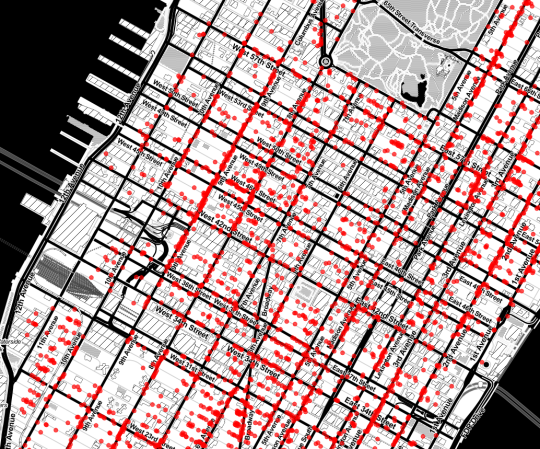
    It is a mapping of “clustered” consumer-facing storefront businesses across the 51 largest cities in the United States and within a 3-mile radius of their CBD. (Their definition of cluster is that the business is located within 100m of another business.)

    At the top of this list is New York (no surprise here) with 9,905 storefronts and at the bottom of this list is Detroit (probably no surprise here either) with 411 storefronts. On average, they found that the “typical” city has about 900 storefronts within this 3-mile radius.

    Here’s a screenshot of New York:

    image

    And here’s a screenshot of Detroit:

    image

    They should be at the same scale.

    If you’d like to read their Storefront Index Report, you can do that here. And if you’d like to explore their interactive maps, you can do that here. City Observatory has made all of this available as a free tool for city builders – which is really great to see. (You can even download their shapefiles if you’re into that sort of thing.)

  • The birthplace of techno

    Detroit has been called the birthplace of techno. Beginning in the early 1980s – when the city was well in decline – the Detroit techno sound started to emerge, thanks to musicians such as Juan Atkins, Derrick May, and Kevin Saunderson. 

    Chicago had house music. And Detroit had techno music – among, of course, many other musical genres. But what I find fascinating about Detroit techno, in particular, was how it really reflected the ethos of post-industrial Detroit. It was high-tech. It was about machines. And it was obsessed with the future.

    Below is a clip from a 1996 French documentary called Universal Techno. Even if you’re not into electronic music, I think you should at least watch the segment starting at 1:40. I love how Derrick May talks about Detroit, and what should be this balance between the past and the future. It really reflects my own views on city building.

    [youtube https://www.youtube.com/watch?v=RSX_r0u3uzE?rel=0&w=420&h=315]

    If you can’t see the video, click here.

    I’m thinking about Detroit and its music because I’m headed there during Memorial Day weekend for the annual Movement Electronic Music Festival. It has been about 2 years since I was last in Detroit and so I’m excited to see the city in full swing.

  • America needs a new map

    image

    Parag Khanna recently published an article in the New York Times calling for a new map for America

    Here’s why:

    “The problem is that while the economic reality goes one way, the 50-state model means that federal and state resources are concentrated in a state capital — often a small, isolated city itself — and allocated with little sense of the larger whole. Not only does this keep back our largest cities, but smaller American cities are increasingly cut off from the national agenda, destined to become low-cost immigrant and retirement colonies, or simply to be abandoned.”

    This is something that I’ve been writing about for awhile on this blog. As we continue to transition to an urban-based information economy, it strikes me that, here in North America, we’re going to need to refocus our governance structures around cities. We’re going to need to place our metropolitan regions at the fore if we want to continue competing with rising powers like China – which, by the way, seem to be adopting a megacity model.

    Here’s another snippet from the article:

    “While Detroit’s population has fallen below a million, the Detroit-Windsor region is the largest United States-Canada cross-border area, with nearly six million people (and one of the largest border populations in the world).

    Detroit’s destiny seems almost obvious if we are brave enough to build it: a midpoint of the Chicago-Toronto corridor in an emerging North American Union.”

    I’ve argued for this before and I continue to believe that it makes a lot of sense.

    Image: New York Times

  • 2 new ways to think about economic inequality

    We talk a lot about economic
    inequality these days. We worry, among other things, that our successful cities
    are becoming playgrounds for the rich and that housing is becoming increasingly
    unaffordable for the middle class.

    Without negating the
    importance of things such as attainable housing, I’d like to offer up two,
    potentially new, perspectives on economic inequality.

    The first is an
    essay by venture capitalist Paul Graham
    . In it, he rationally unpacks, as he always does, the phenomenon of economic inequality. One of his key points is the distinction between rent seeking degenerate economic inequality and the economic inequality caused by rapid value creation (i.e. Two Stanford students decide to create a new search engine called Google).

    “If the rich people in a society got that way by taking wealth from the poor, then you have the degenerate case of economic inequality where the cause of poverty is the same as the cause of wealth. But instances of inequality don’t have to be instances of the degenerate case. If one woodworker makes 5 chairs and another makes none, the second woodworker will have less money, but not because anyone took anything from him.”

    Of course, Paul Graham is thinking about this from the perspective of a venture capitalist that funds startups and helps entrepreneurs get rich. But what about the impacts to people who live in a city where the rich are far richer than the poor?

    That brings me to the second perspective.

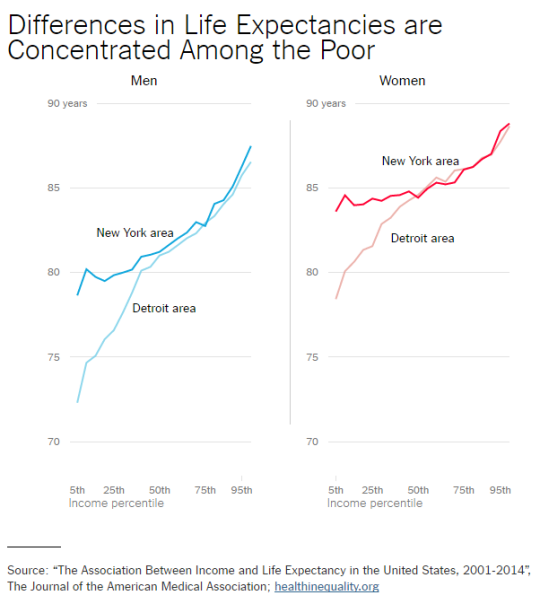
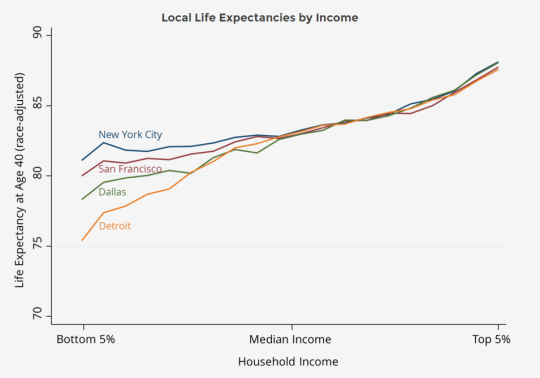
    A recent study, published in The Journal of the American Medical Association and written about in the New York Times, has discovered a surprising relationship between income and life expectancy across the United States from 2001 to 2014.

    What they found was that cities with high economic inequality – such as New York and San Francisco – actually have lower inequality when it comes to life expectancy. 

    Here is a chart from the New York Times:

    And here is a chart from healthinequality.org:

    If you’re rich, it doesn’t matter where you live. The life expectancy of a rich person in New York is roughly the same as a rich person in Detroit. (Though, as to be expected, women generally live longer than men.)

    However, as income levels fall, so does life expectancy. But it falls more in a city like Detroit than it does in New York. In fact, rich cities such as New York and San Francisco are almost model cities in this regard. Why is that?

    The biggest predictor appears to be health behaviors, such as smoking and obesity:

    “The research seems to suggest that living in proximity to the preferences — and tax base — of wealthy neighbors may help improve well-being. New York is not just a city of rich and poor, but also one of walkable sidewalks, a trans-fat ban and one of the most aggressive anti-tobacco agendas of any place in the United States.”

    So there you have it. Two, potentially new, ways to think about economic inequality.

  • Getting distribution and how that is changing

    Aaron M. Renn recently published an article in The Washington Post talking about carless cities and driverless cars. It’s an interesting read, but I’m not going to talk about those topics today. So if that’s what you’re looking for, you’ll have to read his piece.

    I do, however, want to focus on one particular aspect of it. 

    In it, he talks about how Tesla is shifting the “locus of power in the auto industry” from Detroit to Silicon Valley and, at the same time, changing the way cars are sold. Tesla sells direct to consumers through its corporate stores, whereas franchise laws in almost every U.S. state mandate that new cars need to be sold through dealers.

    I’m not sure how these laws came to be, but it’s interesting to note yet another example of technology and the internet sparking disintermediation. That is, the removal of middle people, distributors, brokers, and so on. It’s the same thing that is happening as a result of companies like Uber and technologies like Bitcoin.

    I would imagine that lot of these legacy distribution models exist today because it was previously the most efficient option. If you were a car company based in Detroit, a network of local franchisees all across the country working to sell your cars was probably a great thing. But now there are other options, as is the case with many other industries.

    So what’s next? 

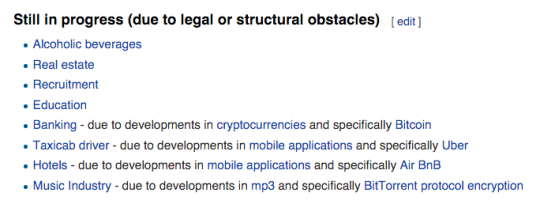
    Wikipedia calls out the following industries as still being in the midst of disintermediation:

    I bet you all know which one I’m watching closely.

  • A Detroit story of single family homes and pianos

    NO MORE MUSIC by Shawn Whitehead on 500px.com

    https://500px.com/embed.js

    I was reading Aaron Renn’s blog this morning and a post called, How Urban Planning Made Motown Records Possible, caught my attention. 

    His argument – taken from a book called Once in a Great City: A Detroit Story – is that the prevalence of pianos in black working class and middle class families was a key ingredient in Detroit ultimately punching above its weight musically.

    Here’s an excerpt that Aaron Renn shared on his blog:

    The family piano’s role in the music that flowed out of the residential streets of Detroit cannot be overstated. The piano, and its availability to children of the black working class and middle class, is essential to understanding what happened in that time and place, and why it happened, not just with Berry Gordy, Jr. but with so many other young black musicians who came of age there from the late forties to the early sixties. What was special then about pianos and Detroit? First, because of the auto plants and related industries, most Detroiters had steady salaries and families enjoyed a measure of disposable income they could use to listen to music in clubs and at home. Second, the economic geography of the city meant that the vast majority of residents lived in single family homes, not high-rise apartments, making it easier to deliver pianos and find room for them. And third, Detroit had the egalitarian advantage of a remarkable piano enterprise, the Grinnell Brothers Music House.

    Detroit is obviously not the only city with lots of single family homes. But it’s fascinating to think that this housing typology, combined with a number of other socioeconomic factors, could be what ultimately led to the creation of the Motown Sound.

    It’s also interesting to think about what kind of talent we might be squandering in our cities. I mean, look what happens when people have access to things like pianos (in the case of Detroit), computers (in the case of people like Bill Gates), and cheap/vacant space (in the case of Berlin and its clubs). They create amazing things.

    This is one of the reasons why I think we sometimes underestimate the importance of small scale moves when it comes to spurring innovation in cities. We forget that people will do incredible things when they are, quite simply, given the freedom to work on projects they are passionate about.

    If we could harness these passions instead of focusing so often on big political announcements, I think we’d all be better off.