Daily insights for city builders, delivered every morning at 6 AM ET. I’m Brandon Donnelly — a Toronto-based real estate developer and founder of Globizen. I’ve been writing here since 2013.

Tag: detroit

  • Urban population densities, compared

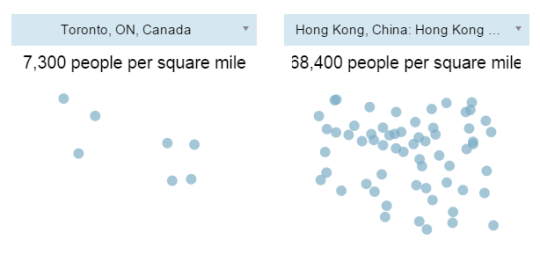
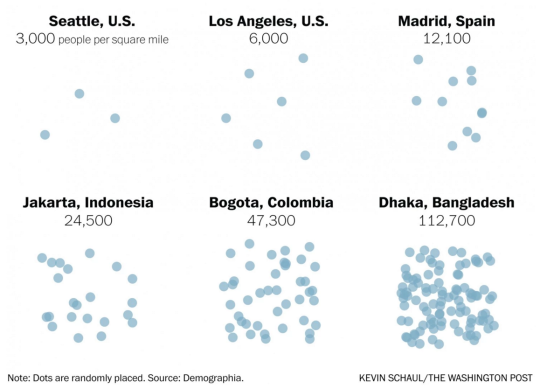
    Earlier this month The Washington Post published an article called, There’s no such thing as a city that has run out of room.

    And what it was really about was that when we say there’s no more room (I guess people are saying this), we are really saying that we just don’t want to allow anyone else to become our neighbor. Because the reality is that urban population densities vary widely around the world. So how can you really call a place full?

    I’m not sure I feel this pain point as much as the author, but I always find population densities to be a fascinating topic. And accompanying the article was a tool – using data from Demographia – that allowed you to compare the population densities of various cities.

    Here are are two scenarios I ran:

    It’s important to keep in mind that these numbers are averages for the entire economically contiguous region. So it tells you nothing about the potential spikiness of certain areas. That’s why the population density of New York (which includes portions of New Jersey and Connecticut) probably seems low to you.

    Still, it’s fascinating to see how extreme some cities – including some first world cities like Hong Kong – can be. Clearly many cities have a lot of room to become a lot more dense. And I think that would be a good thing.

  • Why we should fight the divided city

    No man

    https://500px.com/embed.js

    There has been and continues to be many divided cities around the world.

    Berlin had the Berlin Wall

    Northern Ireland (mostly Belfast) has its Peace Walls that still separate Protestant loyalists and Catholic republicans from each other. 

    Beirut had the Green Line, which separated the predominately Muslim side in the west from the predominantly Christian side in the east during the Lebanese Civil War. And I understand this is still the case today.

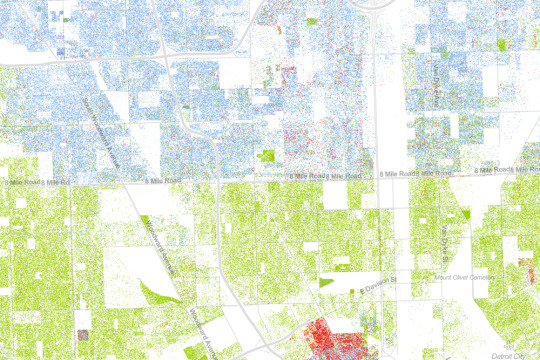
    Detroit has 8 Mile Road, which is a psychological barrier rather than a physical one, but one that still sharply separates whites (blue dots, below) and blacks (green dots, below). The image below is from Wired Magazine.

    image

    And even here in Toronto you could say that we’ve become a divided city, albeit without the civil wars or race riots that have plagued the other cities listed above. Our voting patterns suggest a real urban-suburban divide and the many ethnic groups in this city continue to concentrate themselves in specific areas.

    I’ve been thinking about this phenomenon in the context of a recent article I read talking about closed vs. open social networks. The article was talking about career success, but I think the lessons are also transferrable to cities.

    The argument made in the article is that people who are able to position themselves in open networks – that is, become the connector between diverse kinds of social groups – are more likely to succeed than people who position themselves in closed networks where they are only surrounded by people they already know and by people who are similar to themselves.

    And the reason for this is because people in open networks end up getting exposed to a broader set of viewpoints and ideas. They get a more accurate view of the world and they are able to problem solve better than those who may be coming at it from a more myopic or singular perspective.

    But the challenge with open networks, is that there seems to be an innate human tendency towards closed networks. We love what is familiar. We love what is comfortable to us. In other words, we are attracted to people that are similar to ourselves. This is known as homophily.

    So it’s not surprising that we tend to cluster ourselves in cities. Yes, there are economic benefits to doing so (known as agglomeration economies), but there’s also a certain feeling of solidarity that comes from being around other people with the same view of the world. There’s no tension because everyone has the same beliefs, whether that be religion or politics or sports or what to eat.

    But just like there’s an argument to be made that successful people should try and resist the pull towards closed networks, I think there’s also an argument to be made that successful cities should try and resist the pull towards closed and divided cities.

    That’s why some people believe that tolerance is a critical ingredient to fostering creativity in cities.

  • The second coming of the car

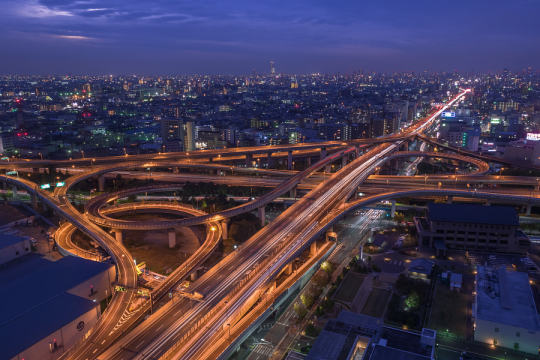
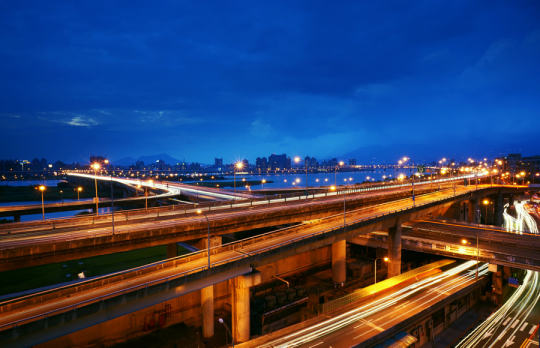
    Blue hour by Ryusuke Komori on 500px.com

    https://500px.com/embed.js

    As a kid growing up in the suburbs of Toronto, I remember when getting my driver’s licence and getting a car were some of my biggest priorities. 

    As soon as I turned 16, I went immediately to get my learner’s permit and then enrolled in a driving school so that I could shorten the time required until I could drive on my own. Every month counted at that age.

    It was such an important milestone that people born earlier in the year were seen as lucky. Because someone born in January, for example, could gain their driving independence before someone born at the end of the year even got their learner’s permit. As silly as it sounds to me right now, that spread was huge back then.

    But the world has changed and we are at the dawn of a new era: driverless cars. 

    Sooner than most people think, we are no longer going to drive ourselves around cities. I absolutely believe this. That means no more steering wheels. No more traffic calming measures on quiet residential streets. Safer streets. Perfect traffic information because all the cars will be networked. And a dramatic increase in urban efficiency. (Relevant post: The tragedy of the commons.)

    I can’t wait for this happen.

    Reid Hoffman, who is the co-founder of LinkedIn, recently wrote a fascinating article on autonomous vehicles called, Driving in the Networked Age. And in it he argues that cities should be starting to look at banning human-driven cars and generally putting in place policies to support networked autonomous cars. In fact, he sees it as an opportunity for Detroit to reestablish itself as the 21st century motor city.

    Again, I don’t doubt that this transition will happen. I think it’s a question of when, not if. But I also think that it’s going to be incredibly important to think about what driverless vehicles will mean for our cities and the built environment. 

    It’s once again an example of Marshall McLuhan’s famous phrase: The medium is the message

    Cars as a medium have had a profound impact on the way we live and the way we build our cities. We know this. But the medium is now changing. And while simply taking out the driver may seem like a small change, it is not. Have a read of Hoffman’s article.

    I’m excited about the possibilities. I don’t really like driving anymore. But let’s make this second coming of the car more positive for cities than the first. Deal?

  • When everyone thinks you’re wrong

    Sunset by Paolo Mastrogiacomo on 500px.com

    https://500px.com/embed.js

    I was recently talking to my good friend Jeremiah Shamess about the current state of development land sales in Toronto (he does this for a living) and he said something to me that I found really interesting.

    He said that because the market is so competitive, you can really only win development sites in one of two ways. Either you’re willing to spend the most money or you see something and have a vision that nobody else sees.

    And it was this second piece that really stood out to me because it reminds me of one of my favorite investing frameworks.

    Warren Buffet is famous for saying that you should be fearful when others are greedy and you should be greedy when others are fearful. And what I’m about to talk about is really that same core philosophy.

    Here’s how venture capitalist Fred Wilson put it (reiterating something that Bill Gurley said):

    I saw Bill Gurley say that you can only make money by being right about something that most people think is wrong. His logic was that you can’t make money by being wrong. And you can’t make money by being right about something everyone else knows. So you have to be right about something that most people think is wrong. I really like that framework.

    But this doesn’t just apply to technology companies or stocks. It applies to city building, most industries, and probably most things in life if you think about it.

    If all you’re doing are things that everyone else is doing, then how can you expect to outperform? You’re going to revert to the mean.

    Take, for example, billionaire Dan Gilbert and Detroit. Not everyone believes that Detroit will come back. In fact, I suspect there are probably more people who think it won’t come back, than people who think it will. Otherwise, it would already be back.

    But Gilbert is unquestionably long on Detroit (via Forbes):

    As you’ve likely heard, over the past four years Gilbert has become one of Detroit’s single-largest commercial landowners, renovating the city with the energy and impact of a modern-day Robert Moses, albeit bankrolled with his own money. He’s purchased and updated more than 60 properties downtown, at a total cost of $1.3 billion. He moved his own employees into many of them–12,000 in all, including 6,500 new hires–and cajoled other companies such as Chrysler, Microsoft and Twitter to follow.

    If/when Gilbert proves to be right about Detroit, then he will have been right about something that most people thought was wrong. And because of that, he will no doubt make a lot of money.

  • Toronto is at the center of an emerging megalopolis

    https://500px.com/embed.js

    With the recent talk around downtown Cleveland’s resurgence, I am reminded that for those of us living near the Great Lakes, we are living in one of the most important urban agglomerations in the world: The Great Lakes Megalopolis.

    In 1962, French geographer Jean Gottmann wrote a seminal book called, Megalopolis: The Urbanized Northeastern Seaboard of the United States. And in it, he described the remarkable clustering of cities in the northeast, running from Boston in the north to Washington D.C. in the south. He called this the Northeast Megalopolis.

    The term megalopolis simply refers to a clustering or chain of generally adjacent metropolitan areas.

    Then in the 1960s and 1970s, architect and planner Constantinos Doxiadis started writing about the emergence of what he called the Great Lakes Megalopolis. In his mind, a contiguous urban region was forming that stretched all the way from Chicago in the west to Quebec City in the north east. And at its economic center was the city of Detroit.

    More recently, Richard Florida, as well as others, have been referring to these urban clusters as mega-regions. And in the case of the Great Lakes, Florida broke the area down into two distinct regions: Chi-Pitts in the west and Tor-Buff-Chester in the east. (I think you can guess how the names were derived.)

    According to his research, these two mega-regions have a combined population of almost 60 million people and an economic output equivalent to almost $3 trillion. That places it in line with the Northeast Megalopolis. But according to the Brookings Institution, the output coming from the Great Lakes could be closer to $4.5 trillion.

    Whatever the case may be and whatever you want to call it, the Great Lakes Megalopolis is unquestionably an economic and cultural powerhouse. But this has me wondering whether or not we’re doing enough to unleash its full potential.

    When I attended Joe Berridge’s talk last week on Toronto as a global city, I asked him how he thought we should be organizing our cities and regions. Do city-states make sense? Should we be rethinking the relationship between provinces/states and cities?

    His response was that we should be creating agencies and entities with regional authority (as opposed to fighting to make any constitutional changes). For example, the Toronto region should not have an array of competing transit agencies (as it does today). It should have one regional transit authority that blankets the region. People, ideas, and capital don’t follow borders.

    So with that in mind, what opportunities are there for us to unite the metropolitan areas within the Great Lakes Megalopolis?

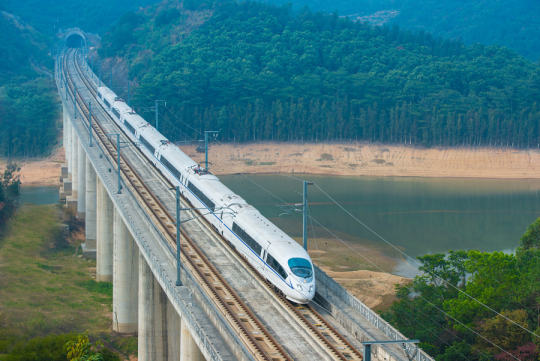
    The first idea that comes to my mind is a high speed rail network that seamlessly connects to each city’s local transit network. Imagine a Great Lakes bullet train that could zip you across the region. It would completely reorganize the spatial landscape.

    Here’s an excerpt from a recent report by the Independent Transport Commission called, Ambitions & Opportunities – Understanding the Spatial Effects of High Speed Rail:

    There has been a global shift of economic power and influence from nation states to cities and city-regions. Today’s successful cities collaborate across existing boundaries to form polycentric metropolitan regions. As a result cities function in a much less self-contained manner than they did fifty years ago. Longterm trends in the pattern of urban settlement reflect the interplay between opportunities for dispersal afforded by greater mobility, and economic and social forces promoting concentration.

    But what else could we be doing to empower the Great Lakes Megalopolis? 

    I would love to hear your thoughts in the comment section below. I think there’s a strong case to be made for thinking at the scale of the megalopolis and not just at the scale of our own backyard.

  • Gardiner East vote shows that Toronto is not yet ready to be an urban leader

    image

    Today is very sad day for Toronto. 

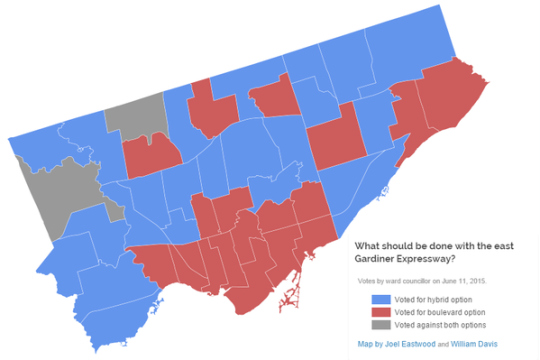
    After 2 days of debate, City Council voted this afternoon, 24-21, in favor of rebuilding the elevated Gardiner Expressway East (”hybrid” option) that runs along the city’s eastern waterfront.

    And once again, Toronto is largely divided. See above image prepared by Joel Eastwood and William Davis.

    It’s the old city of Toronto (who uniformly wanted the elevated highway replaced with a boulevard) versus the rest of the city (who for the most part voted for the hybrid).

    I can’t begin to tell you how deeply disappointed I am by not only the outcome, but also by how it happened and why it may have happened. For all of our talk about being a progressive global city, today we are clearly not that. 

    Because more than a vote on what to do with the Gardiner East, today was a vote on how we believe we should be building this city for the future. 

    When the Gardiner East was first built, the vision was one of fluid private mobility, where it would be possible to quickly circle around and across the city on an endless sea of highways. Detroit was doing it. Baltimore was doing it. Everybody was doing it.

    In other words, we were building our environment around the car. And our primary – some would say singular – focus was to ensure that the car could move unencumbered around the city. That’s why Toronto is now home to the busiest and one of the widest highways in the world.

    But despite all this, Toronto remains crippled by gridlock. And so does every other big city city in the world that has bet on cars as the solution. Why is that?

    Because that model doesn’t work.

    The I-10 Katy Freeway in Houston is 26 lanes at its widest point. It is the largest highway in the world by number of lanes. But from 2011 to 2014, commute times in some sections increased by as much as 51%. Is that because they haven’t built enough highway? How much is enough?

    By comparison let’s look at a city that has bet on transit as the solution: Tokyo. 

    The metropolitan area of Tokyo is approximately 37.8 million people. That’s more than the entire population of Canada and by most accounts is the largest urban region in the world. But despite its size, Tokyo is consistently ranked as one of the most livable cities in the world and also one of the most efficiently run.

    Interesting.

    So when I heard Councillors going on today about how a vote for the “hybrid” is a vote not to increase congestion and gridlock, it became abundantly clear that many – apparently most – people in this city still do not appreciate what it is going to take to get us efficiently moving as this region approaches 10 million people by 2041.

    This should not have been a debate about 3 minutes. That, as I’ve said before, is a red herring.

    Of course, there was lots of lip service to transit. Many seemed to agree that transit is the future. And some even went so far as to say that removing the Gardiner East and replacing it with a boulevard is the right thing to do, but that we simply can’t do it now because we haven’t made the requisite investments in transit. 

    If transit is truly what we want, then we why don’t we take the boulevard savings and put it directly into transit?

    To me it’s like saying: I really want to be homeowner, but I can’t afford it right now. So instead, I’m going spend more on rent so that I can burn through more money and make it even more difficult for myself to eventually become a homeowner.

    Because that is what happened today. 

    We voted to overspend on a stretch of elevated highway that is used by a small sliver of downtown commuters (~3%), instead of replacing it with a cost-effective surface boulevard (with similar road capacities) and then prioritizing the proven solution to urban congestion: transit.

    At the same time, we also made a number of other things clear in today’s vote. 

    We made it clear that cars matter more than our city’s public realm; that cars matter more than our waterfront revitalization plans; that cars matter more than our environment and our “efforts” to reduce GHG emissions; and, frankly, that cars matter more than our overall quality of urban life.

    I believe that cars will always be a part of our cities, but I don’t believe in putting them ahead of you and I. I guess old habits die hard. That my friends, really sucks.

  • Top 10 freeways without a future

    https://500px.com/embed.js

    Last year The Congress for the New Urbanism (CNU), which is based out of Chicago, published a report called, The 2014 Freeways Without Futures. It listed the top 10 freeways across North America that are in need of removal, replacement, and revitalization. You can download the full PDF report by clicking here.

    Here’s an introductory snippet from the report:

    The 2014 Freeways Without Futures Report lists the top opportunities in North America for replacing aging urban highways with boulevards or avenues that connect to the networks of streets. They are presented in no particular order of rank. As in previous reports, the criteria for the 2014 list is based on a number of factors: the age and design of structures, redevelopment potential, potential cost savings, ability to improve both overall mobility and local access, existence of pending infrastructure decisions, and community support.

    And here’s the list of freeways without a future:

    1.  I-10/Claiborne Overpass, New Orleans
    2.  I-81, Syracuse, New York
    3.  Gardiner Expressway, Toronto
    4.  Route 5/Skyway, Buffalo
    5.  Inner Loop, Rochester New York
    6.  I-70, St. Louis
    7.  I-280, San Francisco
    8.  I-375, Detroit
    9.  Terminal Island Freeway, Long Beach
    10.  Aetna Viaduct, Hartford

    Not surprisingly, the Gardiner Expressway is on the list. CNU is in agreement with the “remove” option currently being contemplated by Toronto City Council and will be doing their part to support the Gardiner East petition that Stephen and I created. Thank you for that 🙂

  • Real Scenes Documentary — a look at New York’s electronic music scene [Video]

    image

    I just stumbled upon a fascinating documentary series called Real Scenes. Each film explores “the musical, cultural and creative climate” within a particular city. 

    Below is Real Scenes: New York (click here if you can’t see it below). It’s an inside look at the underground music scene that has developed in Brooklyn, but that is at the same time being threatened by development and rising rents. Disclaimer: There’s a lot of f-bombs and a lot of hating on gentrification.

    [youtube https://www.youtube.com/watch?v=LDtf0uIUPuE?rel=0&w=560&h=315]

    I’ve only watched the New York video from this series, but I plan to watch each and every one of them. The other cities are Tokyo, Johannesburg, Paris, Berlin, Detroit, and Bristol.

    What’s fascinating about these short documentaries is that they give you a glimpse into a particular undertone within each city – one that would otherwise be hard to get if you weren’t living there and engrossed in the scene.

    It’s also interesting to see how some people view change within cities. 

    To some, transforming a neighborhood from one that looks like a “bomb went off” to something more pristine, is a good thing. But to others, it’s the worst possible outcome. It all depends on your frame of reference.

    Now, how do I get them to make a Real Scenes: Toronto? 🙂

    Image: Resident Advisor

  • The great intensification debate–what’s better for cities?

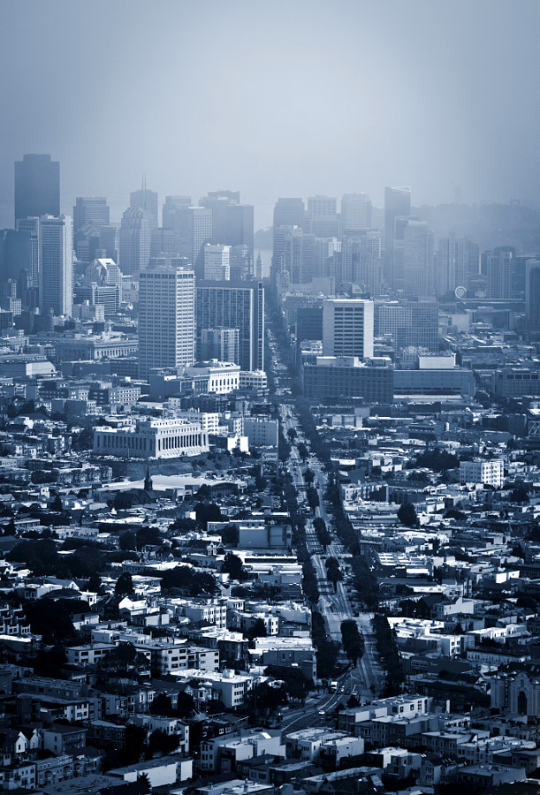
    Photograph San Francisco Bay Blues by Stefano Termanini on 500px

    San Francisco Bay Blues by Stefano Termanini on 500px

    I recently stumbled upon a great Treehugger article by Lloyd Alter called: The real triumph of the city will be seen in Buffalo (2014). The post is partially a response to economist Ed Glaeser’s popular book, Triumph of the City, which I’ve mentioned and cited many times before here on ATC.

    Lloyd’s thesis is basically that Ed is wrong in arguing that reducing the barriers to building is the most effective way to maintain housing affordability; that cities are really made out of flesh, rather than bricks and mortar; and that urbanists need to move beyond the view that a city’s past should be preserved at all costs.

    Lloyd then goes on to argue that rather than continuing to over-intensify cities like New York, San Francisco, and Toronto, we should be turning our attention to former powerhouses like Buffalo and trying to figure out how to reinvigorate those cities. The bones are already in place.

    Now, I don’t disagree that there’s lots of potential in cities such as a Buffalo and Detroit. I’ve written a lot about Detroit and I’m genuinely rooting for the city. But I don’t think it’s as simple as it sounds to shift our attention, and I don’t agree with all of the critiques of Glaeser’s work.

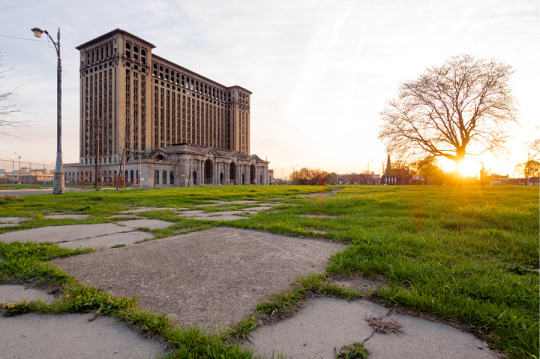
    As important as built form is, cities like Buffalo and Detroit remind us that architecture and buildings alone aren’t enough to build a city. There are countless masterpieces – such as Michigan Central Station in Detroit – that regrettably sit abandoned. You need people and communities.

    There’s also a snowball effect. 

    As a city becomes more successful, there’s a natural tendency for more people to want to be there. It’s no different than the network effect experienced by a social network. A social network without people has no value. But the more people you add to it, the more valuable it becomes and the more difficult it becomes to replace.

    So it shouldn’t come as any surprise that people will put up with expensive real estate and small apartments just to live in cities like San Francisco. That’s where they want to be. And as long as the demand to live in those cities is increasing, I continue to believe that it makes sense to build more, not less, housing and to make it reasonably easy to do so.

    At the same time, I believe whole heartedly in heritage preservation. As a trained architect, there’s a strong possibility that I would shed an actual tear should a building with heritage value be torn down in my city or in any city in the world. 

    And that’s why when I was on CBC radio last week I said that neighborhood investment needs to be a balance between preservation and progress. The Twittersphere later blasted me for using the term “progress”, but I think you get my position.

    My interpretation of Glaeser’s work has never been that he supports completely erasing a city’s past in order to make way for the future. If that is his position, then I too disagree with it. 

    My interpretation has instead been that he supports removing unreasonable barriers to development so that cities are able to supply – or can at least try to supply – enough housing to meet growing demand. This also doesn’t exclusively mean high-rise intensification. It could mean removing the barriers in front of things like laneway housing. And I continue to believe that this is a good idea.

    I don’t believe that this approach alone will solve all housing problems, but I do think it’s a great place to start.

    Thank you Lloyd for the great post.

  • Two thoughts on reviving post-industrial cities

    image

    Yesterday Adam Radwanski of the Globe and Mail published an interesting article called, Rust Belt revival: Lessons for southwest Ontario from America’s industrial heartland

    The article talks about some of the things that the Rust Belt is doing to revitalize their cities and the lessons that many cities in Ontario – which are facing similar fates – could learn from. It’s worth a read.

    I’m not going to summarize his article, other than to say that some of the key points were around tax increment financing, tax incentives, University connections, a DIY/entrepreneurial culture, and the American tradition of philanthropy – which Radwanski points out is probably the least imitable for Canada.

    And it’s this last point that I would like to focus on first. The US has a deep history of people getting rich and then giving back – certainly more so than in Canada in my opinion.

    If you think about the resurgence of cities such as Detroit, you’d be hard pressed not to think of people like Dan Gilbert. He has become the poster boy for Detroit’s resurgence by moving his companies to downtown and buying up most of the office buildings. If and when Detroit comes back (I think it’s a when), Gilbert will easily be one of the biggest beneficiaries.

    Now, you could argue that this is made possible because of greater income inequality, but there’s something to be said about powerful individuals acting on intrinsic passion. Gilbert is investing in Detroit because he personally wants to see his home city come back. And that’s hard to replace.

    The second point I would like to focus on has to do with this snippet:

    With oil’s current slide, Canada really can’t afford for it to remain a drag – and in fact there is some expectation that Ontario will instead reclaim its old role as the leader of Canada’s economic growth. Its premier, Kathleen Wynne, recently expressed optimism that plummeting oil prices and a sinking dollar will prove a boon to manufacturing. “I don’t wish for low oil prices and a low dollar for Alberta,” she said earlier this month. “But at the same time, we want our manufacturing sector to rebound. So if that [low oil price] helps, then that’s a good thing.”

    I don’t know what context this was said in, but I continue to feel strongly that we cannot rely on low oil prices and a low Canadian dollar for Ontario’s competitiveness. That is a terrible business model, and an unsustainable one. We need to figure out ways to create value and grow the economy without relying on currency differentials and other macroeconomic factors. Radwanski is right to point that out in his article.

    So let’s hope we don’t let any short term benefits go to our head. There’s lots of exciting work to be done.

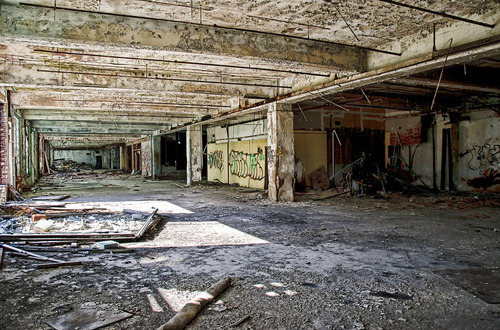
    Image: Old Detroit auto factory via Flickr