Daily insights for city builders, delivered every morning at 6 AM ET. I’m Brandon Donnelly — a Toronto-based real estate developer and founder of Globizen. I’ve been writing here since 2013.

Tag: detroit

  • Atlantic City is the next Detroit

    If you have been following the headlines over the past year, you’re probably aware that Atlantic City — the “Gambling Capital of the East Coast” — is in trouble. This year alone, 4 casinos shut their doors – including Revel, which only opened in 2012.

    To be perfectly honest with you, gambling isn’t my thing. I’ve only been to Atlantic City once, and it was really just so that I could say I had been (it was when I used to live in Philadelphia). But I know that many people derive a lot of entertainment value out of gambling.

    However, I worry when cities starting believing that a casino can fix all of their city building and economic development challenges. They are not a silver bullet. And many would argue that they cause far more harm than potential benefit. The negative socioeconomic impacts have been well documented.

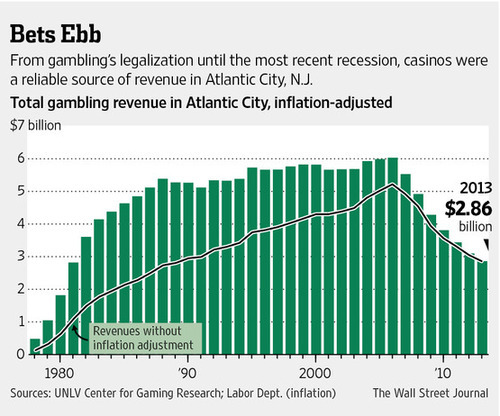
    In the case of Atlantic City, I suppose you could say that casinos “worked” – for awhile. But that’s because Atlantic City had a monopoly on gambling. In 1978 the city opened the first legal casino in the eastern United States. And that led to a boom in casinos and a spike in municipal revenue. But those revenues peaked in 2006 and have been on the decline ever since. 
    My good friend Alex Feldman argued in a recent Next City article that Atlantic City is, quite frankly, the next Detroit. It repeated the same mistakes and now it’s going to need to go through the same painful rebuilding process:

    It’s no exaggeration to say that Atlantic City is poised to become the next Detroit. In many ways, the trajectories of the two cities are similar. Both cities relied on one industry to prop up their economies — and both failed to innovate as competition increased. Similarly, both Atlantic City and Detroit failed to invest in a sense of place — casinos and factories were more successful when their customers and employees had little reason to go outside. The result: defensively built cities designed around the automobile that gave visitors little reason to stay.

    And I think he’s right. The time has come to rethink Atlantic City. Onwards!
  • The role of the private sector in city building

    image

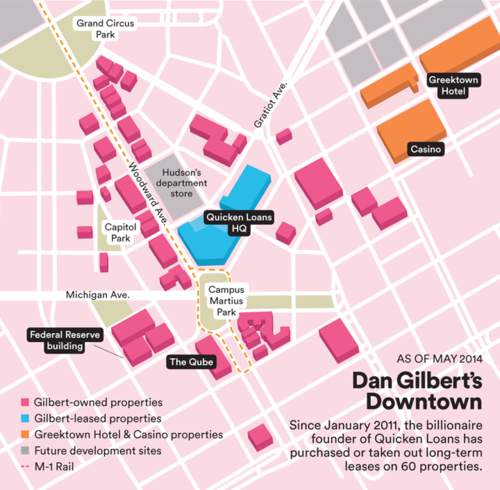
    The New York Times published an interesting and popular article last Friday called The Post-Post-Apocalyptic Detroit. It of course talks all about the efforts of billionaire Dan Gilbert, but it also talks about the initiatives of many small and local entrepreneurs who are doing their part to help revive the city – while at the same time making a profit.

    One thing that I found interesting about the article is the extent to which the private sector has taken over the responsibilities of the public sector. With only 35,000 of the city’s 88,000 streetlights actually working, the city simply doesn’t have the money to pay its bills. When I visited the city last fall, I was told that the city couldn’t even afford batteries for its parking meters. 

    So the private sector has stepped up. 

    In downtown, Dan Gilbert pays for his own security force to patrol the area 24 hours a day both on the ground and through 300 surveillance cameras. And in the Jefferson East corridor, John Stroh III – of the Stroh Brewery Company – is paying for 3,500 hours of private security in order to help transform the area into a walkable retail strip.

    It’s a model that relies on the funding and vision of rich people to catalyze change. And it strikes me as a quintessentially American way of going about it. In Canada, I’m not so sure it would be approached in quite the same way, which I think is both good and bad. I think in Canada there would be more government involvement.

    If the rich people are there and willing to step up (like they are right now in Detroit), then I would assume the capital would be deployed more efficiently and that change would happen more quickly. But if the rich people aren’t willing to step up, then nothing happens and the place declines.

    That might be an oversimplification, but I think there are differences.

    To end, I’m going to leave you with this Bloomberg video about Steve Case’s (former AOL founder) “Rise of the Rest” road trip to Detroit. If you can’t see the video below, click here.

    [youtube https://www.youtube.com/watch?v=_RUG0H4VThM?rel=0]

  • How could cities better connect all their residents to economic opportunity?

    image

    This blog post is a submission to a group blogging event being put on by Meeting of the Minds and Living Cities. The focus is on urban opportunity. Click here for more information about the event.

    Since the beginning of time, the purpose of cities has been to bring people together to socialize with one another and to generate wealth. And, today, more than ever, the potential returns of being smart and being in a global city are huge. Cities are our economic unit. They are what’s driving the global economy.

    But as the world continues to urbanize at an unprecedented rate and as the global economy becomes increasingly concentrated in select urban centers, how do we ensure that all city dwellers are connected to the economic opportunities being made available by this new information age?

    Here are 3 suggestions.

    First, we need broad and equitable access to education. I was deliberate in talking about the “returns of being smart.” Education and the right skills are even more critical today, because the labour market is not what it used to be. In Edward Glaeser’s book, Triumph of the City, he talks a lot about Detroit and how the greatest thing the city–and the car industry–did in its history was create lots of high paying jobs for people with little or no education. However it was also possibly the worst thing Detroit did because, today, the city is now stuck with that legacy. And those same high paying jobs for people with little or no education aren’t coming back. The labour market has changed. 

    Second, we need to ensure that people living in cities have the opportunity to be physically connected. That our cities offer strong transportation and mobility options and that our cities are designed to be inclusive. When I was visiting a friend in Los Angeles a few years ago and lamenting about the traffic, he responded by telling me that LA traffic is merely a socioeconomic problem. If you have the means, you get to live in desirable central neighborhoods where your commute is entirely reasonable. And if you don’t have the means, well, then you get stuck with a horrible 2-hour commute. We know that the rich will always outbid the poor for housing in any city, but as much as possible, we need to give people physical mobility so that they can then achieve economic mobility.

    At the same time, the design of individual neighborhoods and buildings matters a great deal. If you’ve ever watched The Human Scale, you’ll likely remember the line:

    “First we shape our cities and then our cities shape us.”

    As one example, the documentary talks about how masterfully modernist architecture from the 60s and 70s achieved extreme forms of social isolation. It cleansed the urban environment of any sort of public life and brought it all up into disconnected towers. The problem was that it was far too rational. The power of cities lies in their organic and evolving nature. And when you constrain them with mechanisms such as single use zoning and other restrictions, you stifle their potential to generate economic opportunities for their residents–which, as we’ve said, is one of the main reasons people choose to live in cities in the first place. 

    Finally–and this is a bit of a tie in for everything we’ve been talking about–we need to be proactive about inequality. Research shows that there’s a direct correlation between income inequality and social mobility. The more income inequality a city or country has, the less intergenerational social mobility it has–not to mention that it also leads to more crime and other negative externalities. This is a complex issue though, and I won’t pretend that it can be easily solved with a better public transit and more bike lines. It’s something much deeper and more broad. This one is about a belief that cities should be designed to enhance everybody’s quality of life and to make everybody richer, not just a few.

    Photo: Wikimedia

  • Necessary city

    I’ve spoken about global cities, such as New York and London, many times before on Architect This City. I’ve also talked about the rise of consumer cities. That is, cities with a high “urban amenity premium”, which could be great outdoor amenities or great restaurants, theatre and so on. These are places of consumption.

    Sometimes global cities and consumer cities are one and the same. But there are also cities–such as Vancouver–where I view the urban amenity premium as outweighing their status as a global city. Vancouver, quite simply, is an awesome place to live and enjoy life. I almost went to UBC for grad school because of Whistler Blackcomb and the city itself.

    Today, I’d like to introduce another type of city into the discussion mix: the necessary city. I heard about it here and, although it seems somewhat intuitive, I think it’s an important reminder that, even though a city may not be an alpha global city, it may be fulfilling a specific function for a particular industry or aspect of the global economy. It may still be a necessary city for your corporate headquarters.

    For example, Houston is the city for energy companies. If that’s your business, you likely need a presence there. For fashion and luxury, it’s Paris. And if you’re in the auto industry:

    The major global equipment manufacturers are widely dispersed, but when you look at leading global parts suppliers, they virtually all have their North American headquarters in Detroit – including the German, Japanese and Korean ones. Among them are companies like Robert Bosch, Denso, Yazaki and Hyundai Mobis. If you’re in the auto industry in America, you have to deal with Detroit. Unsurprisingly, Detroit boasts several nonstop flights to key Asian destinations.

    In essence, we’re talking about cities making themselves necessary by becoming niche experts. And what I think is interesting about this concept is that it’s likely much more attainable for a lot of cities. Most cities will never become New York. And most cities will never be able to transform themselves into the next Silicon Valley.

    But maybe those are the wrong economic development goals. It’s not about becoming the next, whatever; it’s about finding and owning a particular niche and making yourself absolutely necessary to the global economy.

  • The business of cities

    Over the past few months on this blog, I’ve started to introduce business terms into the way I describe and talk about cities. I’ve referred to residents and visitors as customers of a city, experiences within a city as products and services, and cities themselves as businesses. Until now though, I hadn’t explicitly talked about this parallel or fleshed it out in any sort of detail. But I think it’s an interesting one so I’d like to do a bit of that today.

    The reason I started referencing cities with business terms is because I think it speaks to 3 important characteristics of cities. First, cities, just like businesses, are in direct competition with each other. We rank cities. We compare GDP per capita. And they fight, or at least should, to attract the best people and to achieve economic dominance.

    Second, city prosperity can be ephemeral. We tend to think of cities as being quite permanent–centuries old–but history is littered with failed cities or cities that simply lost their economic importance (see Detroit). Consider this: The center of trade at one point was the Mediterranean Sea. Then, as the New World emerged, it shifted to the Atlantic. And now, one might argue that it’s moving over to the Pacific (and Asia). Either way, these macro shifts push certain cities to thrive and others to decline. The time horizon is longer than, say the rise and fall of Blackberry, but it’s similar nonetheless. Nothing is guaranteed.

    Third, cities have become centers of lifestyle and consumption. That’s why I previously argued that any economic development strategy should consider lifestyle, and whether or not people actually want to live in the place. In business terms, you need to offer products and services that people actually want. You need to respond to customer needs.

    And if you think of cities in this way, I think you’ll come to the conclusion that, just like businesses, strong cities require strong leadership and management. They need to ensure that they’re delivering the right products and services to their customers and that they’re staying ahead of the innovation curve.

    The switching costs may be higher for cities compared to, again, something like a mobile phone, but that doesn’t mean people won’t eventually vote with their feet and leave for somewhere better.

  • This Built America: Shinola

    If you’ve been reading this blog since last year, you’ll know that I’m hugely interested in Detroit. I went for a visit last fall and I hope to go back sometime this summer. I think the city has tremendous potential and I would love to see it come back. I’m rooting for it.

    Between people like Dan Gilbert and consumer brands such as Shinola, there’s a palatable sense of momentum developing in the city. Here’s a short video of the Shinola story from This Built America–which is a project focused on the people and companies that are rebuilding America and its manufacturing base.

  • Revisiting the Gardiner East debate

    Last week I argued that the eastern portion of the Gardiner Expressway (Jarvis Street over to the Don Valley Expressway) should be torn down and replaced by an enlarged Lake Shore Boulevard.

    To quickly summarize, here’s why I support removing the Gardiner East:

    • Now is the time to do it (before we develop the surrounding area and it becomes both more expensive and more difficult to do it).
    • It would go a long way to stitching our disconnected downtown back to the lake and realizing our ambitions for the revitalization of the waterfront.
    • Unlocking the full potential of our waterfront is hugely important.
    • In my opinion, the only way to build a big, well functioning city, is on the backbone of public transportation. And this—the tearing down of the Gardiner East—could represent that paradigm shift.
    • It is a portion of the Expressway that has relatively low traffic volumes.
    • It’s the cheapest option on the table.

    Somewhat surprisingly though, a lot of people disagreed with me. They told me that adding anything to our already long commutes would be simply unconscionable and that they would not support it, no matter how much it improved our waterfront.

    So in the spirit of avoiding confirmation bias (that is, only seeking out things that reinforce an already established belief), I thought I would share the following article: “Like It or Not, Most Urban Freeways Are Here to Stay.” It’s from Atlantic Cities and there are 3 key take-aways that I’d like to point out.

    First, I thought it was interesting that the interstate system in the United States was, from the onset, always conceived of as a solution to urban congestion. I always thought it was about connecting the country, but that, apparently, was a secondary goal.

    Second, cities all across North America are engaging in the same debate about what to do with their aging highways. Detroit is debating. New Orleans is debating. And so is Syracuse. Toronto is not alone. But we could be alone in taking the lead on this issue.

    Third, the author basically acknowledges that, while not ideal, we’re stuck for the time being with all these freeways and that the better solution is going to be a really tough slog:

    “This is not an easy assignment, seeing as how cars are purchases we make with our hearts, more than our heads. Logic won’t convince Americans to change their ways. What will? Maybe, over time, prohibitive fuel prices and withering tolls, and, most importantly, investment in useful and convenient public transit. Only when the carrot is irresistible, and the stick stings too sharply to bear, will the shift begin, and it will take years to play out.”

    And while I would agree that it’s not going to be easy, that’s par for the course with anything truly worthwhile. If it were easy, everyone would be doing it. But they’re not. And that’s why there are leaders and there are followers.

    People in Toronto like to talk about how our City sometimes lacks vision. Well, here’s our chance. I’m not worrying about what the commute is going to be like tomorrow, because I know there’s an even better solution for that problem. I’m worried about something even bigger. I’m worried about the kind of city we’re all going to leave behind to our children.

  • A Third Coast Megaregion

    The distance between Chicago and Quebec City is roughly 1,000 miles (or 1,609 km). There are 6 major cities and a population of over 25 million people. You have the 4th and 5th largest cities in North America (Chicago and Toronto); the largest city in Canada; the capital of Canada; 2 different languages; 2 different countries; and 5 different states/provinces.

    image

    Now imagine if all of these 6 cities—Chicago, Detroit, Toronto, Ottawa, Montreal and Quebec City—were effortlessly connected through a high speed rail network, allowing you to travel from one end to the other in just over 5 hours. How would that impact the movement of people, goods and services across the region? How would it change our economies if you could wake up in Detroit and, without any lead time, travel 1 hour and 15 minutes to Toronto for a meeting?

  • Thinking of cities in terms of hardware and software

    Ted Serbinski is a Partner at Detroit Venture Partners. He works with billionaire Dan Gilbert. And obviously lives in Detroit. 

    On Monday of this week he wrote a post called, 24 Business Insights I’ve Learned from Billionaire Dan Gilbert. It was clearly inspired by a blog post Gilbert did last year called 27 Things I’ve Learned in 27 Years. They’re both great reads.

    But in particular I liked Ted’s 22nd point called “balance the hardware with software.” It goes like this:

    “Another interesting insight is Dan’s approach to rebuilding Detroit. You need to balance what buildings you own (e.g., the hardware), with what companies lease them (e.g., the software), along with properly connecting building to building via placemaking (e.g., more software), to create a truly vibrant area.”

    It’s an interesting analogy and I think it’s incredibly relevant to Detroit. The City of Detroit has great hardware. As I said before, the city is filled with gorgeous historic buildings. The bones are there. But hardware is useless without the right software. 

  • Video: Detroit just needs 10 years

    As some of you know, I was recently in Detroit. I went to check out the city because I heard about all the positive things that were starting to happen. Well here is a video that does a good job of summarizing some of that momentum.

    The first lady being interviewed in the video is Sue Mosey. She’s the president of Midtown Detroit Inc., which is a highly influential community development corporation. As a result of this, she’s become affectionately known as the “Mayor of Midtown.”

    I actually stayed in her B&B called The Inn on Ferry Street. I would highly recommend it if you’re looking for an affordable boutique place in Midtown Detroit.

    The video ends with everyone saying that they think Detroit needs 10 years before we’ll really see it come back. That actually doesn’t feel that far away.

    Credit goes to Alex Feldman for sending me this video. Thank you.