Daily insights for city builders, delivered every morning at 6 AM ET. I’m Brandon Donnelly — a Toronto-based real estate developer and founder of Globizen. I’ve been writing here since 2013.
I first wrote about Manhattan’s proposed congestion charge back in 2018. Naturally, some people supported it and some people opposed it. Four years later, it was reported that the charge was still being considered for the area of the island south of 60th Street, and that it could generate an additional $1 billion in revenue for the city’s transportation authority. But then in June of this year, right before the charge was set to come into effect on June 30, 2024, New York Governor Kathy Hochul said “nah, let’s pause this indefinitely.” And at that point, it felt mostly dead.
Nope: A revised tolling plan has just been announced — the charge has been reduced from $15 to $9 — and Hochul is now trying to jam it through before Trump takes office in January. Trump opposes the charge and has branded it the “most regressive tax known to womankind”, so there’s a real deadline here. This could get interesting. Do you think it will actually happen, some 6 years later? (In reality, the timeline is far longer. Congestion pricing also looked promising during the Bloomberg era, but then similarly died. And I’m sure there were even earlier proposals.)
As a general rule, road pricing isn’t popular. But that’s not because it doesn’t work. The problem is that it works too well, and people don’t like the idea of driving less and paying for roads (that currently have a zero marginal cost).
Here’s a recent study by Robert Bain and Deny Sullivan that looked at just how well it can work. In it, they examine 76 data points from 16 countries, including roads, bridges, tunnels, and cordons (areas).
The question: What happens to demand once the marginal cost of using a road goes from $0 to some cost greater than zero? (As part of this, they also looked at whether the road or bridge in question has viable alternatives.)
The results:
The median traffic reduction was 25%. But the interquartile range was -17% to -44%. This is all very significant. Said differently, the traffic impact in nearly a quarter of the examples was -45% or more. So almost a halving of traffic congestion.
These reductions are obviously a function of the cost of using each road, but regardless, the overarching takeaway remains the same: You may not like or want road pricing, but it totally works.
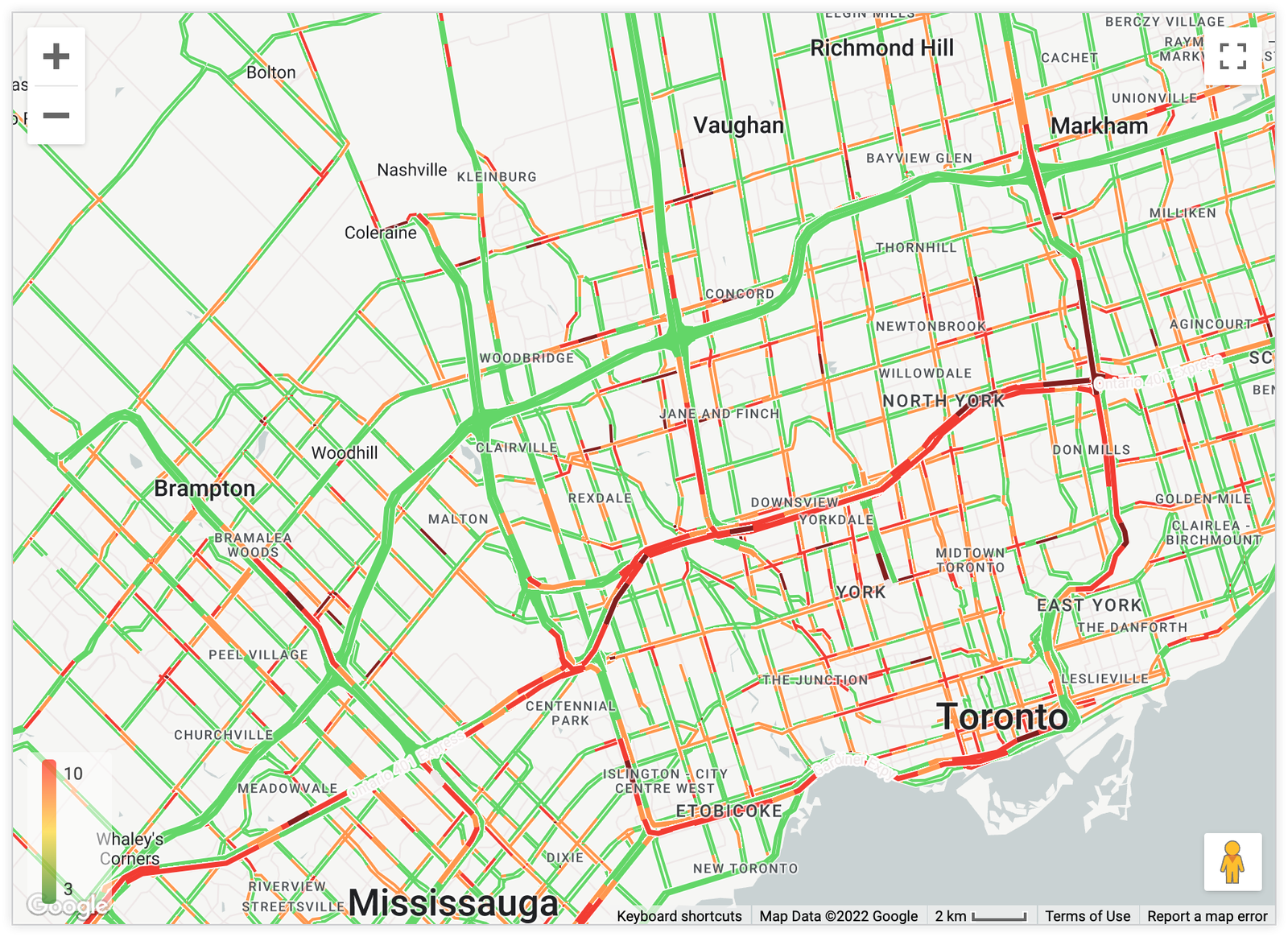
In Google’s guide to its maps, there is a section on live traffic congestion, and in it, this image is used:
It is a map of the Toronto region, and not surprisingly, it is showing traffic congestion on the 401 highway. But what’s interesting about this image is that there’s no traffic at all on the 407 express toll route. (This is the green highway running generally parallel and north of the 401, for those of you who aren’t familiar with Toronto.)
This is, of course, accurate. A 2019 study by the Canadian Centre for Economic Analysis called the Economic Impacts of Highway 407 found that, at the time, an average of 413,000 drivers were using the 407 highway each weekday. And of these trips, more than 85% of vehicles were travelling at or above 100 km/h. This translates into a traffic congestion index of almost zero.
During this same time, the highway 401 through Toronto showed that about 85% of vehicles were travelling below 50 km/h. Meaning, lots of congestion. This also had a significant impact on collision and fatality rates. On the 407, both were about half of what they were on the 401. (I couldn’t find any more decent data, but if you have it, please share it in the comments.)
Naturally, there are people who think the 407 is too expensive and that it shouldn’t have been privatized. But the reality is that it works; really well in fact. And this is the only method that has been proven to reliably combat congestion. We can go ahead and spend a gazillion dollars building a new tunnel under the 401, and double the number of lanes (it’s already 18 lanes at its widest point), but we already know that it won’t solve our congestion problem.
Either we price roads and congestion, or we don’t. But if we don’t, then we need to be brutally honest with ourselves about the economic trade off that we are making: free/underpriced roads = traffic congestion, and accurately priced roads and congestion = less traffic. The choice is ours. But know, there’s no such thing as a free lunch.
In 2019, London implemented something known as an Ultra-Low Emission Zone (or ULEZ). The intent was to reduce the number of older and higher-polluting vehicles entering and driving around the city.
It works like this: If you have a vehicle that does not meet the ULEZ emission standards, you need to pay a daily charge of £12.50. This applies all day every day (except Christmas) and it is in addition to London’s congestion charge.
It’s also done entirely through license plate cameras. If you enter the zone, don’t have an approved plate, and don’t pay the charge within a few days, you get sent a fine. The result is that London’s ULEZ is now the largest clean air zone in the world (at least according to London).
It also achieved its intended purpose. In 2017, only 39% of cars entering London would have met the ULEZ emission standards. Today the number is over 95%. Meaning, most people don’t actually pay the charge.
At the same time, nitrogen dioxide levels in the zone have more than halved, improving overall health outcomes. It’s a perfect example of taxing the things you want less of. What’s also interesting is that there were positive second-order consequences.
Vehicle traffic as a whole declined by about 9% in the first year, with no evidence of displacement to other areas. And according to this research study, it actually encouraged more kids to walk and take other forms of “active transport” to and from school.
In this last one, he specifically talks about things like price gouging (starting with the grocery industry) and apartment rent controls. Each is worth a full read when you have the time, but here I’ll leave you all with a few city building-related thoughts.
Marks describes economics as the study of choice. And within these choices, there are many complicated moving pieces and second-order consequences. Take, for example, rent control in New York City. What rent control does is stop the free market from being able to freely set rents. The result:
A person in favor of this arrangement would argue that it maintains affordability and diversity. What it means in purely economic terms is that some people who couldn’t afford to live in New York City if rents were set by free-market forces are able to live there if they’re lucky enough to secure an apartment with regulated rent. But other people who would like to live in New York City and can afford higher rents can’t do so because there are no apartments for them. And lastly, landlords that have apartments that are somehow unregulated can command higher rents than would be the case if additions to the supply of apartments weren’t being discouraged. It’s a matter of personal philosophy whether this is good or bad. But clearly, the laws of economics and the actions of free markets aren’t at work in New York City. Someone in government is making the decisions.
Much like inclusionary zoning in the case of new housing, the tradeoffs with regulated rents are that you get (1) less overall housing supply and (2) more expensive prices for the people that can pay market rents.
You could argue, as Marks suggests, that these are acceptable outcomes; but regardless of your opinion, there are real consequences to this policy decision. There’s no such thing as a “free lunch” in economics, and consequently there’s no such thing as no-cost affordable housing. The question is: Who pays?
Going back to the topic of traffic congestion from yesterday’s post, Toronto’s general reluctance to implement any form of road or congestion pricing is also an economic choice. We have priced our roads so cheaply that demand is always going to outstrip supply. And this is expected. What we are experiencing today is a natural market outcome.
Targeting bike lanes as part of the problem is meant to counter this by increasing road supply. Less bike lanes means more space for cars, right? But the second-order consequence of this choice is that you push people off their bikes (which take up less road space) and into cars (which take up more road space). So demand is also likely to increase.
The stark reality of solving traffic congestion is that it will require greater change. It will mean fewer people driving, more people taking transit and biking, and the people who do continue to drive will have to pay more for it.
Of course, this is not what any politician wants to talk about. As Marks says: “In the world of politics, there can be limitless benefits and something for everyone. But in economics, there are only tradeoffs.” The tradeoff we have decided to make is cheap roads in exchange for crippling traffic congestion.
There is a simple tool to combat traffic congestion that has been proven to be effective. There are real-world examples of where it has been deployed to great and long-lasting success. It’s called road pricing. And we seem to be deathly afraid of it.
This is even if the benefits are real and measurable:
Jonas Eliasson, director of travel accessibility at the Swedish Transport Administration, has first-hand experience with the effects of the congestion charge implemented in Stockholm in 2006. Public polling showed two-thirds of voters were against the road-pricing plan before it was introduced in a pilot program. A local politician called it the “most expensive way ever devised to commit political suicide.” But after it began, Stockholm traffic levels dropped by 25 per cent, more than double initial estimates. In a subsequent referendum, Stockholm residents voted to adopt the congestion charge permanently.
There are lots of reasons why road pricing is commonly opposed, but at the end of the day, it works, and we know all too well — especially here in Toronto — that the status quo sucks:
“Over the years, transportation economists and planners have pointed out that there really is no other solution to traffic congestion than more efficient pricing,” he said in an interview. “So every time somebody said ‘No, I don’t want road pricing or congestion pricing,’ they’re actually saying, ‘I want traffic congestion.’”
I’ve been writing about this topic for almost as long as I’ve been writing this blog. So at this point, I think we just need to run a pilot. No more studies and reports. No more protracted debates.
Let’s try it out and see how many people prefer (1) less traffic congestion and (2) more money for alternative modes of transport.
Boy, congestion charges are a pain to implement. Back in 2018, I wrote that New York City was considering a congestion charge for drivers entering Manhattan below 60th Street. Then in 2019, about a year later, I followed up with this post saying that the plan could be adopted as early as April of that year!
That didn’t exactly happen. But I followed up again with a post in 2022 saying that New York City was still considering a congestion charge. And ultimately, it did finally get approved, even if it did take much longer than expected. It was rebranded a congestion relief zone (“relief” sounds a lot less offensive than “pricing”), and it was set to come into effect on June 30, 2024.
This remained the situation until the first week of this month, which is when NY Governor Kathy Hochul held a surprise press conference and announced that the congestion relief zone would be placed on “indefinite pause.” I think that means cancelled. And it happened less than a month before the state was finally set to start collecting money.
There is a legal question around whether she actually had the authority to intervene in this way, but let’s put that aside for now. Irrespective of that, this is a disappointing outcome precisely because we know that road pricing works. If you have a traffic congestion problem, price it, and then you will have less of it.
What’s even more disappointing about this particular instance, though, is that many of us were looking to New York City to show us the way. We were looking for the most walkable and transit-rich city in the US to show people that, hey, road pricing works, and it won’t decimate your CBD.
It is shocking to me that traffic congestion is allowed persist in the way that it does in our cities, and that there remains zero political will to actually address it. Instead of action, we like to preoccupy ourselves with red herrings. If only we didn’t have streetcars, Ubers, and so many bike lanes, then there wouldn’t be congestion.
So what hope do we have now that even New York won’t do what is bold and right? Lots, as always. Cities, now is your chance to do what New York was too scared to do. Who will lead?
If you were a city-state only slightly larger in area than the City of Toronto, you would think about space very differently. There would be no option to just sprawl further out. And that is the case for Singapore, which is approximately 734 km2 compared to Toronto’s 630 km2.
So it’s no wonder that Singapore carefully manages how people use and own cars. Not only were they the first country in the world to implement a congestion charge (road pricing), but they also force people to buy 10-year “Certificates of Entitlement” in order to own one.
These are auctioned off every 2 weeks and the overall supply of them is controlled by the government.
Currently, the starting price for a COE is S$104,000 (roughly the same in Canadian dollars). This is a record high and up nearly 3x compared to 2020 when fewer people wanted to own a car. However, if you’d like a COE that works on all sizes of cars, that is right now S$152,000.
It’s hard to imagine a system like this ever flying in a large country like Canada. But if Canada were the size of just Toronto, you can be sure that we would likely have no other choice. That said, this is more or less how we treat new housing: we’ve made it difficult and expensive for new entrants.
New York City is set to become the first in the US to implement a congestion charge (a form of road pricing). I first wrote about this back in 2018, and then again in 2019, but now it is looking more and more like it may actually happen sometime next year.
I think all urbanists agree that this is an important step in the right direction. But some are now worried that New York isn’t going about it in the right way. Here is an excerpt from a recent Vice article by Aaron Gordon:
With all these plans, you could be excused for thinking New York is doing congestion pricing—a potentially transformative policy that would be a first in the nation—right by not only charging drivers to access some of the densest, most valuable land in the world, but also giving them alternatives. Unfortunately, New York isn’t doing that, and in fact looks set to completely screw up congestion pricing so badly it may discredit the policy in a way that makes it harder for other cities to adopt it. Rather than approaching it as a lynchpin to a wide-ranging effort to reshape Manhattan’s relationship to the private car, congestion pricing has become solely about money—specifically, paying off enough of the credit-card bill New York has run up with a variety of ill-conceived and poorly-executed projects that it can get more credit cards.
You can rightly say that this is decades in the making. Mayor Bloomberg first proposed the idea back in 2007, and I’m sure there were others before him with a similar idea.
So Gordon raises a valid point: It’s important that NYC gets this right. Otherwise, it’s going to be that much more difficult for other North American cities to even think about implementing road pricing.
For next year’s budget (2024), the City of Toronto is projecting a $1.5 – $1.7 billion budget shortfall. And over the next 10 years, this shortfall is expected to grow to nearly $47 billion if changes aren’t made. This is according to a recent report prepared by Ernst & Young and Strategy Corp. So right now, all of this is being looked at and debated by Council.
Where are we going to get this money?
One persistent debate is whether the city actually has a revenue problem, or whether it’s simply an expense/spending problem. I can’t say that I’ve scrutinized the city’s expenses at any length, so I’m not going to get into that level of detail today. For this post, I’d like to focus on two specific things. The first is property taxes.
Here is a figure, from the report, showing residential property tax rates across southern Ontario:
What you will see is that Toronto has the lowest rate of the 35 municipalities that they looked at. Now obviously there are some nuances to consider. The average home price in Toronto is higher than it is in, say, Sault St. Marie. Toronto also has a large commercial property tax base. But even still, historically speaking, Toronto has tended to increase its residential property taxes at or below the rate of inflation.
This is a problem. And it is the exact same problem that we have talked about on this blog in regards to residential rent controls. If you own an apartment building where the rents are capped and your expenses are, therefore, growing faster than your revenue, you are (1) highly incentivized not to invest in the apartment (you can’t afford to) and (2) eventually going to hit a financial wall.
Sound familiar? As far as I can tell, that is, at least partially, what is happening here.
Secondly, one of the first things that I did when I opened the report was run a search for “road tolls” and “congestion charges”. Regular readers of this blog will know that this is something I feel strongly about. Here’s what I found:
In 2017, when the City considered implementation of tolls for the Gardiner and the DVP, staff estimated that a $2-per-trip toll would generate $5.6 billion in 10 years. The province has refused several requests to consider these options, with the Minister of Transportation rejecting any discussion of uploading or tolling as recently as December 2022.
This is also a problem. One of the general rules with taxes is that you should ideally tax the things you want less of. Hmm. So why not tax traffic congestion? There is no question that it works. There’s lots of evidence from all around the world. We just lack the political will to actually do it. Instead, we pay lip service with solutions that don’t work.
At the same time, if we were to actually implement road pricing, I don’t believe that a flat toll is the way to go. $2 also seems low. The best practice is dynamic road pricing that fluctuates based on actual congestion levels. Meaning, if you’re driving at 5am, expect a low rate. And if you’re driving at 5pm, expect a high rate.
Virtually overnight, we know this would do at least three things: (1) it would reduce/eliminate traffic congestion (congestion levels would become a function of pricing); (2) it would reduce overall carbon emissions in the city; and (3) it would take a meaningful chunk out of this $47 billion budget shortfall.