Daily insights for city builders, delivered every morning at 6 AM ET. I’m Brandon Donnelly — a Toronto-based real estate developer and founder of Globizen. I’ve been writing here since 2013.

Tag: congestion charge

  • Manhattan is still looking at a congestion charge for south of 60th Street

    We talk a lot about congestion charges and road pricing on this blog. Here’s a list of some of those posts. I found 46 that were tagged with “road pricing.”

    I continue to believe that it’s the only way that big cities can effectively solve the problem of traffic congestion. It’s not being caused by the bicycle lanes that were just added to your street. It’s not the new COVID street patios. And it’s not the new apartment that was just built with too many parking spots.

    The problem is mispricing.

    If you want free roads, then you don’t get free-flowing traffic. That’s how this equation works, which is why I have always thought it a good idea to dynamically price roads based on demand, and then to direct those funds toward more efficient forms of mobility — such as transit.

    Despite all this, it’s not a very popular approach in this part of the world. Toronto looked at road pricing back in 2016, but we got nervous and backed away from it. New York City has also been looking at a congestion charge for Manhattan south of 60th Street for at least 4-5 years. But this one appears to still be on the table.

    According to this recent CityLab article, New York’s congestion prices could look something like this (note that this chart includes other pre-existing tolls):

    But with some exceptions (I think this is an interesting approach):

    Primary residents of the Manhattan central business district, which is south of 60th Street, and New York State residents with adjusted gross income of less than $60,000 would be eligible for a state tax credit equal to the amount of the new tolls, paid during the taxable year.

    In total, this current pricing scheme is expected to generate an additional $1 billion in annual revenue for the city’s transportation authority. The MTA also plans to bond against this revenue and raise an additional $15 billion for new transit projects.

    This sounds like a reasonable approach to me.

  • Free roads or free-flowing traffic?

    If you are a longtime reader of this blog, you’ll know that I am a supporter of road pricing. I believe it’s the only way to realistically solve the problem of traffic congestion and I believe that underpricing roads (such as not charging for them) isn’t fair and equitable to taxpayers, especially given our need to shift to more sustainable forms of mobility.

    Todd Litman’s recent opinion piece in the Globe and Mail is a good reminder of these points:

    Also, new highways are far more expensive than most people realize, typically costing tens of millions of dollars for each kilometre of lane. Considering land, construction and additional operating expenses, the cost-recovery price for additional highway capacity – the toll required to repay its incremental costs – is typically 50 cents to $2.00 per vehicle-kilometre, far more than what motorists pay in fuel taxes.

    The law of demand is a fairly simple economic concept. It states that price and quantity demanded have an inverse relationship. The more you charge for something, the less demand there will be. And the less you charge for something, the more demand there will be.

    So it shouldn’t come as a surprise to anyone that when you underprice road and highway usage, you get lots of demand — oftentimes too much demand. As Litman argues in his article: “You can have free roads or you can have free-flowing traffic, but it is not economically feasible to have both.”

    Photo by Denys Nevozhai on Unsplash

  • Vancouver is probably getting transport pricing

    Earlier this month, Vancouver City Council approved a plan that will have staff developing a “transport pricing” strategy for the city’s core. (Transport pricing is just another term for road pricing or congestion pricing.) The plan is for staff to go away and work on this and then report back to Council with a pricing strategy sometime in 2022. At that point Council will look to approve the plan and it will all get implemented by 2025. Or at least that’s the plan. I remain somewhat skeptical because Vancouver certainly isn’t the first Canadian city to look at pricing its roads and congestion. Toronto has tried and failed. And so if Vancouver does end up doing this, they’ll likely be the first city in the country.

    So why are they doing this, or least trying to do this? Well, if you’re a regular reader of this blog you’ll know that I’ve been a supporter of road pricing for many years. Lots of old posts over here. But in the case of Vancouver, their stated goals are really as follows: 1) They want to reduce congestion and encourage people to use other forms of mobility; 2) they want to reduce carbon emissions by 50% by 2030; and 3) they want another revenue stream that can be used to fund things like transit and active transport. Put differently, it’s about pricing/taxing the things that we want less of and then using that money to pay for the things we want more of.

    Some of you might be wondering whether this is a good idea at a time when the centralizing pull of cities is being called into question. But I think it’s important to keep in mind that Vancouver thinks it needs at least five years to implement its transport pricing. We’ll be living through the roaring twenties by then. I am also a firm believer that cities are going to snap back significantly faster than most people think.

  • Portland is considering whether to solve traffic congestion

    image

    Chris Hagerbaumer is the deputy director of the Oregon Environmental Council. She recently delivered the below testimony on “variable traffic-based tolls”, a form of road pricing. This is something we have talked a lot about here on the blog. 

    Oregon is currently looking at implementing this on two freeways in Portland, which is why Chris delivered this testimony. And as many of you know, I am very much in support of this demand management approach. So here you are: why congestion pricing makes sense for Portland (taken from City Observatory).

    ——————————————————–

    The question in front of you is: how do we actually solve congestion, solve it in a way that is the least cost to the taxpayer, and in a way that doesn’t result in more pollution. When we add more supply (in other words, build more roads) we end up exactly where we started when it comes to congestion (due to induced demand), we spend billions of taxpayer dollars (much of which comes from drivers who aren’t the ones demanding more road space), we harm surrounding communities as highways encroach into neighborhoods, and we pollute the air and heat up the planet.

    Induced demand is the fact that when you add freeway capacity it induces longer trips, more sprawl and more driving. Traffic is like a gas, expanding to fit whatever space there is. In one infamous example, Texas spent nearly $2.8 billion expanding Katy Freeway to 26 lanes and congestion has actually worsened.

    Building new roads is a supply-side solution that simply doesn’t work.

    An effective, least-cost, environmentally sound way to address congestion is the proposal before you: congestion pricing to manage demand. Drivers pay an automated fee to enter highly congested roads at peak hours; in return, they travel smoothly and reliably, getting where they need to go on time. Prices are set at the lowest possible level to free up just enough road space to eliminate bottlenecks.

    When you eliminate bottlenecks and get traffic flowing freely, you have—in essence—added capacity. You no longer need to add new lanes, you save taxpayers a bundle, and you reduce dangerous auto and truck exhaust.

    Congestion pricing is a demand management solution that’s proven to work and does so in cities around the world. Drivers opposed congestion pricing at first: no one wants to pay more. But that opposition of 60% or more turned into support of 60% or more after congestion pricing was implemented. People’s opposition turned to support because they now get that it works—they experience the value.

    Equitable application of congestion pricing absolutely requires mitigating diversion to local streets. But note that congestion pricing actually pulls many drivers who were already cutting through local roads back to the highway because those drivers who were stuck in traffic now have an option to get where they need to go, on time, for a small price.

    Equitable application of congestion pricing also requires significantly increasing transit service and other travel options in the corridor and considering other means to make the system work for low-income commuters who must drive during peak hours, such as targeted discounts or exemptions.

    We think of highways as free and we think of driving as freedom, but by investing almost solely in infrastructure for cars over most of the 20th century and into the 21st century, we created a transportation system that is costly not only for our pocketbooks, but for our very health and wellbeing and our region’s economic prosperity, a transportation system that contributes to the existential risk of runaway climate change.

    You have an opportunity to make a decision that will lead to less time stuck in traffic, healthier air, and more economic prosperity for the region and state. We hope you embrace that opportunity.

    Photo by Zach Savinar on Unsplash

  • Road pricing for whom?

    New York City is considering a congestion charge for drivers entering Manhattan below 60th street. It is part of Governor Cuomo’s Fix NYC plan. But we all know how difficult these things are to implement.

    Last month, Felix Salmon wrote a piece in Wired where he argued that our cities are dying of traffic congestion and that the cause is ride-hailing services like Uber and Lyft. The solution: A tax on ride-hailing services.

    The article elicited a few reactions, including this one by Charles Komanoff over at Streetblogs and this one by Joe Cortright over at City Observatory. Joe’s message: “The problem isn’t the ride-hailed vehicles, it’s the under-priced street.” 

    Precisely.

    Felix later followed-up with a post on his blog where he clarified that the reason he loves this idea – of taxing ride-hailing companies, not riders – is that it’s far more politically palatable than a blanket tax on all cars. I don’t disagree.

    Which is why I think my idea is something which is eminently politically possible, in contrast to congestion pricing, which has been implemented exactly nowhere in the USA.

    Americans love their cars, and they love the freedom that cars represent, and they hate the idea that they should be taxed for driving their cars. Tolls on roads and bridges are bad enough, but a fee just to drive in to a city?

    That said, I’m with Charles and Joe. 

    Last year, it was reported that roughly 25% of all Uber trips in New York City were UberPool trips. I’m not sure what the number is today, but these are people who are car pooling to get around. That’s generally considered to be a positive thing.

    Are these really the trips we want to be discouraging (and singling out) with a charge simply because we don’t have the moxie to do what is right and makes rational sense?

    Photo by Austin Scherbarth on Unsplash

  • Stockholm’s congestion charge reduced car traffic by 20%

    Stockholm has a congestion charge that is used to reduce traffic volumes in the center of the city. Toronto does not. We looked at it, actually fairly recently, but then we lost our nerve.

    Stockholm’s congestion charge was first implemented on a trial basis starting in January 2006. Trials and pilots have become a common way to actually create positive change. Otherwise the status quo bias may simply be too strong.

    When Stockholm started the trial back in 2006, public support was very low. Maybe 30%. But as soon as it was implemented, car trips dropped overnight by 20%. Once people saw the benefits, support grew – hitting around 70% by 2011.

    Here is a brief Street Films video with Stockholm’s Director of Transport, Jonas Eliasson, talking about their experience with congestion pricing. If you can’t see the video below, click here.

    [vimeo 244771087 w=640 h=360]

  • Toronto exploring road pricing on downtown highways

    Road pricing is on the table in Toronto. (Somebody has to fund the expensive Gardiner Expressway East rebuild.) On March 11, 2016, the City issued a Request for Proposal for: “Options for Establishment of Toll Facilities on F.G. Gardiner Expressway/Don Valley Parkway.”

    As a vocal supporter of road pricing, I am happy to see us headed in this direction. And I bet that today’s post will just be the beginning of my ruminations on this topic.

    Because naturally, it raises a lot of questions:

    Should the pricing be fixed or variable? Similar to how Uber’s surge pricing model is intended to ensure that there are always enough drivers on the road, should our road pricing model strive to eliminate traffic congestion by increasing the price of the road as demand rises beyond road capacity? I like the idea of a “congestion charge” rather than just a road toll. There’s something very efficient about it.

    Who should pay? Should anyone and everyone who uses the road pay? Or should it just be be non-Toronto residents who aren’t already paying property taxes in the city? I would imagine that this latter scenario would be easier for Toronto politicians to get behind, since there will obviously be a segment of people who flat out don’t want road tolls/pricing. But if we stick with the principle that it’s a “congestion charge”, then everyone should pay. It doesn’t matter where you live when you are demand trying to exceed the available supply of road.

    (I’m running a Twitter poll right now with this exact question. At the time of writing this post, “everyone should pay” is winning.)

    Should electric vehicles be exempt from the road tolls or congestion charges in order to help accelerate our transition away from fossil fuels? With Tesla getting ready to announce its mass market Model 3 (price $35,000), I’ve been thinking lately that the car I currently own may very well be the last gasoline car I ever own.

    It’s still early days for road pricing and our mayor doesn’t seem to be a fan. So who knows how far we’ll get with this RFP. But I for one hope that we find the courage to make the difficult decisions and that this new revenue stream is leveraged for the purpose of building more sustainable forms of urban transport in this city. 

    Let’s make a 50 year decision and not an election cycle decision.

  • New startup wants to solve urban congestion through data and lotteries

    image

    If you’re a regular reader of Architect This City, you’ll know that I’m a supporter of congestion and road pricing. Any valuable good or service, such as a road, that’s offered for all intents and purposes as free, will never be able to keep up with demand. You need to price it.

    However, the political risk associated with implementing something like this has made it such that few cities around the world have done it. London and Singapore are the two most common examples.

    The more populist solution is to simply build more roads and highways, even though study after study shows that this doesn’t work. If it did, we would have already solved the problem of traffic congestion. And we most certainly haven’t.

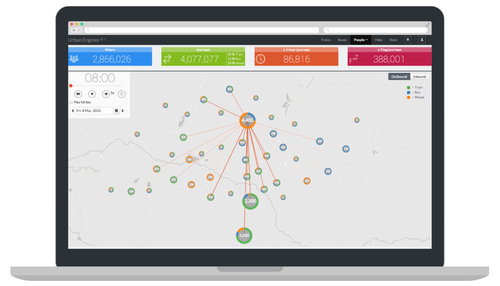
    Which is why I’m excited about a new startup that recently launched called Urban Engines. Their solution is twofold. It’s based on incentives and on treating people and cars in cities as sensors that feed back data into their network. Here’s a brief video. If you can’t see it below, click here.

    [youtube https://www.youtube.com/watch?v=oaCp5Tl-uAc]

    The data piece is almost a no-brainer (provided they can get the data). The more data we can collect about the way people and cars move in a city, the more they’ll be able to optimize and manage the flows. The possibilities are endless.

    But what I found really interesting is their incentives based approach. Typical road pricing methods are, one could argue, a punitive approach. As traffic increases so does the price of the road. (I like to look at it as efficient pricing.)

    With Urban Engines, their approach is the opposite: it’s to reward people–through money and lotteries–for driving during off peak times. It’s smart because selling a reward program to cities will be a lot easier than selling a new charge.

    Overall, this a great example of how startups are stepping up to solve some of our most important societal problems. For more information on Urban Engines, check out their website and this writeup on CityLab.