Daily insights for city builders, delivered every morning at 6 AM ET. I’m Brandon Donnelly — a Toronto-based real estate developer and founder of Globizen. I’ve been writing here since 2013.

Tag: city council

  • Remember unfunded inclusionary zoning?

    Over the weekend, we spoke about how the “GTA condo market is in a state of economic lockdown.” What this generally means is that the math isn’t making sense to build new condominiums. And so the market is necessarily pausing.

    We spoke about what this will likely mean for supply in the coming years, but I think it’s also interesting to talk about this in the context of something else: unfunded inclusionary zoning.

    As a reminder, inclusionary zoning is, in its most basic form, a requirement to build a certain amount of affordable housing as part of new housing developments. And what I mean by “unfunded” is that there are no subsidies or other incentives being provided to the project.

    This means that the cost of providing this housing — and there is an additional cost — needs to be shouldered by the project, which ultimately means the market-rate units need to pay for it.

    Which is why if you look at most policy studies, you’ll often find recognition that, because of this economic reality, IZ tends to work better in areas where home prices/rents are higher. And again, that’s because the market-rate homes need to shoulder the cost.

    We have questioned, many times, on this blog, whether this is the right approach to delivering affordable housing, but I think this question becomes even more critical in our current market environment.

    If the entire market is, for the most part, in a state of economic lockdown, should we really be layering on additional costs and making it broadly more difficult to build any sort of new housing? It seems counterintuitive.

    For more on this topic, check out this recent Sightline article by Dan Bertolet.

  • Toronto’s elimination of most parking minimums is now official

    We knew it was coming. But it’s important and worth mentioning again. This week, Toronto City Council adopted new Zoning Bylaw Amendments that will remove most parking minimums across the city. We now join many other cities across North America who have done similar things in order to try and encourage more sustainable forms of mobility.

    If you’d like to take a spin through the draft amendments, you’ll find them linked here. I haven’t gone through them in detail, but I did do a word search for “maximum” given that this week’s adoption represents a pretty clear change in perspective. Here’s an excerpt from the staff recommendation report that speaks to what I’m talking about:

    Recognizing these challenges, this review of the parking standards in the city-wide
    Zoning By-law 569-2013 was guided by the principle that parking standards should
    allow only the maximum amount of automobile parking reasonably required for a given
    use and minimums should be avoided except where necessary to ensure equitable
    access. The previous review, which began in 2005, was guided by the principle that the
    zoning standards should require the minimum responsible amount of parking for a given
    land use. This is inconsistent with Official Plan policies which discourage auto
    dependence.

    One other thing I found in the documents that went to Council was this map of parking spot selling prices in active high-rise developments across the city. Not surprisingly, downtown and midtown are showing the highest prices per parking space. I can’t vouch for the accuracy of all of these dots, but it looks directionally right and I can tell you that at least one of them is correct.

    All of us in the industry know how much parking drives decision making. There’s a joke (half-joke) that when you’re designing a building, first you lay out the parking and then you design all of the residential suites around that structural grid. That’s not the way things should be done. The future of this city should not and cannot be centered around the car. This week’s adoption is in service of that.

  • Toronto green-lights new inclusionary zoning policy

    Toronto’s new inclusionary zoning policy went to Planning and Housing Committee this week. Agenda item, here. The recommendations were approved, which means that the item will move onto City Council next month for final approval.

    Here’s a summary of some what is being proposed (though keep in mind that I am not a planner and you should probably do your own due diligence if you’re looking to buy land and/or develop here):

    • IZ to come into force next year in 2022.
    • IZ to only apply on projects with 100 or more residential units.
    • Three distinct market areas across the City with differing set aside rates (see below charts). This strategy acknowledges the fact that you generally need submarkets with expensive housing and rising prices to be able to absorb the financial burden of the affordable housing units. I’ve written a lot about this dynamic on the blog. Relevant posts, here.
    • It’s in the chart, but it’s perhaps worth repeating: Purpose-built rental projects will not be required to deliver any affordable housing units at the outset of this policy. This is important to note because the margins on purpose-built rentals are razor thin.
    • The set aside rates are planned to increase to 8-22% by 2030.
    • The affordable units will need to remain affordable for 99 years. And the rents and prices are to be geared toward low and moderate income households, which are currently defined as those earning between $32,000 and $92,000.
    • Clear transition period for the development industry.
    • Ongoing monitoring of the policy to make sure it doesn’t suck.

    If you’re interested, the full staff recommendation report can be found here and the draft OPA and zoning by-law can be found here and here.

  • Stable low-rise residential neighborhoods are the be-all and end-all

    Toronto city council has decided to defer its decision on legalizing rooming houses across the city one more time. Some of you may remember that this item went to council in the summer and was deferred to this fall. So now a new report is going to be drafted and the item will then make its way back to council sometime in the new year. Perhaps a decision will be made at that point. We will see.

    This is an interesting debate for many reasons, one of which is its divisiveness. Shawn Micallef wrote a searing piece in the Toronto Star over the weekend talking about how city council is showing its contempt for renters in this city and how council’s inaction is both “insulting and cowardly.” Article, here (paywall).

    At the same time, we know that many/most councillors don’t want this to happen. Which is why you get comments like this (taken from Micallef’s article): “…fundamentally what we need to talk about is what we don’t talk about enough at this council … homeowners’ rights. People who invest in this city and who live in stable residential neighbourhoods, the people that pay the taxes in this city.”

    I have already shared my views on this topic in past posts, but these are annoying comments. I live in a multi-family building. I build multi-family buildings as my job. And my next home is already planned to be in a multi-family building. Does that make me a second class citizen because I don’t live in a “stable residential neighborhood?” Am I not adequately investing this city?

  • Should rooming houses be allowed across the city?

    One of the debates I came across on Twitter this week was about multi-tenant houses (also known as rooming houses) in Toronto. Currently, they are allowed in the former city of Toronto, parts of Etobicoke, and in York. But they are illegal everywhere else in the city.

    The reason why the rules differ is simply because they weren’t harmonized following amalgamation in 1998. And so right now we are debating whether or not things should be changed so that multi-tenant houses are permissible across the city.

    As you can probably guess, it’s a divisive issue.

    The more urban councillors believe that rooming houses are vital because of their relative affordability. The more suburban councillors are, on the other hand, speaking for their constituents and saying that homeowners really don’t want them in their communities. It’s about “protecting the integrity of single-family communities.”

    No surprise here.

    For this reason, a recent vote on the issue was deferred. It’s expected to come back to council in September. Maybe there will be more support at that time. Or maybe there won’t be. Either way, rooming houses will continue to exist all across the city. Some of them may just be illegal.

    If I had any say in the matter, I would vote “yes.”

  • Building a new city in Colombia

    This month’s issue of Monocle Magazine has a feature on a new masterplanned community to the north of Cartagena called Serena del Mar. Currently under construction, the entire 971 hectare community is slated to be finished by 2030. When complete the developers believe it will house upwards of 200,000 people — effectively an entirely new city.

    It will also be entirely self-governing. There will be no mayor or city council. Revenue to operate the community will be collected through a mandatory monthly fee, though low-income residents will be exempt from paying it. As I understand it, large projects in Colombia have historically been mired in corruption issues, and so this is probably a response to that.

    But the approach has naturally caused a bunch of skepticism. Does this bifurcate the city between public and private? Is this a vote of no confidence on Cartagena’s current governance structures? Building a city from scratch is also exceptionally difficult (there’s a quote in Monocle from Toronto’s own Shawn Micallef on this). Cities usually take time to evolve and settle in.

    I don’t know enough (or anything, really) about Colombia, Cartagena, and this development project to comment specifically. And so I won’t. But these are the questions that are being asked of contemporary masterplans. There’s a reason most (or all) of the tech companies involved in large scale masterplans have banned the word “campus” from their lexicons.

  • Vancouver approves new rental housing policy

    New rental housing measures were approved by Vancouver City Council this week. I haven’t gone through the policies in the detail (you can do that here), but they aim to increase rental housing supply by doing things such as “pre-zoning” for 6-storeys on main streets and by allowing rental apartments to be built on some side streets (up to 150m away from arterial roads).

    Here’s an excerpt from the staff report:

    Enabling new rental housing in all neighbourhoods would support an increase in supply and choice. The incentive programs have concentrated secured market rental development in selected neighbourhoods and along arterial streets. This has been effective at creating larger multi-unit projects, but has created an inequitable environment, where renters have limited housing choice. Expanding program coverage into low density areas, areas zoned for single detached housing and non-arterial locations to allow for a greater mix of structure types and densities (e.g. townhouses, small apartment buildings) are important considerations moving forward.

    It is yet another data point for what I wrote about here — the loosening of single-family zoning. Turns out, it can be difficult to meet the demand for new housing when you set aside a large part — or most — of your land for low-rise single-family homes. And there seems to be growing acknowledgement of that on the part of cities.

    Photo by Aditya Chinchure on Unsplash

  • Toronto laneway suites go back to Community Council

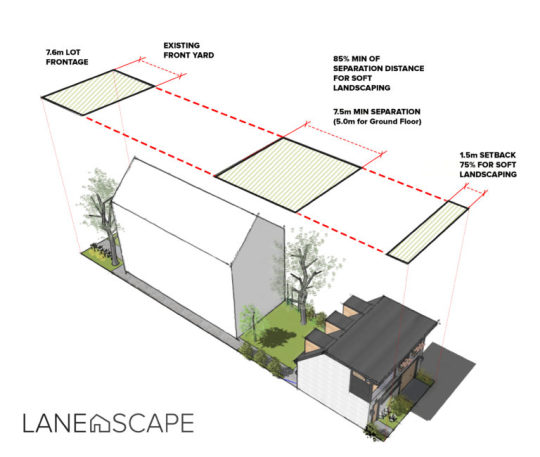
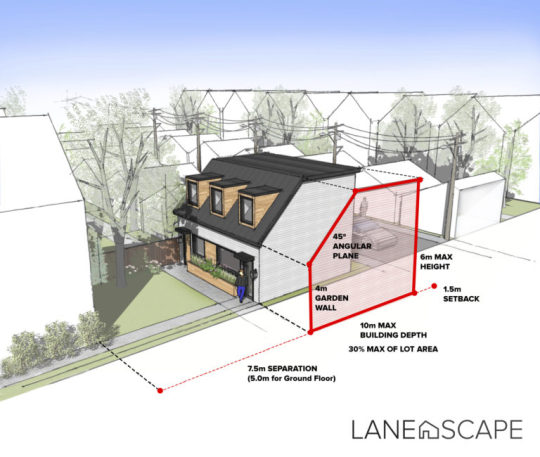
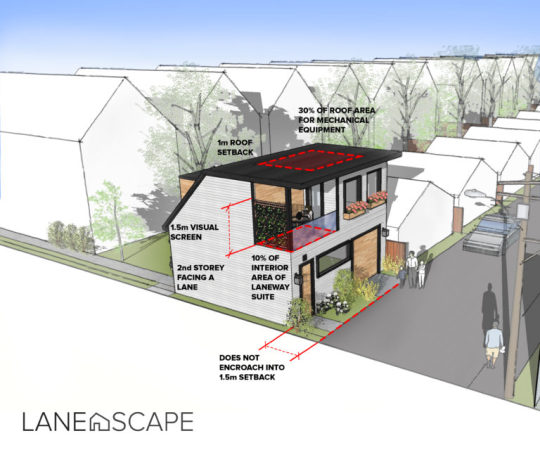
    Last month the Official Plan Amendment and Zoning By-law Amendment that would have permitted laneway suites as-of-right in Toronto was deferred by Community Council. 

    So the “Changing Lanes” policy has been updated – to obviously make it more restrictive – and it will head back to Toronto and East York Community Council this week on Wednesday, June 6th. 

    Lanescape did a great job summarizing some of the updates on their blog. Here are a couple of their images:

    If you haven’t already, now is the time to write your local Councillor and TEYCC to tell them that you support laneway suites and the proposed Changing Lanes policy. I did that last month and I did it again this month. I hope that many of you will do the same.

  • Learning from King Street

    Toronto is now a week into the King Street Transit Pilot.

    It’s still early days and transit guru Steve Munro hasn’t yet published any before and after route performance. He will. But already the sentiment seems to be clear: This shit is working. There are many recounts of people’s commute times being more than cut in half. 

    As somebody who walks this stretch of King every day, this isn’t surprising to me. There has been a dramatic reduction in the number of cars on the street.

    What is perhaps surprising is that none of the surrounding streets seem to be any busier. I would like to see the data, but it feels as if most of the cars have simply disappeared. Are more people now taking transit? Has this been your impression?

    Of course, the pilot isn’t perfect. What is not working are the signs that tell drivers they can’t drive through most of the intersections (only turn right). The circular green lights confuse them or they simply don’t care. 

    There have been suggestions for better signals, such as this one:

    image

    And if the pilot in its current incarnation does stick, I am sure there will be many additional improvements like this one made. But even at this early stage, Toronto is calling the pilot a “transit miracle.”

    When City Council approved the pilot in the summer it had a preliminary cost estimate of $1.5 million. (Figure excludes the lost parking revenue associated with removing approximately 180 on-street parking spaces).

    This is a relatively minuscule amount considering it has had an immediate impact, basically overnight, on the commute times of the 65,000 or so people who use this line every day.

    And it feels even more minuscule when you consider that our Scarborough Subway extension is expected to cost $3.35+ billion to build and only service around 64,000 people a day when you look far into the future – 2031 to be exact.

    The lesson here on King Street should be that light rail and surface transit routes can move lots of people very efficiently and cost effectively when you empower them to do precisely that.

  • The first North American night mayor

    With Mirik Milan (Night Mayor of Amsterdam) speaking at the upcoming NXT City Symposium here in Toronto, I figured it was time to revisit the topic of night mayors. If you’re new to this topic and/or the blog, you can get yourself up to speed here (scroll down).

    Firstly, this idea is clearly spreading and it just crossed the pond. Last month on August 24, 2017, New York City Council voted to create the “Office of Nightlife.” It’s a small start. The office will have an annual budget of $300,000. But that’s okay.

    As far as I know, NYC is now the first major North American city with government humans focused on leveraging the benefits of the nightlife industry.

    For the record, my post “Why Toronto needs a night mayor” was published in March 2016. It was obvious that the idea was already spreading throughout Europe and I was hoping that this city (Toronto) take notice and decide to lead within North America. New York City decided to do that instead.

    Secondly, CityLab published an article today called how to be a good night mayor. It is about what NYC can learn from the European cities who are already experimenting with this kind of office. Perhaps my favorite is the recommendation to “reflect your own city’s DNA.”

    Of course, having a night mayor is one thing. Making it highly effective is another. In that regard, it is still early days for North American night mayors, and night mayors in general. Who will truly lead?

    Photo by Alina Grubnyak on Unsplash