Daily insights for city builders, delivered every morning at 6 AM ET. I’m Brandon Donnelly — a Toronto-based real estate developer and founder of Globizen. I’ve been writing here since 2013.

Tag: city council

  • My approach to blogging

    In yesterday’s post about the city as an egg, I received a comment basically saying that I use this blog to carefully curate my own image and that I would never argue against “dumb Toronto planning” because, after all, I’m a developer. I am going to do what breads my own butter.

    I welcome intelligent debate on this blog. That’s why it is open to anyone who would like to comment. But since I’ve received similar comments in the past, I thought I would use the opportunity to talk broadly about my approach to blogging.

    Firstly, there will always be some level of curation involved. That’s inevitable. We see it all over social media. But I’m a big believer in transparency and I try to do exactly that on this blog. I am keen to push the boundaries in this regard.

    At the same time, part of what makes blogs unique is that they’re often personal. That is the origin of blogging. Some of my favorite blogs to read are the ones that have figured out how to combine a particular niche topic with personal stories. And since ATC is ultimately my personal blog, I am going to continue taking that exact same approach.

    Secondly, I only write about things that I’m passionate about. I get asked all the time to write about and promote specific projects, causes, and events. But almost all of them do not get written about it. Because if I don’t care about it, then I’m not going to write about. It’s as simple as that.

    Thirdly, I believe in positivity over negativity. I believe that optimists, not pessimists, change the world. President Obama won his first term with a message of hope, not despair. To me, that is a stronger motivator.

    I’ve been told before that I’m overly optimistic and that my youthful exuberance will one day wear off. Boy, I sure hope it doesn’t. Because would you rather have a beer with someone who is optimistic or someone who is pessimistic? I will always take the former.

    However, this is not to say that I want to be blind to the realities of the world. Last summer I disagreed with Toronto’s decision to rebuild the elevated Gardiner Expressway East along the waterfront, and I continue to disagree with that decision. 

    When I believe something is a mistake, I am happy to make it public and put it in writing on this blog. But as a developer, I suppose I have certain biases working against me. That’s just the way it is.

    In any event, this is my rough and ever-evolving approach to blogging. As usual, I welcome any and all comments.

  • Guest Post: How We Changed Toronto

    This past summer I participated in a Jane’s Walk here in Toronto, where I was the only speaker to advocate for removing the eastern portion of the Gardiner Expressway.

    After my short talk I was feeling a bit like the black sheep of the group. Either nobody felt the same way as me, or nobody was willing to speak up. Most of the other people there seemed more enamoured by architect Les Klein’s “Green Ribbon” proposal.

    But as I put down the megaphone and began walking to the next stop, a man came up to me. Truthfully, I didn’t know who he was at first, but he reassured me that it was the right thing to do. The Gardiner East should come down.

    Eventually he gave me his business card. On the front it said: John Sewell. And as soon as I saw that I said out loud: “I know this name!”

    John Sewell was a member of Toronto City Council from 1969 to 1984 and was Mayor of Toronto from 1979-1980. Today, he is a Toronto activist and has written dozens of books, mostly relating to urban issues.

    His latest book, released last month, is called: “How We Changed Toronto – The inside story of twelve creative, tumultuous years in civic life, 1969-1980.”

    And today I’m delighted to share a guest post that he has written for Architect This City. The focus of his post below is on the importance of community participation in the planning process and how it was used in this city in the 1970s.

    If you’re a developer, this post might scare you. I think there’s often the perception that communities will generally oppose any sort of development. But there are developers in this city, such as Westbank, which have been taking a more proactive approach to community consultations. And it appears to be working for them. So maybe this is something we should be talking about.

    If you have any thoughts on this, let’s have a discussion in the comment section below. I hope you enjoy the guest post. Thank you again, John.

    _________________________________

    Transportation plans, redevelopment schemes, urban expansion: municipalities address big issues like these in several different ways. A staff report can be requested; consultants can be called in; a competition can be held.

    The device used most successfully by Toronto City Council in the 1970s was a committee of citizens working directly with city staff and council members. It produced enormously successful results, as I recount in my new book `How We Changed Toronto’, but sadly it is rarely used in the 21st century.

    In 1970 City Council appointed a working committee of local residents and several councillors to create a new plan for the Trefann Court Urban Renewal Area, a neighbourhood that had been fighting the city’s plan of demolition for half a dozen years. With the help of a city planner hired specifically for this task, a new plan satisfactory to the different factions in Trefann was hammered out within a few years, then successfully implemented.

    In 1973, when the new Council pondered how to rethink a downtown designated for more office towers, it appointed the Core Area Task Force, a body of community representatives and developers, to give direction to city planners as a new approach to the downtown was devised. The result was the remarkable Central Area Plan which encouraged housing downtown and mixed uses, put an end to windy plazas, and generally created an environment that was active and felt comfortable to anyone on foot.

    In 1974, as Council faced the problem of how it would redevelop 45 acres of wasteland on the edge of the downtown, it appointed a working committee of concerned residents and councillors to give direction to city staff. It’s fair to say that no one had a good idea of how the site should be developed, but the working committee and city staff conceived a brilliant plan which was quickly executed – the first new building was under construction within two years of the working committee being established – and the neighbourhood, now known as St. Lawrence, remains one of the great successes of the latter half of the 20th century.

    From the 1980s onward, City Council has touted the idea of citizen participation, but confined that activity to public hearings on decisions recommended by staff. That generally is the practice today, although open houses have been added, as though showing people plans and getting informal comments is a good way of involving people.

    What’s lost in public hearings and open houses is the creativity that a group of committed, diverse individuals can bring to a problem when they meet together over a number of weeks and months. The members of the group know the local scene but they aren’t experts, so they must be advised by planners and other professionals about the issues they should address, the pitfalls of some options, and the trade-offs available before decisions are taken. It is an open ended process fueled by debates about different opinions, but held together by a common purpose and the realization that those around the table are playing an important role in shaping the direction of the city.

    The working committee that started meeting in Trefann had no clear idea in advance of what the plan it finally arrived at would look like. It was the same with the Central Area Plan, the St. Lawrence community, and the other processes in the 1970s which I touch on in the book. The process that the politicians, staff and residents committed themselves to made all the difference.

    One reason this kind of process is not employed much today is because too many elected figures take an ideological approach. They think they have the answers which they have been elected to implement, rather than to establish ways in which many more minds can be involved in seeking results which are widely agreed on.

    As well, city staff are not seen as independent professional advisors serving the public at large, but as a part of a corps serving the mayor and city councillors. In the 1970s in Toronto there was a clear separation between the politicians and the administration, and there were frequent (and welcome) debates on the floor of City Council between the two factions. Both were there to serve the public although they might have different ideas of how that should be done. This kind of tension was seen as entirely appropriate.

    In Toronto (and probably other cities) the situation is now even more complicated as councillors see themselves not as public servants for a few years, but rather as individuals with a lifetime commitment to holding public office. Too many members of Toronto City Council have been there for more than 15 years, and they fear that taking a principled stand on an important issue might result in the worst of all possible outcomes, their defeat. They decide not to take on the big issues.

    Toronto is currently facing significant problems.  The downtown is being overrun with new tall condo towers, for which the city does not have the infrastructure, and the new housing is not designed to meet the needs of future residents. It is the perfect opportunity for a new look at the Central Area Plan, using the same mechanisms as in the 1970s: a holding bylaw so the new plan won’t be pre-empted by development applications; a citizen-led task force including some councillors, advised by city staff. Who knows what brilliant plan an open ended process can recommend?

    Another problem is money. Toronto does not have enough money to upgrade its transit system or repair the affordable housing it owns, let alone build the new affordable housing it needs. The demands of the mayor that other governments should pay are understandably disregarded. It is time that the city had its own revenue sources, and what better than a citizen led initiative to point the way?

    It’s the same with a plan to build the affordable housing the city needs, to ensure development activity enlivens the near suburbs, to put some restraint on the continued low density subdivisions which are being unrolled far beyond the city’s borders, to restructure the megacity into something which works for the different communities within the city. These challenges all need strong citizen driven processes.

    As I recount in `How We Changed Toronto’, the 1970s really did change Toronto for the better. The city has been coasting ever since on those successes. It is time for renewal, and using the successful mechanisms from forty years ago is something worth doing.

    -John Sewell

  • Revisiting electronic road pricing as a way to fight traffic congestion

    https://500px.com/embed.js

    As disappointing as this week’s vote on Toronto’s Gardiner Expressway East was, there is one good thing that has come to the forefront and that is the will to explore road pricing. At this point, I have almost no confidence that this City Council would ever vote it in, but at least we’re talking about it. That’s better than not talking about it.

    If you’ve been reading Architect This City since the beginning, you might know that I’ve been a vocal supporter of road pricing. I wrote two posts on the topic: The case for electronic road pricing (which was based on an HBS case I did as part of my MBA) and More on electronic road pricing (which was a Lunch & Learn I did while I was at TAS).

    I continue to believe that road pricing is a highly sensible solution to big city traffic congestion. But I do think that an electronic/variable pricing model is preferable to and more equitable than a flat toll model. A variable model means that the price of using the road adjusts based on congestion levels and/or the time of day. I also think that we should use as much of the revenues as possible to fund continuous transit improvements.

    If you’re interested in learning more about this topic, check out the two posts mentioned above. I’d also love to hear your thoughts on road pricing in the comment section below. Would you welcome it in your city?

  • Gardiner East vote shows that Toronto is not yet ready to be an urban leader

    image

    Today is very sad day for Toronto. 

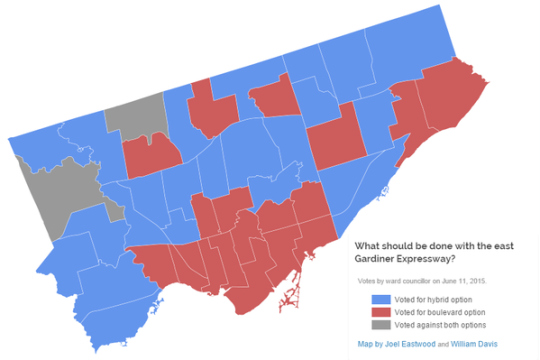
    After 2 days of debate, City Council voted this afternoon, 24-21, in favor of rebuilding the elevated Gardiner Expressway East (”hybrid” option) that runs along the city’s eastern waterfront.

    And once again, Toronto is largely divided. See above image prepared by Joel Eastwood and William Davis.

    It’s the old city of Toronto (who uniformly wanted the elevated highway replaced with a boulevard) versus the rest of the city (who for the most part voted for the hybrid).

    I can’t begin to tell you how deeply disappointed I am by not only the outcome, but also by how it happened and why it may have happened. For all of our talk about being a progressive global city, today we are clearly not that. 

    Because more than a vote on what to do with the Gardiner East, today was a vote on how we believe we should be building this city for the future. 

    When the Gardiner East was first built, the vision was one of fluid private mobility, where it would be possible to quickly circle around and across the city on an endless sea of highways. Detroit was doing it. Baltimore was doing it. Everybody was doing it.

    In other words, we were building our environment around the car. And our primary – some would say singular – focus was to ensure that the car could move unencumbered around the city. That’s why Toronto is now home to the busiest and one of the widest highways in the world.

    But despite all this, Toronto remains crippled by gridlock. And so does every other big city city in the world that has bet on cars as the solution. Why is that?

    Because that model doesn’t work.

    The I-10 Katy Freeway in Houston is 26 lanes at its widest point. It is the largest highway in the world by number of lanes. But from 2011 to 2014, commute times in some sections increased by as much as 51%. Is that because they haven’t built enough highway? How much is enough?

    By comparison let’s look at a city that has bet on transit as the solution: Tokyo. 

    The metropolitan area of Tokyo is approximately 37.8 million people. That’s more than the entire population of Canada and by most accounts is the largest urban region in the world. But despite its size, Tokyo is consistently ranked as one of the most livable cities in the world and also one of the most efficiently run.

    Interesting.

    So when I heard Councillors going on today about how a vote for the “hybrid” is a vote not to increase congestion and gridlock, it became abundantly clear that many – apparently most – people in this city still do not appreciate what it is going to take to get us efficiently moving as this region approaches 10 million people by 2041.

    This should not have been a debate about 3 minutes. That, as I’ve said before, is a red herring.

    Of course, there was lots of lip service to transit. Many seemed to agree that transit is the future. And some even went so far as to say that removing the Gardiner East and replacing it with a boulevard is the right thing to do, but that we simply can’t do it now because we haven’t made the requisite investments in transit. 

    If transit is truly what we want, then we why don’t we take the boulevard savings and put it directly into transit?

    To me it’s like saying: I really want to be homeowner, but I can’t afford it right now. So instead, I’m going spend more on rent so that I can burn through more money and make it even more difficult for myself to eventually become a homeowner.

    Because that is what happened today. 

    We voted to overspend on a stretch of elevated highway that is used by a small sliver of downtown commuters (~3%), instead of replacing it with a cost-effective surface boulevard (with similar road capacities) and then prioritizing the proven solution to urban congestion: transit.

    At the same time, we also made a number of other things clear in today’s vote. 

    We made it clear that cars matter more than our city’s public realm; that cars matter more than our waterfront revitalization plans; that cars matter more than our environment and our “efforts” to reduce GHG emissions; and, frankly, that cars matter more than our overall quality of urban life.

    I believe that cars will always be a part of our cities, but I don’t believe in putting them ahead of you and I. I guess old habits die hard. That my friends, really sucks.

  • 14 CityBuilders come together in support of removing the Gardiner East

    This will probably be my last Gardiner East post before the decision goes to City Council next week on June 10th. But I have such good news that I need to share it with you all.

    This morning 14 “CityBuilders” came together for the first time in support of removing the elevated Gardiner East and replacing it with a surface boulevard. They are real estate developers, investors, and other prominent business leaders in the city. And they sent a letter this morning to every single Toronto City Councillor outlining their position. 

    I can’t tell you how thrilled I am to see this happen, so I’d like to call out each and every member of the CityBuilders. They are (in alphabetical order):

    1. Castlepoint Numa
    2. Cityzen Development Corporation
    3. Context Development
    4. Continental Ventures
    5. Daniels Corporation
    6. Distillery Historical District
    7. Dream Unlimited Corporation
    8. Greybrook Capital and Greybrook Realty Partners
    9. Kerbel Group Inc.
    10. Manulife Real Estate
    11. QQE 162
    12. Streetcar Developments
    13. TAS
    14. Tridel Group of Corporations

    These are some of Toronto’s most important city builders and I am sure this will get the attention of both Mayor John Tory and the rest of City Council.

    If you haven’t yet signed the Gardiner East petition that Stephen and I started, please do so by clicking here.

    Happy Friday 🙂

  • A petition to Toronto City Council to remove the Gardiner Expressway East

    image

    “If the decision ultimately of the council is to support the hybrid I think frankly it’ll be a major step backwards and you’re going to miss a once in a lifetime opportunity, and I’ll be very frank, we’ll be the laughingstock of the world.” 

    -Paul Bedford, former chief planner of Toronto

    As many of you I’m sure know, I have been a vocal and passionate supporter of removing the eastern portion of the elevated Gardiner Expressway in downtown Toronto. I have written about it so many times that a lot of you are probably sick of hearing about it.

    I’m sorry if that’s the case. But it’s a hot and important topic in Toronto right now. We’re just over 3 weeks away from City Council finally making a decision. That is scheduled to happen on June 9th and/or 10th. 

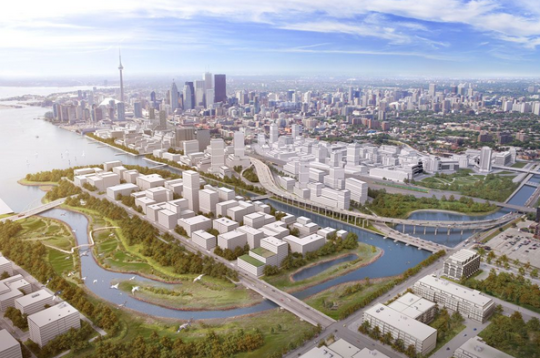
    For the most part though, I was pretty confident that we would ultimately make what many of us believe is the right decision. But then this past week Mayor John Tory went public in his support for the “hybrid” option, which is basically to rebuild the elevated expressway in a slightly different configuration. And that really upset me.

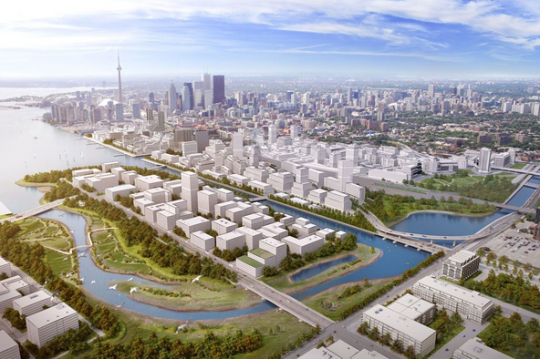
    Here’s what that looks like (versus the remove option shown at the top of this post):

    image

    Have we learned nothing from our past city building mistakes?

    Since that announcement, I went on Twitter every night this week to check out the discussions that were happening around #GardinerEast. And every night it got me so worked up that I then had trouble falling asleep. I have since stopped reading about the Gardiner East before bed.

    But rather than just get frustrated, my friend (a fellow city builder named Stephen Job) and I decided to do something about it and create a petition using Change.org.

    It is a petition that we will ultimately be sending to Toronto’s entire City Council prior to their June 9 meeting and we hope that you will consider signing it and sharing it with your network – regardless of whether or not you happen to live in Toronto. (Although it’ll certainly help if you’re a taxpayer and voter in the City of Toronto.)

    We just finished getting it up and you can check it out and sign it by clicking here.

    Images: Toronto Star

  • Driverless cars, urban mobility, and Toronto’s Gardiner Expressway

    image

    About a week ago I wrote a post questioning what driverless cars will mean for cities. I ended by saying that that it feels as if we’re going to see increasing tension between private and public transport.

    What I meant by that was simply that conventional notions around private car use are going to change. And ultimately that is going to mean that we need to rethink public transport and how that fits into a broader urban mobility framework.

    What do I mean by this?

    The International Transport Forum at the OECD recently published a fascinating report called, Urban Mobility System Upgrade: How shared self-driving cars could change city traffic. And it deals with exactly the sorts of things I am thinking about.

    The study looked of what might happen when all cars become self-driving in a mid-sized European city (specifically Lisbon, Portugal). They leveraged existing transportation data from the city, but replaced 100% of the human powered cars with two types of self-driving cars: TaxiBots and AutoVots.

    TaxiBots were driverless cars that would be shared with multiple people at the same time. In other words, they were a kind of pseudo-public transit. And AutoVots we’re your more conventional private taxi. They picked up one person at a time.

    So, what did they find?

    In the first scenario, they combined their TaxiBots and AutoVots with public transit (light rail) and discovered that the same number of people could be moved around with only 10% of the cars currently on the road. That’s a 90% reduction!

    They also found that the city needed 20% less on-street parking and 80% less off-street parking since driverless cars don’t need to sit idle waiting for a driver.

    In the second scenario, they removed mass transit from the equation. And in this instance they found that the city was still able to get around, but with an 80% reduction in the number of cars on the road. Remarkably, it also led to a 10% reduction in rush hour commute times.

    These are pretty profound changes. Reducing the number of cars on the road by 80-90% is a significant change. 

    But it’s also why I’ve been thinking about the tension between private and public transport. As we get better at optimizing “cars” (their definition will change), what becomes the role of true public transit?

    Ultimately, I think what will happen is a blurring of the two. In the example above, the TaxiBots served basically as small scale public transit. But that does not necessarily mean that true mass transit will become irrelevant. We’re just going to need to rethink how the entire mobility network fits together.

    I’d now like to bring this discussion back to Toronto for a minute.

    As many of you probably know from this blog, Toronto is on the cusp of deciding what to do with the eastern portion of the Gardiner Expressway (an elevated highway that runs across the downtown waterfront). It will go to City Council next month. 

    I firmly believe that we should remove it, but there many people who believe we shouldn’t. The main objection seems to be that the traffic projections indicate that removing it could make commuting into downtown – by car – 3 to 5 minutes longer by 2031

    By today’s standards, I believe this concern represents an outdated way of thinking about cities and urban mobility. Adding more lanes is like loosening your belt to deal with obesity. However, it gets even worse when you think about urban mobility in the context of this post.

    Given the profound transportation changes that are currently underway, I think there’s a strong likelihood that the Gardiner projections we have today will be completely wrong by 2031. I don’t know know for sure, but I’m guessing the models don’t account for the efficiencies being created by driverless cars and peer-to-peer networks.

    In other words, I am suggesting that those 3 to 5 minutes could prove to be a red herring. The relevant question should be: Which decision will allow Toronto to build the absolute best waterfront in the world? And in my opinion that leads to removing the Gardiner East.

    If you feel similarly, I would encourage you to write your local City Councillor.

  • Toronto approves 755 storeys of new development

    image

    Earlier this week, Toronto City Council approved the equivalent of 755 storeys of new development, a lot of which will end up in the downtown core. The translates into 6,887 new housing units and roughly 4 million square feet of new commercial space. The Globe and Mail called it the Manhattanization of downtown.

    If you’d like to go through the complete City Council meeting agenda, you can do that here. (I warn you though, it won’t be an exciting read.)

    One notable project that was approved is 50 Bloor Street West, which is a 71-storey mixed-use building in Yorkville adjacent to and on top of Holt Renfrew (It includes a $6 million Section 37 contribution). I mention this one because it’s impressively tall and because it’s a project that I was involved with when I was at Morguard. Watch for Yorkville in the coming years, there’s a lot in the pipeline.

    While I think this is all incredibly exciting, our chief planner, Jennifer Keesmaat, is entirely correct in pointing out that all of this highlights the desperate need for better infrastructure, the most critical of which is a relief subway line that cuts across downtown.

    But to be clear, this isn’t a question of just planning for growth. This is a question of planning for growth and making up for decades of infrastructure disinvestment. That’s the position we’re in today, which means we have a lot of hard work to do. Though I’m confident we’ll get it done.

    The other thing that this level of intensification should highlight for you is that public transit, and other forms of mobility such as biking and car sharing, have to be central to our goals. It’s simply infeasible for everybody to be driving around in a car. We’re currently demonstrating how efficient that ends up being.

    So as Toronto continues to intensify, I think we’ll quickly discover that traffic and private cars aren’t the answer or even the right question to be asking.

    Image: Flickr

  • Mirvish + Gehry gets nod from City Council

    image

    Last week Toronto City Council voted to support planning staff’s recommendation to approve the landmark Mirvish + Gehry development on King Street West in the Theatre District. 

    The revised design now includes 2 towers (as opposed to 3) at 82 and 92 storeys tall. As a result of this change, 3 of the 5 existing buildings on the site will now be retained. I think this represents a good balance between (historic) preservation and progress.

    If you’re interested in a bit more of the backstory, Toronto Life published an article today called David Mirvish on the Edge. It talks about his father (Ed Mirvish), his upbringing, and how he got into the real estate development business.

    I thought you all might enjoy it.

    Image: Projectcore

  • The future of Vancouver’s West End

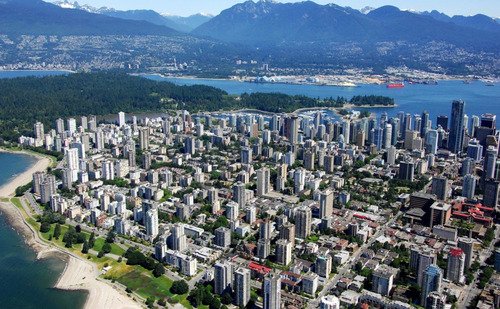
    Spacing Vancouver recently published an interesting look at Vancouver’s West End neighborhood. And it led me into a deep dive of the neighborhood’s recently adopted Community Plan (November 2013). So today I’d like to talk a bit about the neighborhood and also their plans for managing growth over the next 30 years.

    Officially established in 1969, the West End spent the next 3 decades as the most densely populated area of Vancouver. But starting in the 2000s with the development of high-rise condo towers in neighbouring areas such as Downtown South to the southeast and Triangle West and Coal Harbour to the northeast, the West End lost this position. Today it’s the 4th most densely populated neighborhood in the city.

    The bulk of the housing (77%) is in the form of apartments with 5 or more storeys. And 81% of residents are renters. This is well above the city average of 52% and is likely a reflection of the neighborhood’s younger demographic (25-29 years old is the largest segment) and its position as a landing ground for new Vancouverites.

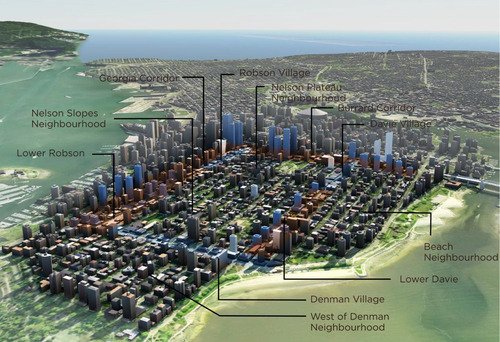
    But as a large central area with exceptional access to natural amenities, I would imagine that development pressures are and will continue to be significant. To plan for this growth, the city wants to intensify the central areas of the neighborhood with low-rise and mid-rise form and the periphery with high-rise towers. And already this is happening with developments such as the 62-storey Shangri-La Hotel.

    Here’s an image depicting their 30 year vision:

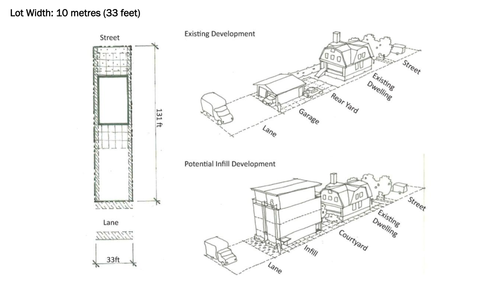
    But what stands out for me in the Plan is Vancouver’s continued commitment to laneway intensification. The Plan refers to it as “Laneway 2.0” and they specifically mention the opportunity to redevelop the West End’s wide laneways with “ground oriented infill housing.” Below is an example of how this could be done on a small residential lot, but the Plan also includes images for how the same might be accomplished on underutilized apartment building sites.

    Laneway housing is a topic I’ve written about extensively on ATC. Toronto is absolutely behind on this. And as I’ve argued before, we need to be looking at urban intensification across all scales, from low-rise to high-rise, if we want to create inclusive and vibrant cities. With the West End Community Plan, Vancouver seems to be doing just that.