Daily insights for city builders, delivered every morning at 6 AM ET. I’m Brandon Donnelly — a Toronto-based real estate developer and founder of Globizen. I’ve been writing here since 2013.

Tag: city building

  • An Ethereum story

    We’ve spoken about Vitalik Buterin before.

    He is the inventor of the Ethereum blockchain, and its most prominent figure. He also happens to have grown up in Toronto. He went to the University of Waterloo. So when I wrote this post back in 2021, I asked: Why the hell is nobody talking about this? Why are we not celebrating the fact that our great city helped birth one of the most important technologies of our time? You couldn’t ask for a better economic development story. Well, I guess the answer is twofold. Crypto isn’t mainstream. Even back in 2021 when things were frothy it wasn’t. And, we’re awful at promoting and driving a global brand for our city. Both of these things need to change. So if you’re interested in learning more about Vitalik and Ethereum, you should check out this new movie (trailer) called Vitalik: An Ethereum Story. To watch it, go to ethereumfilm.xyz and mint the NFT for $20. You’ll then be able to stream it. I haven’t done this yet, but I’ll be doing it very soon. All of the proceeds from the NFT sales will go toward getting a more mainstream distribution deal.

    So by watching, you’re helping.

    Update: I watched it. It’s great.

  • La médina de Marrakech

    Marrakech is one of the most frenetic, vibrant, and exciting cities that I have been to in a long time. Walking through the Medina means walking on streets that are only a few meters wide, but that are still somehow filled to the brim.

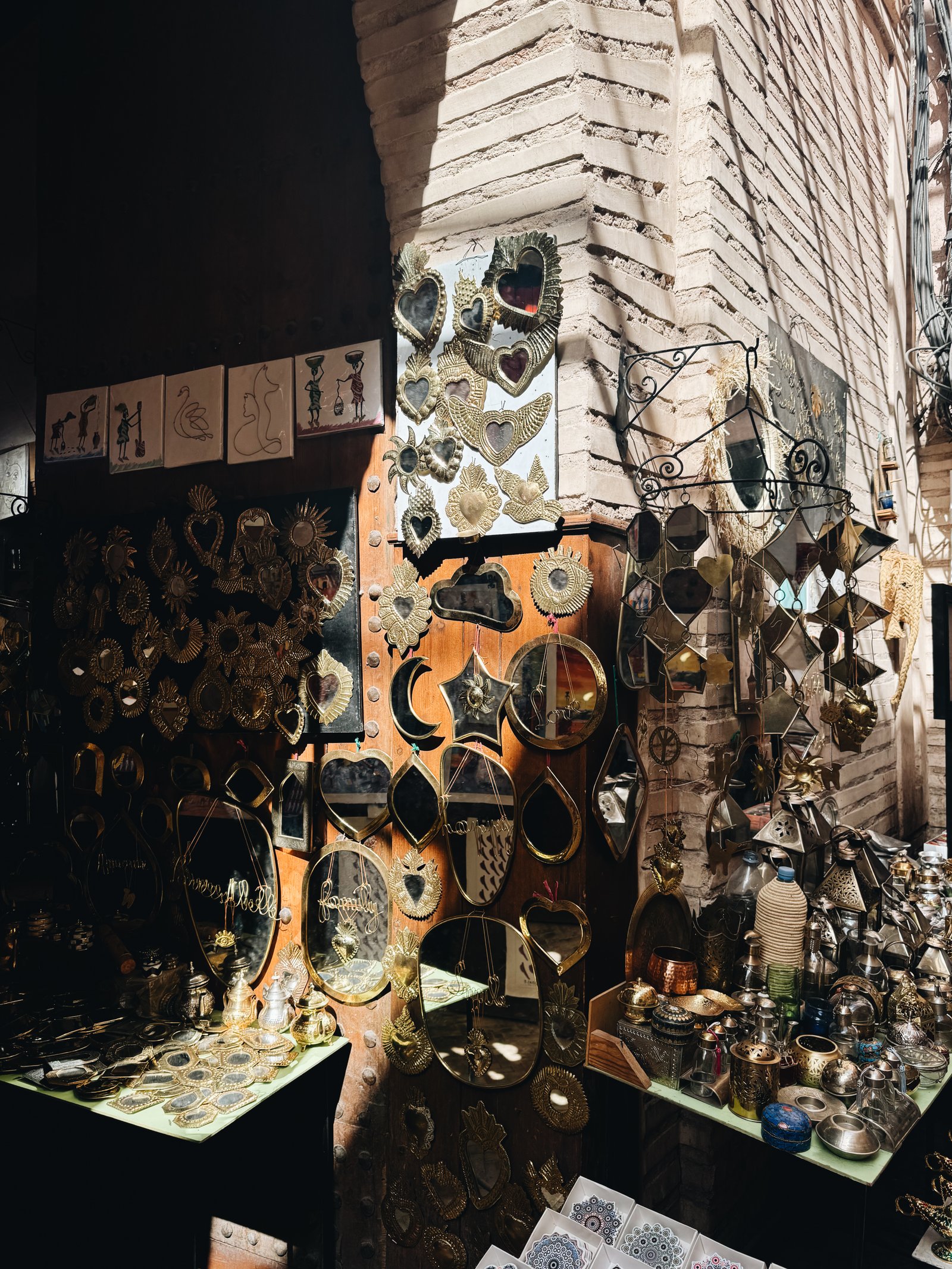
    Filled with a beautiful cacophony of people, smells, and merchants, selling everything from leather sandals to engine parts. Filled with an endless supply of people vying aggressively for your attention (and who all seem to coincidentally have a relative in Toronto). And filled with motorbikes that are liable to ride over your feet if only you let your guard down for a second.

    Sensory overload. It is at the same time exhausting and one of the coolest experiences ever.

    Another name for these streets would be “shared streets,” which is a way of saying that the formal distinctions between areas dedicated to pedestrians, cyclists, and motorists have been removed. While they are intended to be pedestrian-oriented, the overall approach is that all users just, you know, figure it out. Today, this is viewed as an enlightened approach to street design. Though it’s clearly not a new one.

    I will, however, be the first to admit that it’s easy to feel like an uptight Canadian in the Medina of Marrakech. This thought definitely crossed my mind: “I can’t believe they let motorbikes rip through these tiny streets.” You can see why somebody at some point felt it might be a good idea to carefully segregate uses.

    At the same time, the architecture of Morocco feels like the perfect complement to these chaotic streets. Notably inward facing, the central feature of a traditional riad is its courtyard. These spaces offer much-needed protection from the hot Moroccan sun, but they also allow for family privacy, which is something that is important in this culture.

    The result is that you immediately feel it every time you walk inside. You have now entered a beautiful and calm oasis in the middle of a frenetic and exciting city.

  • Building new cities

    On this blog, we often talk about city building in the context of doing things to help improve a city — whether that be a development project, a new public art mural, or an interesting local business. These interventions help to build a city. But even more specifically, the term has, for many, come to mean building up a city in a positive way.

    But there is another way to think about city building. You can think of it in terms of building actual new cities. We’ve spoken about some of these before, namely this one in California and this odd one in Saudi Arabia. But apparently it is becoming more common. According to The Economist, the world is now building more new cities than it has in the last 80 or so years:

    Egypt’s “New Administrative Capital” is part of a rush of city-building. Firms and governments are planning more settlements than at any time in the post-war period, with many already under construction. Ninety-one cities have been announced in the past decade, with 15 in the past year alone. In addition to its new capital in the north, Egypt is building five other cities, with plans for dozens more. India is considering eight urban hubs. Outside Baghdad, Iraq, workers have just broken ground on the first of five settlements.

    In some cases, it is being done as a solution to urban congestion. If this city is too expensive and unaffordable, just create a new one. This appears to be part of the idea with the above city outside of San Francisco. Of course, new cities can also be created for ideological reasons, or for political purposes, which was the case with Brazil’s capital city, Brasilia.

    Here, the idea was to move the federal capital away from the country’s populated southeast region to a more geographically neutral location in the middle of the country. It also turns out that seeding a new city with government institutions is a good way to get one of these started. Existing cities do, after all, benefit from network effects.

    History points to characteristics shared by successful projects. State institutions can help anchor cities, as Brasília (in Brazil) and Chandigarh (in India) showed in the 20th century. Although both have had problems, people in Brazil and India are voting with their feet. Brasília’s population is growing at 1.2% a year, more than double the national average. Chandigarh, a state capital, is now India’s fourth-richest region on a per-person basis.

    But putting money, ego, and ideology aside, when does it actually make sense to start a new city in lieu of just expanding (or addressing the problems in) the one(s) you’ve already got? Population size can’t be the only factor in determining whether a city is “full”, because Tokyo seems to do just fine as the largest metropolitan area in the world.

    If it hasn’t already been done, I think this would make for an interesting research project. Until then, there’s this (paywalled) Economist article.

  • Be your own bitch

    I just joined Warpcast. You can find my profile, here.

    At first glance, Warpcast is going to look a lot like X. But instead of tweets, you cast. There are also various topic channels, similar to how Reddit works. But the most important difference is that Warpcast is a client for the Farcaster protocol, which is a social network built on Ethereum. This means that it is a decentralized social network.

    You won’t see of any this if you decide to sign up. All of the esoteric crypto things are hidden in the background. But it’s there. And it ultimately means that, as a user, you get to own your online identity and whatever content and following you create. Meaning, you can take it with you if you decide you no longer want to use Warpcast and instead want to access the network through another client.

    It also means that software developers now have a real incentive to build things on top of the protocol, because unlike with a centralized service like X, they can be confident that they won’t get the rug pulled out from underneath them. And herein lies the feature that will ultimately lead to an enormous amount of new ideas and innovation.

    In real estate terms, you can think of developing on top of a centralized service like building within a theme park owned by a single company. The theme park might want you to build on their land, right now, but if at some point it no longer suits their business needs, they can always change the game on you.

    On the other hand, building in a city on land you own outright is a lot like developing on top of a decentralized service. Sure, you need roads and municipal infrastructure to service your land (think of these like the above protocol), but you generally don’t need to worry that the city might wake up one day and remove all of this important infrastructure. It’s a given. And that’s a fundamental difference, even if the buildings might look the same in the end.

    Venture capitalist Fred Wilson once explained it in this way, “don’t be a Google bitch, don’t be a Facebook bitch, and don’t be a Twitter bitch. Be your own bitch.” What he meant by this is that if you build on someone else’s land, then you’re opening yourself up to being their bitch. What you want to be is your own bitch. And similar to how our cities work, this is the potential of decentralized services.

    As I write this post, I currently have 6 followers on Warpcast. If you’d like to be number 7, you can follow me here.

  • How to make the internet more like our cities

    I am halfway through reading Read Write Own and I can confidently say that you want to read this book. If you’re already a believer in this “next era of the internet” (like I am) it will make you a true believer. And if you’re not a believer, maybe it will make you one. Or not. Either way, I am thoroughly enjoying it.

    One chapter that will be particularly interesting to all of you is the one where Dixon makes a comparison between the internet and cities. Cities, he argues, work because of a delicate interplay between public and private interests. And the private side works because, among other things, we have the rule of law and the construct of ownership.

    If I own an asset, like a piece of real estate, I’m only going to be confident to invest in it if I know that someone won’t take it away from me (or dramatically change the rules on me), which is why if this prerequisite doesn’t exist, you typically see a lack of investment.

    The same is true on the internet. But currently, the dominant form of networks are centralized corporate networks. In city terms, you can think of these like an amusement park. Once you enter through the gates, you’re in their world. You could maybe rent some space, but at the end of the day, the owner makes the rules. And if they don’t like what you’re doing, they can remove you.

    It’s a pretty stark contrast when you think of it in these terms, which is why it’s hard not to feel compelled when you consider that similar dynamics are playing out on the internet right now. Cities thrive because we have rules, ownership, and the freedom to innovate on top of the foundations laid by government.

    So I’m all for making the internet more like our most successful cities.

  • Feel-good stories about city building

    One of the things that I have learned over the years from sitting on panel discussions about city building is that, if I talk about the challenges and economic realities of development, I will be less popular than if I just tell feel-good stories about urbanism and architecture. The latter is often what people want to hear. It’s more exciting.

    But to ignore the economic realities of the world is to ignore real solutions. And this, as I have talked about before, is one of the main qualms that I had with architecture school. Money, economics, and real estate matters were tertiary, if not entirely taboo. Just focus on the purity of design and everything else will resolve itself.

    Now don’t get me wrong, I love design. It is fundamental. But so are a bunch of other things, which is why I think this article, by Benjamin Schneider, hits the nail on the head. It is specifically a review of a MoMA exhibit called New York, New Publics, but really the overarching message is this one here: “Enough with the feel-good architecture.”

    To tell a feel-good story within this framework, urban development projects must be edited and curated to cleanse them of these associations. Favored projects must somehow appear to transcend capitalism, NIMBYism, an anti-urban federal government, and the compromises inherent in the transformation of the built environment. Because this is impossible—except in the case of marginal beautification projects—the public is left with false expectations about how cities get built, making the hard stuff even harder to pull off.

    City building always involves compromises. But the more we’re upfront about what they are, the sooner we’ll get to more optimal solutions.

  • Corktown Condos to launch sales this spring

    Earlier this week, I shared this image of Corktown Condos on my Instagram. It represents the first phase of Slate’s two-phase project in Hamilton, and I’m excited to announce that we’ll be launching sales this spring (both in Hamilton and in Toronto).

    We love Hamilton. It has walkability, transit, a wonderful stock of old buildings, and a dynamic and growing cultural scene. In other words, it has all of the characteristics that we look for when it comes to new projects. And here, our approach to city building is exactly analogous to what we did in Toronto at Yonge & St. Clair.

    Those of you who are familiar with our work will know that Slate owns 8 office buildings in midtown, including all four corners of the Yonge & St. Clair intersection. And that we have spent the last decade investing in these buildings, investing in the public realm, investing in public art, and working to support businesses in the area. Then in 2021, we launched sales on a landmark condominium tower called One Delisle that is now under construction.

    Here in Hamilton, we are similarly investing in economic development and in housing. Last year, it was announced that we acquired approximately 800 acres of industrial land and buildings on Hamilton’s waterfront. This site alone has the potential to create up to 23,000 new jobs across the region and inject up to $3.8 billion into Ontario’s economy. It will likely also take some time and be measured in decades.

    We prefer to think of ourselves as city builders. And that means taking a long-term view and thinking about the broader city — not just about our individual projects. So for us, Corktown is part of a much larger and longer-term commitment to the City of Hamilton. And we couldn’t be more excited to share it with all of you in the coming weeks.

    Stay tuned. And if you’d like to register for Corktown, you can do that over here.

  • Don’t get me started

    I cover a lot of different topics on this blog. It’s hard to write daily for a decade and not meander every now and then. But generally speaking, I do try and keep this forum focused on things that are related to city building — real estate, housing, design, transportation, etc. And I do try and share some of the things that I have learned (and the mistakes that I have made) since I started working in real estate development back in 2007.

    But we all have limits, and different perspectives are vital for solving problems. So I’d really like to introduce more Q&A features on this blog, similar to this recent one that I did with structural engineer, James Cranford. If this sounds interesting to any of you, please reach out. I’m open to anyone who touches the built environment: architects, artists, planners (private or municipal), lenders, furniture designers, bollard manufactures … you name it!

    Image: Jason Adam Katzenstein

  • What would you do if you were Mayor?

    Let’s assume that you’re Mayor of your city and that, for whatever reason, you have no need to pander to voters. You’re a benevolent dictator. You can do whatever you think is best overall for the city and it will just happen. What would you do? This is more or less the question I asked on Twitter this morning, and I think it’s only fair that I answer my own question. So here is a non-exhaustive list of items that came to mind while thinking of Toronto:

    • Substantially increase the pay of public sector workers throughout the city and bonus them based on measurable outcomes. Forget things like time limits on development applications; instead align incentives. For example, if we’re trying to get more shovels in the ground on affordable housing, incentivize people based on building permits issued. I’ll never forget what Roger Martin told me while I was at Rotman. When he became Dean of the school, Rotman was a whatever business school that wasn’t faring all that competitively in the rankings. One of the problems he discovered was that the school’s professors were getting paid far less than those at Wharton, Harvard, Stanford, and so on. So if you were a star, why would you ever want to teach at Rotman? He immediately matched the salaries of those top-tier schools and then, not surprisingly, the top-tier talent arrived. You get what you pay for.
    • Immediately price roads and congestion, and direct, to the fullest extent possible, the funds toward transit and cycling infrastructure. At the same time, the planning and building of transit would be depoliticized. There would be a reccurring funding stream and a plan that we’re continually building out. Minimize protracted debates. Never stop building. There’s a lot of talk this mayor election about solving traffic congestion. I have yet to see a plan that will actually work. Accurately pricing congestion likely won’t be popular, but I can guarantee you that it will be highly effective.
    • Ensure that property taxes are sustainably covering the costs of operating the city and then, at a minimum, peg all future increases to CPI.
    • Make any new housing development less than 12 storeys as-of-right. That would mean, no rezoning process and no site plan approval; just straight to building permit.
    • Empower the private sector to build affordable housing through incentives and subsidies. Affordable housing isn’t feasible to build on its own, which is why nobody is doing it. Inclusionary zoning also won’t get us there. Make developers want to build it and they’ll do it.
    • Liberalize licensing and cut red tape to empower small entrepreneurs across the city in various industries. A perfect example in my mind is street food. Toronto is the most diverse city in the world with some of the best restaurants, and yet the only thing you can buy on the street is a stupid hot dog. If we empowered small entrepreneurs to setup shop on our streets, we would easily have the best street food scene in the world. And I am positive that there are countless other latent opportunities in this city that are being held back by dumb and archaic rules.
    • Make dramatic improvements to our public realm with an eye toward becoming the most beautiful and livable city in the world. Finally pedestrianize Kensington Market, remove the elevated Gardiner Expressway, make it so that we can swim in the Lake, build beautiful public washrooms all across the city that are actually open and aren’t gross, and the list goes on. And yes, “beauty” should be requirement so that we don’t end up with shit like this.
    • Focus on art, design, culture, and innovation as central pillars of Toronto’s brand. Miami is a good example of what this approach — along with favourable taxes and nice weather — can do for a city. I’ve said this before, but here’s just one example: Toronto is in many ways the birthplace of the cryptocurrency Ethereum. Why is nobody talking about this? Why are we not celebrating and leveraging this? It’s a missed opportunity. Broadly speaking though, I think just having and doing three things can be effective in promoting new ideas for these pillars: have reasonably affordable housing, be a city that young people want to live in, and remain open and tolerant to immigrants.
    • Stop thinking of the night-time economy as a nuisance and instead think of it as a powerful economic development tool. I recently responded to this “night economy survey” that the City of Toronto released and the obvious bias is that nighttime things are seen as a terrible nuisance. In other words, “tell us how do we make all of this less annoying for grouchy voters.” My response was to extend last call to 4am and to start thinking of it as an opportunity to draw in young people, tourists, and whoever else. This complements my previous point.

    This is, again, a completely non-exhaustive list. But if I had to summarize the overall ambition, it would be to make Toronto a truly exceptional and remarkable city. We should never be happy with mediocrity.

    What else would you do? Leave a comment below.

    Photo by Aditya Chinchure on Unsplash

  • What does Toronto want to be?

    “On some level, we’re [Toronto] still trying to be a Victorian city.” —Peter Clewes

    It is not an exaggeration to say that Peter Clewes, of architects-Alliance, is one of the most important architects working in Toronto today. Over the last two decades, Toronto has built a lot of new condominiums and Peter’s firm has been behind many of them.

    I mean, I currently live in a building designed by architects-Alliance. My mom lives in a building designed by architects-Alliance. And the first condominium I ever lived in around 2005 or so, was naturally also designed by architects-Alliance.

    Peter’s work is everywhere. And it has been instrumental in helping to define this new Toronto. But what is this new Toronto? It’s hard to say really.

    Toronto may have built a lot of new things and added a lot of new people over the last two decades, but it has done so almost begrudgingly and without the confidence to say, “we are building this way because this is the kind of global city we want to become.”

    I think Peter gets a lot right in this excellent interview with Azure about Toronto, condominiums, and city building. Despite everything that has changed, on some level, we are still trying to be a Victorian city.

    Of course, we are no longer that city. It’s long gone. Time to think much bigger.

    Photo by Dillon Kydd on Unsplash