Daily insights for city builders, delivered every morning at 6 AM ET. I’m Brandon Donnelly — a Toronto-based real estate developer and founder of Globizen. I’ve been writing here since 2013.

Tag: atc

  • Kingston&Co at the Beaches Jazz Festival

    image

    One of the best things about Toronto in the summer is that it feels like there’s a special event happening almost every day of the week. It would be impossible to go to everything, but one of my favorites is StreetFest at the Beaches Jazz Festival, which is running this week from Thursday (July 24) to Saturday (July 26).

    If you’re from Toronto, then you’ve probably been. But if you haven’t been, StreetFest is basically a 2.5 km stretch of Queen Street East in the Beaches that gets closed to traffic so that hundreds of thousands of pedestrians can walk around and listen to jazz music on the street. It’s a lot of fun and I’m told there will be 40 bands this week.

    This year TAS has sponsored a tent and so the Kingston&Co Condominiums team will be there to talk to people about our project (and also listen to some jazz music!). I’ll be there on Thursday night (tomorrow) and so if you’re around, come by and say hello. If you can’t find us, send me a tweet.

    If you haven’t been to StreetFest before, here are two tips. It gets super busy and traffic is often bad heading in and out of the area. If you have the option of biking there (or riding on someone else’s handlebars), I would highly recommend that.

    Also, given how busy it is, I remember it being difficult to find a beer the last time I went – all the restaurants and patios were full. So you may want to consider investing in a CamelBak Pack. We wouldn’t want you getting dehydrated 🙂

    I hope to see some of you there.

    Image: JR Photography

  • Rules are made to be broken. So which one is next?

    Jevon MacDonald of StartupNorth published an interesting article today called, You are supposed to break the rules. It talks about entrepreneurship and how great companies are built by disregarding the way things are done today.

    And I think it’s for that reason that many stupid sounding ideas (think Airbnb and its initial idea of offering air mattresses) actually turn out to be great ideas. In reality, they weren’t stupid ideas. They just contravened the norm, and that made them sound stupid. It made people feel uncomfortable. And as humans, we tend to have a bias towards things that reinforce our existing view of the world.

    In any case, Jevon talks about some of the “big rules” that are being broken today. His list includes:

    But really he’s talking about Uber, Tesla, and Airbnb. They are the startups breaking those rules. However, that’s old news for most of us. What’s more interesting are the following two takeaways.

    The first is his prediction that startups are going to start running into more and more regulatory hurdles. In other words, we’re going to see more, not less, litigation. And I think he’s right. As technology starts to creep into other industries (like it has with the taxi industry, the car industry, and the hospitality industry), we’ll probably see a lot of incumbents fighting to hold on.

    The second interesting takeaway for me was that out of his list of “big rules”, the real estate industry (i.e. the MLS) is the only one that doesn’t have a formidable disruptor attached to it. Which makes me wonder: Is something like Opendoor.com inevitable?

  • What are the most compelling reasons for someone to become an architect now?

    Since I’ve talked a lot before about the profession of architecture and the future of it, I thought I would share this recent interview with Mark Wigley from Surface Magazine (May 2014). Since 2004, Wigley was the Dean of Columbia University’s Graduate School of Architecture, Planning and Preservation. But he’s now stepping down and this was his exit interview.

    The first question he was asked was: 

    What are the most compelling reasons for someone to become an architect now?

    I actually think that there’s never a compelling reason to be an architect. The decision is irrational, and that irrationality is an enormous and precious asset. Architecture is full of romantics who think that even relatively small changes to the built environment create the aspiration for a better society. It sounds hokey, but there is in every architect the thought that things could be better. This is a kind of professional optimism. And that leads to an expertise in entering situations in which the dynamics are unclear. Architects are only ever called into a situation when it’s impossible. If it’s possible, you invite somebody with a toolbox who can give answers. You call the architect in when it’s not clear what the question even is. 

    The line I really like is the one I highlighted in bold above: “…there is in every architect the thought that things could be better.”

    Wigley is talking about it in a kind of romantic and idealistic way, but I don’t think it necessarily needs to be that way. The optimistic belief that things could be better, that things could be improved, is a powerful notion. In my view, it’s what drives entrepreneurship and that happens to be our most powerful economic engine.

    I actually think there are a number of parallels between architecture and entrepreneurship. In school, architects are indeed taught to enter into situations where “the dynamics are unclear.” It’s about taking an idea, developing it, and trying to figure out what it could become.

    Then, once you’ve poured your heart and soul into that idea, you get up in front of everyone and you pitch it. It’s your job to convince everyone that, yes, the way you’ve developed your idea is in fact the right way. Sometimes you get shot down. And other times you don’t. But you just have to take the risk.

    Click here to download the full PDF of Mark Wigley’s interview.

  • 2 parents, 2 kids, and 1 cat in 1,000 square feet

    Yesterday a colleague at the office sent around this Globe and Mail article talking about a Vancouver family of 4 (plus one cat) who live in a 1,000 square foot loft near downtown that they purchased in 2003 for $269,900. There weren’t really any photos of the place, but the article makes it sound like they have 3 beds crammed into one room. (I wonder how the parents ever manage to have sex. There are better ways to lay out 1,000 sf.)

    In any event, the point of the article is that there’s a growing number of families who are clinging to the downtown lifestyle that they’ve grown accustomed to and are refusing to follow the path of a conventional suburban house – regardless of how tight their current quarters might be. It’s happening in Toronto (here’s an article from the Toronto Star and here’s a post I wrote) and it’s happening in New York:

    A recent New York Times article on a similar trend noted that the number of white professionals with one or more children living in one-bedroom condo units in that city had jumped by almost a third between 2000 to 2006. Prof. Andrew Beveridge, from Queens College of the City University of New York, said the pattern was showing up in other expensive American cities. In Toronto, the 2011 National Household Survey showed there are about 72,000 families living in 71,500 units in buildings with five or more storeys – undoubtedly many of them the new, tiny condos proliferating there.

    To some this might sound crazy. I mean, why would a dual income family–such as the one in Vancouver–subject themselves to a smaller space when they could easily afford a bigger place somewhere else? Isn’t that the dream – to have a big house?

    The answer is that these families are considering–in addition to the direct costs of a bigger place–both the indirect costs of living further away from the core (such as longer commute times) and the inevitable lifestyle changes that would happen should they move out from their downtown neighborhoods. The urban lifestyle is different.

    But what I find interesting about this phenomenon is that if this trend continues (and I think it will), we’re going to have a new generation of people in North America who grew up in apartments, condos, and lofts, and don’t have the same biases around single family houses and suburban living. To them, an apartment will be a perfectly normal place to raise a family.

  • The impression you are leaving

    image

    “Toronto is a city that has long struggled to make any sort of impression on the imagination.”

    That is how Monocle correspondent Christopher Frey started his recent architectural feature on Toronto’s iconic City Hall. To watch the video click here. It’s about 5 minutes long.

    As a born and raised Torontonian who loves this city, I absolutely hate that sort of introduction. But at the same time, it doesn’t surprise me. Growing up in this city, there were always the haters. However, I think it’s important to keep 2 things in mind.

    Firstly, Toronto has gone through a dramatic transformation over the last decade or so. In fact, I recently had a friend say to me: “Brandon, 10 years ago you told me that Toronto was going to be a super cool global city. I didn’t believe you then. But you were right.” This is what I was getting at in my Guardian Cities piece when I talked about how people are becoming noticeably more passionate about this city. (I actually wrote about what my friend said but they edited that part out.)

    Secondly, if you’ve ever read Seth Godin’s book All Marketers Are Liars, you might remember this line:

    To illustrate what he means by this, Godin uses the example–among many others–of Riedel wine glasses. Riedel is a high end glassware company founded on the belief that every type of wine needs its own unique glass shape. And indeed, their customers believe that the right glass makes all the difference in terms of how their wine will taste. That’s why they buy them.

    However, when you blindfold those same people, they are no longer able to tell the difference between a Riedel wine glass and some cheap alternative. The wine all of a sudden tastes the same. What that tells us is that when we believe something is supposed to be better, we actually experience it differently. You could say that we’re actually lying to ourself.

    And I’ve thought about this same phenomenon when it comes to cities. When people visit a place like New York they’re supposed to like it. That’s what everybody tells them. New York is great. You’ll love it. But ultimately, that “supposed to” changes how people experience the city.

    Which is why when Toronto gets introduced as being bland and banal I get upset. Not only because I disagree, but because I know it’s creating a “supposed to” in somebody’s mind. And that’s not the story we should be telling as a city.

    Image: Wikipedia

  • The story of a symbol of belonging

    image

    I’ve been following Airbnb pretty much since the beginning. The company has always fascinated me because I saw it as being less about technology and more about travel, hospitality, community and, in my view, real estate.

    An office building is just a set of spaces that get rented out on long term leases. A hotel building is just a set of spaces that get rented out on short term leases (one night at a time). And Airbnb spaces are simply extra or “found spaces” – such as an extra bedroom – that could never really be rented out at any sort of scale before. But then Airbnb came along, built a community around it, and empowered everybody to make money off that found, extra space. I think that’s pretty neat.

    Well today, Airbnb unveiled an entirely new logo, brand, and expression. It’s all about belonging, and their new logo is called the Bélo. Here’s a quick video that they call “the story of the symbol of belonging”. If you can’t see it below, click here.

    [youtube https://www.youtube.com/watch?v=7Hs0C2UvVBY?rel=0]

    What’s interesting about this new expression is that it’s a perfect example of Simon Sinek’s belief that people don’t buy what you do, they buy why you do it. And in this case, Airbnb’s why is community, trust, belonging, and a sense of place. Talk about emotive.

    In both the above video and in CEO Brian Chesky’s blog post today, reference is made to our cities and towns, and the fact that as they continue to get larger, we’re also becoming increasingly more disconnected. Things have gotten impersonal. But Airbnb is bringing back that sense of belonging.

    On a less emotive level, what it also does is set Airbnb up for expansion.

    Chesky has said before that the company wants to own the entire travel experience – from the moment you leave your home to the moment you return. So presumably a big impetus behind the rebrand was to develop something that could become ubiquitous across a number of different products and services. Which is why it makes perfect sense that they would encourage people to design their own versions of the logo.

    So while the rebrand has received a lot of criticism today – some people say it looks like a vagina – I wouldn’t discount it just yet. There are bigger plans in store.

  • Mirvish + Gehry gets nod from City Council

    image

    Last week Toronto City Council voted to support planning staff’s recommendation to approve the landmark Mirvish + Gehry development on King Street West in the Theatre District. 

    The revised design now includes 2 towers (as opposed to 3) at 82 and 92 storeys tall. As a result of this change, 3 of the 5 existing buildings on the site will now be retained. I think this represents a good balance between (historic) preservation and progress.

    If you’re interested in a bit more of the backstory, Toronto Life published an article today called David Mirvish on the Edge. It talks about his father (Ed Mirvish), his upbringing, and how he got into the real estate development business.

    I thought you all might enjoy it.

    Image: Projectcore

  • What we could do to improve traffic in Toronto

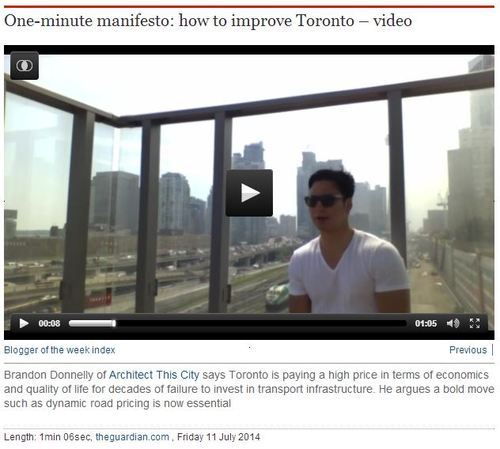
    This morning The Guardian Cities published my one-minute video talking about how much traffic sucks in Toronto and why we should be considering bold initiatives like dynamic road pricing.

    The video was shot on the sundeck of my building on a holiday Monday (meaning traffic volumes should have been less). The dirty glass makes the city look a lot smoggier than it really is, but it felt appropriate for the topic I was discussing.

    I’m sure many of you will disagree with what I’m advocting for, so let me know your thoughts in the comment section below.

  • Further evidence that laneway housing is going to happen

    image

    Earlier this week Fast Company ran a piece talking about “the next big thing in urban planning” – backyard cottages. As the name suggests, backyard cottages are basically accessory dwellings built in the backyards of existing single family homes. And the idea is that they’ll provide new affordable housing options in competitive and supply constrained markets such as the Bay Area in California.

    While somewhat different than laneway housing–which you probably know I support here in Toronto–they do share many similarities. We’re talking about the intensification of our residential neighborhoods at the scale of the single family home. And the potential benefits go beyond just affordability. It would also make our communities more sustainable, more walkable, and more conducive to transit.

    But there are challenges. I don’t know about the Bay Area, but many municipalities don’t allow a “house behind a house” and many communities don’t want to see their neighborhood itensify. However, we are seeing companies, like New Avenue, emerge to help homeowners navigate the process of building a backyard cottage. This company in particular claims to have worked with over 90 homeowners. 

    So I think we’re going to see more, not less, of these types of housing solutions. Vancouver is already doing it. And so is Portland

    Now here’s a question for you. If you owned a house in a single family neighborhood, would you be fussed if your neighbor erected a backyard cottage or laneway house? I’d love to get your opinion. Let me know in the comment section below.

    Image: New Avenue

  • Architect This City is The Guardian Cities blog of the week

    image

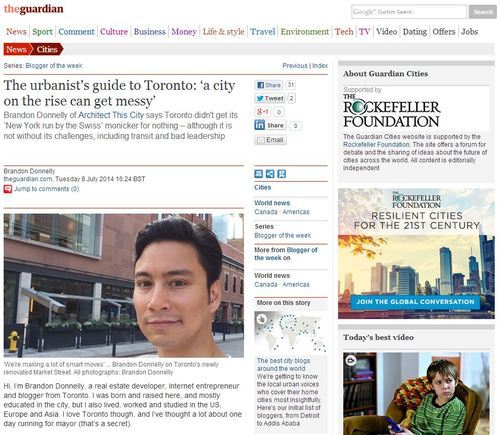
    ATC was featured in The Guardian Cities today as the city blog of the week. It’s a Q&A about Toronto and the idea is for it to be an “urbanist’s guide” to the city. They asked me to be playful and humorous in my responses, and so I tried to do just that.

    But my underlying message was that–despite being an awesome city–Toronto needs to get its act together with respect to mobility and transportation. I also recorded a video talking about this problem, which I believe will be released in the next week or so.

    A big thanks to The Guardian Cities for asking me to participate and to Athlyn Cathcart-Keays for continuing to be an avid supporter of Architect This City.