Daily insights for city builders, delivered every morning at 6 AM ET. I’m Brandon Donnelly — a Toronto-based real estate developer and founder of Globizen. I’ve been writing here since 2013.

Tag: atc

  • Opendoor.com raises $9.95M to make selling your home as easy as a few clicks

    image

    If you’re a regular reader of ATC, you’ll know that I’ve been following the startup Opendoor.com for a few months now. I first wrote about it when it was codenamed Homerun and I just recently wrote about them as preface to a real estate survey I was conducting.

    Well, about an hour go it was announced that they’ve just raised $9.95M in venture funding from everyone and their grandmother. Here’s the list of investors (via TechCrunch):

    Paypal co-founder Max Levchin, Former YouTube and Facebook CFO Gideon Yu, Eventbrite co-founder Kevin Hartz, Y Combinator’s Sam Altman, Quora CEO Adam D’Angelo, Yammer co-founder David Sacks, Angelist’s Naval Ravikant, Yelp CEO Jeremy Stoppelman, Box CEO Aaron Levie, Initialized Capital’s Harjeet Taggar, Garry Tan and Alexis Ohanian, Former Twitter vice president Elad Gil, Blippy co-founder David King, Flixster co-founder Joe Greenstein, Angel investor Mike Greenfield, Quora co-founder Charlie Cheever, Path’s Dave Morin, Facebook vice president Dan Rose, Trevor Traina, Resolute Ventures’ Mike Hirshland, Caffeinated Capital’s Ray Tonsing, Felicis’ Aydin Senkut, True Ventures’ Om Malik, Thrive Capital’s Josh Kushner, Crunchfund’s Michael Arrington (who disclaimer: founded TechCrunch) and SV Angel.

    Not surprisingly, there are quite a few people who see an opportunity in the $20 trillion US residential real estate market – which I think is a good thing. This is a space that–despite its size–hasn’t seen an awful lot of innovation.

    There still isn’t a lot of information about the product, but there’s a clear focus on creating liquidity in the marketplace. Despite being located in San Francisco, the company will be launching in 3 markets outside of California – where liquidity isn’t as great for homeowners.

    The goal is to transform the typical 90 day selling process into a few clicks online. Homeowners submit their home to the platform and then Opendoor makes an instant offer to buy. Done.

    What I wonder then is if it’s going to be an arbitrage play. They buy the homes below market (because they’re offering total liquidity) and then they turn around and sell them at market.

    Do you have any guesses as to their business model?
  • Why constraints can be a good thing for design

    image

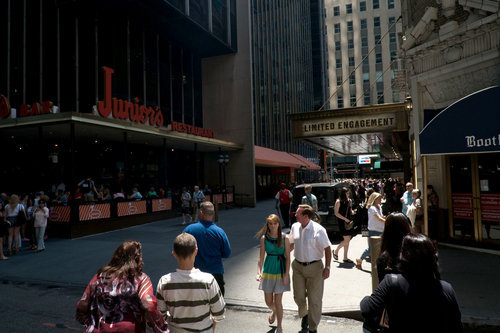
    I was reading the New York Times this morning and I stumbled upon an interesting article about Shubert Alley. I wasn’t aware of Shubert Alley, but I’m sure many of you probably are. It’s a 300-foot long pedestrian-only alley in the theater district of New York. It connects 44th Street and 45th Street and runs west of Broadway.

    And apparently it’s a big deal in the theater world – or at least according to Richard Hornby in 1991: “In New York, the desirability of a theatre is inversely proportional to its distance from Shubert Alley.”

    But what you may not be aware of is how the alley–which today serves as a public gathering space–was actually created. In 1913 when the Shubert and Booth theaters were built, the fire code dictated that theaters had to have separate fire exits on the sides of their buildings that connected directly to a main street. 

    Most of the time this led to blank sidewalls, but in this instance, the Shuberts and their architect Henry Beaumont Herts, decided to run an alley all the way through the block to serve as their emergency exit. 

    But what seemingly started as a pragmatic response to a code requirement, ended up creating what some people would consider the heart of the theater district. Sometimes constraints can be a good thing for design.

    Image: New York Times

  • Pop-up housing (it’s not what you think it is)

    image

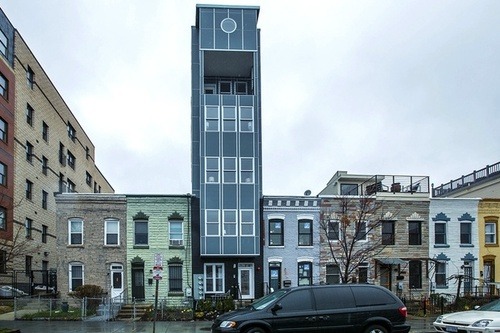
    You were probably expecting some kind of temporary housing solution. Because that’s certainly what I was thinking when Big Ben Myers tweeted me this article yesterday. But it turns out that in D.C., “pop-up housing” has come to mean what you see in the above photo – a pencil thin house rising amongst a bunch of low-rise rowhouses.

    Local bloggers are calling it a “middle finger to taste and scale”, but it’s happening because of what appears to be a real housing supply shortgage in the District. And it’s been said to be hurting not only housing affordability, but also exacerbating income inequality. 

    However, it’s become a threeway debate. You have people worried about aesthetics, local homeowners and residents worried about their own interests, and you have people worried about the overall health of the housing market. As I’ve argued before here on ATC, too much protectionism is often a bad thing for housing markets.

    But policy makers in the District appear to be responding in exactly that way, by clamping down on pop-up housing, as well as on accessory dwellings such as nanny flats (which I’m assuming are similar to what we would call laneway houses here in Toronto).

    I can certainly understand the concerns, but I think that cities need to find that fine line between preservation and growth. Because banning pop-up housing is only addressing the symptom. It doesn’t address the underlying cause, which, in this case, seems to be a housing market in search of more housing options.

    Update: This post was updated to give credit to Big Ben Myers for the article.

    Image: Washington Fine Properties via Citylab

  • Thoughts on real estate marketplaces

    The responses are still coming in from yesterday’s real estate marketplace survey, but I wanted to thank everyone who took the time to complete it. I really appreciate it. I was reviewing the responses this morning and I thought there were a couple of interesting takeaways.

    First, most people who own a home have at one point or another thought about selling that home. And even the people who haven’t thought about it, said they would be willing to sell under the right circumstances. That is, they would sell for the right price, for a better place, and so on. At the time of writing this, nobody said they would never ever sell.

    I think this is interesting because, even though the real estate market is a highly illiquid market, my hunch is that it could be made a lot more liquid with the right frameworks in place and if the barriers to selling could be reduced.

    And sure enough, many of the folks who said they have thought about selling (but haven’t yet), said it’s partially because it’s too expensive and too much work to sell. But in addition to these barriers, two other points emerged that I hadn’t given a lot of thought to before – but make total sense. 

    Homeowners also said that they haven’t sold because they’re too emotionally attached to their home and because they’re afraid they won’t be able to find another place to move into. 

    Because of how illiquid the real estate market is and because home transactions are typically asymmetric (that is, buying and selling are independent actions), there appears to be a real concern that you could sell your home and never find anything better.

    And since a home is such an emotion filled asset (as opposed to, say, a stock), people are naturally afraid of making the wrong choice. But then that begs the question: Are we, as real estate consumers, being left with suboptimal outcomes because we’re simply too afraid of the making the wrong choice?

  • Your thoughts on the real estate marketplace, please

    If you know me at all, then you’ll know that I’m a big proponent of introducing more technology into the real estate space. I think the industry is one that has been incredibly slow to embrace technology, but that it’s only a matter of time before it does.

    Two months ago I wrote a post talking about how entrepreneur and venture capitalist Keith Rabois is working on a home buying startup codenamed Homerun — now called Opendoor. Here’s how he recently described the state of affairs:

    “My friend [PayPal and Palantir cofounder] Peter Thiel suggested that I come up with an idea to innovate in residential real estate,” Rabois told VentureBeat in April. “It’s the largest part of the economy unaffected by the Internet. And that was definitely true then, and even with things like Trulia and Zillow, it’s fundamentally true today. But the process of [selling a home] hasn’t been transformed by technology.”

    What Opendoor is trying to do is really interesting, but I have a different idea. It’s called Unlyst. And today I’d like to ask the ATC community for a small favor. I’ve created a short home buying and selling survey (embedded below) that will take you at most 2 minutes to complete.

    If you could please take the time to do that, I would greatly appreciate it. I’ve made the results public as well, so you’ll be able to see how buyers and sellers currently feel about the real estate marketplace. If you can’t see the survey below, please click here. Thanks for your help!

    [googleapps domain=”docs” dir=”forms/d/1bKvHYdSUfYH3AGX7LcLIK0_-i7nt7WIdTmHeaJ8P7pY/viewform” query=”embedded=true” width=”760″ height=”500″ /]

  • Cawthra Park revitalization

    I must have been living under a rock because I just discovered this weekend that Toronto is in the midst of hosting WorldPride. I obviously knew that it was Pride Week, but I didn’t realize that we had outbid Stockholm in 2009 in order to be awarded the event. 

    I also didn’t realize that Cawthra Park near Church Street & Wellesley Street was being revitalized in preparation for both WorldPride 2014 and for the Pan Am & Parapan American Games in 2015 – which Toronto will also be hosting.

    Here’s a site plan of the final design:

    image

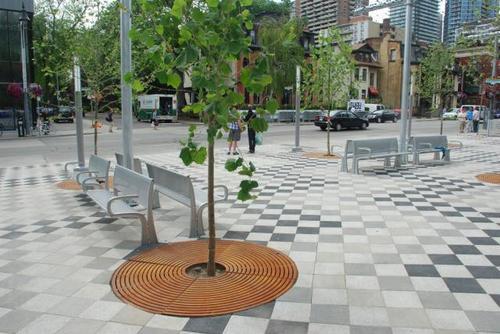
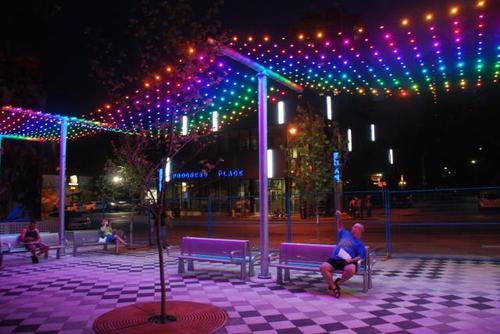
    And here’s what the completed design looks like:

    image

    image

    I like the pavers and I like the overhead LED lights. Those may not seem like big additions, but it’s amazing how those small little details can impact the way a space feels. I think it creates an intimate and inviting space. What do you think?

    Images: thinc design

  • Revisiting the urban farm

    If you’re a regular reader of ATC, you might remember that last month the team at TAS planted 100 EarthBoxes on the roof of our office building to grow everything from beets to hot peppers. Well it has now been over a month, so I thought it would be interesting to show you the progress that has been made.

    May 16, 2014

    June 27, 2014

    The area we’re occupying on the roof is probably around 400 square feet and many of the EarthBoxes have already been harvested a few times. So it just goes to show you how little you need to grow quite a bit of food. Now imagine what we could do if we transformed all of our urban rooftops.

  • Without trust, you have nothing

    I was reading Fred Wilson’s AVC.com blog this morning (as I do every morning), and I thought his post on trust was a really important one. He was talking about it in the context of building successful web applications, but I don’t think it’s only applicable to internet businesses.

    As marketer Seth Godin wrote on his blog earlier this year, the most important questions are not:

    Is my price low enough?

    Is it reliable enough?

    Do I offer enough features?

    Am I on the right social media channels?

    Is the website cool enough?

    Am I promising enough?

    No, the most important question in marketing something to someone who hasn’t purchased it before is,

    “Do they trust me enough to believe my promises?”

    Without that, you have nothing.

    I thought this was such an awesome, yet simple, post that I actually circulated it to a bunch of people in the office after I read it. Because whether you’re marketing widgets, marketing private cloud storage, marketing to investors, or marketing new condominiums, that question of trust is paramount.

    And it’s for that reason that I think social media and mediums such as blogging have become so important. Customers want to feel like they trust you before they buy your product. The best brands know this and forge “relationships” with their customers. And with the tools at our disposal today, it’s become a lot easier for companies to do that.

  • Do you love or hate streetcars?

    image

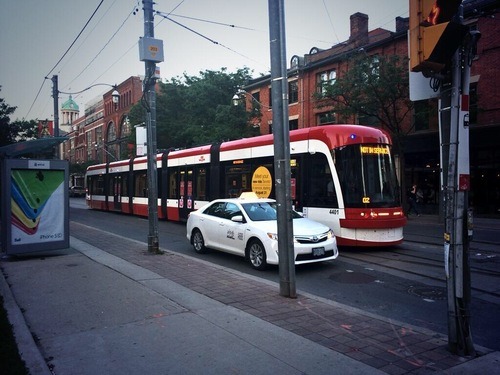
    Tonight I saw one of Toronto’s new streetcars cruising down King Street. They’re still in test mode and the first batch won’t go into operation until this August, but every now and then you’ll see one circulating around the city. This was the first one I’d seen in person.

    If you’re a transit geek or urbanist, you’re probably excited about the arrival of these new streetcars. But I know that there are a lot of people who aren’t. They hate streetcars and they think of them as basically rolling stop signs on our congested downtown streets. And since these new streetcars are even longer than our existing ones, they’re worried they’ll just make the situation worse.

    Personally, I think that streetcars mixed into traffic is generally pretty inefficient. But I know that surface light rail has the potential, when executed properly, to be a cost-effective and sustainable way of efficiently moving lots of people around a city. When I lived in Dublin I took the Luas every day. It was great.

    So I’m curious to hear from you. What do you think of Toronto’s new streetcars? Let me know in the comment section below.

  • Tech and the City

    image

    I’m reading a great book right now called Tech and the City. I’m only 31% of the way through it (according to my Kindle app), but already it’s been an interesting read. It’s about the making and rise of New York City as a technology and startup hub – which, is fairly recent phenomenon. There aren’t too many cases where New York plays second or third city, but tech is one of those instances. Silicon Valley dominates.

    The book talks about the deliberate efforts that were made, by the Bloomberg administration as well by many others, to diversify New York’s economy away from financial services and towards technology, startups, and entrepreneurship. It gives you all the backstory about the rise of Silicon Alley in the 90s, its subsequent crash in the dot com era, and all the players involved. And yes the reference to Sex and the City is both on purpose and explicit throughout the book.

    But at a time where cities all around the world are trying to replicate the success of Silicon Valley, the takeaways from this book are perhaps universally applicable. It certainly got me wondering if, here in Toronto, we’re doing enough to prepare our city to dominate in the 21st century.

    Image: Stephen Wilkes