Daily insights for city builders, delivered every morning at 6 AM ET. I’m Brandon Donnelly — a Toronto-based real estate developer and founder of Globizen. I’ve been writing here since 2013.

Tag: atc

  • What use could driverless cars serve beyond just transport?

    image

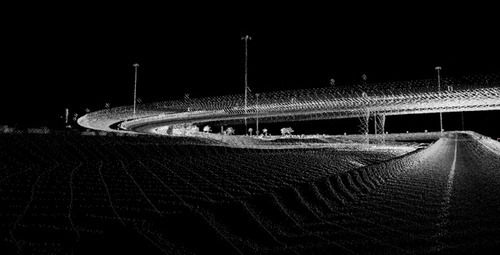
    Here’s further evidence that technology is starting to infiltrate into many other industries, including architecture. London-based architect and designer Pernilla Ohrstedt is currently working on an exhibition for Dezeen and MINI Frontiers that will architecturally visualize the 3D data that driverless cars collect in order to navigate around.

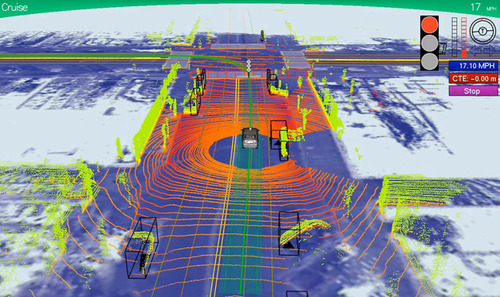
    I had never thought of this before, but as a byproduct of driverless cars, we’re about to start collecting detailed replicas of all of our cities – well beyond the static images we currently have with Google Streetview. In order to navigate by themselves, driverless cars are constantly scanning their surroundings to create a “point cloud” replica of the built environment. This point cloud basically tells the car where they are, where they should drive, and what obstacles might be around.

    It could look something like this:

    image

    Already there are firms like ScanLAB emerging to provide 3D scanning, publishing, and visualization services. But this is obviously just the tip of the iceberg. I can only imagine what innovation will emerge from the passive collection of all this data once driverless cars become commonplace in our cities.

    As one example, it could be a way for us to systematically measure the correlation between the qualities of a street and the vibrancy of its street life. Is there a perfect width? An ideal traffic volume? A right scale? All of this data could make city building more of a science (and perhaps less political).

    My hope though is that this data would be open and accessible to all, so that clever entrepreneurs could build on top of it.

    What are some of your ideas?

    Images: Dezeen

  • Introducing: ATC city tees

    image

    I’ve just launched a set of city tees over at shopATC. To start, there are 4 cities (Toronto, New York, Vancouver, and London) and each one is available in either black or (ATC) orange. They’re printed on a super soft American Apparel tee and cost only $30 each. I picked the cities based on readership levels. I hope you like them.

  • What to do when a car is blocking your bike lane

    I was out for a bike ride last night and, on my way home, I decided to try out the new dedicated bike lane on Adelaide Street. Usually I would take King Street, but it was completely full because of Caribana parties.

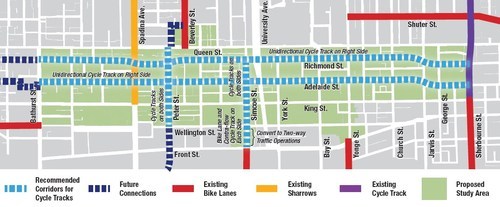
    For those of you who may not be aware, the city of Toronto is currently piloting two dedicated bike lanes on Adelaide Street and Richmond Street in the downtown core. Both streets are one-way and because the lanes were so big to begin with (highway-like spacing), I’m told that these new bike lanes didn’t even eat up a driving lane.

    Here’s a map of the pilot area:

    image

    Given that dedicated bike lanes are a scarce resource here in Toronto, I have to say that it was rather luxurious having my own piece of road. And because there’s no longer any fear of parked car doors swinging open, I was able to ride a lot faster than I normally would. 

    But as my friend Evgeny pointed out earlier this week, there’s a big difference between dedicated and grade separated bike lanes. Indeed, on my trip from Bathurst Street to Church Street last night, I encountered 3 cars parked in my lane.

    //platform.twitter.com/widgets.js

    So, I hope that these bike lanes become a permanent fixture downtown, but that the city makes them grade-separated. I’m sure people will use them. At the same time, I think they could also act as a catalyst for more pedestrian life along both of these streets.

    If you haven’t yet tried them out, I would encourage you to do so. The city is tracking usage and so you would be supporting the cause. And if there’s anybody parked in your lane, below is one way to handle it. It’s a video by Casey Neistat out of New York. If you can’t see it below, click here.

    [youtube https://www.youtube.com/watch?v=bzE-IMaegzQ?rel=0]

  • How many households in Canada live in a condominium?

    Click here to zoom in / download a copy

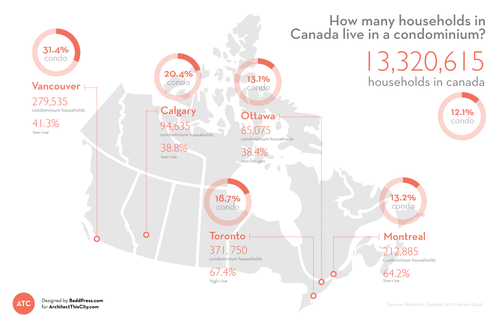
    I’ve been meaning to introduce infographics and diagrams into my posts at ATC for quite some time now, so I’m excited to introduce the first one: How many households in Canada live in a condominium? I hope to make this a regular feature.

    While a lot of the new development happening in Canada is condominium – particularly in cities like Toronto and Vancouver – the vast majority of households in Canada still live in non-condominium dwellings. Only 12.1% of households are condominium households, which could be high-rise, low-rise, row-housing, or other, according to Statistics Canada.

    Perhaps not surprisingly, the Vancouver CMA has the highest percentage of condominium households at 31.4%. I would have expected Toronto to come second, but Calgary (20.4%) actually takes that position (probably) due to an abundance of low-rise condominiums (38.8% of all condos in the CMA). However, Toronto has, by far, the highest percentage of high-rise condominium households at 67.4%. This isn’t surprising to me.

    All of the data for this infographic was taken from Statistics Canada and the total number of households in each Census Metropolitan Area (CMA) was assumed to be “occupied by usual residents.” StatsCan defines this as households that are permanent as opposed to ones that could be second homes and so on.

    I hope you like the first ATC infographic.

  • What makes a city a smart one?

    There’s a lot of buzz around the idea of a “smart city.” IBM is involved. Cisco is involved. And so are many others. But what exactly is a smart city? 

    In the Electric City talk below, Adam Greenfield provides his definition, while at the same time being critical of the ones we currently use today, such as this one: It’s the missing link – the connective tissue – between the real estate and technology sectors. (Personally, I find this definition really interesting.)

    He also goes on to argue that the way we’re largely thinking about smart cities today is incorrect. We’re far too centralized and administrative in our thinking. Instead, we should be focused on leveraging the crowds of people in our cities that are now virtually all networked.

    He then goes on to list 5 technological preconditions to any smart city:

    1. Broadband connectivity
    2. Low-cost smartphones or personal devices
    3. Commitment to open municipal data
    4. Cheap public interfaces
    5. Cloud computing infrastructure

    If you’re interested in this topic, I suggest you watch his talk. It’s only about 10 minutes long. Click here if you can’t see it below.

    [youtube https://www.youtube.com/watch?v=9keDwTBmZ3o?rel=0]

    Update: This post was revised to reflect the fact that Adam Greenfield is “sharply critical” of the real estate + technology definition of a smart city.

  • 5 ways in which you’ve got it wrong when it comes to cities

    About a month ago, a reader of ATC and friend of mine suggested that I write a post on some of the common misconceptions that people hold about cities. I immediately thought it was a good idea and so I started a draft post with some of my initial thoughts.

    Over the past couple of weeks I’ve been collecting fallacies as they came to me, waiting until I reached a nice round number like 5. Well today, I reached that number. So here are 5 misconceptions that I think people often hold about cities. If you have any others, or if you disagree, please share your thoughts in the comment section below.

    1. Adding more lanes will solve traffic congestion

    There’s a saying I read somewhere: Adding more lanes to solve traffic congestion is like loosening your belt to deal with obesity. I can’t remember where I read it, but I like it a lot because it gets at the heart of this fallacy: Trying to build our way out of traffic congestion has proven time and time again to be a losing battle. In fact, it has been shown to make traffic even worse as a result of “induced demand.” The more roads you build, the more people drive.

    2. A suburban home is always cheaper

    While it is true that the direct cost of a suburban home is usually less than one in the center of a city, many people often neglect to factor in the indirect costs of a home purchase – the biggest of which is usually transportation costs.

    As you move out from the center of a city and home prices start to fall, I like to think of it as transfer from housing costs to transportation costs. In other words, what you save on the price of your home, simply gets used to pay for a car (or perhaps a second car), as well as the additional time you’re going to spend traveling.

    So how much is an hour of your time worth? Have you ever attached a value to it and added it to the price of your home? Because if you factor in transportation costs and your time, you might find that your suburban home is actually more expensive.

    3. Opposing new development and advocating for affordable housing is a responsible way to build cities

    Community opposition is a big part of the development game. But what a lot of people don’t think about is that when you oppose or stop new development (let’s say it’s residential), the demand for that housing doesn’t go away. 

    In fact, all it does is create more pressure on the housing stock that does exist and foster an environment where the rich will starting outbidding the poor for housing. More simply, you end up creating a supply constrained market and that drives up home prices. Demand > supply. So in reality, opposing new development and, at the same time, advocating for more affordable housing is a contradiction.

    As a comparative example, let’s think about another basic human need: water.

    Imagine that you could only buy water from stores (it didn’t come out of taps). But that every time the delivery people were trying to bring more water to these stores, that there was a group of people who fought and opposed them. These opposers already had enough water for themselves and they didn’t want additional water being sold as it would bring new customers into their local grocery store and disrupt their way of life.

    This, of course, caused the price of water to rise as the rich people started offering more for the water. This in turn made it difficult for the poorer folk to afford any water at all. But instead of allowing the delivery people to simply deliver more water, it was decided that out of the water that they have, that some of it should be earmarked as “affordable water” and priced accordingly. That would guarantee that the poorer folk could still have some.

    Does that sound like a sensible solution to you?

    4. Developers don’t want to build big apartments

    Here in Toronto there’s a somewhat pervasive belief that developers don’t want to build big condo and apartment units. The thought is that small units are more profitable and so developers are doing everything they can to squeeze people into small units. But I’ve argued before that this isn’t the case. It’s far more nuanced than that.

    To illustrate this point, imagine you’re a developer debating between building two 500 square foot condo units or one 1,000 square foot condo unit. If you build the two 500 square foot condo units you’ll need 2 x kitchens, 2 x entry doors, 2 x separate color selection appointments, 2 x separate PDI appointments, and you’ll have to pay development charges on two 1 bedroom units (to name only a few things).

    On the other hand, if you build one 1,000 square foot condo unit you’re only going to need 1 of each of the items listed above and you’ll be paying development charges on only one 2 bedroom condo unit (which currently works out to be less than what you’d be paying for the two 1 bedroom units – it’s not quite double).

    Which one do you think would be cheaper to build?

    5. Technology is going to make cities irrelevant

    Lastly, during the dot com era there was a growing belief that technology and the internet were going to make cities and real estate irrelevant. Capital was flowing out of real estate and into tech companies, because that was seen as the future. Bricks and mortar were passé.

    But since then we’ve learned that it’s actually the opposite. Paradoxically, technology has made cities even more important. The returns to being smart and talented are huge in the right place. So much so that our biggest concern shouldn’t be whether cities are going to become irrelevant, but whether we’re concentrating too much wealth and talent in only a select few.

    So there you have it, 5 misconceptions about cities. I’m sure there are many others, so I’d love to hear from you in the comment section below.

  • Biggest US real estate website to acquire 2nd biggest US real estate website

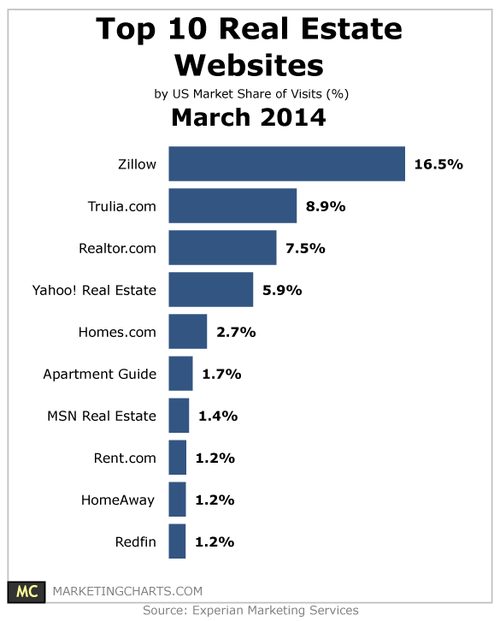
    Today it was announced that Zillow.com will be buying Trulia.com for $3.5 billion in a stock-for-stock transaction. Based on share of web visits, the biggest real estate website in the US has just acquired the 2nd biggest.

    image

    Both companies make the bulk of their money through advertising sales to real estate professionals (i.e. agents and brokers). But what was interesting to read in their press release is that, even with this merger, the combined revenue of both Zillow and Trulia still only represents about 4% of the estimated $12 billion that US real estate professionals spend on marketing each year. 

    Zillow says it’s because the real estate industry hasn’t fully made the switch to online and mobile – and thus it represents a huge market opportunity for them. And from my experience I would say that this is likely the case. But it could also be because the real estate community is putting their marketing dollars elsewhere online. 

    Whatever the case may be, Zillow.com (and its portfolio of companies) is now firmly positioned as the largest real estate website in the US. But even still, Zillow.com has never felt fully “net native” to me. It has never felt as if it were specifically built for the internet and that it’s only possible because of the internet. Instead, it feels like an offline model ported over to online. And the two are quite different.

    The reason I feel this way is because there’s an inherent tension to the way the online residential real estate market works today. Virtually every lead generation tool (that agents use) is intended to funnel buyers and sellers to them. That’s why so many real estate websites have sucked for so long. Because the goal wasn’t to keep you locked into a website, it was to get you to connect, in person, with an agent.

    Zillow and Trulia started to break with that tradition by offering a lot more information online. Before they came along, it was a lot harder for real estate consumers to do their own research. But at the end of the day, Zillow makes money when it’s an effective sales funnel for agents. And since that’s always been the way the market has worked, it doesn’t feel net native to me.

    If my gut is right, then it means there’s still lots of opportunities in this space.

  • Bad neighbors build wind turbines

    image

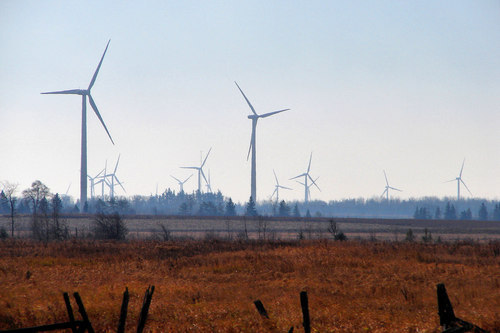
    On Friday when I was driving up to Thornbury, I ended up taking a route that goes through Shelburne, Ontario. I’ve taken this route at some point before, but I don’t remember seeing so many wind turbines. I guess it must have been before this particular wind farm had been built out.

    It turns out that these wind turbines belong to the Melancthon wind facility, which is the largest installation in Canada. The facility contains 133 wind turbines and has the capacity to generate 545,000 megawatt hours each year – enough renewable energy to power roughly 70,000 households. The facility is owned and operated by TransAlta and they’ve entered into a 20-year contract to supply renewable energy to the Ontario Power Authority.

    But what I also happened to notice were the many signs posted around with wording like the title of this post: “Bad neighbors build wind turbines.” And after speaking about it with people over the course of this weekend, I very quickly learned that there was fierce community opposition to this project.

    The concern with wind turbines is typically twofold. People don’t like the way they look and they worry about the noise that they will generate. There’s even an alleged condition called “Wind Turbine Syndrome.”

    I personally think they look quite beautiful. They seem so symbolic of the future and progress. But I am intrigued by the noise concern and so I decided to do a bit of research. I found this video from the UK. The big takeaways are that living beside a main road is generally much louder than living beside a wind turbine, and that a wind turbine isn’t usually that much louder than a quiet suburb, until you get fairly close to it. So I wonder if it’s really as bad as people are making it out to be.

    Either way, the issue at hand is incredibly important. We’re talking about renewable energy. And while you may not like the look of wind turbines scattered across the horizon as much as I do, I strongly believe that we need to figure out ways to wean ourselves off of fossil fuels. It’s for this reason that I’m a big supporter of both wind and solar power.

    So perhaps the counter to those signs scattered around Shelburne is the following: Responsible communities build wind turbines.

    Image: Wikipedia

  • Pools and gardens of New York

    Right now, I’m sitting on the sun deck at my friend’s cottage and looking out at the Georgian Bay. So this is going to be a short post. The New York Times just published a stunning photo series of hidden rooftop pools and gardens in New York. All of the photos were taken from a helicopter. If you’re as fascinated by cities as I am, I think you’ll really like them.

  • Pre-delivering new homes

    image

    Today was my mother’s PDI for her new condo. For those of you who aren’t in the industry, a PDI is a “pre-delivery inspection” that happens about a week or two before you take occupancy of a new home. It’s basically a time for you to identify all the mistakes that the construction team has made and have them (hopefully) correct them before you actually move in.

    But for someone like my mother who is making the move from a house that she’s lived in for decades, a PDI is actually something much more significant: It’s the first time she saw her new “home.” And a home is something much different than just a house or a condo – it has emotional significance.

    It’s going to be an adjustment for her. One of the first things she did was open up the oven to see if she could fit her Christmas turkey in it. But in the end, I have no doubt that she’s going to love her new home. As I’ve mentioned before, people often overestimate the potential risks of change. But never be afraid to give up the good to go for the great.