Daily insights for city builders, delivered every morning at 6 AM ET. I’m Brandon Donnelly — a Toronto-based real estate developer and founder of Globizen. I’ve been writing here since 2013.

Search results for: “road pricing”

  • Free roads or free-flowing traffic?

    If you are a longtime reader of this blog, you’ll know that I am a supporter of road pricing. I believe it’s the only way to realistically solve the problem of traffic congestion and I believe that underpricing roads (such as not charging for them) isn’t fair and equitable to taxpayers, especially given our need to shift to more sustainable forms of mobility.

    Todd Litman’s recent opinion piece in the Globe and Mail is a good reminder of these points:

    Also, new highways are far more expensive than most people realize, typically costing tens of millions of dollars for each kilometre of lane. Considering land, construction and additional operating expenses, the cost-recovery price for additional highway capacity – the toll required to repay its incremental costs – is typically 50 cents to $2.00 per vehicle-kilometre, far more than what motorists pay in fuel taxes.

    The law of demand is a fairly simple economic concept. It states that price and quantity demanded have an inverse relationship. The more you charge for something, the less demand there will be. And the less you charge for something, the more demand there will be.

    So it shouldn’t come as a surprise to anyone that when you underprice road and highway usage, you get lots of demand — oftentimes too much demand. As Litman argues in his article: “You can have free roads or you can have free-flowing traffic, but it is not economically feasible to have both.”

    Photo by Denys Nevozhai on Unsplash

  • Pigovian transport pricing in Switzerland

    A Pigovian tax is a tax on market activities that produce some kind of negative externality for society. The basic idea behind the tax is to try and use it to correct something that is happening, but that isn’t all that desirable. Examples of negative externalities might include things like pollution and traffic congestion.

    Traffic congestion is a bad thing, which is why I have long been a supporter of road pricing. We know how to do this. It has been proven to work in countless cities, including Singapore, London, Stockholm, as well as many others. But in most cases, there isn’t the political will. That has certainly been the case here in Toronto.

    Maybe this post will help.

    A recent study by ETH Zurich, the University of Basel, and ZHAW has looked at the effects of Pigovian pricing on mobility within Switzerland. The study included 3,700 participants and spanned both French and German-speaking parts of the country.

    The way the study works is pretty simple. They took thousands of people, gave them a transportation allowance (in Swiss francs), and then assigned costs to the various mobility options. These costs were intended to be commensurate with their amount of negative societal impact.

    Driving, for example, came at a cost of 0.1 Swiss francs per kilometer. Whereas participants actually earned money for walking, since you could fairly easily argue that walking produces a net benefit to society. At the end of the four-week experiment, participants were allowed to pocket whatever money was left in their transportation wallet. So in theory there was an incentive to spend less.

    What the researchers were trying to do was simulate Pigovian transport pricing and give people a more direct understanding of the societal costs associated with how they move around. And based on their results, it looks to have worked.

    What the results show is that when you start pricing transport in this way, all mobility declines slightly (the “all modes” line). But that the biggest hit is, not surprisingly, driving. Car use declined by almost 5%, whereas walking, biking, and using public transit all increased. (The price elasticity of demand for car travel was found to be similar to when the cost of gas increases — people drive a bit less.)

    The authors go on to argue that longer-term Pigovian pricing is likely to produce an even greater impact on mobility, as people would likely adjust and start making bigger decisions about where and how they live. That seems plausible to me.

    For a full copy of the study, click here.

  • Vancouver is probably getting transport pricing

    Earlier this month, Vancouver City Council approved a plan that will have staff developing a “transport pricing” strategy for the city’s core. (Transport pricing is just another term for road pricing or congestion pricing.) The plan is for staff to go away and work on this and then report back to Council with a pricing strategy sometime in 2022. At that point Council will look to approve the plan and it will all get implemented by 2025. Or at least that’s the plan. I remain somewhat skeptical because Vancouver certainly isn’t the first Canadian city to look at pricing its roads and congestion. Toronto has tried and failed. And so if Vancouver does end up doing this, they’ll likely be the first city in the country.

    So why are they doing this, or least trying to do this? Well, if you’re a regular reader of this blog you’ll know that I’ve been a supporter of road pricing for many years. Lots of old posts over here. But in the case of Vancouver, their stated goals are really as follows: 1) They want to reduce congestion and encourage people to use other forms of mobility; 2) they want to reduce carbon emissions by 50% by 2030; and 3) they want another revenue stream that can be used to fund things like transit and active transport. Put differently, it’s about pricing/taxing the things that we want less of and then using that money to pay for the things we want more of.

    Some of you might be wondering whether this is a good idea at a time when the centralizing pull of cities is being called into question. But I think it’s important to keep in mind that Vancouver thinks it needs at least five years to implement its transport pricing. We’ll be living through the roaring twenties by then. I am also a firm believer that cities are going to snap back significantly faster than most people think.

  • Manhattan is getting a congestion pricing zone

    About a year ago I wrote about how NYC is considering a congestion charge on vehicles entering Manhattan below 60th street. Well it looks like that plan could be adopted as early as April 1 (however the fees won’t start until 2021).

    Here’s a map of the proposed congestion pricing zone from the NY Times:

    I have written extensively on road pricing over the years and so I won’t repeat myself here today. Suffice to say that I think creating a sustainable funding source for transit and other mobility options is a positive step forward.

  • Cost-plus pricing

    Today, Urbanation released its Q4-2018 market highlights report for the Greater Toronto Area. 

    The general media will pick up these numbers and tell you that there’s been a precipitous decline in the number of new condominium sales. But the reality is that 20,028 units were sold in 2018, which is actually in-line with 10-year averages for this region. 2017 was a particularly frenetic, and unsustainable, year.

    The average pre-construction sold price for a new condominium in the former City of Toronto (the core) was $1,117 psf last year, and $921 psf across the broader region. These numbers represent significant double digit increases from the year prior. But again, what I don’t think many people appreciate is that the cost environment has also changed dramatically over the last few years.

    Construction costs are way up, as are development charges and a myriad of other pro forma line items. The above numbers are simply a result of cost-plus pricing. Here’s where costs are at and here’s where we need to be to make the project feasible. Margins haven’t increased; in fact, they’ve probably been squeezed for many developers.

    I think this is an important topic that deserves more transparency and visibility. So I’m hoping to work with a developer friend of mine and publish something more substantial in the coming months.

  • Toronto mayor proposes road tolls, finally

    When I wrote yesterday’s post about road tolls, it hadn’t been announced that Toronto Mayor John Tory was going to call for road tolls on both of the highways coming into downtown. That didn’t leak until late in the evening. So I was just writing another post on a topic that I care about.

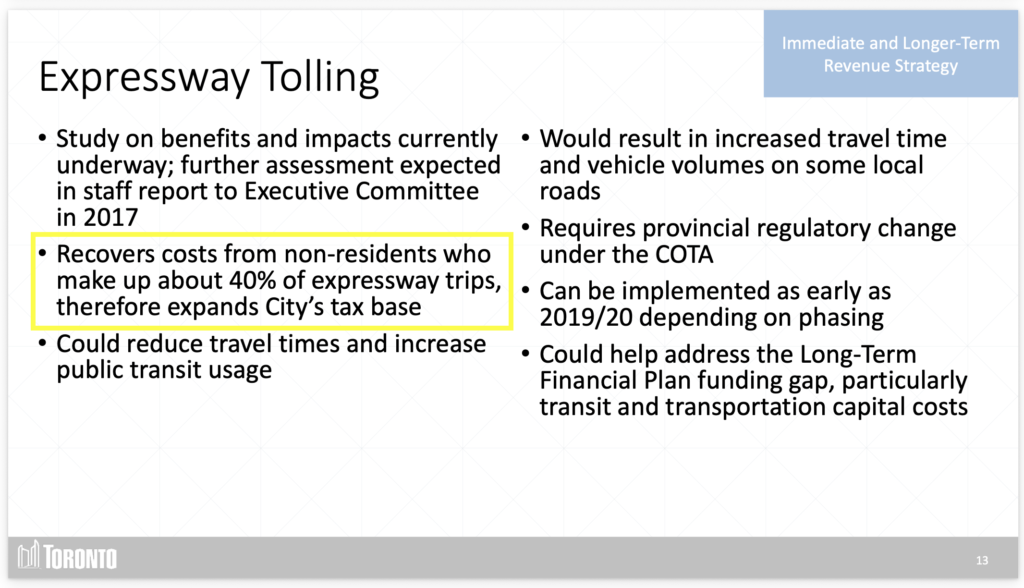
    Today, however, that announcement was made and the proposal is a flat $2 toll on both the Gardiner Expressway and the Don Valley Parkway. It is expected that this could bring in close to $200 million a year in new revenue for the city – all of which would be dedicated towards transit and roads. Good.

    First, I want to applaud the mayor for coming out in support of road pricing. I didn’t agree with him on the Gardiner East, but I agree with him on this – mostly. It is a bold move.

    The reason I say mostly is because I hope that we don’t simply default to a fixed and blunt road toll. There are more sophisticated options out there, such as variable pricing models that change based on demand/congestion levels.

    Here’s a post that explains how that works and why I think it’s a good model.

    With this approach, it becomes more of a congestion charge rather than a toll. It also gives commuters the option of driving during off-peak times to save money. And if we implemented something like this, I am sure that we would see employers and office hours adapt. More on this in the above post.

    Still, I absolutely believe that it’s a step in the right direction for this great city. So thank you Mayor Tory.

  • Guest Post: For whom the road tolls?

    For those of who were following Architect This City during the Gardiner Expressway East debate here in Toronto, you might remember that Darren Davis (transport planner with Auckland Transport) wrote a guest post called, Three minutes that rule the world – Will demolishing the Gardiner East actually make traffic worse?

    It was an incredibly popular post at the time, so I’m thrilled that Darren volunteered to do another one on road tolls. This is a topic that I’m very interested in and have written about a few times. Road pricing, as you’ll see below, puts us in a bit of a chicken-and-egg situation. But sooner or later I think we will need to get our head around it, as will many other cities.

    I hope you enjoy today’s post. Thanks again Darren.

    ——————————-

    A recent post on Architect This City, The Tragedy of the Commons, raised a fundamental but all too often forgotten point about transportation: That in networks where the price of use doesn’t change when demand changes, there is no effective mechanism to manage that demand.

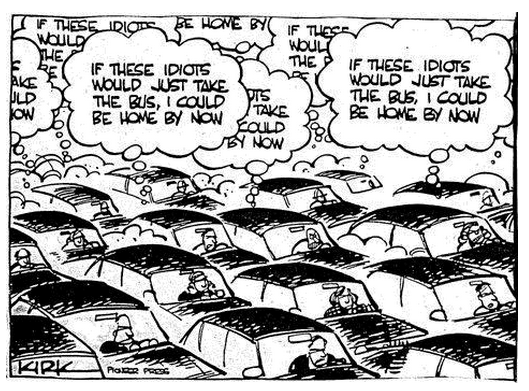
    Because there is no incentive to act in the public good, we often act in what we perceive to be our own personal interest, which is often the antithesis of the public interest. And remember that if we are driving, we are traffic. So often people will sit fuming in their cars in the midst of congestion with thoughts like in this cartoon. But of course with unpriced roads, there is no real price signal to these drivers to consider taking the bus.
    In a world where time is money, we are constantly berated about the economic costs of congestion. In 2011, the Toronto Board of Trade estimated that congestion in the Toronto region alone cost the regional economy $6 billion a year, rising to an estimated $15 billion in 2031 should no action be taken. More recent research by the CD Howe Institute pegs this figure at up to $11 billion.

    Given these sorts of eye-watering figures, one might be tempted to think that car drivers, and in particular the goods industry, would be flinging their wallets open at the chance to buy their way out of congestion. And in fact Toronto has the 407 Express Toll Route which has elements of variable road pricing. However, while the 407 ETR carries around 350,000 vehicles per day, price increases have been matters of controversy. It provides some ability for those who can afford it to bypass Toronto’s notorious traffic congestion, but its fundamental weakness is that it’s just one road in one of North America’s largest city-regions.

    Similar stand-alone efforts to address congestion in Metro Vancouver with tolled routes, such as the Port Mann Bridge on the Trans-Canada Highway and the Golden Ears Bridge, have fallen well short of their projected traffic volumes, while nearby untolled bridges such as the Patullo Bridge are heavily congested. We have a similar experience in New Zealand where our two tolls roads, with car tolls of $2 and $2.20 respectively, experience diversion rates of up to 30% to the alternative but substantially longer and slower free routes.

    This brings up a fundamental paradox: Congestion costs the economy a fortune and congestion is a top-of-mind frustration, yet people seem reluctant to pay even comparatively small amounts to bypass congestion.

    For example, the City of Toronto’s Roundtable on Gridlock & Traffic Congestion in February 2014 came up with the usual shopping list of “transportation systems management” responses – improved management of curbside space and construction projects; synchronized traffic signal phasing; better traveller information and improved incident response. While these are all worthwhile responses, they only improve system operation at the margins. Encouraging greater use of public transit was the very last recommendation and there was not a single mention of charging or pricing as a tool to address congestion. And the feverish activity continues with a hackathon called TrafficJam on October 2 – 4, 2015 with the goal of fixing Toronto’s traffic woes.
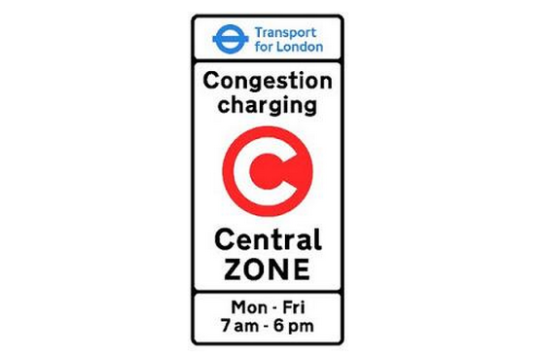
    The very few cities that have actually had significant success at reducing traffic congestion – notably Singapore, London and Stockholm – have done this through cordon-based congestion pricing wherein if you pass the cordon, you pay the congestion charge. Entering central London on a weekday between 7am and 6pm will set you back a cool £11.50 ($C23.30). From 2003 to 2013, about £1.2 billion ($C2.42 billion) of congestion charge revenue has been invested in public transport, road and bridge improvements and walking and cycling, of which £960 million ($C1.94 billion) was for bus improvements. These measures have included significant road space reallocation to improve conditions for pedestrians, cyclists, public transit and the urban realm.

    The latest Travel in London report states that “Over the 10-year period from 2003, total trips have increased by 11.4 per cent, with particularly notable increases of 52.3 per cent in rail trips and 32.0 per cent in Underground and DLR [Docklands Light Railway] trips, with cycle trips (as main mode) increasing by 53.9 per cent. Car driver trips decreased by 12.7 per cent over the same period” (my emphasis).

    One interesting insight is that Stockholm trialed congestion charging and then reverted to business as usual of unpriced roads in advance of a referendum on congestion pricing. This gave Stockholmers a clear sense of the difference in traffic congestion and was crucial in supporting a yes vote in the referendum.

    Stockholm has experienced a permanent reduction in traffic of about 20% across the toll cordon and congestion decreased by 30 – 50% – which demonstrates that traffic volume reductions have a disproportionately positive impact on congestion. About half of the “disappearing” drivers changed to transit, the rest to other alternatives such as different departure times and destinations and taking fewer trips.

    For more on Stockholm, I suggest reading the Tools of Change case study on Stockholm Congestion Pricing.
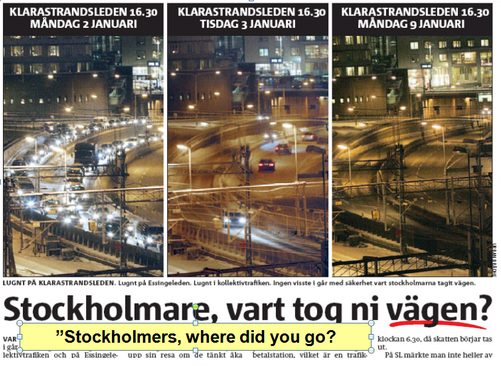
    Before and after congestion charge photos of traffic levels in Stockholm

    While this sounds very promising, congestion charging has significant equity implications and requires upfront investment to provide people who either choose to or can no longer afford to drive with transportation alternatives. Both Stockholm and London invested very heavily in public transit in advance of implementing congestion charging.

    And this brings up a big issue for Toronto. 

    For congestion charging to have a meaningful impact on congestion without stifling economic activity or impeding people’s ability to move around, the core capacity of Toronto’s transit system would need to be addressed first. In particular the Yonge Line capacity enhancements, Metrolinx’s Regional Express Rail and most likely the Downtown Relief Line would need to be in place to provide both capacity and choice for people who either needed or wanted a travel alternative to any congestion charge.  This would mean that Metrolinx’s Big Move might need to get even bigger.

    Disclaimer: The author of the above post is an employee of Auckland Transport, however, the views, or opinions expressed in this post are personal to the author and do not necessarily represent the views of Auckland Transport, its management or employees. Auckland Transport is not responsible for, and disclaims any and all liability for the content of the article.

  • The Fundamental Law of Road Congestion

    A few days ago I wrote a post talking about what happens when you demolish an urban highway. It was a link to an article giving 5 examples of cities that have removed their urban highways and benefited.

    After I wrote the post, a number of people responded on Twitter. Some thought it was a great idea and gave examples of other cities, such as Detroit, that are thinking about doing the same. But others responded and said that I was out of line. And that while it might work in some cities, it simply isn’t a viable option in cities like Toronto.

    So as somebody who believes we should be taking down the Gardiner Expressway, I thought it would be worthwhile to revisit the topic and provide a bit more information.

    To be clear, I’m not suggesting we remove the Gardiner and replace it with nothing. My belief is that we should replace it with a broad surface street that would still move lots of cars, but that would make our waterfront much more open and accessible to everyone.

    So how is this feasible?

    Again it comes back to the concept of induced demand. Back in 2009, two economists from the University of Toronto and University of Pennsylvania – which are actually both of my alma maters – published a study called The Fundamental Law of Road Congestion.

    In it they discovered something really fascinating: there’s a near perfect relationship between new roads and highways built and the total number of miles driven. In other words, as cities increased road capacities (during their study period of 1980 to 2000), the amount of driving went up just as much.

    What this should tell you is that trying to build your way of out road congestion is usually a losing proposition. That’s why every large city has a traffic problem. Try and think of one that has solved this. And as much as it might seem intuitive to tell people at cocktail parties that your city simply needs to build more roads and highways, it’s typically not that simple. (In my view, the solution is road pricing.)

    The other really interesting thing that this study revealed is that it works both ways. When you reduce road capacity, drivers start to disappear. People choose to live closer to where they work. People choose transit. People go into the office at different times. People make all sorts of different decisions in response to this road change, just as they do when there are more free roads available to them.

    So within a reasonable band (obviously you can’t remove all roads), there is no perfect amount of road capacity. If you added another lane to your highway, it would be full. If you took away a lane, it would end up equally full. That’s why removing the Gardiner Expressway isn’t lunacy.

    Instead, it actually makes a lot of sense:

    • It’s the cheapest solution (compared to repairing it or burying it)
    • It would free up money for transit and other mobility solutions
    • It would make our waterfront more open and accessible
    • It would beautify our downtown
    • It would increase land values all along the waterfront

    And since we’re still in the early days of developing our eastern waterfront, now is the time to do it. The longer we wait, the harder it’ll get and the more expensive it’ll get.

    So I hope that the leaders in this city will think long and hard about this as opposed to immediately assuming we need an elevated highway to keep this city moving. The last time I checked, it doesn’t work so well in its current state.

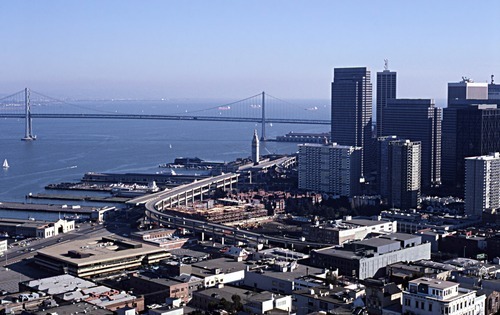
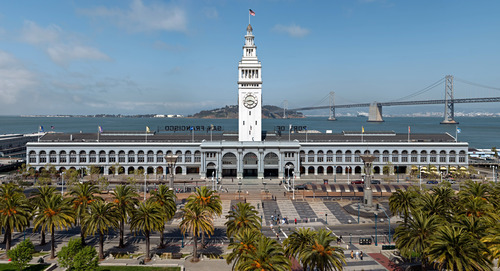
    Images: Before and After the Embarcadero Freeway in San Francisco (via Gizmodo)

  • Finally, New York City gets its congestion relief zone

    January 6, 2025 · View original


    Good morning. Well, it finally happened.

    After decades of delay and negotiations, New York City finally implemented congestion pricing for the area of Manhattan south of 60th Street. This is a first for the United States, and so it’s a big deal not just for the city, but for this part of the world. It went into effect yesterday, on Sunday at midnight, so that the MTA could work out any kinks before this morning’s rush hour. And apparently everything went smoothly. Drivers are now required to pay $9 to enter the zone during peak hours (5am to 9pm during weekdays). The charge is also expected to rise to $15 by 2031. Of course, this is a highly contested initiative. Trump is still vowing to kill the program as one of his first acts in office and, as soon as the pricing came into effect, suburban drivers started protesting it in Manhattan. I thought Jarrett Walker had a clever response to this:

    > Tweet: Tip: An effective protest is one that doesn’t prove the other side’s point.

    One of the common rebuttals when it comes to things like road and congestion pricing is this one: “yeah, this might work in cities like London which have great transit systems, but it doesn’t work in our city because we don’t have that and it will unfairly disadvantage those who have no other alternative but to drive.” In fact, this exact excuse was recently raised by local politicians here in Toronto. But this is New York fucking City. It has the highest annual transit ridership in North America (beating out Mexico City by nearly 2x) and it has the largest system by total length. According to the 2012-2016 American Community Survey, 85% of people traveling to Manhattan’s CBD (I’m assuming lower Manhattan here) also take transit. And only 11% drive a car. So what exactly is the problem here?

    This objection also ignores the fact that, generally speaking, congestion pricing has two main goals: (1) to, of course, reduce traffic congestion and (2) to generate money for more efficient modes of transport. In this case, the MTA is hoping this new congestion relief zone will generate up to $15 billion that can then be reinvested in transit and other infrastructure. Demand for roads can also be relatively inelastic in the short term, meaning demand doesn’t change all that much as the price moves up and down. This makes it a good place to find money for public infrastructure, but it might mean that $9 is too low to have a dramatic impact on traffic congestion. We will see; I’m sure we’ll get some data soon enough.

    My prediction is that this will ultimately have an impact on congestion and that people in New York will get over the $9 charge. They’ll also come to appreciate the reduced traffic congestion within the zone. So I think this road pricing will stick, and my hope is that it will become an example for other cities in the US and across North America. Congratulations on finally getting this over the line, NYC. It was certainly a hard-fought battle.

    Cover photo by Veronika Galkina on Unsplash

  • Why do we choose traffic?

    Scott Stinson gets a lot right in this recent Toronto Star article about road pricing:

    There is a simple tool to combat traffic congestion that has been proven to be effective. There are real-world examples of where it has been deployed to great and long-lasting success. It’s called road pricing. And we seem to be deathly afraid of it.

    This is even if the benefits are real and measurable:

    Jonas Eliasson, director of travel accessibility at the Swedish Transport Administration, has first-hand experience with the effects of the congestion charge implemented in Stockholm in 2006. Public polling showed two-thirds of voters were against the road-pricing plan before it was introduced in a pilot program. A local politician called it the “most expensive way ever devised to commit political suicide.” But after it began, Stockholm traffic levels dropped by 25 per cent, more than double initial estimates. In a subsequent referendum, Stockholm residents voted to adopt the congestion charge permanently.

    There are lots of reasons why road pricing is commonly opposed, but at the end of the day, it works, and we know all too well — especially here in Toronto — that the status quo sucks:

    “Over the years, transportation economists and planners have pointed out that there really is no other solution to traffic congestion than more efficient pricing,” he said in an interview. “So every time somebody said ‘No, I don’t want road pricing or congestion pricing,’ they’re actually saying, ‘I want traffic congestion.’”

    I’ve been writing about this topic for almost as long as I’ve been writing this blog. So at this point, I think we just need to run a pilot. No more studies and reports. No more protracted debates.

    Let’s try it out and see how many people prefer (1) less traffic congestion and (2) more money for alternative modes of transport.