Daily insights for city builders, delivered every morning at 6 AM ET. I’m Brandon Donnelly — a Toronto-based real estate developer and founder of Globizen. I’ve been writing here since 2013.

  • Time to remove the stigma around shopping carts

    August 25, 2025 · View original


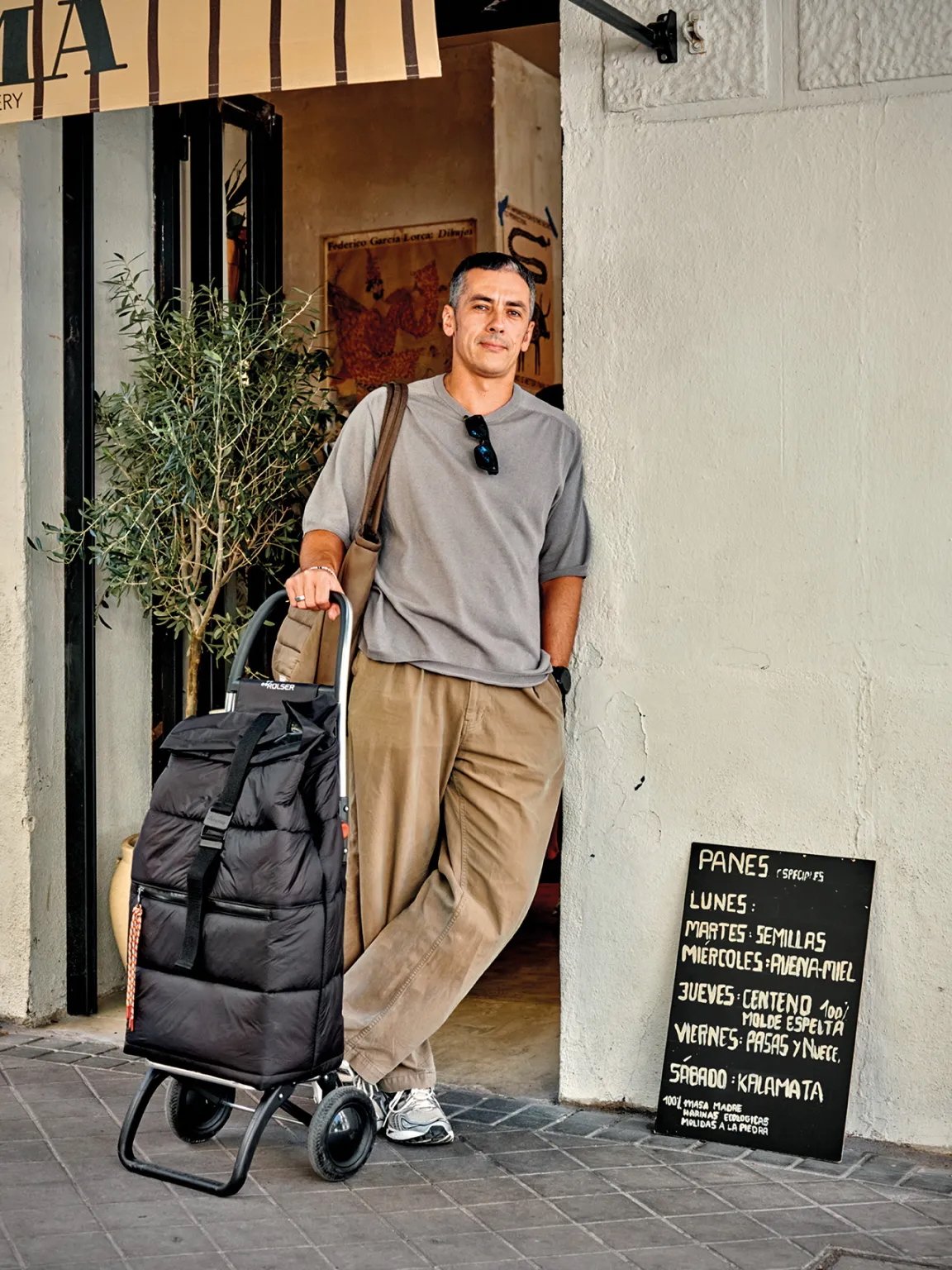
    I’m not actually sure what the official name is for this kind of bag. Is it a shopping cart, shopping trolley or something else? The answer likely depends on where you are. Whatever it is, the September issue of Monocle has a feature on Spanish shopping trolley maker Rolser.

    And for it, they photographed a bunch of cool urbanites with their trolleys, and then asked them: What’s in your Rolser? See above photo. Supposedly, or at least according to the company, about 63% of Spanish households have a Rolser in their house.

    This is interesting. Because in my part of the world, the percentage would be low. In fact, there are stigmas around them. Many people associate grocery carts with elderly people and sometimes with people who can’t afford a car. But that’s the wrong way to think about this bag.

    It’s actually a built environment association. The correct framing is: Are you urban enough to be able to use one? Because they’re very common throughout Europe. Here, for example, is Paris, where they’re called a chariot de courses or a sac à roulettes.

    All of this has me thinking two things. One, our household is overdue for one. And two, this is an opportunity. These are utilitarian and often stigmatized objects that could very easily be reframed into a lifestyle design object for urban cities around the world. (Though, to be fair, the Rolser pictured above looks pretty good.)

    The only prerequisite is a walkable urban environment. Maybe it’s time that Globizen gets into the city roller business. Or maybe one of you can just run with this idea and then I can buy one.

    Photo: Monocle

  • The urban swimming renaissance

    August 24, 2025 · View original


    Cities like Copenhagen, Zurich and many others have, of course, long been pioneers when it comes getting people into natural waterways. But this summer we notably saw the fruits of Paris’ €1.6 billion investment to clean up the Seine ahead of the Olympic Games. And so very quickly, it is becoming clear that this is becoming one of the hallmarks of the world’s most livable cities. How clean is your water and do you enable your citizens to easily swim in it?

    It’s for this reason that earlier in the summer I wrote a post titled “Toronto needs a summer bathing culture.” It was not to suggest that nobody swims in our bodies of water — lots of people do — it was to argue that there’s more we could be doing. Sunnyside Bathing Pavilion, to give just one example, feels like a century-old abandoned relic sitting on prime beachfront.

    Some of you seemed to take offence to this post, suggesting that I should maybe get out and swim in some of our outdoor pools, like the one at Sunnyside. And I can assure you that I have. I’m a regular swimmer in the public pools of Toronto. But that is not what this urban swimming renaissance is about: “Contrary to popular belief, or simply a fair assumption, a lido does not a swimmable city make.”

    What this is about is free, easy access to natural bodies of water. And what makes this livability feature so meaningful is that it’s both an urban amenity and clear evidence that a city has their shit together (pun intended). It means the city has high standards for water quality and that it manages its sewage in a way that doesn’t pollute its waterways.

    Summer isn’t over yet, so if you live in a place where this is possible, go for a swim. And if you’d like to become more involved in this movement, check out The Swimmable Cities alliance. Launched on the eve of the Paris Olympics, it is now a global community dedicated to transforming our urban waterways. There is also the option for organizations to become signatories. Globizen has just applied to be one, and maybe you’d like to do the same.

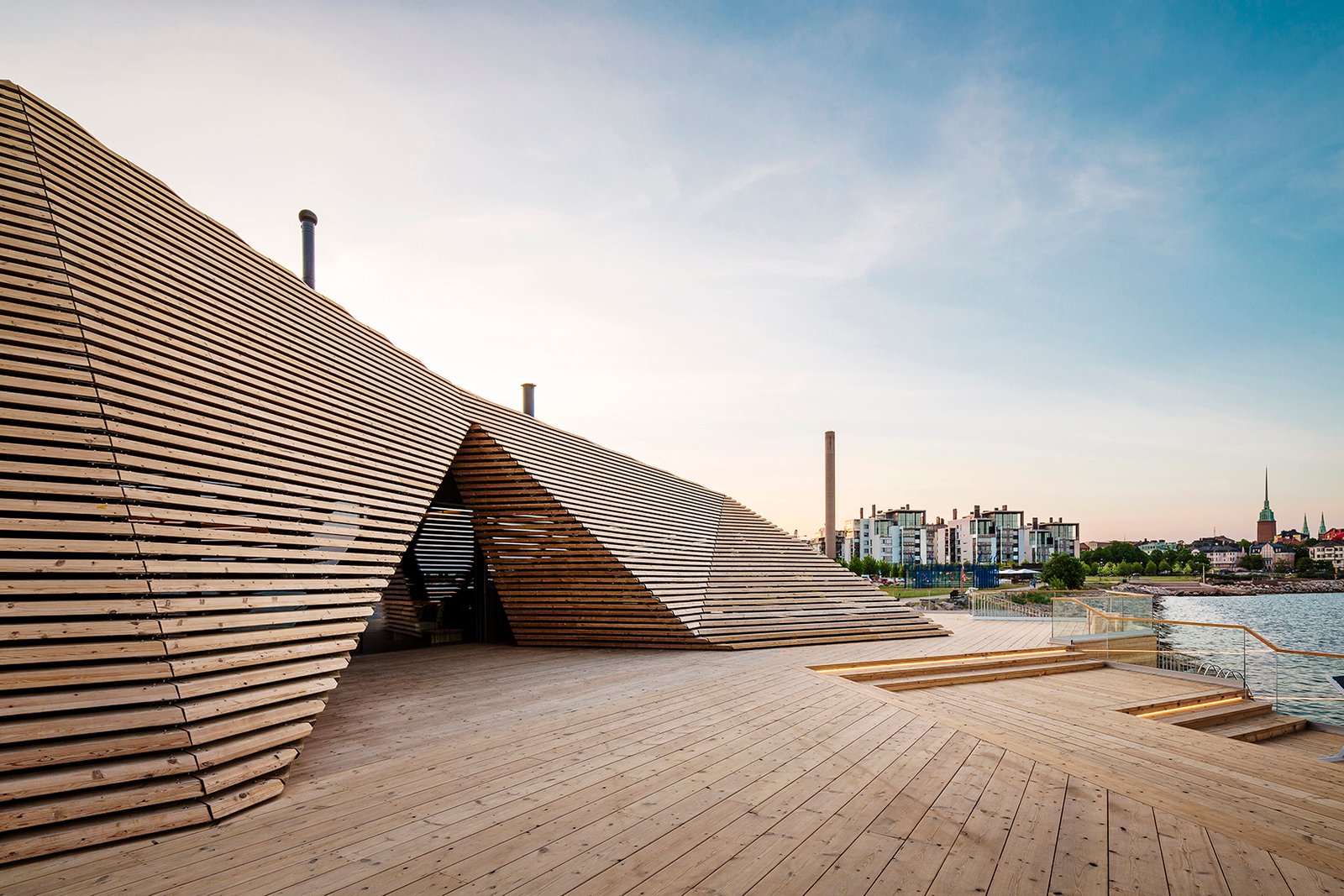
    Photo: Helsinki by Kuvio

  • Dictators in a box on the world’s ledger

    August 23, 2025 · View original


    I spent the past week listening to this Bankless podcast with Vitalik Buterin (the Canadian programmer and co-founder of Ethereum). It took me a week because I was listening to it off and on while I was in the car, headed to and from One Delisle and other meetings. But it’s a fascinating episode. I think Vitalik is easily one of the most important minds of our generation.

    But let me be honest and say that I wasn’t able to follow everything in the podcast. I clearly still have a lot to learn when it comes to cryptography. For this reason, I’m not going to recommend that you all watch/listen to the episode — not unless you’re prepared to go in deep. This is also supposed to be a blog for city builders (at least most of the time).

    But I did want to share one takeaway that I found interesting.

    In the episode, Vitalik describes Ethereum as the world’s ledger. This maybe won’t mean very much if you’re not familiar with crypto, but the goal is a universal, permissionless, and censorship-resistant place for recording and securing basically everything: property title records, financial assets, AI-generated cat videos, and so on. Put another way, Ethereum wants to become a foundational layer of trust for the world.

    Then, later in the episode, they somehow get onto the topic of dictators. There was a general acknowledgment that dictatorships do have their benefits, but that they also have obvious downfalls. Ideally, we would have a best-of-both-worlds scenario. We want the efficiencies of dictatorships, with all of the benefits of capitalist democracies.

    Vitalik refers to this scenario as “dictators in a box,” and he argues that we already have them: they’re called entrepreneurs. When you start a company, you get to run within your box, and that is the power of entrepreneurship. But importantly, these boxes exist within a broader framework that includes the rule of law, property rights, freedom of speech, and all the other benefits of capitalist democracies.

    This is how Ethereum sees itself — as a foundation on top of which “dictators in a box” can build new ideas, businesses, and opportunities. And because of this layering, it will be Ethereum that provides the backstop against people doing bad things, like stealing someone’s crypto or falsely claiming that they hold title to a property when they don’t.

    I found this analogy fascinating, and I think it offers a glimpse of what’s at stake if/when Ethereum becomes what it’s aiming to become — the world’s ledger.

  • Unpacking multiplexes

    August 22, 2025 · View original


    > Tweet: Amazing panel https://t.co/XYvfayrQvI

    Yesterday evening I sat on a panel at The Canadian Real Estate Investor’s 2nd annual Unpacking Multiplexes event. I’m not sure that I would construe myself as an expert on multiplexes, but I was asked to talk from more of a macro perspective and also talk about our productized rental housing strategy. And so that’s what I did. A big thanks to Daniel Foch and Nick Hill for inviting me.

    Two things stood out to me from the sold-out event (~250 people).

    First, there’s a massive amount of interest in building multiplexes in Toronto. In attendance were people ranging from experienced builders to people who are just starting out and looking for their first multiplex site. This breadth of interest seems to be one of the features of this housing typology.

    It’s small enough that it’s accessible to small developers or even individual homeowners who maybe want to live in one of the homes and rent out the rest. At the same time, there are developers who used to be at big shops, are now on their own, and want to build a big business with this scale of housing. Both are good outcomes.

    Second, this entire push for more housing feels very much like an iterative process. The City of Toronto is monitoring these new policies, watching how the market responds, and then making adjustments as needed. This is the way to do it, and it should make us all feel optimistic about the future of our city.

    We’re on our way to creating more missing middle housing — in every sense of the word middle.

  • Housing starts in Ontario are now lagging the rest of Canada

    August 21, 2025 · View original


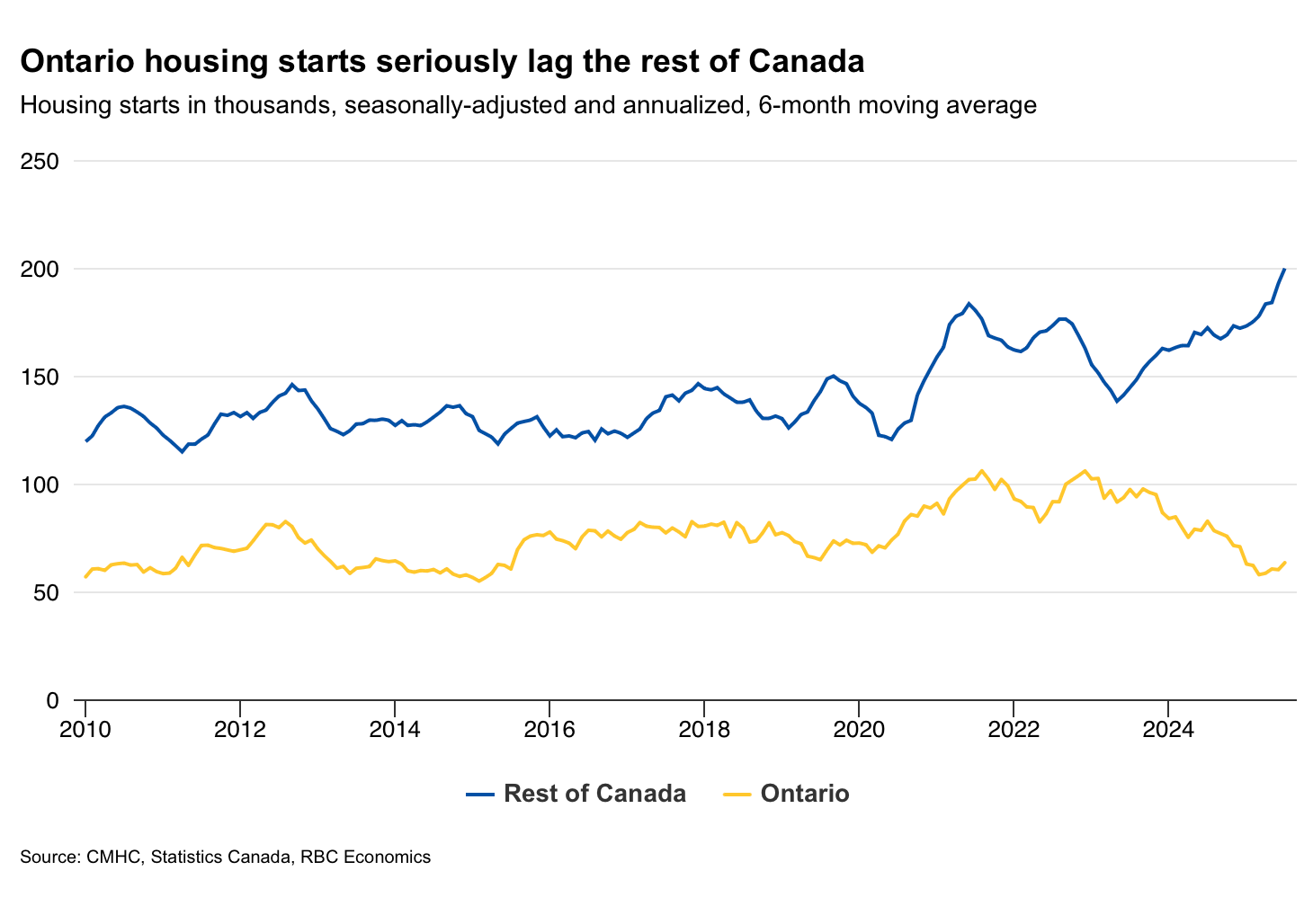
    RBC published a special housing report this week where they argued that, “Canada isn’t in a housing starts slump — Ontario is.” The report is based on new figures from the Canada Mortgage and Housing Corporation that show Ontario lagging behind the rest of the country when it comes to new homes.

    The reason for this is the paralysis of the pre-construction condo market in the Greater Toronto Area, which, up until recently, has been the biggest contributor to new supply — both when it comes to for-sale homes and for-rent homes. (This July rental housing report by BILD estimates that about 39% of all condominiums in the GTA were rented out as of 2022.)

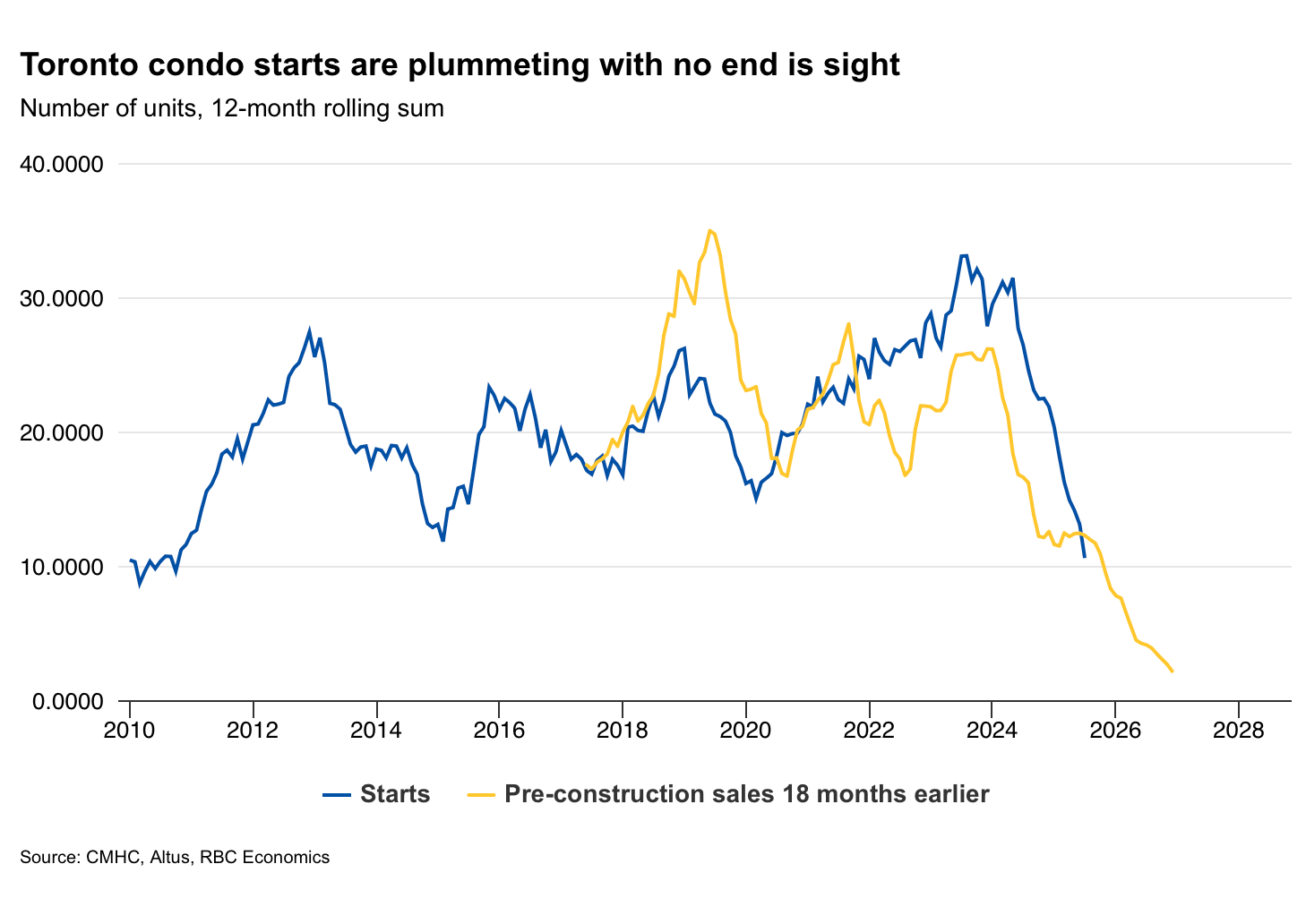
    My favorite chart from RBC is the one below, which overlays Toronto condominium starts with pre-construction sales from 18 months earlier. Naturally, the two are pretty closely correlated. Sales beget starts. What this tells us is that, at this point, condo starts are going to remain depressed until at least 2027.

    But in reality, starts are likely to remain depressed for even longer. The market still needs to absorb the current pipeline of projects under construction. I have said before that this could take another two years. And if that’s right, we could be into 2029-2030 before condo starts turn around, given the lag between sales and starts.

    Some of this supply will, of course, convert to purpose-built rental. But I suspect the conversion rate will end up much lower than most people are currently hoping. Only a minority of projects underwritten as condominiums will be able to make the switch. By default, this means we will eventually enter a period of severe undersupply.

    But as Robert Hogue says in his RBC report, “the full impact of the current slowdown in housing starts won’t be felt for years in Ontario.” And this is absolutely true. It’s an insidious problem right now. We currently have more supply delivering than we have buyers and renters. But just wait. It’s coming.

  • Low-amenity, well-designed, mid-market homes are what’s missing

    August 20, 2025 · View original


    The term “missing middle” is typically used to refer to a missing scale in our built environment. It is that middle scale of housing between low-rise and high-rise. But there’s another way to think about it and that is in terms of the market that the housing is serving.

    Over the last cycle, cities like Toronto saw a kind of “barbell” dynamic. Meaning, new supply tended to target the poles. It was delivering for young professionals and young couples on one end and for downsizers and wealthy retirees on the other. But what has been missing is new supply that targets the belly of the market. And by this I mean something like low-amenity, well-designed, mid-market homes.

    Of course, there are good reasons for why this is the case. The cost structure of new developments makes it so that the only feasible way to underwrite new projects is to maximize rents through smaller suite sizes and copious amounts of amenities. It is not that developers don’t want to do it any other way, it’s that they generally can’t.

    This is the paradox underpinning Canada’s housing crisis. Yes rents are softening and vacancies are rising right now, but it would still be right to say that we are in a crisis. And that’s because it largely exists in a different segment of the market — the biggest one.

    In my view, this is our great challenge and opportunity as we move through this downturn. And I would bet that once we unlock the right model(s), we will see just how pent-up the demand for housing is in cities like Toronto and Vancouver.

  • The foreigners buying homes in the US

    August 19, 2025 · View original


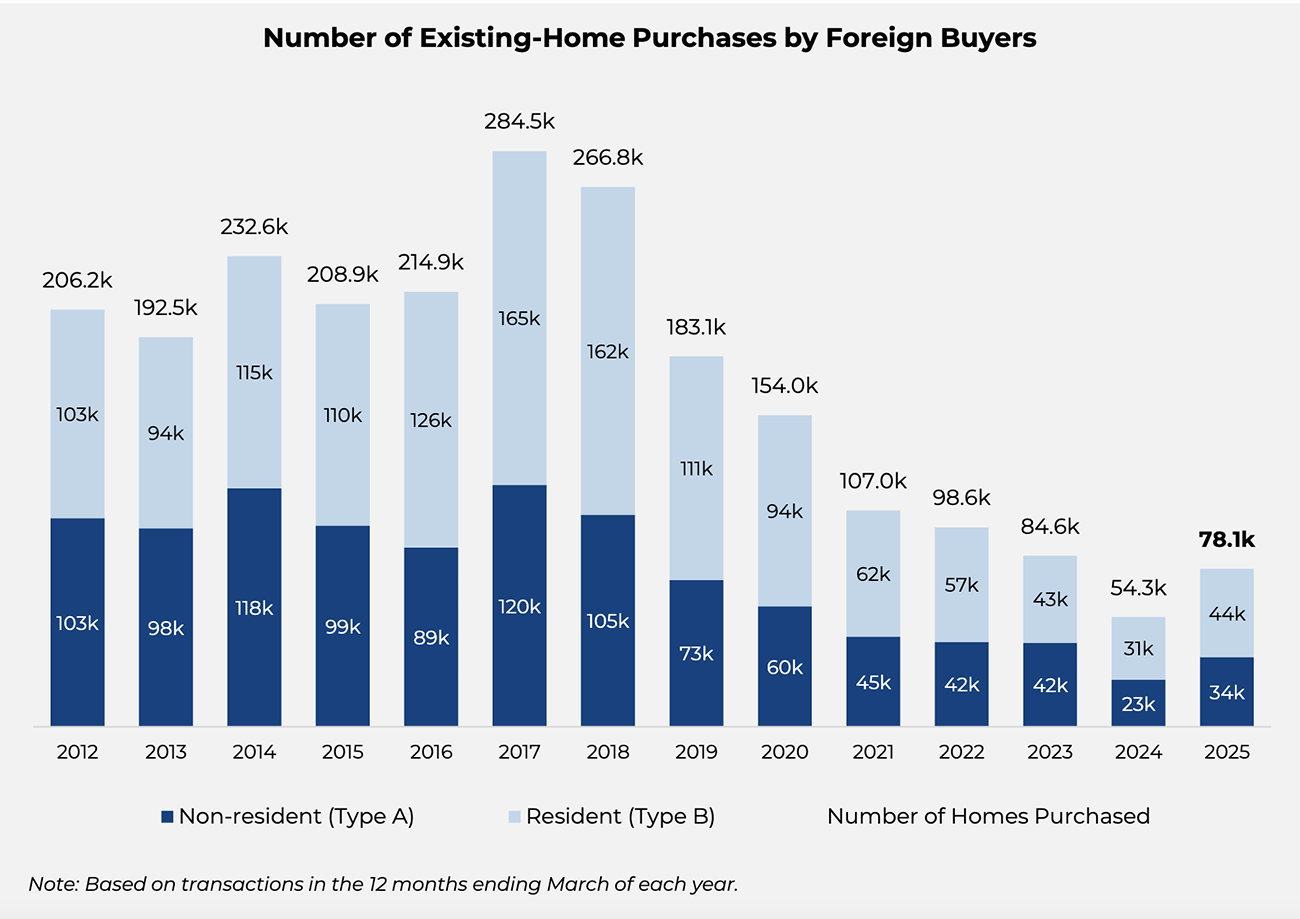
    Based on a recent study by the National Association of Realtors (which is a study based on realtor surveys), foreign buyers bought approximately $56 billion worth of residential real estate in the US between April 2024 and March 2025. This represents about 2.5% of all existing-home sales and is the first year-over-year increase since 2017.

    56% of these purchases were by people who legally reside in the US but who are not US citizens. And the remaining 44% were by foreign buyers who live abroad.

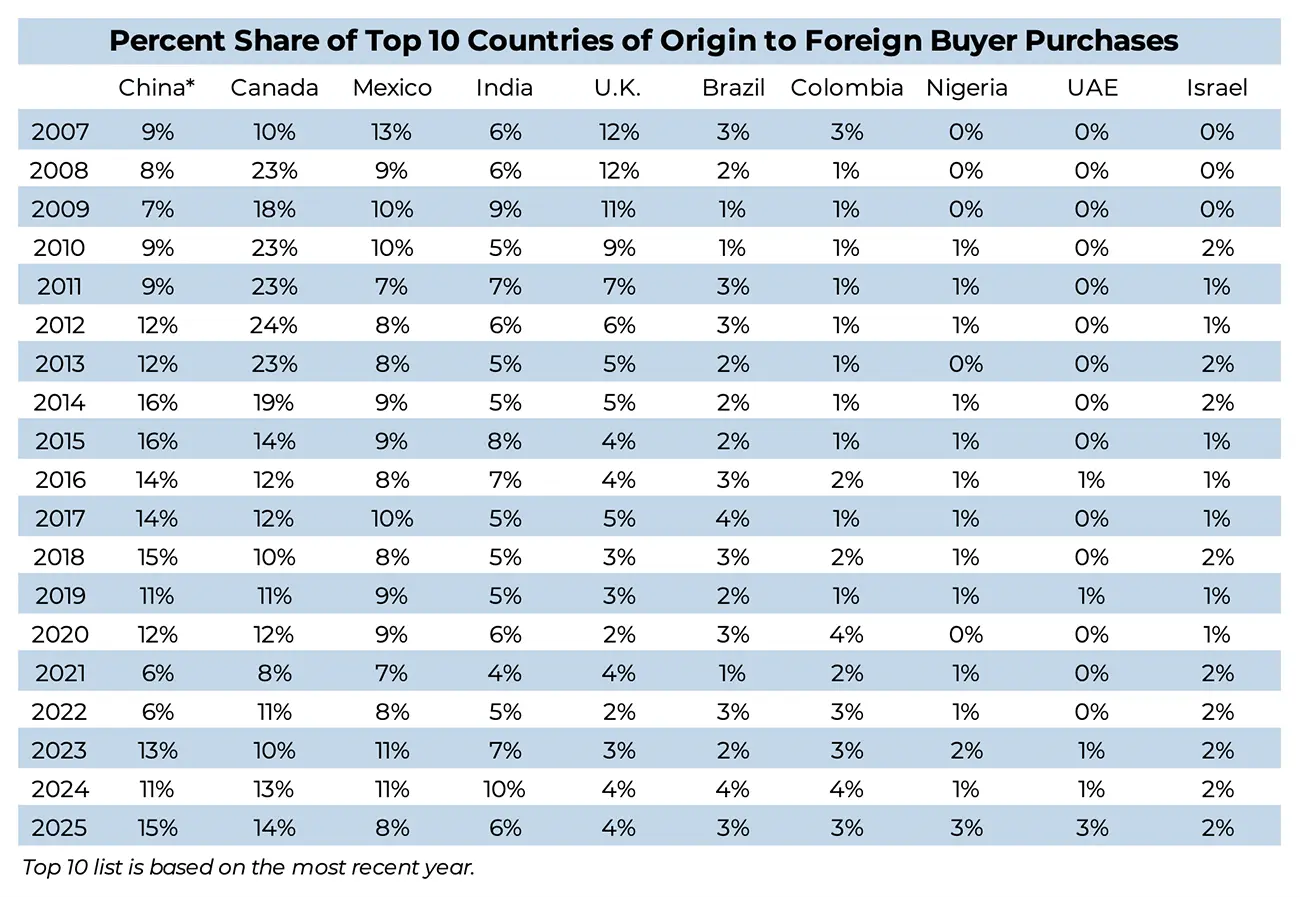
    Here are the top 5 countries of origin:

    – China: 15%; 11,700; $13.7 billion – Canada: 14%; 10,900; $6.2 billion – Mexico: 8%; 6,200; $4.4 billion – India: 6%; 4,700; $2.2 billion – United Kingdom: 4%; 3,100; $2 billion

    And here are the top 5 destinations:

    – Florida: 21% – California: 15% – Texas: 10% – New York: 7% – Arizona: 5%

    What is clear is that foreign demand has fallen dramatically since 2017. This is likely due to stronger capital controls on money leaving China, a stronger US dollar, rising home prices, and other factors. It’s worth noting that this data is up until March 2025 — so right before “Liberation Day.” It’ll be interesting to see the effects of the current geopolitical climate on next year’s data.

    Also interesting is the fact that if you go back to the 2008 financial crisis, Canadians made up almost a quarter of all foreign buyers. Let’s call it 2008 to 2013. This is not surprising. Our economy fared better during the crisis and the Canadian and US dollars were near parity. It was an ideal time for Canadians to buy and, those who did, ultimately benefited from USD appreciation.

    Foreigners buying homes tends not to be politically popular, especially when people are concerned about housing affordability. So I can’t imagine that too many people are fussed by the fall off in demand since 2017. Still, it’s a bellwether for global capital flows, confidence in the US economy, and wealth being created — or not be created — abroad.

    Charts from the National Association of Realtors; cover photo by Colin Lloyd on Unsplash

  • How to look even nerdier while cycling

    August 18, 2025 · View original


    The other morning I woke up and thought to myself: “My cycling isn’t nearly nerdy enough. Sure, I’ve got the spandex. But what I really need is an enormous rear-mounted selfie stick on the bike so I can capture footage of my rides and the city.” So I searched around and found a seat mount rig from Insta360 that looks like this (please note that the stick extends to 1 meter):

    Now, I don’t have an Insta360. I’ve heard they’re fantastic. I have an old GoPro Max that is, well, okay. I find it has terrible dynamic range. The sky is often blown out. It also shuts off constantly when I’m snowboarding due to the cold. It’s suboptimal and at some point I’ll likely invest in an Insta360. But for now, I used an adapter to connect my GoPro to the mount.

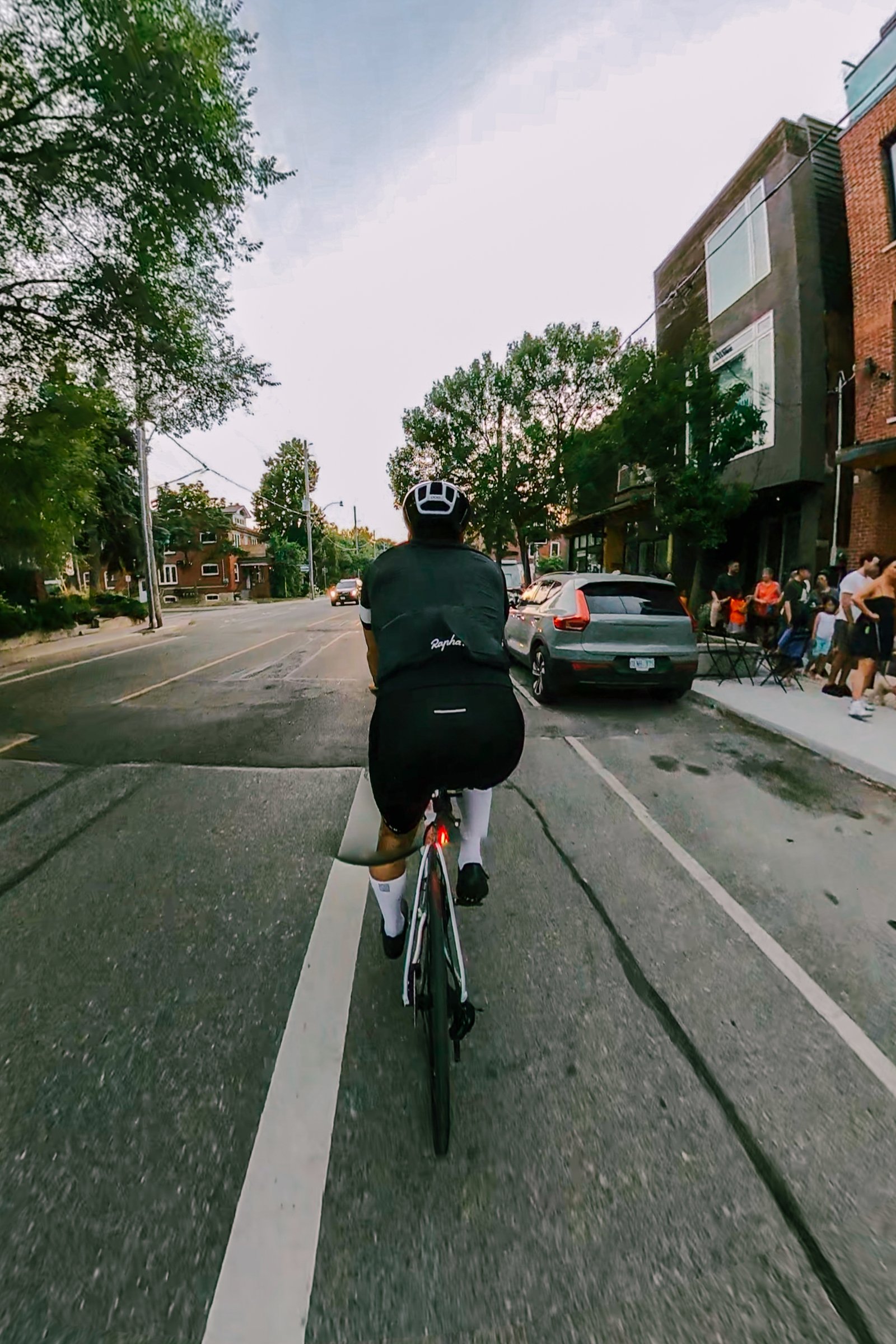
    Below is what the photos/videos end up looking like. As an aside, captured on the right is Good Gang Ice Cream on Annette, which my friend Chris Spoke (of Toronto Standard) tells me is top.

    And here’s a video from Instagram.

    The way these 360 cameras work is that, as long as the camera is perfectly aligned with the selfie stick, then the entire apparatus disappears in the videos it captures. But if the camera gets misaligned because, for example, things start bouncing around, then it can show up. I’m not exactly sure what’s happening in the above, but something is getting in the way of a clean 360-degree stitch.

    I’ll keep working on it.

  • Toronto is planning for a post-car future

    August 17, 2025 · View original


    One of the fundamental principles that we espouse on this blog is that land use and transportation planning are integral to one another. This matters if you’re trying to build a big, bad global city because there are limits to what you can accomplish with car-oriented planning. Eventually traffic congestion becomes unbearable and the model starts to breakdown (consider Toronto and Atlanta right now).

    This means that, if you’d like to continue scaling, eventually you’ll need to start getting serious about transit-oriented development and other forms of mobility. Japan is one of the best examples of this. But the key prerequisite for this is urban density. This is the unlock that makes transit practical and convenient for people.

    That’s why this week’s planning announcement is a big one for Toronto. On August 15, the Government of Ontario (through the Ministry of Municipal Affairs and Housing) approved, with some modifications, 120 Major Transit Station Areas and Protected Major Transit Station Areas in the City of Toronto. Here’s a summary of the MMAH’s decision via the City’s website, and below is a map of the transit station areas. (Note that some station areas are missing from this map and are still under review.)
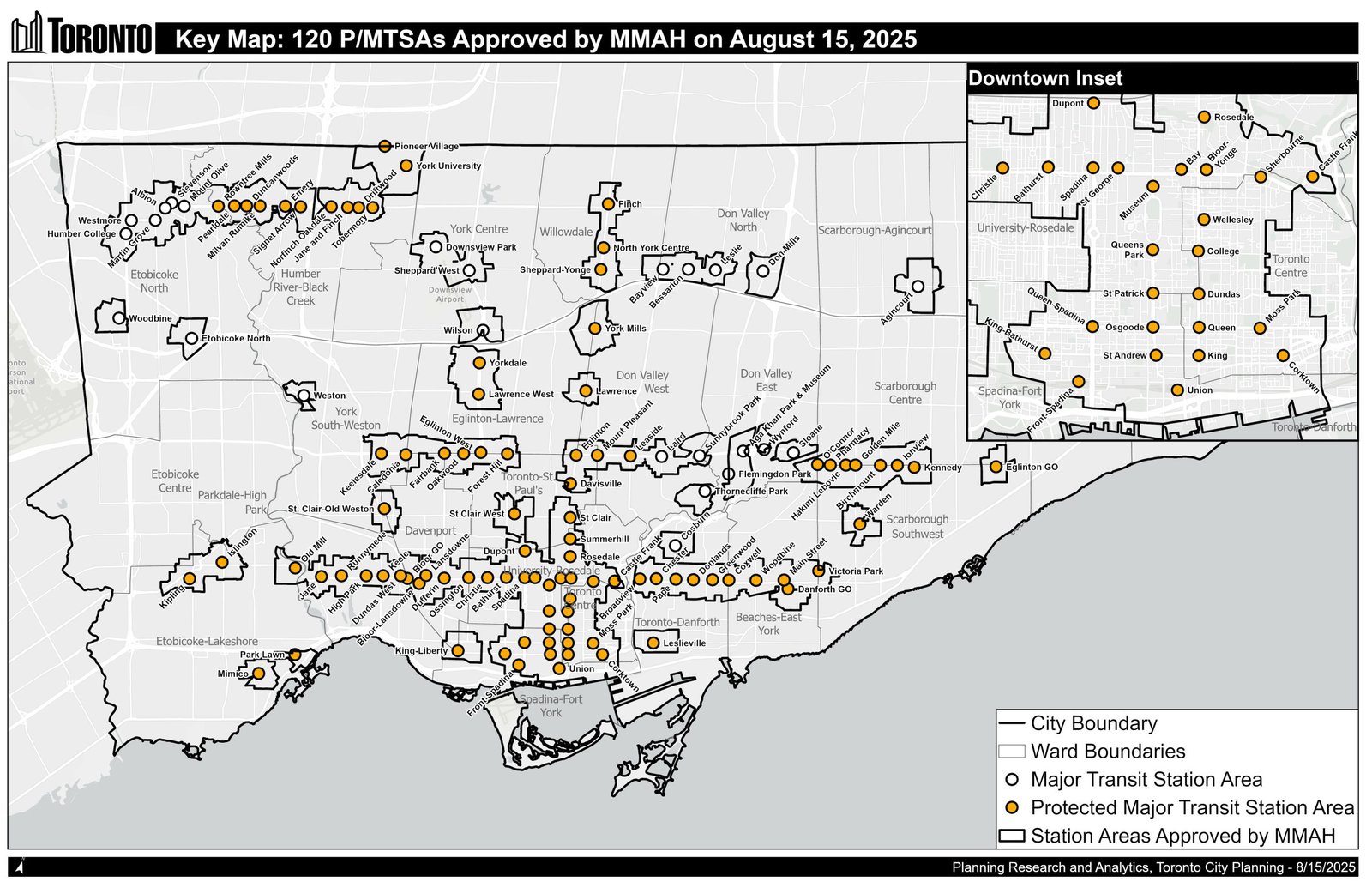
    At a high level, these are areas that fall within an approximately 500-800 meter radius of transit stations, and would therefore be less than a 10-minute walk for most people. It’s land that is best suited to transit-oriented development and that would strengthen any new/existing transit investments. For example, if you have an existing station that is underperforming from a ridership standpoint, the best solution is more density within its immediate catchment area.

    Because of this, Ontario’s Provincial Planning Statement prescribes the following minimum density targets for MTSAs:

    – 200 residents and jobs per hectare for subways – 160 residents and jobs per hectare for light rail or bus rapid transit – 150 residents and jobs per hectare for commuter or regional rail

    And to satisfy these requirements, cities need to demonstrate how they have planned for these minimum targets.

    PMTSAs are a subset of MTSAs and come with some additional features, such as minimum unit counts and/or floor space indexes (floor area ratios). These are also the only transit areas where cities have the option of enabling Inclusionary Zoning, which is something they may do when the market rents in an area are high enough that the subsidies required to build affordable housing can be shifted onto the tenants paying market rents. (My views on inclusionary zoning can be found, here.)

    Over the coming weeks, everyone in the industry is going to be analyzing the implications of this new approval. Overland (which is a legal firm that we work with) just posted on their blog that their review is underway and that they’ll be posting something shortly. But in the meantime, I’d like to say that this is meaningful progress (and one that has been a longtime coming).

    It acknowledges the important link between land use planning and mobility, and it better aligns our policies to support a post-car city. Of course, in many ways, this is an obvious thing to do. I started this post by calling it a fundamental principle of city building. But city planning happens slowly and incrementally. If you’re following along, you’ll see that Toronto is in fact growing up as a big, bad global city.

    Cover photo by Andrii Khrystian on Unsplash

  • How Paris creates such beautiful social housing

    August 16, 2025 · View original


    Back in the spring, I wrote about a small social housing project in Paris at 18 rue Pradier. And the reason I wrote about it is because it’s one of those beautiful European projects that makes every city builder in North America wonder: Why don’t we build projects like this?

    I mean, it’s nicer than most market-rate housing projects.

    As part of my post, I did some internet sleuthing to find out the site area, the gross construction area, and what appeared to be the land price. But it was a modest piece. Thankfully, developer Brendan Whitsitt (of Imprint Development) just published a far more comprehensive summary of the project.

    In it, he pieces together the building’s mechanical systems, the wall assemblies, the project costs, and even the capital stack. He also compares everything back to what’s typical and allowable by code here in Toronto. It’s well worth a read.

    However, I am going to spoil the punchline: Building in Europe is not cheaper. 18 rue Pradier is a beautiful — but very expensive — project. It only works because of subsidies. No private-sector developer would build it otherwise.