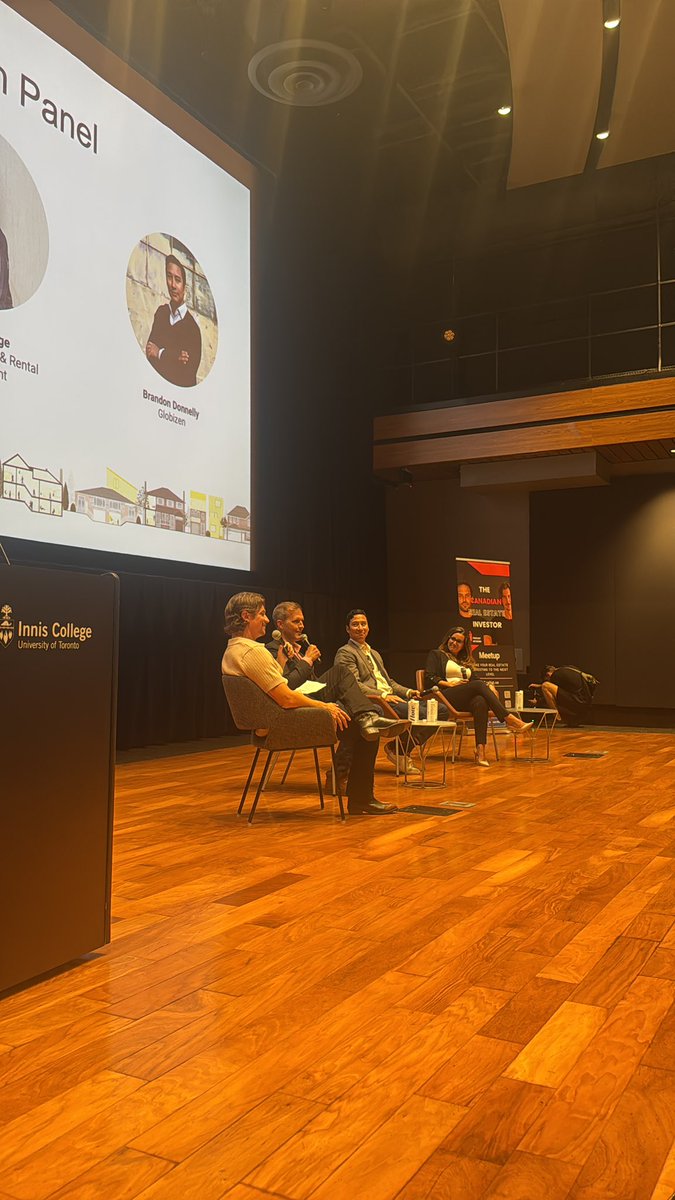
Two things stood out to me from the sold-out event (~250 people).
First, there's a massive amount of interest in building multiplexes in Toronto. In attendance were people ranging from experienced builders to people who are just starting out and looking for their first multiplex site. This breadth of interest seems to be one of the features of this housing typology.
Two things stood out to me from the sold-out event (~250 people).
First, there's a massive amount of interest in building multiplexes in Toronto. In attendance were people ranging from experienced builders to people who are just starting out and looking for their first multiplex site. This breadth of interest seems to be one of the features of this housing typology.
It's small enough that it's accessible to small developers or even individual homeowners who maybe want to live in one of the homes and rent out the rest. At the same time, there are developers who used to be at big shops, are now on their own, and want to build a big business with this scale of housing. Both are good outcomes.
Second, this entire push for more housing feels very much like an iterative process. The City of Toronto is monitoring these new policies, watching how the market responds, and then making adjustments as needed. This is the way to do it, and it should make us all feel optimistic about the future of our city.
RBC published a special housing report this week where they argued that, "Canada isn't in a housing starts slump — Ontario is." The report is based on new figures from the Canada Mortgage and Housing Corporation that show Ontario lagging behind the rest of the country when it comes to new homes.
The reason for this is the paralysis of the pre-construction condo market in the Greater Toronto Area, which, up until recently, has been the biggest contributor to new supply — both when it comes to for-sale homes and for-rent homes. (This July rental housing report by BILD estimates that about 39% of all condominiums in the GTA were rented out as of 2022.)
My favorite chart from RBC is the one below, which overlays Toronto condominium starts with pre-construction sales from 18 months earlier. Naturally, the two are pretty closely correlated. Sales beget starts. What this tells us is that, at this point, condo starts are going to remain depressed until at least 2027.
But in reality, starts are likely to remain depressed for even longer. The market still needs to absorb the current pipeline of projects under construction. I have said before that this could take another two years. And if that's right, we could be into 2029-2030 before condo starts turn around, given the lag between sales and starts.
Some of this supply will, of course, convert to purpose-built rental. But I suspect the conversion rate will end up much lower than most people are currently hoping. Only a minority of projects underwritten as condominiums will be able to make the switch. By default, this means we will eventually enter a period of severe undersupply.
But as Robert Hogue says in his RBC report, "the full impact of the current slowdown in housing starts won't be felt for years in Ontario." And this is absolutely true. It's an insidious problem right now. We currently have more supply delivering than we have buyers and renters. But just wait. It's coming.
The term "missing middle" is typically used to refer to a missing scale in our built environment. It is that middle scale of housing between low-rise and high-rise. But there's another way to think about it and that is in terms of the market that the housing is serving.
Over the last cycle, cities like Toronto saw a kind of "barbell" dynamic. Meaning, new supply tended to target the poles. It was delivering for young professionals and young couples on one end and for downsizers and wealthy retirees on the other. But what has been missing is new supply that targets the belly of the market. And by this I mean something like low-amenity, well-designed, mid-market homes.
Of course, there are good reasons for why this is the case. The cost structure of new developments makes it so that the only feasible way to underwrite new projects is to maximize rents through smaller suite sizes and copious amounts of amenities. It is not that developers don't want to do it any other way, it's that they generally can't.
This is the paradox underpinning Canada's housing crisis. Yes rents are softening and vacancies are rising right now, but it would still be right to say that we are in a crisis. And that's because it largely exists in a different segment of the market — the biggest one.
In my view, this is our great challenge and opportunity as we move through this downturn. And I would bet that once we unlock the right model(s), we will see just how pent-up the demand for housing is in cities like Toronto and Vancouver.
It's small enough that it's accessible to small developers or even individual homeowners who maybe want to live in one of the homes and rent out the rest. At the same time, there are developers who used to be at big shops, are now on their own, and want to build a big business with this scale of housing. Both are good outcomes.
Second, this entire push for more housing feels very much like an iterative process. The City of Toronto is monitoring these new policies, watching how the market responds, and then making adjustments as needed. This is the way to do it, and it should make us all feel optimistic about the future of our city.
RBC published a special housing report this week where they argued that, "Canada isn't in a housing starts slump — Ontario is." The report is based on new figures from the Canada Mortgage and Housing Corporation that show Ontario lagging behind the rest of the country when it comes to new homes.
The reason for this is the paralysis of the pre-construction condo market in the Greater Toronto Area, which, up until recently, has been the biggest contributor to new supply — both when it comes to for-sale homes and for-rent homes. (This July rental housing report by BILD estimates that about 39% of all condominiums in the GTA were rented out as of 2022.)
My favorite chart from RBC is the one below, which overlays Toronto condominium starts with pre-construction sales from 18 months earlier. Naturally, the two are pretty closely correlated. Sales beget starts. What this tells us is that, at this point, condo starts are going to remain depressed until at least 2027.
But in reality, starts are likely to remain depressed for even longer. The market still needs to absorb the current pipeline of projects under construction. I have said before that this could take another two years. And if that's right, we could be into 2029-2030 before condo starts turn around, given the lag between sales and starts.
Some of this supply will, of course, convert to purpose-built rental. But I suspect the conversion rate will end up much lower than most people are currently hoping. Only a minority of projects underwritten as condominiums will be able to make the switch. By default, this means we will eventually enter a period of severe undersupply.
But as Robert Hogue says in his RBC report, "the full impact of the current slowdown in housing starts won't be felt for years in Ontario." And this is absolutely true. It's an insidious problem right now. We currently have more supply delivering than we have buyers and renters. But just wait. It's coming.
The term "missing middle" is typically used to refer to a missing scale in our built environment. It is that middle scale of housing between low-rise and high-rise. But there's another way to think about it and that is in terms of the market that the housing is serving.
Over the last cycle, cities like Toronto saw a kind of "barbell" dynamic. Meaning, new supply tended to target the poles. It was delivering for young professionals and young couples on one end and for downsizers and wealthy retirees on the other. But what has been missing is new supply that targets the belly of the market. And by this I mean something like low-amenity, well-designed, mid-market homes.
Of course, there are good reasons for why this is the case. The cost structure of new developments makes it so that the only feasible way to underwrite new projects is to maximize rents through smaller suite sizes and copious amounts of amenities. It is not that developers don't want to do it any other way, it's that they generally can't.
This is the paradox underpinning Canada's housing crisis. Yes rents are softening and vacancies are rising right now, but it would still be right to say that we are in a crisis. And that's because it largely exists in a different segment of the market — the biggest one.
In my view, this is our great challenge and opportunity as we move through this downturn. And I would bet that once we unlock the right model(s), we will see just how pent-up the demand for housing is in cities like Toronto and Vancouver.