Daily insights for city builders, delivered every morning at 6 AM ET. I’m Brandon Donnelly — a Toronto-based real estate developer and founder of Globizen. I’ve been writing here since 2013.

Category: Paris

  • Paris just banned tall buildings

    So, Herzog and de Meuron are building this trapezoidal-shaped tower in Paris right now.

    It’s 158m tall and about 40 storeys (which makes it comparable in height to One Delisle). It’s extremely narrow in one direction (see above), and so from central Paris it is intended to be read as a kind of thin pencil tower. But when viewed in the east-west direction, you get the full width of its trapezoidal shape (see above, again).

    Not surprisingly, this has been a highly contentious development — which is why it was 15 years in the making. It is now under construction, though, and it is expected to be completed sometime in 2026. But this is likely to be the last tower in Paris for quite some time.

    Partially because of this Triangle Tower, Paris has just decided to ban tall buildings in the city. The new height limit is now back to 37 meters (or 12 storeys), which is essentially the same height cap that was put in place in 1977 following completion of the Tour Montparnasse.

    So this is seemingly how things work in Paris. Somebody builds a tall tower. People mostly hate it. And then the city bans tall buildings for a number of decades. The previous height cap was relaxed in 2010. (Also, for those of you who are wondering, La Défense, which is generally where Paris puts its tall buildings, is outside of the city limits.)

    Regardless, I think there’s no question that this new Triangle Tower is destined to become an iconic punctuation in the city’s skyline. Which means that we’re probably going to have to update our thinking. If Paris, today, is sometimes thought of as a city with two principal towers — the Eiffel Tower and the “awful tower” — it will soon be a city with three principal towers.

    Perhaps the only question that remains is: Will people learn to love it like the Eiffel Tower or will it end up as another Tour Montparnasse?

    Image: Herzog and de Meuron

  • France’s luxury goods empire

    The US has tech and France has luxury goods:

    The roots of French dominance lie in a luxury ecosystem that dates to the court of Louis XIV, and a culture of corporate raiding that began with Bernard Arnault. After gaining control of LVMH in 1989, he set out to build the first house of luxury brands through serial acquisitions. Rivals followed his lead. Increasingly, the global luxury industry is based on goods that are still made by small Italian firms but sold by big French conglomerates. Gucci, Bulgari, Fendi — all are Italian brands now under French owners.

    While US tech firms overshadow all rivals, the same can be said of French luxury. Among the top luxury firms, the French have annual sales three times higher than the Swiss, more than four times the Americans and Chinese and 12 times the Italians.

    One of the most interesting things that LVMH is doing, though, is a combination of tech and luxury goods. In 2021, they announced, along with founding partners Prada and Cartier, a new luxury goods blockchain called Aura.

    The idea behind Aura (an appropriate name, in my opinion) is to create a kind of digital passport that proves authenticity and ownership, and also allows for traceability. So if you want to sell one of your luxury items or you need to service it, now someone can easily see the chain of ownership and determine that it’s real.

    This to me is a perfect use case for the blockchain technology and, as of March of this year, the group was reporting 24 brands on board. At the same time, they also announced a new feature that allows brands to participate through public chains such as Ethereum or Solana.

    All of this is probably still very esoteric to most. But eventually the tech will recede into the background and most will probably just see it as, “I’m buying this expensive purse and along with it I get this digital passport thingy that lives on my phone. I don’t know or care how the tech works, but it makes me feel even more special.”

    However, a big question remains: What does all of this innovation do to industry concentration? (Which is one of the main points of the above article.) One promise of crypto is that it will be a decentralizing force in our economy. And while I believe this to be directionally true, I obviously understand that LVMH has an empire to maintain here.

    For those of us who deal in real estate, it is also interesting to think about this topic of brands and authenticity when it comes to property. And so we will talk about that later this week on the blog.

  • How Paris’ zoning envelope has changed over the centuries

    I came across this French paper over the weekend, while I was at the gym pretending to work out my legs. It is a fascinating look at the evolution of Parisian urbanism from 1600-1902, including how the city’s height limits have changed over the centuries. Here, for example, are two section diagrams showing the allowable building envelopes for both an 8 meter street and a 10 meter street:

    The way to read these is to start at the bottom with the width of the right-of-way (“voie”). As you move up, it then gives you the allowable heights for various dates. So for example, in 1667, the allowable building height for a 10 meter street was 15.60m. After this height, there was then a requirement to stepback following a 45 degree angular plane. Or in some cases, following a certain radius:

    We don’t have a ton of 8 and 10-meter wide streets here in Toronto, but there are obvious similarities between what is shown here and what is in our mid-rise design guidelines. Of course, the big difference is that we’re mostly zoned for low-rises houses and Paris is not. This broader context matters a great deal and it’s why I keep asking: Are you sure you want Parisian-style urbanism?

  • A small subset of Parisians really don’t like shared electric scooters

    So Sunday came and went and Parisians voted overwhelmingly to ban shared electric scooters in the capital. Of those who voted, 89.03% were against them. And this, to be honest, is not all that surprising. Also not surprising is the low voter turnout (7.46% of 1.3 million registered voters).

    But I do think it raises important questions about this “democratic” process — and not just because I happen to like electric scooters. One problem is that there’s an inherent bias. And this same phenomenon can be found in community meetings for new developments.

    If you’re upset about something (and you have the time), then you are probably more intrinsically motivated to participate. In other words, if you think that electric scooters are a horrible nuisance, then you’re more likely to take the time to say something about them. But if you think electric scooters are just, like, fine, then you’re probably less motivated to go out and vote.

    Maybe this doesn’t matter. Maybe the turnout percentage itself is the answer you’re looking for. Only 7.46% of registered voters cared enough about electric scooters to voice an opinion. So if the rest actually liked them, it’s their problem for not voting.

    But if you think that this percentage should be higher to be more representative, then one solution is to try and reduce the barriers to participation. And I think there’s an argument to be made that something as dumb as a Twitter poll, open only to Parisians, might have been more inclusive.

  • Should Paris ban electric scooters?

    This Sunday, Paris will be hosting an important referendum that has nothing to do with France’s retirement age. The question is whether shared electric scooters should be banned citywide. And while there are concerns about whether this single-question referendum will draw many people out to vote, the city has said that, whatever the outcome, the results will be binding.

    To be clear, this would only apply to the three micromobility rental companies that operate in the capital: Lime, Dott, and Tier. It would not apply to privately-owned scooters, of which there are many. In fact, France might just be one of the scooter capitals of the world. Over 900,000 scooters were purchased across France in 2021, and last year the number was about 759,000.

    Mayor Anne Hidalgo has publicly said that she thinks these scooters should be banned. But does that really solve things given the number of private scooters in circulation? And are the current problems truly ones we can’t solve? As I have said many times before, I like scooters. I like them a lot. They’re convenient and fun to ride, and I see their value in helping to solve the last-mile problem.

    I also can’t help but think back to the early 1900s when cars were just starting to infiltrate our cities and there were absolutely no traffic regulations to think of. It was chaos, it was dangerous, and I’m sure it was similarly divisive at the time. So should we have banned them and stuck with horses? Hmm. Maybe.

  • The Centre Pompidou in Paris now owns NFT art

    Last week, the Centre Pompidou — which is Europe’s largest modern art museum — announced that it has acquired its very first NFTs (18 pieces by 13 artists) and that it will be exhibiting the collection this spring. This makes them the first museum in France to own NFT art and, I’m guessing, one of the first in the world. (The Los Angeles County Museum of Art recently got some as well.)

    This is fun for a few reasons. The obviously fun reason is that it’s good for NFT collectors and people who generally support this space. Big institutions bring legitimacy. It’s one thing to say that these JPEGs are stupid while sitting at home on your computer, but it’s an entirely different thing to travel to Paris, visit the Centre Pompidou, look at its white gallery walls, and then say that these JPEGs are stupid!

    The other fun thing about this is that it shows a continued openness to new ideas and new technologies. Here are some words from the Pompidou (that have been translated, by Google, from French):

    The idea was not to be the first, but to bring together a relevant collection, which could testify to a creative and critical appropriation of a new technology by artists, and how this disrupts and displaces the art ecosystem. From its creation, the Center Pompidou has relied on the idea that contemporary technological creation and creativity should be at the heart of the institution. From 1974-1975, therefore even before the opening of the Center, the National Museum of Modern Art acquired major works and installations by Dan Graham and Bruce Naumann. Video installations using real time, and it was the very first institution to do so.

    This wasn’t always the case in France. One of my favorite art history classes from university was one that covered Impressionism. Partly because I thought their work was cool, but mostly because Impressionist painters were, in a way, early modernists. They rejected the academic approaches to painting and instead decided to make up their own rules.

    At the time, in the 19th century, this was seen as entirely radical. And it meant harsh criticism from the established art world and an inability to meaningfully exhibit at the Salon (which was everything at the time). But history has a way of showing us that if something is inherently a good idea, you can only remain stubborn for so long.

    The Impressionist painters began hosting their own exhibitions starting in 1874 and, by 1881, the government had withdrawn its official sponsorship of the annual Salon. The jurors wanted to cling to only traditional painting styles and the world wanted to move on. And here it is doing that again, today.

  • Single-exit housing in Paris

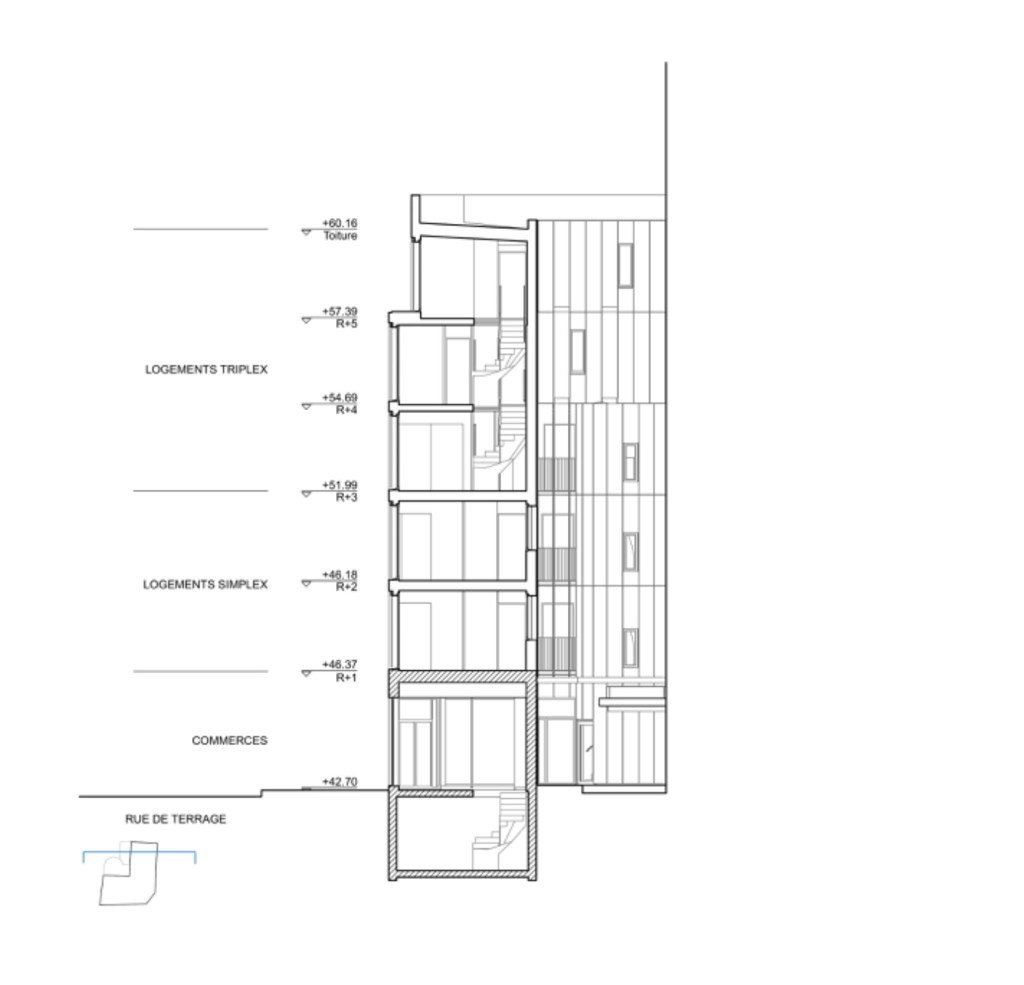
    Lloyd Alter of Treehugger recently wrote about this infill housing project in Paris. Designed by Mobile Architectural Office (MAO), it is a 6-storey building with 6 residential suites (two of which are 3-storey triplex suites) and 1 ground floor non-residential space.

    Building section:

    But here’s where things get really remarkable: the area of this corner site is less than 100 m2 (~1,000 sf), the construction budget was €940,000 (excluding VAT), and almost the entire structure was built out of cross-laminated timber. So overall, this is an incredibly sustainable build: it uses land and services efficiently and it uses low-carbon materials.

    At this point, you should now be wondering, “why can’t we just do this everywhere?” And this would be the right question.

    Lloyd correctly points out in his article that one of the things that makes this building feasible is that it only has one exit stair (as well as no elevator). Typically you need two means of egress, which can serve as a real barrier to smaller builds like this one here.

    But in this case, and this is part of the argument, the building is small enough that, should a fire or emergency happen, occupants could be rescued through their windows. So technically there are still two ways of getting out.

    In this year’s predictions, I mentioned that we would see “supportive building code changes”, which would help to encourage more infill housing. Exiting is one of the changes I had in mind when I wrote the post. So here’s hoping that policy makers are reading this blog, looking to projects like this one in Paris, and recognizing the benefits.

    Talking about exit stairs may not be as exciting and seemingly impactful as something like a foreign buyer ban, but I promise you that removing the many barriers to building this scale of housing would ultimately bring more benefit to our cities.

    P.S. This project is also social rental housing.

    Image: MAO

  • Bikes and property in Paris

    I have been reading Fred Wilson’s blog for over a decade now (and he has been blogging for almost two decades). A lot of the time it is about venture capital and tech, but similar to what I do here, it can be about almost anything. Today he wrote about the two weeks that he just spent in Paris with his wife (the Gotham Gal). And the post covers everything from real estate to relationship advice. But here are two points that will be particularly relevant to what we usually talk about around here:

    • Paris has done an excellent job of prioritizing cycling and building a ton of new lanes over the last number of years. We know this. But another good point that Fred makes is that Paris has allowed competition in their micro-mobility ecosystem. It started with Velib, but now you can also use Dott and Lime. The last time I was in Paris I used Lime bikes and scooters, mostly because I already had the app and because they were everywhere. Competition is good and Toronto should probably allow the same. Our bike share system — specifically the mobile app — is incredibly cumbersome to use, and the last time I checked most of the e-bikes were consistently out of service. Let’s see if someone else can do a better job. We should, of course, also add scooters to the mix while we’re at it.
    • Next, Fred describes Paris’ real estate market as being more “stable.” And by this he means that, for whatever reason, values and rents seem to be more moderated. This has some benefits. Restaurants and other retail businesses seem to stick around for decades, whereas according to Fred, “it’s hard to find a shopping street in Manhattan that doesn’t have multiple vacant stores”. I’m not exactly sure why this is the case in Paris (assuming it is). I don’t believe that they have any sort of vacant store tax. Though they do have a tax on unoccupied homes. Maybe this is just what happens when you’re a little less capitalistic. (This is me deliberately avoiding the term socialism.)

    If any of you have more insight into the real estate market in Paris, I would love to hear from you in the comment section below.

  • France clamps down on “dark stores”

    One way to shop for things is to make a list of all the things you want and/or need, and then go to a location that sells as many of those things as possible. As I understand, this is more or less what people do when they go to a place like Costco.

    Another way to shop is to just order things piecemeal, and have them delivered to you when you want them and in the least amount of time possible. And it turns out that this latter option is pretty popular.

    It is popular because it involves (1) not going anywhere and (2) not having to make a list and think proactively about the things you may want and/or need in the future. But it does mean that we need specific infrastructure to support this method of consumption. Generally speaking you need urban spaces close to where people live and work, and you need people to transport the goods.

    I mention all of this because it has translated into two areas of concern within our cities: (1) we now have “dark spaces” that are embedded into urban areas but don’t have any public-facing components and (2) we now have throngs of delivery vehicles starting to annoy local communities.

    In fact, France has already responded with a new federal policy that is expected to reclassify “dark stores and “ghost kitchens” as warehouses. This is intended to give local municipalities the power to shutter these sorts of spaces. Part of the thinking is that we all did just fine before delivery apps, so why not just go back to doing what we were doing?

    My own view is that this shift in consumption is here to stay. And so we would be better served by figuring out how to respond in a way that is both sensitive to communities and that maintains the vibrancy of our urban environments. We also managed without things like refrigerated food and mobile phones, but I’m pretty happy to have these tools available to me.

  • Are you sure you want Parisian-style urbanism?

    This might seem like a fairly benign tweet by Clive Doucet, a former Ottawa City Councillor. I mean, Paris is wonderful. It is livable, walkable, and my favorite city in the world after Toronto. But as I have argued many times before on the blog, there is a tendency to look at Paris’ uniform mid-rise buildings and then incorrectly try and translate it over to a North American (or other) context with opinions that we should simply cap building heights. Because if only we were to do that, then we would be left with our own version of beautiful Paris.

    This is false. And you should immediately call bullshit on anyone who suggests this might be the case. It ignores most of what Napoleon III and Haussmann did to Paris in the 19th century, and instead just cherry picks height so that it can be exported back home to oppose tall buildings. If we really and truly want Paris, then it is important to be reminded that, among many other things, the Paris we all love today is the result of:

    • The annexation of eleven surrounding communities (in order to form the city’s current boundaries)
    • Mass urban renewal, involving the displacement of some 350,000 people (according to some estimates at the time)
    • Nearly two decades of large-scale disruptive construction
    • The demolition of hundreds of old dilapidated buildings (some of which may have even been in a Heritage Conservation District — bad planning joke)
    • The cutting through of nearly 80 kilometers of new avenues all across the city
    • The building of high-density courtyard buildings and blocks

    As you might suspect, Parisians at the time were upset with this kind of large-scale change. The now famous Impressionist painters lamented the new monotony of Paris’ regular mid-rise blocks. Where had the unique and quirky Paris of past gone? It was, of course, being systematically erased in the name of modernization and urban renewal, which by the way, included a new and important water and sanitation network. What Napoleon III and Haussmann did was transform Paris from a crumbling medieval city into a modern metropolis.

    I am not suggesting that any of this is bad and shouldn’t have happened. Today, Paris is deeply loved the world over. But what I am suggesting is that if we truly want to create our own version of Paris, then we are going to need to be realistic with ourselves on what it is going to take to get there. It will require nothing short of massive change.

    If we want Paris and Paris-like densities (despite what Clive posits in his tweet, Paris is not the densest city in the world), we are going to need to be fully prepared to rip up and rethink our entire approach to zoning. Taller buildings are partially (largely?) a result of our cultural obsession with single-family houses. We restrict supply, codify low-densities, and then wonder why the remaining areas need to be so tall. We then grasp at out-of-context examples in order to justify our own selfish interests.

    If Paris is really what we want, then we must be prepared for everything that comes along with its pretty mid-rise buildings. Are you ready?

    Photo by Nil Castellví on Unsplash