
It’s one thing to have bike lanes. And it’s another thing to have really generous bike lanes. The above video by Streetfilms does a good job of comparing Paris to New York City, and showing just how far Paris has come in terms of cycling infrastructure. Some of you might remember that in the fall of last year, Paris announced plans to become a “100% cycling city.” This was a follow-on to their plan vélo 2015-2020, which saw a doubling of the city’s bike lanes. The current plan, which covers 2021-2026, includes 130 km of new bike lanes and 52 km of pandemic lanes that have been (or will be) made permanent. But again, it’s one thing to have a lot of bike lanes. And it’s another thing to have a lot of wide bike lanes that look like the ones in this video.
Category: Paris
-
The story behind those pixelated video game mosaics in Paris
If you’ve ever been to Paris, you’ve probably noticed the small pixelated art pieces that are scattered all around the city on buildings and various other hard surfaces.
Or maybe you haven’t seen or noticed them in Paris, but you’ve seen similarly pixelated mosaics in one of the other 79 cities around the world where they can be found.
Or maybe you have no idea what I’m talking about right now. Huh? Here’s an example from Bolivia (click here if you can’t see the embedded post below):
These pixelated urban art pieces are the work of French artist Invader. Modeled after 8-bit video games from the 1970s and 1980s, Invader has been installing these mosaics since 1998 as part of his broader “Space Invaders” project. The first one was installed in Paris.
No two pieces are alike and they’re all made out of ceramic tiles so that they last. Invader also meticulously researches and then records each install location. He is basically trying to take over the world with his “invasions”. As of today, there are 4056 invaders in 80 cities.
Here’s a map. Sadly there are none in Toronto.
The goal of the project is to liberate art from what Invader calls “its usual alienators”, that being museums and other institutions. It is about bringing art out and into the public realm so that everyone can enjoy it. And this is precisely what makes his mosaics so wonderful — it is their playful integration into the urban landscape.
But these aren’t exactly sanctioned pieces of art. If he started out by asking, the answer probably would have been no.
Invader thinks of himself as a kind of hacker of public realms. He keeps his identity concealed. He installs these mosaics during the night (from what I have read). And sometimes he gets in a lot of trouble.
Sometimes they also get removed by the building owner, though at this point his mosaics are pretty well known, so I can’t imagine many owners not wanting to be “invaded.”
But let me ask all of you this: If you owned a building in a major city and woke up tomorrow morning to a Space Invader on the front of it, would you celebrate it, apathetically leave it, or would you remove it immediately?
-
Les banlieues of Paris
One of the things that I notice about people from Paris is that they’re always very clear on whether they live in Paris or outside of Paris in the banlieues (the suburbs). They’ll say things like, “No I don’t live in Paris. It’s too expensive. I live in such and such a place in the banlieues.”
I suppose this isn’t entirely different than saying you don’t live in New York, you live on Long Island, or you don’t live in Toronto, you live in Burlington. Except that there seems to be a greater sense of division when they say it here in Paris (although it’s entirely possible that it could be my rusty French that is leading me to believe this).
There is a sense that you’re either inside the Boulevard Périphérique, or you’re really not. And this seems like a shame. Cities regions care less about administrative borders and more about the movement of people, ideas, and goods.
And as much as I love Paris (the central part), it is, from what I can tell, far more static than some of its surrounding areas in terms of new people (immigration), new buildings, and probably new ideas.
Paris can sometimes feel like a perfectly curated museum. It’s beautiful and precious and should not be touched — please stand behind the ropes mesdames et messieurs. But perhaps it’s time to equally celebrate les banlieues and recognize what they have to offer.
-
The compactness of Paris
This is a great diagram from Smart Density comparing the urban and regional rail networks of Toronto, London, and Paris. All are at the same scale.
What immediately stands out to me — besides Toronto’s relatively miniscule network — is Paris’ compactness. I have said this before on the blog (here, here, and here), but I will say it again: There seems to be a tendency to fetishize the scale and height of Paris.
But building height is only one component of its ubiquitous built form. Unlike Toronto, we’re not talking about midrises built up against single-family homes. Paris is far more dense and its buildings are far closer together (usually with interior courtyards)
Are we also okay with these attributes?
-
Le Pen’s voter base: France’s poor rural drivers
The presidential election that is underway right now in France is playing out exactly as one might imagine. The first round of votes took place on April 10, and the second and final round — which is now between Macron and Le Pen — will take place on April 24.
How people voted in the first round can be mostly explained by geography. If you live in an urban center, an attractive tourist center, or have reasonably good rail connectivity to either of these two kinds of places, you likely voted for Macron.
On the other hand, if you live in a poorer rural area, you were more likely to vote for Le Pen. Our spiky unequal world remains, even in France, where more wealth tends to be redistributed compared to places like the UK and the US.
But there’s another potentially correlative factor that should interest readers of this blog (even if it is somewhat obvious). If you voted for Macron in the first round, you were also less likely to rely on a car to get to work. Here are two charts from the Financial Times:
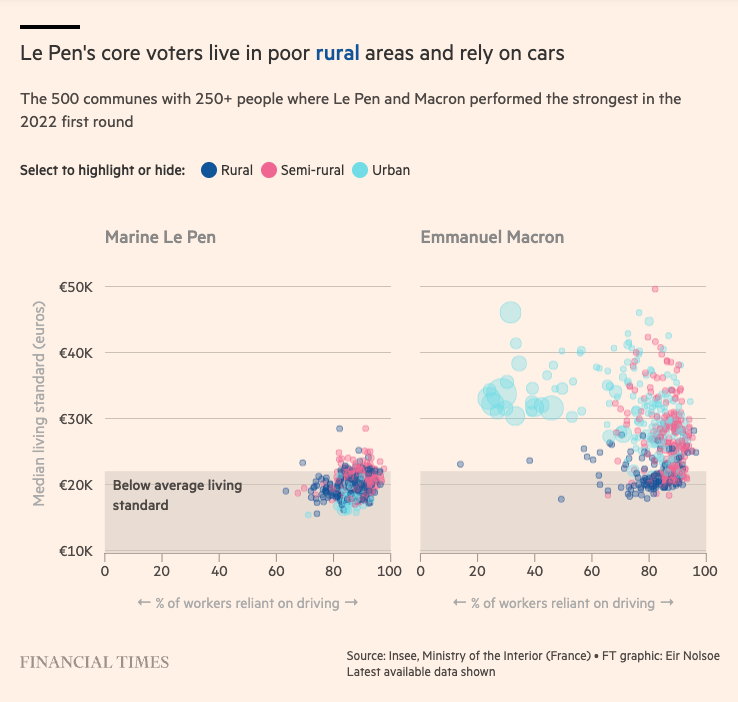
This point is perhaps obvious because geography and built form largely determine whether or not you want/need to drive. And the way to not drive is to live in a dense city. But I think it’s also a useful reminder that owning a car does not necessarily need to correlate with high economic status.
In fact, when I look at these charts, not having to drive to work feels like a good thing.
-
How past pandemics affected the urban housing markets of Amsterdam and Paris

Past performance, we are often told, is not necessarily indicative of future results. At the same time, history has a funny way of repeating itself. I recently stumbled upon this research paper by Marc Francke (University of Amsterdam) and Matthijs Korevaar (Erasmus School of Economics) looking at the impact of pandemics on housing markets. More specifically, it looks at the impacts of the bubonic plague on 17th-century Amsterdam and of cholera on 19th-century Paris. Here’s an excerpt that summarizes what they found:
Our analyses for both cities point to substantial impacts of pandemics on property prices. We find that sales prices respond negatively to outbreaks, in particular in heavily affected areas, and that responses are short-lived, with the effects on sale prices being particularly significant in the first six months of an epidemic. Evidence from aggregate house and rent price indices suggests a smaller negative impact on rent prices. Amsterdam and Paris were very resilient to these outbreaks, with population and house price growth quickly reverting to prior trends.
This paper was first published at the beginning of 2021. A lot has changed since then and, in some ways, their findings now seem obvious. There was still a great deal of uncertainty in the market 12 months ago. While it seems like eons ago, I remember our team having discussions around when would be the right time to launch sales for One Delisle. Of course, 2021 turned out to be a record-setting year for housing and that includes the core/urban housing that the media was quick to write off at the onset of COVID.
This is not to say that certain things haven’t changed or that there won’t be further changes — both positive and negative — that come out of this. To give one just example, we all continue to hear anecdotal evidence that a lot of tech talent would now prefer to be in cities like Miami over San Francisco. (I’m not tech talent, but this would be my strong preference.) Did the pandemic help fuel this? Probably. It opened a door for the people who no longer wanted to live in a city with such a supply-constrained housing market. (I’m sure there were other reasons, too.)
These things, of course, happen. Cities are powerfully resilient, but they still need to compete. The bigger point is that cities continue to be our greatest centers of opportunity. And here we have centuries of data and housing records to support the fact that opportunity is both a powerful motivator and a centralizing force for urbanization. This is true even in the face of things like pestilence.
Happy new year, everyone. I think there’s a lot to look forward to in 2022, including far less talk about pandemics and hopefully far more talk of places like Miami.
Photo by Adrien Olichon on Unsplash
-
Toronto, Paris, Park City — New city tee collection from Globizen
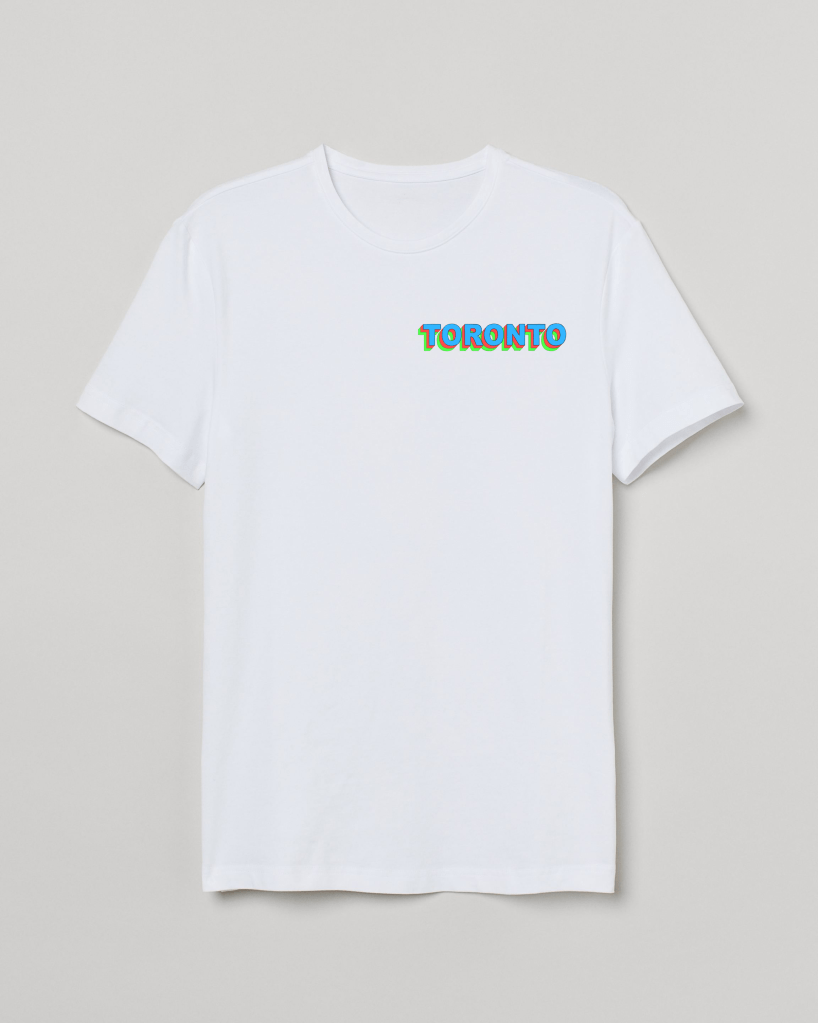


This week Globizen announced a collection of new city tees.
Each t-shirt comes with a custom hand-drawn logo and playful colors that are intended to reflect the spirit of each place. The first three cities are Toronto, Paris, and Park City (Utah). And the goal is that once this first release is sold out, there will be a subsequent drop with three new places.
This is a project we’ve been thinking about for a while now, so it feels great to get it out the door. To pre-order a city collection tee, click here. All prices in Canadian. Global shipping available. Please note that these are pre-orders. All tees will ship in early 2022.
If you have any feedback on the tees, I’d love to hear from you in the comment section below.
-
A figure-ground map of Paris by building period
This is a great tweet and link:
The link is to a figure-ground map of Paris that allows you to filter its buildings by period of construction. Here’s what all of the periods and all of the buildings look like:
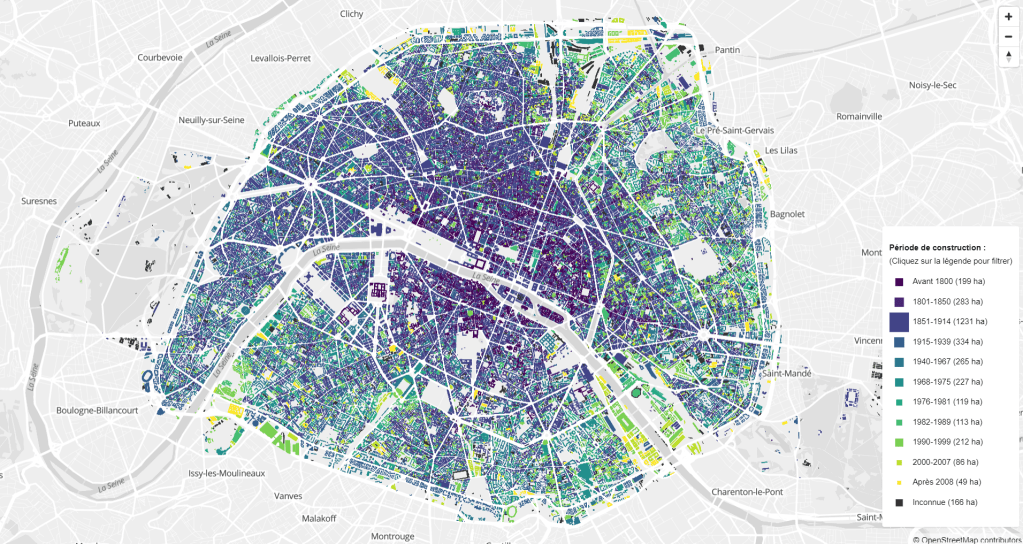
Once you play around with the map, it will become obvious that the second half of the 19th century and the early 20th century was a prolific building period for Paris (1231 hectares of area). This is what Samuel was getting at in his tweet.
I would love to see a map like this for every city in the world.
-
Paris announces plan for “100% cycling city”
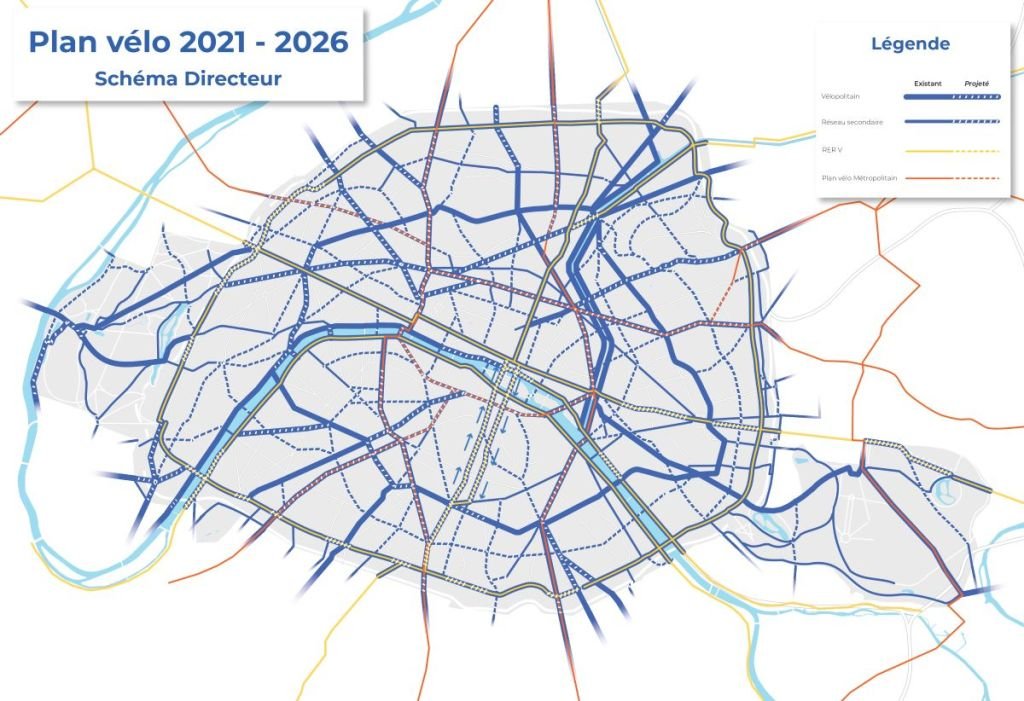
Paris just announced plans to become a “100% cycling city.” A follow-up to plan vélo 2015-2020, which saw a doubling of the city’s bike lanes, plan vélo 2021-2026 includes 130 km of new bike lanes and 52 km of pandemic bike lanes that will now be made permanent.
In addition to cycling lanes, the plans include new bike parking, new transit integrations, and a bunch of other things that are meant to strengthen the overall ecosystem in the city. The total budget for this second plan is about €100 million, which will bring the total cycling investment over the last 10-11 years to about €250 million. This is a serious commitment to cycling.
It’s also a good example of one of the things that we have been talking about on this blog. This pandemic forced us to rethink how we allocate urban space — everything from outdoor restaurant patios to bike lanes. And as we can see here, many of the positive changes are not surprisingly starting to stick.
-
A few observations from Paris

The last time I was in Paris was in 2006. That’s a long time ago and so it was great to be back in the city earlier this week. I don’t know the city as well as I do many other cities, but I speak enough French to be dangerous and we spent a good amount of time on this trip just exploring. On average, we clocked about 20,000 steps a day. So here’s a list of some of the things I was reminded of or learned of on this visit. If any of you are more familiar with the city, please feel free to speak up in the comment section below.
- I love Paris.
- The Parisian art of people watching is alive and well. One of my favorite things about Paris is how so much of the cafe seating faces out toward the street. That’s what you’re supposed to be watching: urban life.
- Most cities have a clear message. In Los Angeles, it’s probably that you should be more famous. In Boston, it’s arguably that you should be smarter. And in New York, it is perhaps that you should be richer. In Paris, the message feels loud and clear: You should be more fashionable.
- Compared to Toronto, the center of Paris feels far more static. Less construction. Less change. Less that is new. That’s not such a bad thing given how beautiful the city is. But in my view, cities are about balancing preservation and progress. From what I could tell, a lot of the new construction seemed to be happening in the suburbs and in the outskirts of the city.
- That said, COVID feels much further along in Paris. The city was very open and everyone seemed to be back in the office. Locals said that the city was operating at maybe 80%. It felt busy.
- Dress shoes are dead in Paris. Everyone wears cool sneakers no matter how young or old. Think business suits with Nike Air Maxes. My hypothesis is that it’s just far more practical given how much people walk in Paris. I plan to adopt this strategy immediately.
- In addition to walking, everyone seemingly bikes and/or uses an electric scooter. Again, it didn’t seem to matter how young or old. Paris also seems to have solved the scooter clutter problem, as has many other cities. There are designated spots (painted lines next to on-street car parking) and that’s where you’ll find the scooters. Toronto needs to get on board.
- Traveling at 300 km/h on a train is a highly civilized way to move between urban centers.
- There’s nothing wrong with having a picnic and drinking a bottle of wine (or two) in a park. In fact, it is probably something that should be celebrated. Let people be grown-ups.
- When you purchase a baguette, you should immediately take a bite out of it to see how fresh it is.
- The Eiffel Tower, much like the CN Tower, looks far better when illuminated.
- Balconies of any size can be wonderful. We had a small Juliet balcony off of our hotel room in Nice and we used it every day for croissant eating and to dry our bathing suits. In a more permanent situation, I am sure we would have started growing things on it.
- Midrise buildings do indeed create nice urban street walls. But it’s important to keep in mind that Paris’ midrise blocks are also deep and dense and with lots of courtyard conditions. That’s how the city is able to house so many people at such low building heights.
- Facing conditions between buildings is less of a concern when you employ less glass. Smaller punched windows allow you to better manage privacy. I would go so far as to argue that if Paris were an all-glass city, much of its current built form would be fairly unlivable.
What did I miss in this list?
Photo by Alexander Kagan on Unsplash


